My friend gleefully emailed me: “The IRS will cancel audit appointments.”
Paul Krugman wrote a piece “Rebels Without a Clue.”
This may be the way the world ends – not with a bang but with a temper tantrum.
O.K., a temporary government shutdown – which became almost inevitable after Sunday’s House vote to provide government funding only on unacceptable conditions – wouldn’t be the end of the world. But a U.S. government default, which will happen unless Congress raises the debt ceiling soon, might cause financial catastrophe. Unfortunately, many Republicans either don’t understand this or don’t care.
Let’s talk first about the economics.
After the government shutdowns of 1995 and 1996 many observers concluded that such events, while clearly bad, aren’t catastrophes: essential services continue, and the result is a major nuisance but no lasting harm. That’s still partly true, but it’s important to note that the Clinton-era shutdowns took place against the background of a booming economy. Today we have a weak economy, with falling government spending one main cause of that weakness. A shutdown would amount to a further economic hit, which could become a big deal if the shutdown went on for a long time.
Still, a government shutdown looks benign compared with the possibility that Congress might refuse to raise the debt ceiling.
Bob Hanle of Madison, WI commented on Krugman’s piece:
The problem with liberals, progressives, moderates and mainstream conservatives is that they rely too much on so-called scientific evidence to make decisions. The Tea Party fundamentalists rely on the much more relatable personal experience: the day-late bill payment that did not result in their electricity being shut off; the forgotten umbrella on the day it didn’t rain as predicted; those three years after college when they didn’t have health insurance and never got sick; that guy down the block who got a worker’s compensation check the same day he was out mowing his lawn. All those academics with their number-crunched theories my constituents don’t understand can’t hold a candle to a good homespun anecdote, whether it’s true or not.
The Republicans have tried to kill Obamacare 43 times and failed every time. In my dictionary, I define “insanity” as
Doing the same thing again and again, but expecting a different result the next time.
Barrry Ritholtz wrote:
I have some good news and some bad news.
The bad news? Well, as the futures above shows, US markets are under lots of pressure, widely blamed on the economic impact of the likely shut down of government tonight at midnight. Shutting down nearly 25% of an already fragile economy is hardly the recipe for growth and advancement.
The good news is that so far, all we have is political posturing. History suggest that nothing happens until at least 12 hours after our September 30th midnight deadline. No one gets serious about any sort of deal before noon on October 1. At that point, political pressure on the House Republicans – from constituents, from Business leaders, and from elder statesmen – will start in earnest. A few days later, it can become more intense. We see the same sort of patterns with the debt ceiling limit as well (that’s schedule to hit at midnight October 17).
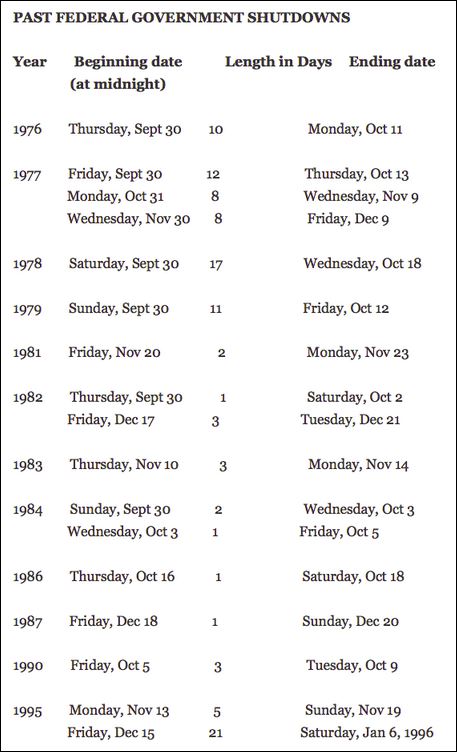
As NBC’s Pete Williams have reported, we have had 17 prior government shutdowns over the past 40 years, including 21 days in 1995 (table below). So while this feels like its new and unusual, it is actually more commonplace than most of us believe.
You can read Krugman’s piece here and Barry Ritholtz’s piece here.
I tried to be “super smart” yesterday and bought a little UWM and UYG yesterday. I’ll sell them today at a profit, I hope.
Today is the first of the month — a day stocks usually rise. I should have bought the straight index ETFs — SPY, DIA, AMCX and QQQ. But I got distracted by the weather. See below.
Technology’s march. Think today’s smartphone.

Interesting business opportunity?

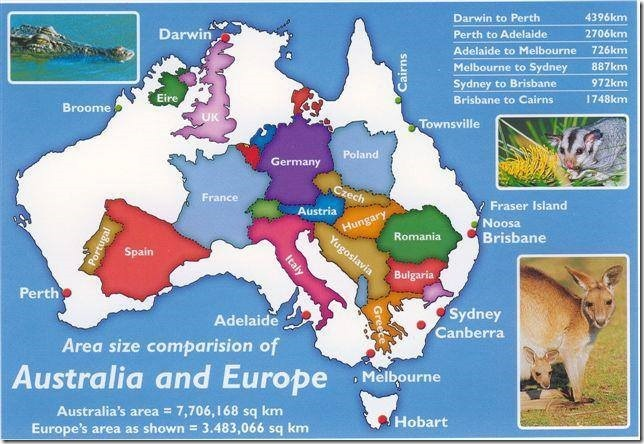
Amazing map. I was born there. But I had no idea growing up how big the place really is:
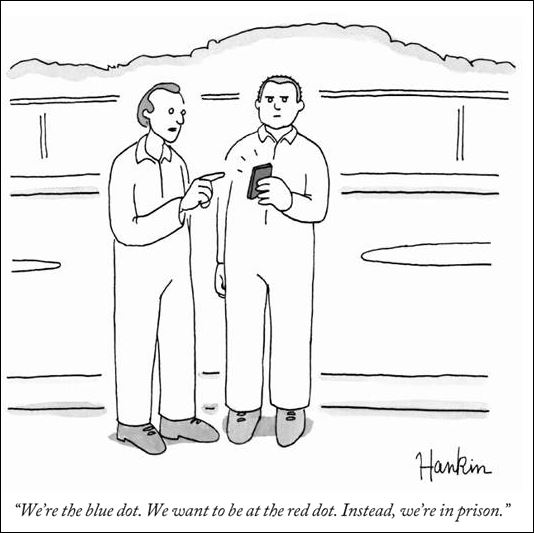
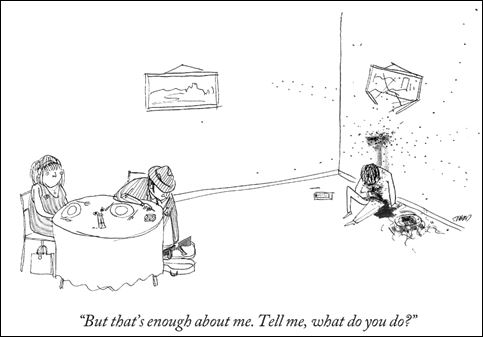
Wonderful New Yorker cartoons:

Harry Newton who yesterday biked ten miles down to Wall Street and then back to his home on West 65th. It was gorgeous day. New York City is booming. I started to photograph all the new buildings under construction and gave up. There were simply so many of them. They’re everywhere.
Owning real estate in the right place is a mitzvah. Ultimately something good happens. A friend just sold the air rights above his tiny Manhattan building for $28 million. A total fluke. Another friend, over many years, bought all the properties on his block and is building two brand-new residential towers — a brilliant use, given all the surrounding buildings are new commercial. Their tenants and employees got to live somewhere. Close is better than far.
A couple of decades ago, New York City taxi medallions (you need one per taxi) were $30,000. Now — wait for this — they cost over $1 million:
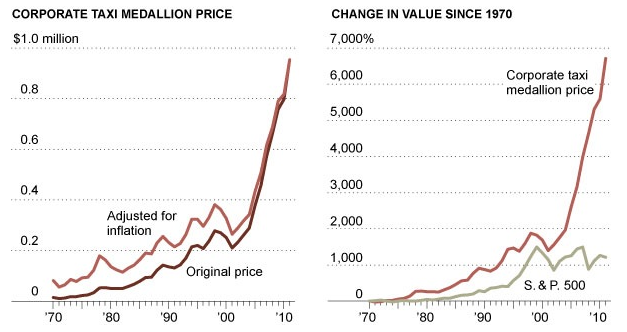
You can read Felix Salmon’s piece on “Why taxi medallions cost $1 million” here.
Our mayor Bloomberg is leaving office shortly. As one legacy, he has the city selling 2,000 new medallions over the next few years. Figure $1 million a piece, that’s $2 billion. Not a bad legacy for a three-term mayor who gets paid the princely sum of $1 a year.

” Today we have a weak economy, with falling government spending one main cause of that weakness.” He just spouts those lies without a hint of shame. He doesn’t even flinch! Good grief.
He sold the “air rights” over his tiny building for $28 million? I call total B.S., either on your part, Harry, or on the part of your friend. Who the hell would pay $28 million for “air rights” over a tiny building? This is garbage, it’s bunk; if your friend told you that, you need new friends. This guy is probably one of the same friends who’s always emailing you to say “Cash is king.” No, apparently air rights over tiny buildings is king. It’s garbage!!!
Yeah, Harry. You need new friends like “Cliff” who can tell you all about trolling on the internet.
It’s actually not garbage. It’s true.. But people want to believe what they believe.
So buy “TAXI” now at $14.97 per share and paying a 5.9% dividend.
How many Citi bikes did you pass on your ride?
Zillions. I didn’t count. But there were many empty Citibike stands — suggesting all the bikes were out riding. It’s another gorgeous day today.
Two Sundays ago, my wife and I rode our bikes from Red Hook, in Brooklyn, over the Brooklyn Bridge, across to the Hudson River bike bath, and up to 120th Street and Amsterdam to meet our daughter for brunch. When we got to the Hudson River bike bath, Gail decided to count Citibikes on our way north. She lost count at around 75, and we hadn’t gotten to 23rd Street yet!