Europe is not the United States of Europe. Financial woes there brought European stocks down sharply today. In a connected world, we’ll be hit too.
Richard Rusell, the 85-year old stockmarket doyen writes yesterday:
My job is to get my subscribers OUT of stocks in any way I can. I’ve used logic, technical analysis with explanations, threats, pleading, history, tears, arguments from authority (my authority), warnings about the treacherousness of the bear. What’s left? I guess more work on my part.
I showed subscribers the rare head-and-shoulders top-pattern in my PTI.
I showed you the bearish pattern in the point&figure chart of the Dow.
I showed you the bearish simultaneous breaking of the May 7 lows by Industrials and Transports.
I included a chart of the fatal downward zig-zag in the advance-decline line.
I show on today’s site where 50% of the stocks on the NYSE are now trading BELOW their 200-day moving averages.
I sent Russell’s newsletter to one of my last remaining money managers, who’s savvy enough to be net-short. He emailed me back this morning:
Yup.
We’re in pretty good shape, Harry. We might make a few bucks today.
Logic tells me there’s a growing risk of going back to 1987 levels -i.e. below Dow 3,000. (We’ll break 10,000 going down today.)
I don’t say this publicly. But it makes sense. We rode the back of debt accumulation on the way up, now it’s time to ride its unwinding on the way down.
Think of all the excess government jobs and govt. spending. It’ll take a long time to set that straight. And it will be painful: very high unemployment, social unrest, etc… Corporate earnings will take it on the chin. What would prevent such a decline is the government printing oodles of $$ to support the market, which they’ll probably do.
This explains the rise in gold — the anti-paper currency.
I’m off to exercise… will be back before the open.
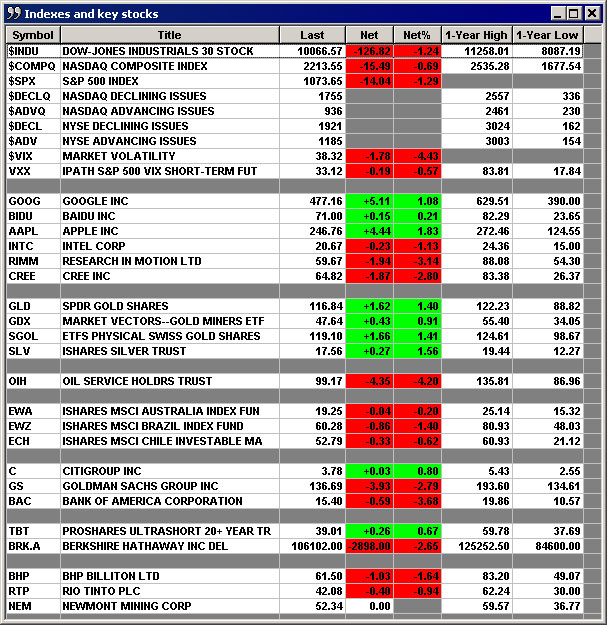
This was yesterday’s “action.” The Dow was down 126. Much was red, except for gold and silver.
Barron’s carries a story:
FAMED BOND-FUND MANAGER Bill Gross isn’t shy about expressing himself when he’s got an opinion about the market. His actions may mean even more when investing his own money.
Even as the market reeled in recent weeks, Gross plowed about $7 million into three bond funds he manages at Pimco.
Gross, the co-chief investment officer of the bond giant, has bought a total of 1.1 million shares in three bond funds — the Pimco Corporate Opportunity Fund (PTY), the Pimco Income Strategy Fund (PFL), and the Pimco Income Strategy Fund II (PFN) — since the beginning of this month. Gross had not bought into any of the three closed-end funds since 2007.
The Pimco Corporate Opportunity Fund invests in the lowest rated investment grade corporate bonds and highest-rated junk bonds. The Pimco Income Strategy Funds invest in floating or fixed-rate debt instruments. Bank debt makes up the largest portion of each of the funds’ holdings. …
Gross helps manage more than $1 trillion worth of assets at Pimco. In recent weeks, Gross has said that investors world-wide are liquidating holdings amidst the uncertainty caused by Europe’s debt problems. Last week, Pimco’s Total Return Fund, its most prominent fund, revealed that it had increased its holdings of US government debt to 36% of the portfolio in April, its highest level since last November.
Ben Silverman, the research director of InsiderScore.com, says investors should certainly take note of Gross’ buys.
“Anytime Gross is buying and disclosing what he’s buying, it’s certainly worth taking note of, especially if he’s buying when the markets are volatile,” he says. “He’s generally a more conservative investor.”
On May 20, when Gross did much of his buying, the Dow Jones Industrial Average dropped 376 points, or about 3.6%. The opportunity fund lost 2% that day, and the income funds lost about 3% each.
These funds are high yielders:

But they are also volatile. Check out the spread between the 1 year high and the 1 year low. This means you could lose in principal more than you make up in yield.
Here are a bunch of ultra-high yielders.
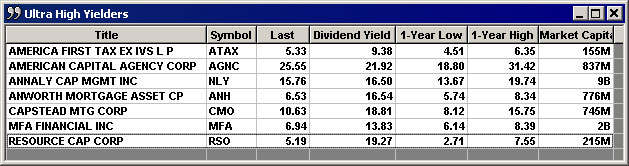
They are also volatile.
So, now I’ve read your introduction, Harry, what do I do?
Answers Harry: Stay heavily in cash until this blows over
Some of the financials are clearly ripe for shorting. (“Why didn’t you tell me that three weeks ago?”)
Our Drug War sucks bigtime. The analysis is simple:
If drugs are illegal, but there is a huge and growing demand for them, someone will step in to supply the demand.
You must read William Finnegan’s long piece “Silver or Lead — The drug cartel La Familia gives local officials a choice; Take a bribe or a bullet.”
The piece is in the May 31 issue of the New Yorker.
If you have a fast broadband connection, you can read the entire piece now. But beware it’s nine megabytes. It’s a big file. Click SilverorLead
There is only one solution to the growing drug violence — legalize drugs. Tax them. Quality control them. And educate the masses that taking them is seriously bad for their health, their family and their careers.
My wife says I have no taste. I like this.

I also like Nescafe. My wife likes coffee. This painting is the work of an American called Len Tantillo. He paints in the tradition of the Dutch masters of the 17th century. But unlike his predecessors, Tantillo doesn’t paint what he sees. He reinvents places in the common history of New York State that none of us have ever seen. He isolates us in a moment past, and makes us accept his vision of these lost worlds as “restored reality.” This picture depicts a 1640’s Dutch farm on one of the creeks that lead into the Hudson River. It was about 5 miles south of Albany. You can buy a signed and numbered print for as little as $125. Here’s his website. I also like this one. It’s called Creekside.

As a postscript, a story. A few years ago, I was in Paris alone. I happened on an art “gallery” selling paintings of Paris. I fell in love with one. I paid $3,000 for an “original.” The painting has never received permission to be hung. It now resides behind a couch where it gathers not praise, but dust.
The management efficiency expert. A lesson on how consultants can make a difference in an organization.
Last week, we took some friends to a new restaurant, ‘Steve’s Place,’ and noticed that the waiter who took our order carried a spoon in his shirt pocket.
It seemed a little strange. When the busboy brought our water and utensils, I observed that he also had a spoon in his shirt pocket.
Then I looked around and saw that all the staff had spoons in their pockets. When the waiter came back to serve our soup I inquired, ‘Why the spoon?’
‘Well, ‘he explained, ‘the restaurant’s owner hired Andersen Consulting (now Accenture) to revamp all of our processes. After several months of analysis, they concluded that the spoon was the most frequently dropped utensil. It represents a drop frequency of approximately 3 spoons per table per hour.
If our personnel are better prepared, we can reduce the number of trips back to the kitchen and save 15 man-hours per shift.’
As luck would have it, I dropped my spoon and he replaced it with his spare. ‘I’ll get another spoon next time I go to the kitchen instead of making an extra trip to get it right now.’ I was impressed.
I also noticed that there was a string hanging out of the waiter’s fly.
Looking around, I saw that all of the waiters had the same string hanging from their flies. So, before he walked off, I asked the waiter, ‘Excuse me, but can you tell me why you have that string right there?’
‘Oh, certainly!’ Then he lowered his voice. ‘Not everyone is so observant. That consulting firm I mentioned also learned that we can save time in the restroom..
By tying this string to the tip of our you-know-what, we can pull it out without touching it and eliminate the need to wash our hands, shortening the time spent in the restroom by 76.39%.
I asked quietly, ‘After you get it out, how do you put it back?’
‘Well,’ he whispered, ‘I don’t know about the others, but I use the spoon.’
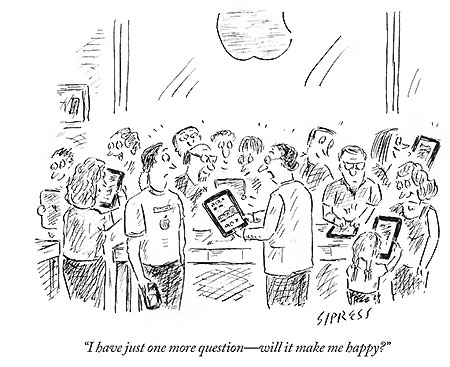
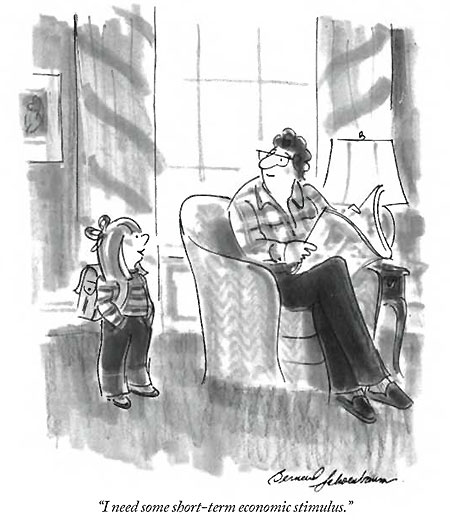
Favorite two New Yorker cartoons:

Harry Newton, who spent far too long reading the brilliant New Yorker article.

Oh man, you have to take a pick of the painting you have behind the sofa… let us judge 🙂
Tantillo's artwork is appealing – colors, light and shadows – spectacular! Find a place to hang that Parisian art piece – on a trip with friends, I paid $35 for an original watercolor of a the bridge near Notre Dame, while they harrassed me for being a tourist. It hangs over my desk and is great stress relief – no regrets ever!
I suspect you got a better deal on your watercolor.You just gave me an idea where to hang my Paris scene painting…thanks.
More casualties of the drug war.
http://rawstory.com/news/afp/Jamaica_battle_for…
The illegal drug business is very large and very profitable. The drug lords have guns, ships, planes, helicopters and — wait for this — submarines. With tough economic times, they have no trouble recruiting. As the dollars expand, so the drug lord armies get stronger, better armed and more violent. And they have more to protect. Read the New Yorker piece. The Mexican drug lords are far better equipped than the Mexican police and the Mexican army. It will only get worse. I hadn't realize the extent of the violence in Jamaica. But Pete's clip tells of the latest batter with 28+ people killed.
Here is the Reuters article-now up to 31 dead. It's messed up how much money we spend on enforcement/incarceration and we could be making money from taxing. I'm undecided about the “hard” drugs, but marijuana seems like a no brainier. That New Yorker piece is scary. As they said in the piece it sounds like the insurgency in Afghanistan and Iraq. It doesn't seem like these problems can be solved with the crackdown paradigm.
http://www.reuters.com/article/idUSTRE64O4QY201…