One theory is that the selling in recent days has been triggered by hedge funds saying, “Let’s lock in all our gains this year. Sell everything we own. Go play tennis (or whatever).”
Another theory is that talk of Fed tapering is spooking the market.
Fact is no one knows.
But. Earnings are improving. The momentum stocks have their momentum.Well, most of them. Especially the BIG ones, like AMZN, GOOG, AAPL, NFLX, and PCLN. And the smaller ones like APO, BX and KKR.
Finally QCOM is getting some attention. And my IBM and LL shorts are continuing to work.
Most importantly, I don’t want to dump what I have, pay the taxes on this year’s hefty profits and gamble that stock prices will be cheaper on January 2, 2014.
Stay the course.
Morgan Stanley Predictions for 2014. They’re positive and all summed up in one slide:
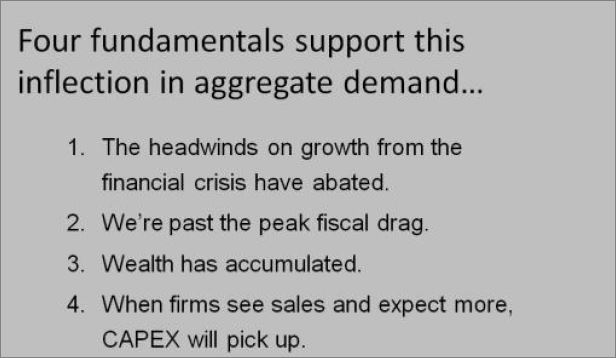
Courtesy these nice economists: (They’re having fun being positive??)
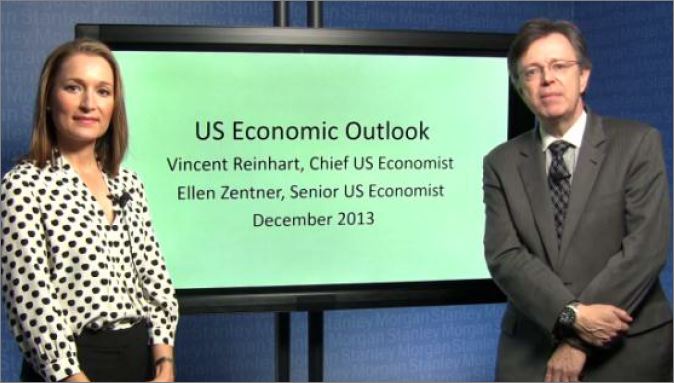
Here’s the entire short presentation if you want to read it. Click MorganStanleyPredictions2014
Updated stock chart:
|
Trends |
Stocks and ETFs
|
|
| Air travel boom | BA, HON | |
| Huge oversupply of all commodities and minerals | Gold SGOL, GLD) and gold miners (GDX), BHP, RIO | |
| Big year for the barbarians as they sell assets. Big dividends coming in Q1, 2014 | BX, APO, KKR | |
| Energy from solar panels has reached par with coal and is falling | Solar stocks — FSLR, CSIQ | |
| Shopping recovery | MA, V | |
| Energy from solar panels has reached par with coal and is falling | Electric utilities, especially in sunny states | |
| Obamacare | UNH, XLV, GILD, JNJ | |
| Interest rates low | The mortgage REITs — NLY, AGNC, | |
| The Internet | GOOG, AMZN, AAPL, PCLN, NFLX, OPEN, QCOM, SFTBF | |
| 3D printing | DDD, SYS, VJET | |
| Desktop design to manufacturing | ADSK | |
| Housing recovery | HD, WY | |
| TV’s re-emergence | DTV, CCV, TWC, CHTR | |
| The Cloud | AMZN, GOOG | |
| Tech recovery | MU | |
| Alibaba and Sprint | SFTBF (Softbank) and YHOO | |
| High speed cellphone data explosion | QCOM | |
| Falling knives to watch | CCV, AGNC, NLY | |
| Consumer icons | NKE | |
| Healthy eating | WFM, WWAV |
How to organize your life. The champ is software called Evernote. I’ve resisted it for reasons as “logical” as “I don’t want to learn another software as long as I live.” But the forces are aligning against me. Yesterday’s New York Times had a huge plug for “An App That Will Never Forget A File.” Not only does it NOT forget a file, but it gives you a way to find the bits of pieces of your life — which Microsoft’s miserable Windows search engine can’t find. For the Times’ piece, click here.
The Hilton IPO was good for BX. It should continue to do well with upcoming deals and nice dividends.
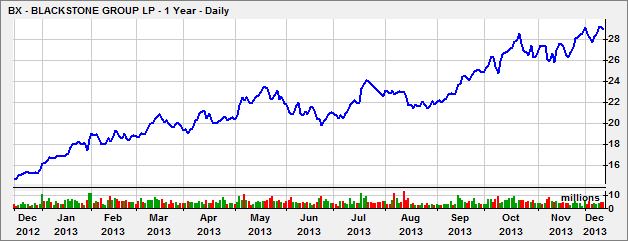
Writes the New York Times Dealbook,
The Blackstone Group, which took the Hilton hotel group public on Thursday, has increased the value of its investment by nearly $10 billion through a combination of lucky timing, smart financial engineering and disciplined management.
Harry Dent sells books. His theme is usually doom and gloom. Hhe newest book is ” Demographic Cliff: How to Survive and Prosper During the Great Deflation of 2014-2019.” Two quotes:
+ The U.S. stock market will crash. “Our best long-term and intermediate cycles suggest another slowdown and stock crash accelerating between very early 2014 and early 2015, and possibly lasting well into 2015 or even 2016. The worst economic trends due to demographics will hit between 2014 and 2019. The U.S. economy is likely to suffer a minor or major crash by early 2015 and another between late 2017 and late 2019 or early 2020 at the latest.”
+ “You need to prepare for that crisis, which will occur between 2014 and 2023, with the worst likely starting in 2014 and continuing off and on into late 2019,” Dent concludes. “You can contribute to the solution by conserving your financial assets and reinvesting them after the crisis.”
BusinessInsider has more on the Dent nonsense. click here.
Why do I give Dent publicity? I’m jealous? A warning? Yes. You have to be aware that it’s easy to write these sort of books — the amazing thing is that how many otherwise sane people keep buying this nonsense. My God, ask yourself. How accurate can you possibly be making predictions for 2019 and 2020?
Movies new on Netflix. The company has always disappointed me. It’s rarely had a movie I wanted to see. Here’s a list of new movies it’s just added, very few of which I’ve ever heard of. Click here.
Meanwhile, you can watch Bing Crosby, Danny Kaye in Irving Berlin’s classic “White Christmas” tonight at 7 PM on AMC. You can also watch it on Netflix. It was made in 1954. (They occasionally have later movies.)
Exercise as potent medicine: From Wednesday’s New York Times:
Exercise can be as effective as many frequently prescribed drugs in treating some of the leading causes of death, according to a new report. The study raises important questions about whether our health care system focuses too much on medications and too little on activity to combat physical ailments.
For the study, which was published in October in BMJ, researchers compared how well various drugs and exercise succeed in reducing deaths among people who have been diagnosed with several common and serious conditions, including heart disease and diabetes.
Comparative effectiveness studies are a staple of science, of course, especially in pharmaceutical research. Scientists often track how well one drug treats a condition compared with the outcome if they use a different drug. But few studies have directly compared drugs with exercise, and even fewer have compared outcomes in terms of mortality or whether the intervention significantly lessens the chance that someone with a disease will die from it, despite treatment.
So Huseyin Naci, a graduate student at the London School of Economics and Political Science, and Dr. John Ioannidis, the director of the Stanford Prevention Research Center at the Stanford University School of Medicine, decided to create a comprehensive comparison of the effectiveness of drugs and exercise in lessening mortality among people who had been diagnosed with one of four diseases: heart disease, chronic heart failure, stroke or diabetes. They chose these particular conditions because those were the only ones for which they could find studies that had examined whether exercise lessened the risk of death among patients with that disease, Mr. Naci said.
He and Dr. Ioannidis then gathered all of the recent randomized controlled trials, as well as previous reviews and meta-analyses of older experiments relating to mortality among patients with those diseases, whether they had been treated with drugs or exercise.
They ended up with data covering 305 past experiments that, collectively, involved almost 340,000 participants, which is an impressive total. But most of the volunteers had received drugs. Only 57 of the experiments, involving 14,716 volunteers, had examined the impact of exercise as a treatment.
Still, the numbers were large enough that Mr. Naci and Dr. Ioannidis could create an elaborate network of cross-references, comparing the outcomes when people received certain drugs, followed exercise regimens or, occasionally, both. The exercise routines, typically part of rehabilitation programs, usually involved walking or other aerobic routines but sometimes consisted of weight training or other exercises.
The researchers compared mortality risks for people following any of the treatment options.
The results consistently showed that drugs and exercise produced almost exactly the same results. People with heart disease, for instance, who exercised but did not use commonly prescribed medications, including statins, angiotensin-converting-enzyme inhibitors or antiplatelet drugs, had the same risk of dying from – or surviving – heart disease as patients taking those drugs. Similarly, people with diabetes who exercised had the same relative risk of dying from the condition as those taking the most commonly prescribed drugs. Or as the researchers wrote in statistics-speak, “When compared head to head in network meta-analyses, all interventions were not different beyond chance.”
On the other hand, people who once had suffered a stroke had significantly less risk of dying from that condition if they exercised than if they used medications – although the study authors note that stroke patients who can exercise may have been unusually healthy to start with.
Only in chronic heart failure were drugs noticeably more effective than exercise. Diuretics staved off mortality better than did exercise.
Over all, Dr. Ioannidis said, “our results suggest that exercise can be quite potent” in treating heart disease and the other conditions, equaling the lifesaving benefits available from most of the commonly prescribed drugs, including statins. Statins are at the center of a debate about new treatment guidelines that could vastly expand the number of people taking the drugs.
The results also underscore how infrequently exercise is considered or studied as a medical intervention, Dr. Ioannidis said. “Only 5 percent” of the available and relevant experiments in his new analysis involved exercise. “We need far more information” about how exercise compares, head to head, with drugs in the treatment of many conditions, he said, as well as what types and amounts of exercise confer the most benefit and whether there are side effects, such as injuries. Ideally, he said, pharmaceutical companies would set aside a tiny fraction of their profits for such studies.
But he is not optimistic that such funding will materialize, without widespread public pressure.
For now, Mr. Naci said, he hopes that this new study will prompt smaller-scale negotiations. “We are not suggesting that anyone stop taking their medications,” he said. “But maybe people could think long and hard about their lifestyles and talk to their doctors” about whether exercise could and should be incorporated into their care.
How Jews celebrate Christmas (?)

Another dumb blond “joke”
Two blond men find three grenades, and they decide to take them to a police station.
One asked: “What if one explodes before we get there?”
The other says : “We’ll lie and say we only found two.”

Harry Newton who finds the more aggressive he plays tennis, the better he feels several hours later (after a hot shower and a short nap). Eleanor is now four weeks old. If her rate of growth continues (ain’t statistics wonderful?), we’d have to write an “irrational exuberance” book. My son, Michael claims that 74.3% of statistics are made up on the spot. He says people will accept made-up statistics if:
1. They seem plausible. You couldn’t get away with saying 67% of people are women. It’s not plausible. But 50.13% is. Unless it’s China where 59.6% of the population are men (and sex-crazed).
2. Simple statistics, like 75% … are generally not believable. But 75.1% is.
3. No one has any better statistics to contradict you.
4. . If your made-up statistics are repeated often enough and in sufficient diverse places by many diverse sources, they’ll become accepted wisdom.
67.3% of the nice people reading this column will believe the above, because it’s on the Internet and hence must be true. Have a great weekend.

Christmastime For The Jews! http://goo.gl/kf6JLY It’s not just Chinese food!
Watch “What Maisey Knew” on Netflix
Why was the stock market down the past few days, Harry asks. Could it possibly be that many with sizable gains in 2013 are less enthusiastic about 2014 and want to protect their gains? Just maybe?
There are a lot more than just Harry Dent who are concerned about 2014 and even the 2018 and 2019 timeframes. Predict with accuracy all that? No, but how long can the USA keep digging a deeper and deeper black hole of massive debt before we all “get hit in the belly with a wet fish”?
My statistics teacher started our college class with the statement that statistics prove that 99% of all statistics are wrong.
Please allow me to digress back to yesterdays article about the Fed.
The Fed and the government are not the solution and are the
problem. Stop…think…do you really expect different results from the same
old actions? The solution is to change our tax code that now punishes production,
taxes on income, jobs, savings and investment. Without production there is nothing to
buy, no improvement in standard of living, no tax base to support government.
The solution is to repeal the 16th Amendment that enabled direct taxation on
incomes and jobs, the IRS and tax withholding. When you are through dreaming
and want a real solution stop bitching and take action!!! Support the FairTax,
learn more at fairtax.org and start with Q&A, to more the tax base to consumption with a progressive national sales/consumption tax system.