Remember Boeing? The batteries burned. The stock plummeted. I jumped in and bought. The stock recovered immediately and flew.
Yesterday, one of Micron’s competitors announced it was building a new plant whose products would compete with Micron’s and potentially cause Micron’s memory prices and profits to fall. So Micron plummets. See chart. How bad was the news? Not bad, according to my thinking. The new plant is to replace an existing, old one. And it won’t be built for eons. Then, predictably, Micron bounced.
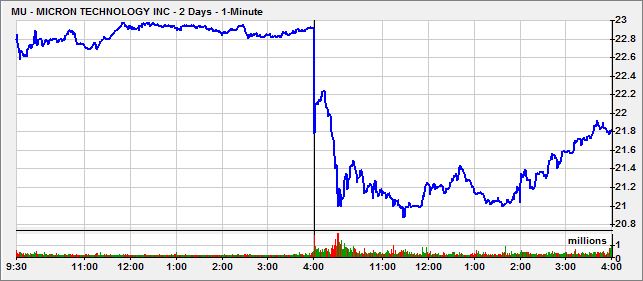
So, now do we have a new policy: Watch for Bad News that’s not really bad, and buy on the dip. Quickly.
My illustrious commodities play.
I once had a million in a commodities fund. It went nowhere. and I got out. This year it’s down 8%. I have a short fuse, which generally works.
I also used to own gold — largely through the ETF SGOL (which I prefer to GLD). But I got out of all my gold a while back. It just kept falling. Look at this five year chart. Great until September 2011. Then it fell out of bed.:
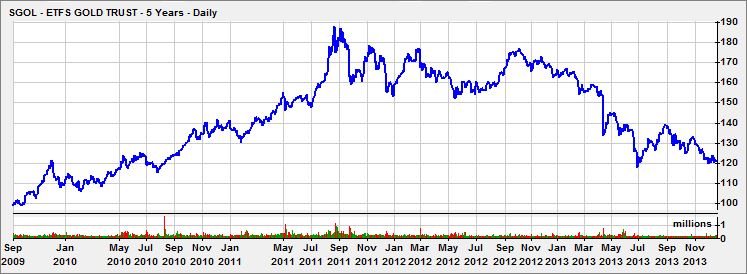
There are still gold bulls, though fewer than before. They argue as they’ve argued before. But it’s not working. Which is why I worship my mandatory stop loss rule. Here’s the Economist on Investing in commodities
Rust-proof
Despite a tarnished record, commodities have not lost their lustre for all
GRAIN silos, oil pipelines and copper smelters are not exactly glamorous. Yet for a glorious couple of years up until mid-2008, commodities were all the rage. China was booming, and supplies of everything from soyabeans to iron ore were failing to keep pace, prompting a giddy leap in prices. Financial engineers minted all manner of products tied to these movements. Not only were commodities on a roll, their patter went; they also provided a crucial hedge for any diversified portfolio, since they did not move in tandem with other assets.
This spiel convinced all sorts of big investors to pile in. Pension funds, endowments, sovereign-wealth funds and the like scrambled to grab a piece of the commodities boom, only to see prices wobble along with the world economy, and then slip as China’s growth slowed. Yet overall investment in commodities has barely fallen, even though the sales pitch that drummed it up has been largely disproved.
According to Barclays bank, the flood of investment in commodities reversed only slightly this year (see chart). If gold, which behaves more like a currency, is left out of the picture, the sum of commodity-related assets under management has hovered at a little under $220 billion since 2011.
Falling commodity prices, thanks both to increased supply and to slower economic growth in emerging markets, have called into question the long-term return that the burgeoning asset class was presumed to offer. But that is not the only reason that investors have gone lukewarm on commodities. The role of raw materials as a hedge against rising prices remains untested and unimportant while inflation stays stubbornly low.
The supposed power of commodities to diversify portfolios has also failed to match the billing. In the decades leading up to the financial crisis there had been no consistent correlation between returns from commodities and other investments. But the crisis hit all types of asset. Commodity indices and the S&P 500 moved more or less in sync. Commodities, in other words, were no hedge against economic cataclysm. It is little comfort that the link seems since to have been broken again, as equities have prospered while commodities have not. Indeed, historically, commodities have yielded little return except during the oil crises of the 1970s and the heady years before prices peaked in 2008.
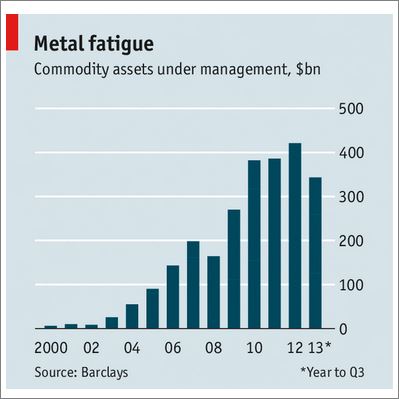
These disappointments have provoked retreats from some prominent advocates of commodities. A few big commodity-focused hedge funds have closed and several investment banks are getting out of the commodities business. CalPERS, a giant pension fund for state employees in California, which helped to cement commodities’ status as a mainstream asset class with a big investment in 2007, cut its exposure late last year from 1.4% of its total assets to a niggardly 0.5%. But it says this reversal may only be temporary, and other investors continue to pile in.
Indeed, some boosters argue that commodities’ time will come again. Nick Brooks of ETF Securities, a commodities-investment firm, senses tentative interest and reckons a small recent inflow of investors’ cash might herald better times.
Kevin Norrish of Barclays also sees reason for optimism. Both reckon that investors in commodities are becoming cannier. Although most still bet on simple price rises, the more sophisticated are exploring subtler strategies to eke out returns, tied to relative movements in price between different commodities, for example. As a fairly new and little-studied asset class, more research might boost returns.
Of course, across-the-board price rises would provide the biggest boost. Mr Norrish says that commodities tend to perform better in the later stages of an economic recovery. That still looks some way off. Worse, China is unlikely ever to return to the tearing growth that sent commodity prices skyward a decade ago. But miners are cutting investment and oil production growth is sluggish. So there is a chance that prices will rise again and commodities will swing back into fashion.
A truly wonderful SNL skit — The Three Wise Guys.

Robert De Niro, John Goodman and Sylvester Stallone perform “Saturday Night Live”. Turn up the volume. Click here.
The joys of being a landlord.
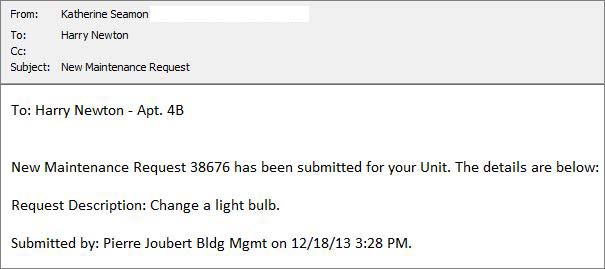
The NYC building I own an apartment in installed a fancy new computer system that tags everything from deliveries to maintenance requests. Here’s yesterday’s request by my wonderful tenant:
Daily stuff:
+ Watch out for magazine subscriptions. The publishers are no desperate they’re sending our “urgent” renewals a year or more in advance of when your subscription expires. It’s crazy. But they’re desperate.
+ You can subscribe to Fortune Magazine’s daily free Term Sheet email. It’s actually useful. Click here. The New York Times also has one called DealBook (spelled DealB%k). You need to log into the NYTimes and manage your own personal subscriptions. They have several interesting newsletters.
+ Never pay tax or shipping when you’re buying expensive electronics. There are a zillion hungry online electronics vendors. Always negotiate on the phone with a real person.
+ The Canon G15 is on sale at $299. That’s a bargain compared to the newer G16, which is now $499. I suspect there aren’t many G15 left. So hurry.
+ The personal hotspot on the iPhone 5s via Verizon works remarkably well. It creates a Wi-Fi area which your laptop can log into and use. I used mine this morning to edit and post this column. Worked like a charm. Most newer smartphones have Personal Hot Spots. They’re useful if you’re traveling or at meeting where they won’t let you onto their precious Wi-Fi network.
+ Recently I published a list of 12 interesting stocks for 2014 I’d found on Seeking Alpha by Shaun Currie. Several readers poohed-poohed the picks. I had forgotten to mention that his picks for 2013 had done very very well. And that had impressed me. If you want to read his recommendations, click here.

Harry Newton who is not spending the money the soaring market gave him yesterday. But I’m also staying in. I’m not going to cash.

“The personal hotspot on the iPhone 5s via Verizon works remarkably
well. It creates a Wi-Fi area which your laptop can log into and use. I
used mine this morning to edit and post this column. Worked like a
charm. Most newer smartphones have Personal Hot Spots. They’re useful if
you’re traveling or at meeting where they won’t let you onto their
precious Wi-Fi network.”
…Harry: only works with Verizon?
No, also works with AT&T and others. Need to check phone and your carrier.
Harry – nice to see you’ve reconsidered your longstanding advocacy of gold.
Approximately two years ago, on her show, Suze Orman responded to a caller who asked about investing in gold. Suze urged the caller to buy gold and then said: “Go where the people are going.” In other words – pile into what’s hot at the moment. Still the single worst piece of investing advice I have ever heard.
Harry
I live on your point about buying when something dips big time. I am very narrow, sticking only to stocks I know. But it never fails; they ALWAYS overreact and plunge too far to represent the facts. A very good recent example was the potash scare with MOS. Selling puts/buying calls in the two days that it plunged was like taking candy from a baby.
I am also very interested in your comments on commodities. I would like to see you do more on this subject as I think you have an interesting perspective on issues. have been following Tungsten. It is a global top 5 or 10 in strategic metals and very hard to mine, yet it has continually declined into a deep slumber. Hope you are having great Holidays!