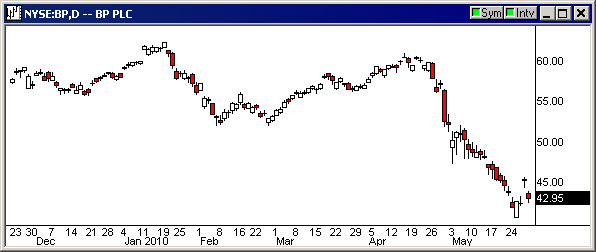
BP’s woes. BP’s latest effort failed. BP’s stock falls 14%. That’s below this chart, which only shows Friday’s close:
Not funny to make fun of hapless BP. This is actually one of its own ads from 1999. Prophetic:
Housing’s woes. The New York Times runs a cover story this morning on Owners Stop Paying Mortgage…And Stop Fretting About It. They use some of their savings to pay lawyers to delay the foreclosure process. It’s working spectacularly well. Says the Times, “Foreclosure procedures have been initiated against 1.7 million of the nation’s households. The pace of resolving these problem loans is slow and getting slower because of legal challenges, foreclosure moratoriums, government pressure to offer modifications and the inability of the lenders to cope with so many souring mortgages.
The average borrower in foreclosure has been delinquent for 438 days before actually being evicted, up from 251 days in January 2008, according to LPS Applied Analytics. …
More than 650,000 households had not paid in 18 months, LPS calculated earlier this year. With 19 percent of those homes, the lender had not even begun to take action to repossess the property — double the rate of a year earlier.
You can read the entire Times piece here.
The Euro’s woes. Will the Euro collapse? Nothing’s off the table. Fitch downgraded Spain on Friday, sending markets into a spin. Some words I found:
A sudden disintegration of the euro due to financial panic on international markets would almost certainly increase the risk of financial contagion spreading to the United States, especially in light of America’s $12 trillion debt load. In the ensuing turmoil, American banks could stand to face billions or possibly trillions of dollars in losses on their credit exposure to Europe, and thus call into question the solvency of the entire American financial system. At a very minimum, economic and financial chaos in Europe would severely disrupt American exports to Europe, and thus slow the economic recovery in the United States.
On the other hand, in a controlled break-up of the euro (a scenario whereby Germany tires of its role as EU paymaster and makes a policy decision to exit the single currency and reinstate the Deutsche Mark in an orderly, phased-in fashion), the United States could stand to benefit handsomely. Any unraveling of the euro would end that currency’s function as a reserve currency and boost the demand for safe-haven assets in the United States. As a result, a stream of money from Asia and elsewhere would flow into United States Treasury bonds, and thus provide financing for U.S. deficits. Although a stronger dollar would hurt American companies trying to sell abroad, a stronger greenback would also bring benefits to American consumers, in the form of lower oil and commodity prices and lower inflation.
My best contacts tell me the Euro will from its present $1.26 to par with the U.S. dollar. One Euro will be worth one dollar. This is not unthinkable. It was 82.5 cents in 2000. Read more the Euro at Wikipedia.
What will happen to BP? To the Euro? To trading uncertainties (we still don’t know what happened with the Flash Crash.) To the banks who hold the housing and commercial real estate mortgages? And worst, to figuring out what the politicians are going to do now.
Investors don’t like uncertainty, and fear.
May was rough, down 8.2% — worst down May since 1940. June will be rough. You should be in cash (except for Apple which has sold an amazing two million iPads — and now my wife wants one.) You should be a little short.
Some people believe interest rates will eventually rise. They buy TBT. They haven’t made any money yet:
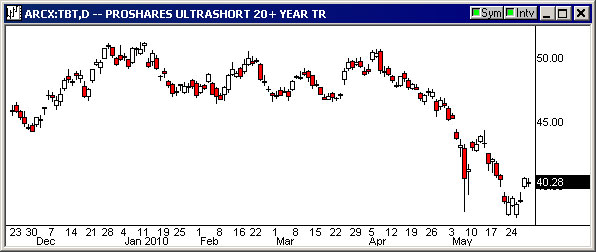
Personally, I’m dubious of this TBT play.
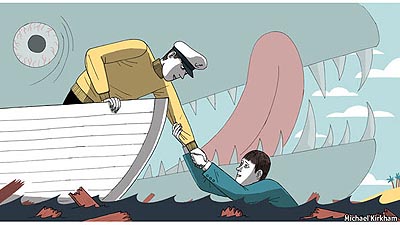
The rescuers’ woes. The Economist has the best piece on all this:
Rescuing the rescuers
Having saved the banks, governments now find themselves under the wary eye of the markets
IF BULLISH investors had been given two Christmas wishes at the end of 2009, they probably would have asked for booming profits and a continuation of ultra-low interest rates. Their wishes have been granted. According to Morgan Stanley, the first-quarter profits of companies in the S&P 500 have been more than 12% better than expected. Meanwhile, few expect the Federal Reserve, the European Central Bank (ECB) or the Bank of England to raise rates this year. Some think rates will stay where they are in 2011, too.
So why is the MSCI World index of global equities down by more than 10% this year, with emerging markets showing double-digit losses and European bourses shedding more than 20% in dollar terms? On May 25th the FTSE 100 index closed below 5,000 for the first time since last October. The next day the Dow Jones Industrial Average closed below 10,000 for the first time since February.
This latest setback may simply be a reaction to the phenomenal rally that has taken place since March 2009. Back then, fears of a second Depression were widespread. As confidence returned, the S&P 500 index jumped by 80% to its most recent high in late April. Eventually, all the good news was priced in and there were signs of complacency: in early May a survey by Investors Intelligence, a research firm, found that three times as many American financial advisers were bulls (54%) as were bears (18%).
May has seen the re-emergence of a number of worries that had been beneath the surface. The latest is geopolitical risk, in the specific form of rising tension in the Korean peninsula. Reports that Kim Jong Il, the North Korean dictator, had placed his forces on a war footing caused Asian markets to fall sharply on May 25th. The erratic actions of North Korea, a country with too many weapons and not enough food, are akin to Middle East politics: a wild card that can occasionally upset investors.
However, investors’ biggest financial concern is sovereign debt, notably that of some southern European countries. In recent weeks the European Union has been forced both to rescue Greece and to unveil a general bail-out package, worth up to €750 billion ($920 billion) including a contribution from the IMF, for struggling countries. Investors seem to be in two minds on sovereign debt. They worry that individual countries may default if they do not cut their deficits and that banks holding their debt will be clobbered. They think that Greece’s debt crisis has been postponed rather than solved. But investors are also concerned that, if several governments try to tighten fiscal policy at once, the global economy will take a hit.
Europe is expected to experience sluggish growth in the medium term as it struggles with its debts. But in recent weeks worries have also emerged about growth in Asia and America. In Asia, the question is whether China’s attempts to rein in its housing market will prompt a broader slowdown (see article). In America, momentum seems to have faded a little after a strong performance in the last quarter of 2009. Some data, such as initial jobless claims and the Conference Board leading indicator, have been disappointing.
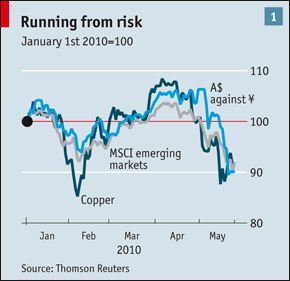
All this has led to a sell-off of the “risk basket”—those assets that seem most correlated with global growth, such as the Australian dollar, copper and emerging-market equities (see chart 1). Oil has been another casualty, with crude prices falling by around 20% in May alone. This week the price of a barrel dipped below $70. Investors have headed away from risk, flocking into the bonds of what they deem the safest governments: German ten-year bond yields fell to 2.58% on May 25th, the lowest in recent memory, while the yields on ten-year American Treasury bonds dropped to close to 3%.
Blaming the markets
A further complication of the debt crisis is that governments have turned from trying to support financial markets to blaming them for the world’s ills. Rather than accepting rising government-bond yields in southern Europe as a rational response to worsening public finances, politicians believe that troubled countries have been unfairly targeted by speculators. That seems to explain Germany’s hastily imposed restrictions on short-selling of government bonds and on buying sovereign credit-default insurance without owning the underlying bond. In response to market criticism of the ban, Wolfgang Schäuble, Germany’s finance minister, quipped: “If you want to drain a swamp, you don’t ask the frogs for an objective assessment.”
However, it seems unwise for European governments to start bashing the very people from whom they need to borrow hundreds of billions of euros. Investors do not need to sell bonds short—bet on a falling price—to cause governments trouble. All they need to do is to shun bonds in governments’ frequent auctions (Germany, Italy and Portugal all held auctions on May 26th, for example). A failed auction would quickly cause bond yields to soar, increasing the cost of servicing those huge deficits.
The impression of erratic government policy has been bolstered by the tortured negotiations over America’s finance-reform bill (see article) and Europe’s Alternative Investment Fund Managers Directive. Taxes on banks and financial transactions are being discussed. Such measures may never be agreed on by the G7 or the G20, but given the financial industry’s unpopularity, countries or regions may act on their own. On May 26th the European Commission proposed a levy on banks to pay for future failures. Mr Schäuble has said that the German government will seek a “European solution” to a transactions tax if the G20 cannot agree on one. Last autumn there was a sense that global governments were co-ordinating their actions; now they seem to be dashing off in different directions in an attempt to appease their voters.
Viewed politically, in fact, the recovery in profits that has given encouragement to the bulls has been a mixed blessing. With growth in the rich world sluggish, the corollary of the rise in profits has been a fall in the share of income going to labour, because of job losses and stagnant wages. To the ordinary voter, the picture seems perverse: the bankers and bosses who caused the crisis and were then bailed out by taxpayers are now reaping a disproportionate share of the rewards. Meanwhile, public services and public-sector pensions and wages face deep cuts—seemingly at the insistence of the same financial elite. No wonder voters are angry.
Watch the banks
Although falling stockmarkets may capture most headlines, a less obvious alarm signal is probably more unsettling. This is the sharp rise in the rate at which banks borrow and lend to each other, known as LIBOR (London Interbank Offered Rate). On May 26th three-month dollar LIBOR was 0.54%, its highest since last July (see chart 2). Although this is still a long way below the near-5% reached in 2008, the trend is worrying. It indicates that the health of the banking system is once more being called into question.
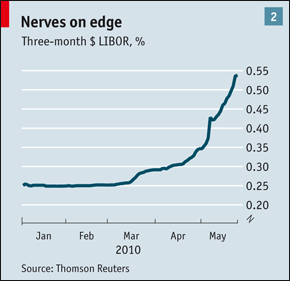
Indeed, much bigger rate moves are priced into the forward market. And Pavan Wadhwa, a strategist at JPMorgan, points out that Libor measures the funding cost for only 16 big banks; smaller banks have to pay a premium. The Eurodollar future that shows the cost of borrowing dollars for the average bank in the three months between September and December is already 1.1%. European banks, which seem desperate to get their hands on the American currency, have to pay a further half a percentage point, making their total cost 1.6%.
Central banks have tried to ease the pain. A swap deal between the Federal Reserve and the ECB, intended to last until January 2011, allows banks to borrow dollars for seven days at 1.25%. But the rise in Libor creates a number of potential difficulties. Mr Wadhwa points out that, as banks become more concerned about their own borrowing costs, they become more reluctant to lend. That was precisely what caused the interbank markets to freeze in 2008. Meanwhile, an increase in Libor squeezes the profits of even healthy banks, since they had been borrowing cheaply from the money markets and investing in higher-yield assets such as government bonds.
There is a strange symbiosis between governments and banks. It may have been governments that rescued banks in the autumn of 2008. But governments rely on banks to market and indeed to buy their debt. The one cannot survive without the other. A big reason why EU politicians raced to push through the €750 billion bail-out package was that a default by a southern European government would create a severe funding crisis for banks. Royal Bank of Scotland reckons that foreign banks own about €1 trillion of the sovereign debt of Greece, Portugal and Spain. There would be a risk of another crisis in the style of 2008, in which the markets would be uncertain which banks were most exposed to the defaulting assets, and would therefore apply a general boycott.
Spain has been in the spotlight in recent days. The government has had to rescue CajaSur, a small savings bank, and four other savings banks have chosen to join forces (see article). An IMF report on Spain, published on May 24th, gave warning that the risks for banks “remain elevated and unevenly distributed across institutions” and recommended consolidation “to reduce overcapacity and produce more robust institutions.” The Spanish stockmarket is one of Europe’s worst performers, having fallen by around a third, in dollar terms, since the start of 2010.
Andrew Smithers of Smithers & Co, a firm of consultants, points out another problem. If governments now strive to reduce their fiscal deficits (and contingent liabilities), this limits their ability to bail out the private sector, including banks. In addition, recent political discussions about financial reform have centred on the desire to avoid future bank bail-outs; Barack Obama has said as much. Markets may be taking politicians at their word.
These tensions illustrate a contradiction at the heart of the market’s rally from the lows of March 2009. Governments and central banks have supported the recovery with huge fiscal deficits and near-zero interest rates. Yet the sheer scale of these measures should have given investors cause for concern, as they indicate how fearful the authorities had become.
At some point, if the economy recovers, the stimulus will have to be withdrawn, leaving the markets facing higher interest rates and tighter fiscal policy. And if the stimulus fails to work, market hopes of future profits growth (double-digit gains are expected in 2011 and 2012) would clearly be disappointed. Governments have shown they can support consumption in specific areas, such as the cash-for-clunkers subsidy in cars or the homebuyers’ tax credit. But sales have fallen back quickly once the subsidies end.
Lacking strong demand at home, governments are tempted to let their currencies depreciate so that their exporters can grab a bigger share of the global market. The problem is that not all currencies can fall at once. Britain stole a march when the pound fell sharply in 2008. Now the euro is taking a battering, hitting a four-year low against the dollar. With China seemingly unwilling to let the yuan appreciate, the danger is that a series of beggar-thy-neighbour competitive depreciations create protectionist pressures. This is a particular danger in America, where congressional elections take place in November.
Governments ought also to consider the creditors’ point of view. Deficit countries are all competing for the good opinion of global savers. Depreciation may help the domestic economy, but it inflicts a loss on foreign holders of local-currency government bonds. Rationally, investors should eventually respond by demanding higher yields to compensate for the currency risk. It seems rather surprising, for example, that Britain can still borrow for ten years at 3.5% when its central bank has been so relaxed about letting its currency depreciate and its budget deficit is among the highest in Europe.
In addition, government borrowing could crowd out the private sector. That may not be a problem at the moment, when companies and consumers are so reluctant to borrow. But it could become one if deficits do not fall substantially in the medium term, beyond a mere reflection of a cyclical improvement in the economy. “We’ve long held the view that risk assets could see crowding-out over the next few years as there is more and more Western government debt to finance,” says Jim Reid, a strategist at Deutsche Bank. “It makes perfect sense that risk assets would trade at lower levels than they would do if governments had less [debt] to issue.”
But the absence of crowding-out at the moment is hardly a matter for rejoicing. It simply indicates that the private sector is not yet ready to shoulder the burden of recovery from the public sector. Demand for credit remains low. Companies have issued just $47 billion of bonds so far in May. They are on course for the lowest monthly total since December 1999, according to Bloomberg. And earlier this month Volkswagen was forced to postpone a bond issue of nearly €700m, backed by Spanish car loans. Yields on corporate bonds have been rising again, discouraging companies from raising money. Broad-money supply was flat in the euro zone in the 12 months to the end of March. America’s measure of broad money rose by only 1.6% in the year to April, and fell slightly in the second half of that period.
The bears come out of the woods
The latest market setback has given heart to those bearish commentators who were looking out of touch towards the end of last year. Albert Edwards of Société Générale has long believed in an “ice age” in which deflationary pressures drag down equity valuations, as they have in Japan over the past 20 years. He believes the recovery will be short-lived. “Renewed recession awaits,” he says. With core measures of consumer-price inflation in both America and the euro area below 1%, “the icy tentacles of outright deflation are now just within reach.”
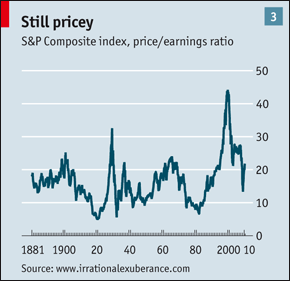
Bears would also argue that shares do not look cheap. This may seem remarkable, given that profits are close to a 50-year high as a proportion of American GDP and the S&P 500 index is back at levels it first reached in March 1998. But chart 3, from a website updating “Irrational Exuberance”, a book by Robert Shiller of Yale University, shows the best long-term valuation measure, the cyclically adjusted price-earnings ratio. On this indicator, which smooths profits over a ten-year period, shares are still trading at 20 times earnings, more than double the ratio of the 1930s or early 1980s. “These types of brutal downdraughts coupled with intense volatility are generally the hallmark of overvalued markets as we saw in 1990, 1998, 2000 and again in 2007,” says David Rosenberg of Gluskin Sheff, a Canadian asset-management firm.
But the bulls will continue to take comfort from those low rates and booming profits. Company finances are improving. The default rate on speculative corporate bonds has been steadily declining; according to Standard & Poor’s, only 7% of issuers defaulted in the past 12 months, down from almost 10% in the year to November. With companies still churning out cash and paying dividends, bulls say investors will eventually be tempted to put their money back into the stockmarket, especially given the tiny yields on cash. Some see good signs in the mad dash into Treasuries: American mortgage rates will drift lower, supporting the housing market.
When investors get a few days without bad political news, bulls argue, the markets will rebound. Ian Harnett of Absolute Strategy Research spies a buying opportunity in the turmoil, because the underlying economic situation is improving and the monetary authorities may provide further support, such as asset purchases by the ECB. A slowdown in Europe is not as important as it used to be, given Asia’s strength. On May 26th the OECD raised its forecasts for global GDP growth to 4.6% for this year and 4.5% for 2011. That is largely because of optimism about China, India, Brazil and, to some extent, America; its predictions for euro-area growth rose only from 0.9% to 1.2% this year and from 1.7% to 1.8% next.
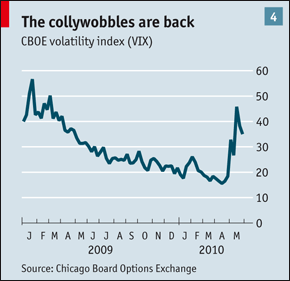
Markets are thus trying to make sense of a world in which political and regulatory risks are balanced by strong profits growth and low interest rates. No wonder they have been volatile. That is also the picture that emerges from the VIX, a measure of volatility that shows how much investors are prepared to pay to insure themselves against extreme market outcomes. After a long period of calm, the VIX has soared again (see chart 4). Investors are clearly expecting a bumpy ride.
More love for the iPad. Emails my friend Frank Derfler:
We drive about 20,000 miles a year. Yes, I bought the AT&T version. Works super with great coverage all the way across the Everglades and in the deepest reaches of Florida. Used it to pull up Interstate 75 traffic cams while approaching Tampa to see if a backup was impacting our exit.
Only drawback, this afternoon took it to the grandkids. It was productively used by grandkids 18 months, five years, eleven years, and sixteen years old. I wonder if I can get a deal on a 6-pack of iPads?? — FJD
I haven’t figure this one, yet. I fished this story out of the June issue of Fast Company magazine. I signed up this morning and am playing with it. It seems to be free. Let me know what you think.
Trading Places.
There’s an old saying on Wall Street: When you have something good, you’re not going to share it. “But you can’t develop good ideas without collaboration,” counters Howard Lindzon, CEO and cofounder of StockTwits, referring to the traders who use his social stock-picking site. “From 9:30 a.m. to 4 p.m., we’re all in the trenches together.” Lindzon’s 17-person team has spent more than a year building the Web’s most comprehensive — and accessible — virtual trading floor, letting users share ideas and data in real time without paying or registering (premium services deliver most of StockTwits’ revenue). The site, which attracts 300,000-plus unique visitors a month, has expanded to include its own news feed, user-generated charts, and Web TV channel. Here’s how it works.
1. Virtual Traders
Every day, the platform receives roughly 12,000 postings, half of which are tweets pulled in from Twitter (tagged with “$$,” or “$” preceding a ticker symbol). For example, Apple (AAPL), not surprisingly, bubbled to the top of StockTwits’ trending ticker list the first trading day after the company’s iPad debut.
2. News Junkies
StockTwits acquired the Techmeme-like news aggregator Abnormal Returns in January because it featured “the best, most-talked-about stories from the financial Web,” says curator Tadas Viskanta, who also writes big-picture commentary for the site. AR is now folded into StockTwits and includes the most clicked-on links from the StockTwits feed in real time.
3. Chart Toppers
The site also serves as a “Twitpic for financial data,” Lindzon says, hosting user-uploaded charts. In mid-February, users began posting technical analysis charts to predict when Clean Energy Fuels (CLNE) — a young and highly volatile stock — would surge. “Within three weeks, prices went from $17.50 to $22.50,” says Leigh Drogen, the site’s manager. “Everyone who invested made money.”
4. HotShots
StockTwits shares revenue with a handpicked group of expert traders who sell advice to its users. “I focus on what I’m good at: looking at markets and explaining them to people,” says Brian Shannon, founder of stock-analysis site alphatrends.net and a 17-year trading vet. More than 400 subscribers pay $59.99 a month for Shannon’s weekly Webinars and daily market-recap videos.
5. Talking Heads
“It’s like CNBC but featuring real traders instead of celebrity anchors,” Lindzon says. Longtime investor Quint Tatro, whose public portfolio was up 17% in 2009, talks market trends with roughly 3,000 viewers on his thrice-weekly Web show (Tickerville Mid-Day View). It’s one of more than 15 original programs on stocktwits.tv. “They’re available 24 hours a day,” says Lindzon, “so it keeps users engaged after market hours.”
Favorite New Yorker cartoons. The New Yorker is the only magazine I actually enjoy reading the print edition on line. They do a really good job with their own software.
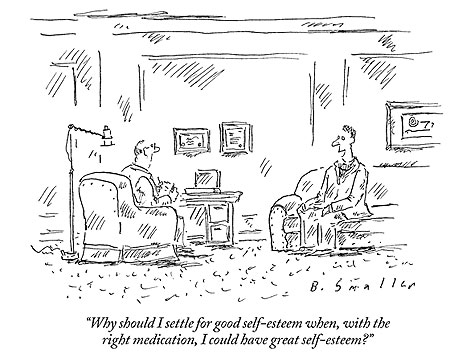
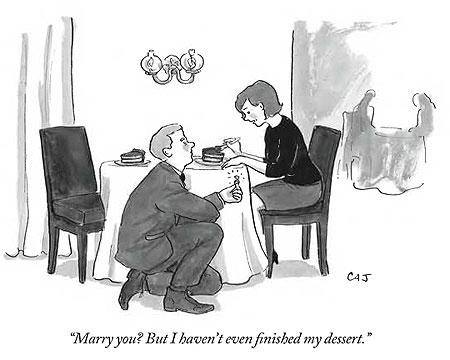

Harry Newton, who’s wondering the cost of children visits. Michael appeared for one day and two nights. He left his morning with my new backpack, a new pair of shoes, a new suit, two pricey dinners and a free ride back to the airport. Chauffeur Harry is driving. Despite all this munificence, he hesitates on the grandchild. Maybe that will take an iPad?

In Miami, the anti-foreclosure attorneys have their own Sunday afternoon call-in talk shows. Their logic is that any banks that were involved in the home loans got their money long ago from collateralized bundle deals. These attorneys argue that the whole chain of paperwork for the loan and therefore the title is flawed and that no one can prove ownership of the mortgage. It is interesting that perhaps once each show someone calls in to argue that the mortgages were moral and financial obligations and that the people living in the houses and fighting foreclosure are at least morally wrong. The attorneys do not seem to be swayed by moral arguments. It is clear that someone is getting screwed. That “someone” will certainly eventually be those few of us who are left to pay taxes.