I bought a little WAG and some more V and ADSK (see below).
Marijuana stocks have become a high-risk, popular, very speculative and very dangerous investment playground. And one I’m not touching with a ten-foot pole. They’re penny stocks, often not traded on anywhere you’ve ever heard of. They live or die on rumors, stock hype and the latest breeze from Washington. Not on financials or fundamentals. Still no one can deny the explosive growth. Rolling Stone latest issue has an excellent piece that begins:
The Great Marijuana Experiment: A Tale of Two Drug Wars
As Washington and Colorado create rules and regulations for selling legal marijuana, in many other cities across the country pot arrests are near record highs
Legal marijuana in America is now estimated to be a $1.43 billion industry. And it’s expected to grow to $2.34 billion in 2014. If those numbers hold, the 64 percent increase – a steeper trend line than global smartphone sales – would make pot one of the world’s fastest-growing business sectors.
Matt Taibbi on the yuppie prohibition league denouncing pot legalization
Signs of the new age abound. In Colorado, retail marijuana stores welcomed their first legal-age customers (21 and older) on January 1st. Washington state is expecting to license the first of its projected 334 pot shops by late spring. A Gallup poll taken last fall found that 58 percent of Americans supported legalization, a 10-point uptick from the year before. Alaska and Oregon will likely vote to go legal in 2014; California and five other states are expected to do the same in 2016. The legalizing states aren’t going in half-assed, either. Officials tasked with ramping up a marijuana regulatory system are taking to it with a tradesman’s pride. “We are going to implement Initiative 502,” says Sharon Foster, the brassy chairwoman of the Washington State Liquor Control Board, at a public hearing last fall. “This state is not going to allow it to fail.”
But these gains tend to obscure the dismal reality playing out in many other states. As Colorado and Washington license pot growers and sellers, cops elsewhere continue to carry out marijuana busts at a rate of one every 42 seconds. If you drop a gram of Sour Diesel on the sidewalk in Seattle, a police officer may help you sweep it up. Do that in New Orleans and you could face 20 years hard labor.
What we’re witnessing now is a political movement giving birth to an economic awakening. The struggle to end the War on Drugs – at heart a movement to stop the mass incarceration of black men – is creating one of the greatest business opportunities of the 21st century.
You can read the entire fascinating piece here.
Quartz recently headlined a piece, “Investing In Pot Is A Lot More Dangerous Than Smoking It:” It wrote:
One of the byproducts of Colorado’s recent decision to legalize weed has been a boom in the prices of stocks linked, however tenuously, to the marijuana industry.
A handful of smaller companies, listed on over-the-counter markets (where liquidity is thin and there are no real quality standards needed to secure a listing) and not on the more reputable NYSE or Nasdaq exchanges, have seen their share pries soar since the beginning of the year. And for no discernible reason other than the fact that marijuana is now on sale for legal recreational use in Colorado, and soon will be in Washington state.
I charted some of the marijuana stocks this morning:
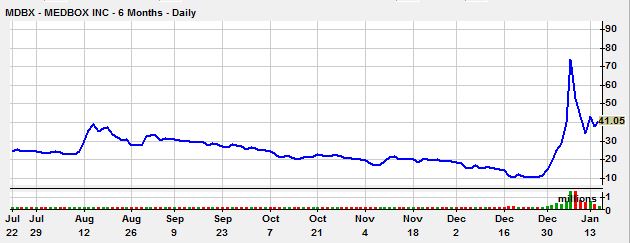

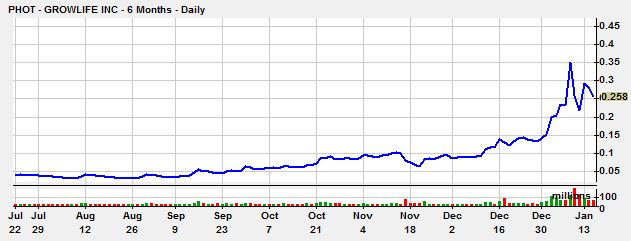



That’s enough for now on pot. My reading simple: We’ve missed the run-up, for now. Kick yourself (and me).
How my favorite “technology movement” company (ADSK) is doing.
From the latest issue of Popular Science:
The Maker King
How Carl Bass, the CEO of Autodesk, is shaping the maker movement-from his garage.
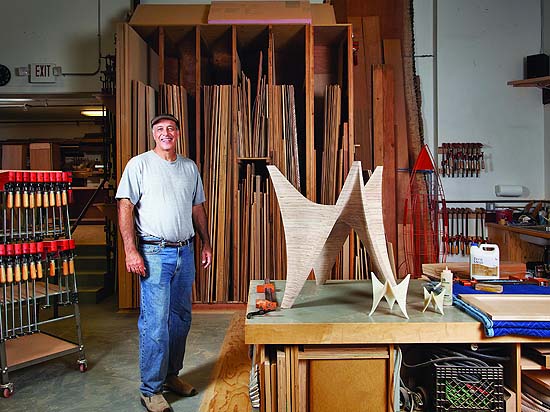
When you first meet him, Carl Bass comes off like any other weekend carpenter. Dressed in a worn T-shirt and jeans, he shakes hands with a wooden grip and has a big, brassy laugh. His workshop is a warren of lumber and hammers and idle projects. A half-built chair sits here. A sculpted Styrofoam head there.
But Carl Bass is no ordinary carpenter. He’s the CEO of Autodesk, a $10-billion company that makes AutoCAD, the standard software used by engineers to digitally design such products as cars, airplanes, and skyscrapers. And his maker space is no ordinary garage. First, it’s huge. His wood shop alone occupies 20,000 square feet-and he’s got a comparably sized metal shop down the street. Second, it’s sophisticated. 3-D printers sit among the band saws and planers. And then there’s his CNC router.
“This is my coolest thing,” Bass says, stepping to the monitor that controls it. He’s a big guy, tall and thick, but he looks small next to this machine. The Thermwood 90’s five-axis head can move anywhere within a 5′ x 10′ x 4′ space and can carve pretty much anything-a perfect orb, a model of the space shuttle or Michelangelo’s David-out of materials like plastic and plywood. The machine is incredibly complicated. It usually comes with its own instructor. “I don’t think anyone else has one for themselves,” Bass says.
Bass isn’t boasting. He has poured at least as much money into his workshop as other CEOs pour into vintage wine collections or boats, but his hobby isn’t about impressing anybody else. It’s just for him. He still spends every Saturday morning from 6 to 11 beavering away on various projects in pleasant isolation. And yet, his weekend work is having a profound effect on the maker movement.
A few years ago, Bass recognized that two powerful forces were poised to intersect: the rise of online sharing and the return to analog building in maker spaces. Up until that point, Autodesk stuck primarily to the virtual realm by developing increasingly refined CAD software. Bass saw that Autodesk could fill a crucial niche by helping everyday people bridge the gulf between digital design and physical manufacture.
The company’s first consumer product was an experiment. A team in Toronto developed a dramatically simplified modeling program, formatted it for use on mobile devices, and put it online as a free app, called Sketchbook. Within 50 days, Sketchbook had a million downloads. So the company created more products, and then a whole consumer group focused on design, personal manufacture, and home decoration. In three years, Autodesk had more than 100 million registered users across its various consumer products. Compare that with the company’s 12 million professional users, which it took more than three decades to accrue. (Harry’s bolding.)
The range of applications people found for the new products was tremendous. Louise Leakey, the famed Kenyan paleontologist, recently used 123D Catch, a web-based app that stitches snapshots into a 3-D image, to model her skull collection so others could view it online. With 123D Make, a product that allows people to modify 3-D models, fans then carved the CAD skulls into pieces that could be printed and reassembled as a puzzle. In Florida, the owners of a female duckling named Buttercup used Autodesk software to get the animal back on its feet after an amputation to correct a birth defect. They made a model of Buttercup’s good foot and printed it. After the surgery, they attached the prosthetic, so she could waddle and paddle like any of her companions.
For the entire Popular Science article, click here.
Future huge growth industry: Secure, private, anonymous dealings on the Internet. Have you noticed how your searches are following you around the Internet. Search for Ford F150, or a pair of shoes or a backpack for your computer. Every time you go anywhere else — like reading a newspaper — you’ll be plagued by ads for the truck, the shoes, or the backpack. Someone is bugging you. Not just the NSA.
Does this lack of personal privacy bother you? Apparently it bothers a lot of people. New web services are being created that return your privacy. I’m fascinated by DuckDuckGo, a new search engine that purports to “throw away” all your search history. (I heard the founder on CNBC yesterday.) Another startup is Snapchat, which kills your photographs and posting after a certain time.
Facebook, Linkedin, Google and others are intruding more and more into your privacy.
Tell your children: the next big growth area on the Internet will be companies that respect our privacy, and let us unsubscribe, remove our posted information, etc.
We buy stuff online. Excellent. Before you hit “Place Order” button, call on the phone and ask if there are any promotional discounts available. 10% here. 15% there. It all adds up.There are always discounts — if you ask.
If the banks charge you fees, ask for a refund. If they refuse, ask for the supervisor and stress how long you’ve been a client. That works.
In search of the perfect hearing aid. My hearing is perfect for ignoring people I don’t want to hear. But not good for hearing stuff I want to hear — like at restaurants. Conventional hearing aids have two disadvantages: First, they’re pricey — often as much as $6,000 for two. Second, they amplify everything, which is often worse than doing nothing.
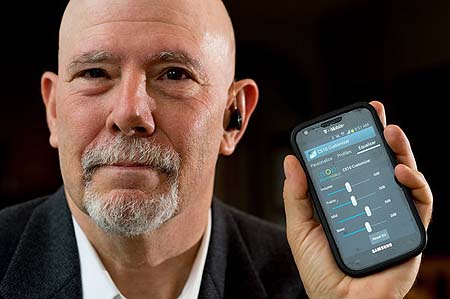
Something new is out: a PSAP — personal sound amplifier product. They’re cheaper (a few hundred dollars) and don’t require a long, boring visit to an audiologist. I just ordered one CS10 for my left ear. The thing is programmable via Bluetooth. See picture below. Price: $270 after discount FBFRIEND10. Click here. To read where I got the idea from, go to the New York Times latest piece on this ultra-boring subject, called Better Hearing Through Bluetooth.
For the full Times, piece, click here.
You’ll love this performance. Embroiled in multiple political scandals, New Jersey Gov. Chris Christie (and a front runner for GOP presidency) has just received his harshest rebuke yet, courtesy of the Garden State’s real boss, Bruce Springsteen.
Christie — a Republican — is a major Springsteen fan, noting that he cried last year when the liberal rock legend, who regularly campaigns for Democratic candidates, finally acknowledged him in the wake of Superstorm Sandy. The two men hugged at the time, but that embrace is now ancient history after seeing Springsteen’s latest appearance on Late Night With Jimmy Fallon.
The host and the rocker both donned Springsteen’s signature Born in the USA-era outfit (complete with bandana, jeans, and a cut-off shirt) to play a modified version of the classic song “Born to Run” — with a dash of “Jungleland” at the end — reworked and titled, “Gov. Christie Traffic Jam.” The lyrics reflect the George Washington Bridge lane closures that were allegedly Christie’s form of payback after the Mayor of Fort Lee, N.J. refused to endorse his re-election bid — retribution that Christie denies knowing about.
Seems the Boss doesn’t buy it.
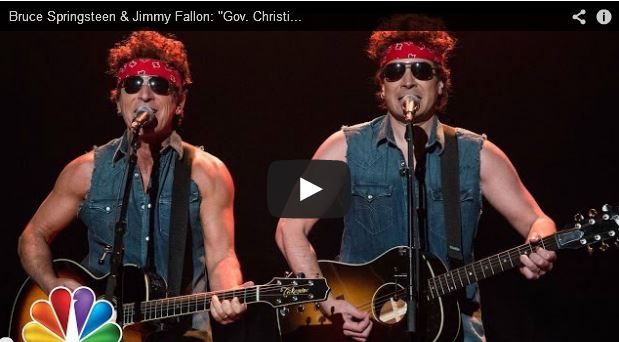
The video is on Buzzfeed. Click here.

Harry Newton who’s happy to report that Eleanor, two months young, is now 10 lbs 14 ounces and 23 inches long. She’s growing like a weed. Best: She’s healthy.

“Gov. Chris Christie (and a front runner for GOP presidency)” A GOP Front Runner ONLY in the mind of Liberals. Christie is who the NYT would LIKE to run against!
As a Washington resident I recommend not investing in “Green” at all.
Betting on a crop that the Fed can take at any time is a bad idea.
Harry, Rachel Maddow has an alternate analysis on the Bridge Scandal:
http://thenewcivilrightsmovement.com/fascinating-rachel-maddows-deep-investigation-offers-most-plausible-bridgegate-explanation/politics/2014/01/10/81505#.Utgw7_ZcRFS
10 lbs at age 2 months is undersized.
Just because you are a fat troll does not mean being lean is a bad thing for a two month old baby, Cliff. FYI: The stats that Harry listed are average for babies in the US, placing Eleanor in the 50th percentile. You are just a piece of work…and that’s not a compliment.
The average weight for a baby that age of 23 inches is 12 lb 56 ounces. I’m looking at the chart, Mile High. Sounds iike you’ve been smoking too much recreational marijuana. What’s it like living in a station that’s a national laughing stock?
12 lbs 5 ounces. At the size of Harry’s great granddaugher, she could be carried off by dingoes.
ADSK insider selling is a concern, however still admirer of Bass.
Harry, choose Cyber Dust over Snapchat ;0