I did warn you on this one. Best Buy remains a place singularly lacking in inventory, singularly lacking in employee knowledge and singularly lacking in competitive prices.
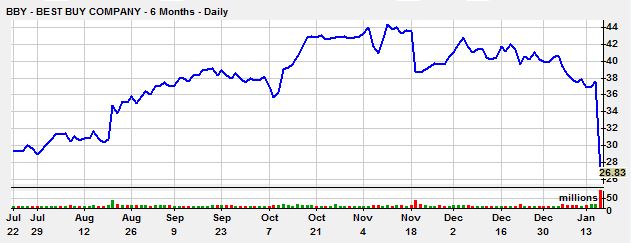
Cramer had a take on BBY last night. His take was all about one Wall Street analyst convincing the next one who convinced the next one that the Best Buy recovery was for real. They all joined the bandwagon. If they were all on it, they were all right… But they weren’t. They were all living in their own fantasy world.
As Cramer reported, they sucked in every analyst until there was no analyst left who hadn’t upgraded the stock. There were 15 upgrades in Best Buy in the last year.
The stock was “too loved.”
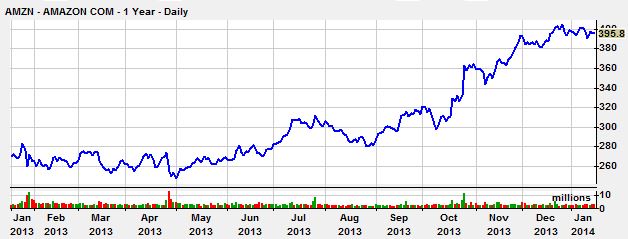
My take: Singularly lacking. (See above.) People are still “showrooming” hey check BestBuy’s prices, then shop an online store or Amazon, which, I bet, had a sterling Christmas selling season.
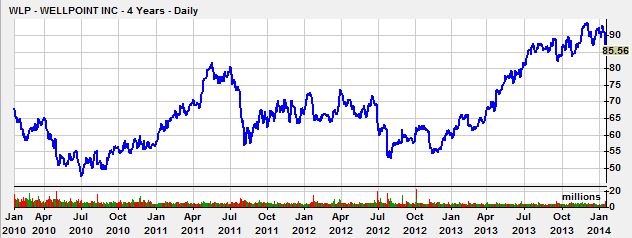
Cramer highlighted the same phenom a few years ago with Wellpoint. See the drop in 2011. But the chart he showed last night was misleading. He forgot to mention the stock has more than recovered. I’m dubious that that will happen with Best Buy.
How could I have ignored HAIN? Am I an idiot or what?
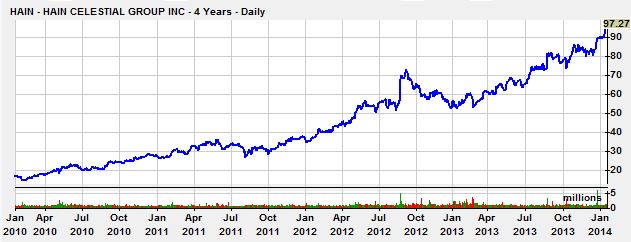
Is it too late? P/E is 37.1. That’s high. But there’s still plenty of buzz. Maybe, jump in. Watch carefully. Dump if it starts to turn seriously down.
Is Nike turning “seriously down?”
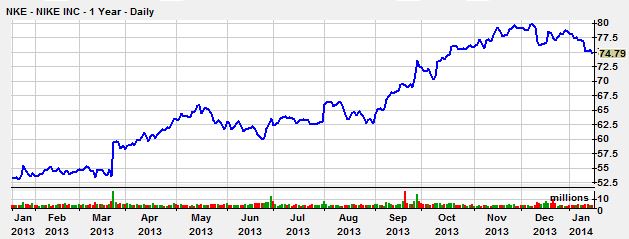
It’s down nearly 7% from its 52-week high. I’ll wait for 9%, then dump it. P/E is a high 23.9.
Harry’s lesson remains: Dump stocks that are no longer working. That’s also called Harry’s Inviolate Stop Loss Rule. The logic? You don’t know what’s going on with the company. You can always get back in. These days, you can buy $100,000 of stock for $8. And if you’re good, you can always beg free trades out of your favorite on-line broker if you transfer some more money in.
Today’s Economist has a big report on Tech Startups. It begins:
ABOUT 540M YEARS ago something amazing happened on planet Earth: life forms began to multiply, leading to what is known as the “Cambrian explosion”. Until then sponges and other simple creatures had the planet largely to themselves, but within a few million years the animal kingdom became much more varied.
This special report will argue that something similar is now happening in the virtual realm: an entrepreneurial explosion. Digital startups are bubbling up in an astonishing variety of services and products, penetrating every nook and cranny of the economy. They are reshaping entire industries and even changing the very notion of the firm. “Software is eating the world,” says Marc Andreessen, a Silicon Valley venture capitalist.
This digital feeding frenzy has given rise to a global movement. Most big cities, from Berlin and London to Singapore and Amman, now have a sizeable startup colony (“ecosystem”). Between them they are home to hundreds of startup schools (“accelerators”) and thousands of co-working spaces where caffeinated folk in their 20s and 30s toil hunched over their laptops. All these ecosystems are highly interconnected, which explains why internet entrepreneurs are a global crowd. Like medieval journeymen, they travel from city to city, laptop not hammer in hand. A few of them spend a semester with “Unreasonable at Sea”, an accelerator on a boat which cruises the world while its passengers code. “Anyone who writes code can become an entrepreneur-anywhere in the world,” says Simon Levene, a venture capitalist in London.
Here we go again, you may think: yet another dotcom bubble that is bound to pop. Indeed, the number of pure software startups may have peaked already. And many new offerings are simply iterations on existing ones. Nobody really needs yet another photo-sharing app, just as nobody needed another site for pet paraphernalia in the first internet boom in the late 1990s. The danger is that once again too much money is being pumped into startups, warns Mr Andreessen, who as co-founder of Netscape saw the bubble from close by: “When things popped last time it took ten years to reset the psychology.” And even without another internet bust, more than 90% of startups will crash and burn.
But this time is also different, in an important way. Today’s entrepreneurial boom is based on more solid foundations than the 1990s internet bubble, which makes it more likely to continue for the foreseeable future. One explanation for the Cambrian explosion of 540m years ago is that at that time the basic building blocks of life had just been perfected, allowing more complex organisms to be assembled more rapidly. Similarly, the basic building blocks for digital services and products-the “technologies of startup production”, in the words of Josh Lerner of Harvard Business School-have become so evolved, cheap and ubiquitous that they can be easily combined and recombined.
Some of these building blocks are snippets of code that can be copied free from the internet, along with easy-to-learn programming frameworks (such as Ruby on Rails). Others are services for finding developers (eLance, oDesk), sharing code (GitHub) and testing usability (UserTesting.com). Yet others are “application programming interfaces” (APIs), digital plugs that are multiplying rapidly (see chart 1). They allow one service to use another, for instance voice calls (Twilio), maps (Google) and payments (PayPal). The most important are “platforms”-services that can host startups’ offerings (Amazon’s cloud computing), distribute them (Apple’s App Store) and market them (Facebook, Twitter). And then there is the internet, the mother of all platforms, which is now fast, universal and wireless.
Startups are best thought of as experiments on top of such platforms, testing what can be automated in business and other walks of life. Some will work out, many will not. Hal Varian, Google’s chief economist, calls this “combinatorial innovation”. In a way, these startups are doing what humans have always done: apply known techniques to new problems. The late Claude Lévi-Strauss, a French anthropologist, described the process as bricolage (tinkering).
Technology has fuelled the entrepreneurial explosion in other ways, too. Many consumers have got used to trying innovative services from firms with strange names (which, unavoidably, will abound in this special report). And thanks to the web, information about how to do a startup has become more accessible and more uniform. Global standards are emerging for all things startup, from programming tools to term sheets for investments, dress code and vocabulary, making it easy for entrepreneurs and developers to move around the world.
Private communications no one can listen in on. I’m obsessed with this new area — not because I plan or do naughty things. But because it’s a huge business opportunity. Yesterday I wrote how everyone was being freaked out by NSA surveillance, ads following you around the Internet and the increasing intrusion into your life of services like Facebook, Twitter and LinkedIn. Further the impossibility of deleting stuff you posted years ago could seriously impede your career now.
It’s called security technology. A piece on TechCrunch concludes:
The more mainstream security technology can become, and the more average Joes who can be encouraged to use locked-down products, the greater the chance for everyone’s privacy to survive the onslaught from overreaching governments.
The full article reads:
Silent Circle & Geeksphone Join Forces To Build Blackphone: A Pro-Privacy Android-Based Smartphone
As the reality of the extent and invasiveness of the security services’ dragnet surveillance programs hits home, the pro-privacy movement has been cranking up its own ideas to counter spy-tech with pro-privacy tech. The Lavabit founder’s recent Kickstarter for a secure end-to-end open source encrypted email project called Dark Mail is one example.
Today, here’s another: meet Blackphone, a smartphone that’s been designed to enable secure, encrypted communications, private browsing and secure file-sharing.
The project is a joint venture between Silent Circle – which shuttered its own encrypted email service last summer in order to preemptively avoid having to comply with government requests to provide data – and Spanish smartphone startup Geeksphone, which has previously made more standard Android handsets, and more recently has been building phone hardware for Mozilla’s open web standards HTML5-based Firefox OS.
The pair said today they have established a new Switzerland-based joint venture to collaborate on technology projects, with Blackphone set to be the inaugural product. They describe the phone as “the world’s first smartphone placing privacy and control directly in the hands of its users”.
Despite that grand claim, Blackphone is by no means the first encrypted smartphone. For example, back in September TC’s John Biggs and I paid a visit to a German based secure phone maker, GSMK Cryptophone, which has been in the encrypted telephony business for 10 years.
Another recent project to build a phone designed with security, encryption and identity protection in mind is the Quasar IV, which is using a hybrid Android/Linux and Quatrix mobile OS called QuaOS as the foundation for secure telephony.
But while Blackphone is not the only secure phone game in town, there’s no doubt that last year’s revelations about security agencies’ consumer electronics and services powered data-harvesting habits – revealed by NSA whistleblower Edward Snowden – have accelerated interest in security and privacy. The fallout from Snowden’s big reveal is clearly attracting new players to what could potentially become a much more mainstream space.
Hence, presumably, the Blackphone makers’ reasoning about now being the right time to build a pro-privacy phone that doesn’t carry the stench of security geek. The tone and nomenclature of their announcement very much feels targeted at a mainstream smartphone user, not a security specialist.
Their press release includes a statement from Phil Zimmermann, the creator of PGP, who is also involved in the project, which sets this tone.
“I have spent my whole career working towards the launch of secure telephony products,” he says. “Blackphone provides users with everything they need to ensure privacy and control of their communications, along with all the other high-end smartphone features they have come to expect.”
Blackphone’s website is also light on deep-dive security terminology which could alienate an average phone buyer. Instead there’s a slick marketing video and explainer text that takes a broad-brushstrokes approach to fleshing out the device.
Using the Blackphone is described as “the trustworthy precaution any connected worker should take, whether you’re talking to your family or exchanging notes on your latest merger & acquisition”.
The site goes on to add:
Blackphone is unlocked and works with any GSM carrier. Performance benchmarks put it among the top performers from any manufacturer.
It has the features necessary to do all the things you need, as well as all the things you want, while maintaining your privacy and security and giving you the freedom to choose your carrier, your apps, and your location.
The tools installed on Blackphone give you everything you need to take ownership of your mobile presence and digital footprints, and ensure nobody else can watch you without your knowledge.
You can make and receive secure phone calls; exchange secure texts; exchange and store secure files; have secure video chat; browse privately; and anonymize your activity through a VPN.
Details of Blackphone’s pro-privacy feature-set are relatively scant at this point, perhaps because they want to avoid it feeling too complex, but they do say it is being built atop a “security-oriented” Android build called PrivatOS.
Blackphone is due to be previewed at the Mobile World Congress tradeshow in Barcelona next month where the JV will also be taking pre-orders. There’s no word on exactly when the phone will ship to buyers, as yet.
It’s worth noting that making an encrypted phone call – or sending an encrypted email – requires the use of two encrypted devices/clients: both your own phone/email client and the phone/email client of the person you’re talking to. So the Blackphone’s security credentials will inevitably depend on how you use the device – who you place calls to and which device they use; who you email and which email client they use; and so on.
However, as with the Dark Mail initiative, the more encrypted products that are out in the market, the greater the number of secure channels that can be used for communications.
So the more mainstream security technology can become, and the more average Joes who can be encouraged to use locked-down products, the greater the chance for everyone’s privacy to survive the onslaught from overreaching governments.
You can read the full piece and see the video here.
How I reward myself. When my partner Gerry Friesen and I would finish a great one-day seminar in a distant city, we’d go out for our reward — a chocolate milkshake in the hotel’s coffee shop. I can’t do chocolate milkshakes any longer, but the “reward” theory for good work lingers on. These days I “reward” myself with on-line buys. I get a triple reward. First, when I shop on-line. Second, when the stuff arrives. Third, when I return it. My favorite “buys” (which I keep) have been Uniqlo’s ultra-light weight down parkas. They’re unbelievably well-made, warm as toast and roll up into the tiniest of packages — great for traveling. Here’s my latest buy.

On sale today at $59.90. Click here.
Should I buy my kids and their spouses one? I will, if they read this column, and beg. “Please Harry Daddy, buy me a red ultra light down parka from Uniqlo.”
Tim Whyatt is Australia’s Gary Larson.
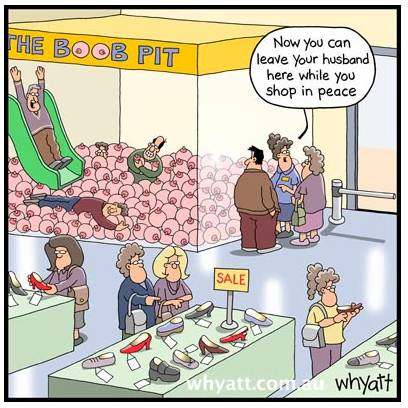


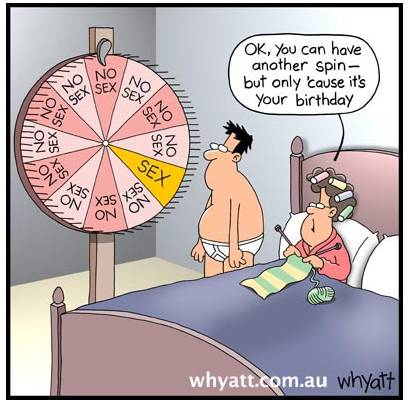


The Australian Tennis Open is on ESPN2 and The Tennis Channel. They make it all look so easy. It’s not. Trust me. It’s not. Tennis is a running game. Being young helps.

Harry Newton who warns you about opening emails that reward you for being a Walmart Survey Winner, a coupon winner from Dunkin Donuts, or my JCPenny’s Shopping soon expires, or a discount coupon from Target. They contain links to sites that have viruses and malware, or they contain viruses and malware in an accompanying attachment. A spate of these bad emails appeared just after news of Target’s problems. Stay away from them. Delete them instantly, if not sooner.
Have a great weekend. I will. I’ll be as snug as bug (or something) in my new red Uniqlo parka, which Susan actually likes. Miracles happen.

Certainly agree with you that “Don’t Bug Me’ services will become hugely important. Phil Zimmermann is a fascinating ball carrier. He seems to have incredible sense of when to dodge and when to plunge. I’d follow him. He was part of an excellent Science Friday program on encryption. Podcast version, it’s not very long, is here: http://www.sciencefriday.com/segment/10/04/2013/cracking-open-encryption-standards.html
Interesting: Dell, a company named as cooperating with the NSA by Snowden — they make/made servers with easy-to-hack firmware — has invested a few bucks ($16M) in a software security company that ideally would catch the hacks. The circular logic and possibilities warp my little mind. http://blogs.wsj.com/cio/2013/12/16/dell-invests-in-zero-day-security-startup-invincea/
Great call on BestBuy. Remember though, you also were singing praises for Bed, Bath, and Beyond around the same time that you were hammering BestBuy in your columns and I mentioned they essentially have the same problem. Both are down huge this quarter. Anyway, hilarious cartoons, thanks for sharing. Did you read the Bloomberg article on the guy who uses quant models to gamble on tennis? Fascinating.
Have a good weekend