This is insane. Suddenly I’m overlwhemed. I’m continue to be intrigued with writing covered calls. Their big appeal to my brain is they give you the ability to manage your stocks. I’ll explain more with an example tomorrow.
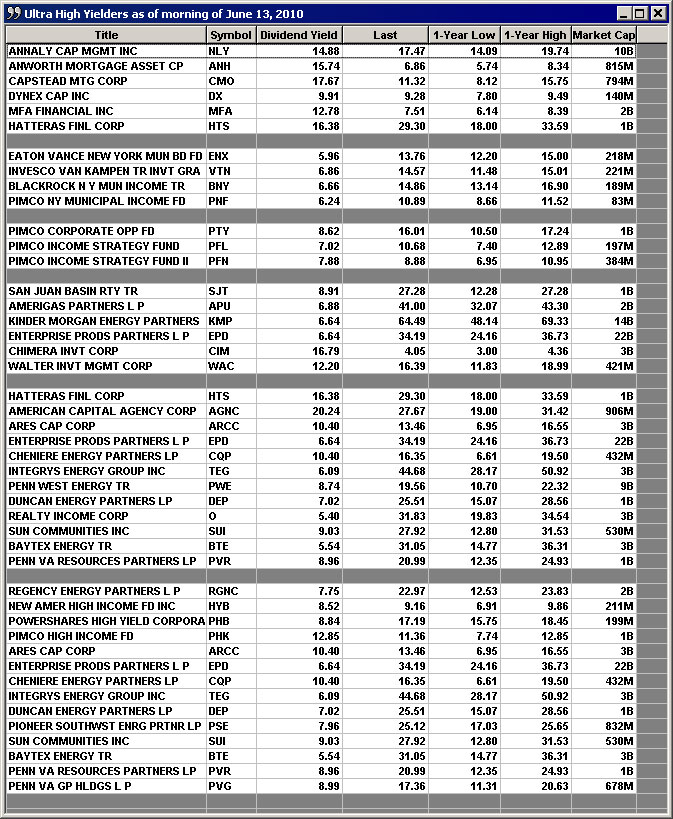
I continue to be fascinated with high-yielders. Here’s Friday’s chart updated:
I’m reading “Stocks, Options and Collars” an excellent book by Jay L. Lord of Random Walk Trading. I’ll have a review on it when I’m done.
Now here’s a REAL reason to own Apple stock. After Friday’s “busted” iPad story, Apple people emailed, then called and the upshot is they’re sending me a brand-new, fully tested iPad. My original birthday one is going back to Cupertino for analysis.
In 35 years of writing about technology, Apple is among of handful of companies who actually read a piece of mine and reached out.
Most tech companies don’t give two hoots about writers or what they say.
Apple cares. That’s to their enormous credit. Look at Apple’s stock. Look at Microsoft’s. Look at all the nasty things I’ve written about Microsoft in recent years. Not a peep out of them.
Apple runs its company the way I would — caring for its customers (and poor, suffering technology writers.)
Apple stock. $300, here we come.

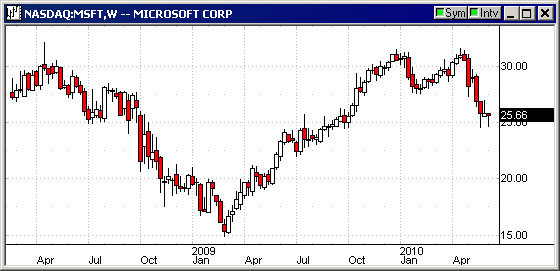
Business Insider quotes a former high level Microsoft employee as saying the company has two problems: The management style is all screwed up, and there’s just too many people working there.
Microsoft has over 92,000 employees today, up from 31,000 at the start of the decade. Read Business Insider here.
What Microsoft does will those people beats me. I played around with Windows 7 a bit on the weekend. There’s enough annoying about it to drive me bonkas. But I’m still fiddling. Initial conclusion: too much work to get it working the way you like. Stick with XP for now.
The Spill, The Scandal and the President. that’s the title of the latest Rolling Stone article. It is “The inside story of how Obama failed to crack down on the corruption of the Bush years – and let the world’s most dangerous oil company get away with murder.“
Some paragraphs from this horrifying article:
+ The median figure for Crone’s independent calculations is 55,000 barrels a day – the equivalent of an Exxon Valdez every five days. “That’s what the plume team’s numbers show too,” Crone says. A source privy to internal discussions at one of the world’s top oil companies confirms that the industry privately agrees with such estimates. (Timothy Crone is a marine geophysicist at Columbia University who has consulted with the government’s team.) … That’s accurate – if not more than that.” The reason, he adds, is that BP appears to have unleashed one of the 10 most productive wells in the Gulf. “BP screwed up a really big, big find,” the source says. “And if they can’t cap this, it’s not going to blow itself out anytime soon.”
+ Most troubling of all, the government has allowed BP to continue deep-sea production at its Atlantis rig – one of the world’s largest oil platforms. Capable of drawing 200,000 barrels a day from the seafloor, Atlantis is located only 150 miles off the coast of Louisiana, in waters nearly 2,000 feet deeper than BP drilled at Deepwater Horizon. According to congressional documents, the platform lacks required engineering certification for as much as 90 percent of its subsea components – a flaw that internal BP documents reveal could lead to “catastrophic” errors. In a May 19th letter to Salazar, 26 congressmen called for the rig to be shut down immediately. “We are very concerned,” they wrote, “that the tragedy at Deepwater Horizon could foreshadow an accident at BP Atlantis.”
+ During the Bush years, the Minerals Management Service, the agency in the Interior Department charged with safeguarding the environment from the ravages of drilling, descended into rank criminality. According to reports by Interior’s inspector general, MMS staffers were both literally and figuratively in bed with the oil industry. When agency staffers weren’t joining industry employees for coke parties or trips to corporate ski chalets, they were having sex with oil-company officials.
+ Ken Salazar took over Interior in January 2009, vowing to restore the department’s “respect for scientific integrity.” He immediately traveled to MMS headquarters outside Denver and delivered a beat-down to staffers for their “blatant and criminal conflicts of interest and self-dealing” that had “set one of the worst examples of corruption and abuse in government.” Promising to “set the standard for reform,” Salazar declared, “The American people will know the Minerals Management Service as a defender of the taxpayer. You are the ones who will make special interests play by the rules.” Dressed in his trademark Stetson and bolo tie, Salazar boldly proclaimed, “There’s a new sheriff in town.”
+ Salazar did little to tamp down on the lawlessness at MMS, beyond referring a few employees for criminal prosecution and ending a Bush-era program that allowed oil companies to make their “royalty” payments – the amount they owe taxpayers for extracting a scarce public resource – not in cash but in crude. And instead of putting the brakes on new offshore drilling, Salazar immediately throttled it up to record levels. Even though he had scrapped the Bush plan, Salazar put 53 million offshore acres up for lease in the Gulf in his first year alone – an all-time high. The aggressive leasing came as no surprise, given Salazar’s track record. “This guy has a long, long history of promoting offshore oil drilling – that’s his thing,” says Kierán Suckling, executive director of the Center for Biological Diversity. “He’s got a highly specific soft spot for offshore oil drilling.” As a senator, Salazar not only steered passage of the Gulf of Mexico Energy Security Act, which opened 8 million acres in the Gulf to drilling, he even criticized President Bush for not forcing oil companies to develop existing leases faster.
Salazar was far less aggressive, however, when it came to making good on his promise to fix MMS. Though he criticized the actions of “a few rotten apples” at the agency, he left long-serving lackeys of the oil industry in charge. “The people that are ethically challenged are the career managers, the people who come up through the ranks,” says a marine biologist who left the agency over the way science was tampered with by top officials. “In order to get promoted at MMS, you better get invested in this pro-development oil culture.” One of the Bush-era managers whom Salazar left in place was John Goll, the agency’s director for Alaska. Shortly after, the Interior secretary announced a reorganization of MMS in the wake of the Gulf disaster, Goll called a staff meeting and served cake decorated with the words “Drill, baby, drill.”
Salazar also failed to remove Chris Oynes, a top MMS official who had been a central figure in a multibillion-dollar scandal that Interior’s inspector general called “a jaw-dropping example of bureaucratic bungling.” In the 1990s, industry lobbyists secured a sweetheart subsidy from Congress: Drillers would pay no royalties on oil extracted in deep water until prices rose above $28 a barrel. But this tripwire was conveniently omitted in Gulf leases overseen by Oynes – a mistake that will let the oil giants pocket as much as $53 billion. Instead of being fired for this fuckup, however, Oynes was promoted by Bush to become associate director for offshore drilling – a position he kept under Salazar until the Gulf disaster hit.
“Employees describe being in Interior – not just MMS, but the other agencies – as the third Bush term,” says Jeff Ruch, executive director of Public Employees for Environmental Responsibility, which represents federal whistle-blowers. “They’re working for the same managers who are implementing the same policies. Why would you expect a different result?”
+ On April 6th of last year, less than a month after BP submitted its application, MMS gave the oil giant the go-ahead to drill in the Gulf without a comprehensive environmental review. The one-page approval put no restrictions on BP, issuing only a mild suggestion that would prove prescient: “Exercise caution while drilling due to indications of shallow gas.”
+ BP is the last oil company on Earth that Salazar and MMS should have allowed to regulate itself. The firm is implicated in each of the worst oil disasters in American history, dating back to the Exxon Valdez in 1989. At the time, BP directed the industry consortium that bungled the cleanup response to Valdez during the fateful early hours of the spill, when the worst of the damage occurred. Vital equipment was buried under snow, no cleanup ship was standing by and no containment barge was available to collect skimmed oil. Exxon, quickly recognizing what still seems to elude the Obama administration, quickly shunted BP aside and took control of the spill.
In March 2006, BP was responsible for an Alaska pipeline rupture that spilled more than 250,000 gallons of crude into Prudhoe Bay – at the time, a spill second in size only to the Valdez disaster. Investigators found that BP had repeatedly ignored internal warnings about corrosion brought about by “draconian” cost cutting. The company got off cheap in the spill: While the EPA recommended slapping the firm with as much as $672 million in fines, the Bush administration allowed it to settle for just $20 million.
BP has also cut corners at the expense of its own workers. In 2005, 15 workers were killed and 170 injured after a tower filled with gasoline exploded at a BP refinery in Texas. Investigators found that the company had flouted its own safety procedures and illegally shut off a warning system before the blast. An internal cost-benefit analysis conducted by BP – explicitly based on the children’s tale The Three Little Pigs – revealed that the oil giant had considered making buildings at the refinery blast-resistant to protect its workers (the pigs) from an explosion (the wolf). BP knew lives were on the line: “If the wolf blows down the house, the piggy is gobbled.” But the company determined it would be cheaper to simply pay off the families of dead pigs.
After the blast, BP pleaded guilty to a felony, paying $50 million to settle a criminal investigation and another $21 million for violating federal safety laws. But the fines failed to force BP to change its ways. In October, Labor Secretary Hilda Solis hit the company with a proposed $87 million in new fines – the highest in history – for continued safety violations at the same facility. Since 2007, according to analysis by the Center for Public Integrity, BP has received 760 citations for “egregious and willful” safety violations – those “committed with plain indifference to or intentional disregard for employee safety and health.” The rest of the oil industry combined has received a total of one.
+ Obama and Salazar appeared together at Andrews Air Force Base on March 31st to introduce the plan. The stagecraft was pure Rove in its technicolor militaristic patriotism. The president’s podium was set up in front of the cockpit of an F-18, flanked by a massive American flag. “We are not here to do what is easy,” Salazar declared. “We are here to do what is right.” He insisted that his reforms at MMS were working: “We are making decisions based on sound information and sound science.” The president, for his part, praised Salazar as “one of the finest secretaries of Interior we’ve ever had” and stressed that his administration had studied the drilling plan for more than a year. “This is not a decision that I’ve made lightly,” he said. Two days later, he issued an even more sweeping assurance. “It turns out, by the way, that oil rigs today generally don’t cause spills,” the president said. “They are technologically very advanced.”
Eighteen days later, on the eve of the 40th anniversary of Earth Day, the Deepwater Horizon rig went off like a bomb.
+ The failure of the obama administration to crack down on BP – and to tackle the crisis with the full force of the federal government – is likely to haunt the Gulf Coast for decades to come. Oil continues to lap up onshore in Louisiana, Alabama, Mississippi and Florida. Pelican rookeries are fouled, their eggs and nests soaked in oil. The region’s fisheries – some of the richest in the world – are imperiled; anglers and shrimpers have been barred from more than a third of the Gulf’s waters, which may never fully recover from the toxic stew of crude and chemical dispersant now twisting in its depths. The region’s beaches are empty, and tourist towns are dying. Administration officials now admit that the oil may continue to gush into the Gulf until August, when relief wells are finally in place.
Both the government and BP have reasons to downplay the extent of the spill. For BP, the motive is financial: Under the Clean Water Act, the company could owe fines of as much as $4,300 for every barrel spilled, in addition to royalties for the oil it is squandering. For the Obama administration, the disaster threatens to derail the president’s plan to expand offshore drilling. “It’s crystal clear what the federal response to the tragedy ought to be,” said Sen. Frank Lautenberg, who chairs the Senate subcommittee on environmental health. “Bring a dangerous offshore drilling pursuit to an end.”
The administration, however, has made clear that it has no intention of reversing its plan to expand offshore drilling. Four weeks into the BP disaster, when Salazar was questioned in a Senate hearing about the future of the president’s plan, he was happy to stand up for the industry’s desire to drill at any cost. “Isn’t it true,” asked Sen. Lamar Alexander, a Republican from Tennessee, “that as terrible as the tragedy is, that unless we want $14, $16, $18, $20-a-gallon gasoline, that it’s not realistic to think that we would actually stop drilling for oil in the Gulf?” Unbowed by the catastrophe that was still unfolding on his watch, Salazar heartily agreed, testifying that the president had directed him to “move forward” on offshore drilling.
That may help explain why the administration has gone to unusual lengths to contain the spill’s political fallout. On May 14th, two days after the first video of the gusher was released, the government allowed BP to apply a toxic dispersant that is banned in England at the source of the leak – an unprecedented practice in the deep ocean. “The effort should be in recovering the oil, not making it more difficult to recover by dispersing it,” says Sylvia Earle, a famed oceanographer and former NOAA chief scientist who helped the agency confront the world’s worst-ever oil spill in the Persian Gulf after the first Iraq War. The chemical assault appeared geared, she says, “to improving the appearance of the problem rather than solving the problem.”
If you want to be really depressed about Obama and BP, read the entire Rolling Stone article.
You always wanted one. It’s called a face-down portable chaise. It’s only $99.50, model not included.

Allah and the virgins.
An 18-year-old suicide bomber blew himself up and appeared before Allah.
He said, “Oh, Allah, I did your bidding, but I have a request. Since I’m only 18 and spent all my time in terrorist training school, I never was with a woman. So, instead of 72 virgins, who also won’t know what to do sexually, can I have 72 whores?”
Allah regarded him for a moment, then replied, “Actually, the 72 virgins are here in heaven because arseholes like you murdered them before they could experience the pleasure of sex. So ‘you’re’ here to service ‘them.’ Since they’re virgins, they’re quite sexually ravenous; and, frankly, you’ll be on constant, exhausting duty.”
The bomber responded, “Well, I guess I can live with that. How hard can it be to keep 72 women satisfied for all eternity?”
Allah replied, “Who said they were women?”

Harry Newton,who turned 68 last week. For some reason this number 68 has freaked me out more than any other birthday. I wonder what I will do with the rest of my life — trying to learn investing (semi-futile), improving my tennis game (semi-futile), helping the kids achieve their goals (to their credit, they listen), and not freaking out over all my friends who are being diagnosed with horrible life-threatening diseases. When my father reached 50, he told me that before he was 50 he did things for the first time. Now he was 50, he was doing things for the last time. I don’t relish this mentality. Susan is being sympathetic, but maintains I worry too much. “I can’t all this depressing stuff — like the economy and the Gulf oil spill — life’s too short. Let’s go have some fun.” And why not?

RE: Macs and Windows PCs
My MacBook Pro is the best Windows machine I have ever owned. When I bought it Mac versions of all my Windows apps were not available so I used Boot Camp to load XP and my Windows apps. I never bothered to replace the Windows apps because they work so well now — much better than on a PC. I almost never reboot it, Windows never crashes, etc. I used to be in the semiconductor business and from first-hand experience know why Mac's are so much better Windows machines than PCs.
RE: call options
I have made a fair amount of money selling covered calls the past few years. I take a conservative approach if I am writing calls on stocks I want to keep: I only write calls at strike prices above my cost basis; I do not select strike prices too close the current price (A couple of times I got too aggressive (i.e. greedy) and had shares I wanted to keep assigned); I only close a position before the contracts expires if the premium is almost $0 and if I can replace it with a higher premium contract. It's not a very sophisticated approach, but it takes very little time and I make money with no risk. Of course, good premiums come and go so I haven't been able to turn covered calls into a monthly income, but I have been able to make a couple of percent per year on the stocks I am holding.
check out this blog: http://blog.mdwoptions.com/options_for_rookies/
Everyone has their milestone birthday number resulting in lots of inner reflection–good for the soul. But don't dwell too long – life goes on!
wonder if Ballmer is a closet bureaucrat hankering to run an oversized, unwieldy government?
I have no idea what Ballmer wants to run. I do know that there's an old rule in investing: When the founder leaves, sell the stock. Would have worked with Microsoft.
Harry, do you think I would get the same servcie from Apple if I did not have a blog?
Yes, I suspect you might. I've heard really good stories about Apple's exemplary service.
Harry,
I'm a experienced computer user like yourself and I think Win 7 is terrible too. That is unless you use it right out of the box, send email using MS software, and never try to incorporate another single piece of software that is not written by MS.
I run several personal websites using MS FrontPage and have for years. It won't work at all with Win 7. The MS replacepent for Frontpage, Web Expressions is a waste too, so that ends that program. I'll just run FrontPage on an XP machine for as long as I can.
I guess I could move to Apple and start over from scratch. At 66…it's not going to happen.
Mike
Harry, “High yielders”, puts and calls!? You sound bored and seeking action. What happened to when in doubt stay out? High yielders sound to good to be true don't they? Buying and selling puts and calls has been a famously losing proposition. You're reading a book! You'll be competing against sharks who have done this daily for decades, have infinite resources, advance information and mega-super-computers. When there's nothing to do, do nothing.
Vincent
I'm not denying anything you say. “When in doubt, stay out” is a good mantra. I can't write that everyday, though. That would give boredom a whole new meaning.
Hi Harry,
Here are my latest calculations for you on the Gulf Oil Spill
On June 11,2010 :
1,760,000 1.76 million barrels of oil spilled
42 1 barrel = 42 US gallons of oil
73,920,000 Gallons of oil to date
8,000,000 Gallons of water contaminated by 1gal oil
591,360,000,000,000 Gallons of contaminated water to date
64,300,000,000,000 1 percent of Gulf water
9.19688958 Percent contamination as of June 11, 2010
For each passing day after June 11, the contamination rate increases by 0.176623998%
This does not mean 100% of Gulf waters are 9.19688958% contaminated
but rather 9.19688958% of Gulf waters are 100 percent contaminated.
The contamination is not spread over the entire Gulf of Mexico waters.
The ten percent contamination is densely concentrated along the coasts of Louisiana, Mississippi, Alabama, and west Florida.