In 2005-2007 the world was a glowing place. Investors had come off a couple of years of extraordinary gains. Whatever they had touched turned to gold. the world was bursting with opportunities. It was a once in a life time opportunity to get rich beyond their wildest imaginations. Hence many otherwise sane people dumped their caution and went at it, borrowing to the hilt.
By 2008, things started to fall apart. By 2009, it had all fallen apart. To repay the loans, to meet their commitments, they sold their best investments. Some sold their houses, cut their lifestyle, putting their kids (God forbid) into public schools. Some actually went bankrupt.
The biggest problem was their illiquid investments — stuff like commitments to private equity funds, or real estate for which there was no market.
Slowly, ever so slowly, this stuff is percolating into today’s market. By now, the stuff should be an absolute bargain. But most of it is not — chiefly as a result of what I called The Egypt Syndrome. Which comes from Denial. Denial.
Vast amounts of free money are still floating around, creating the impression among many sellers that happy days are here again. For those of us actively looking for bargains, this is supremely annoying.
What’s the solution?
Patience. Patience. Patience.
Bargains are around. I promise you. I’ve seen them. I’ve seen real estate at half the price it was three years ago. I’ve seen businesses selling cheaply because the owners need money to pay off debts. I’ve seen real cash flow that owners want to “monetize.”
These are private deals. I don’t see them on the stockmarket — a major reason I like high-yielders and covered calls.
To latch onto private deals, you have to be in the right place at the right. Kiss a lot of frogs.
Princes are rare. One friend said NO to real estate deals for three long years before he finally said YES to a totally stupendous deal.
Do you have the discipline to pursue opportunities, but to say NO, NO and more NOs?
Can you manage the process of saying NO without annoying the people showing you the deals? Can you manage your own psyche?
Saying NO does not add to your accomplishments.
It’s hard to be in cash (not having your money “at work”) and saying NO constantly.
But you have to.
Play some tennis. Or even some golf. Go for a long walk.
Pray that this law passes. Paul A. Volcker, the former Federal Reserve chairman,
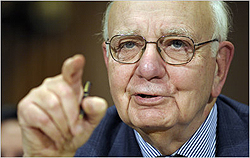
has been the most dogged advocate of a provision that would effectively bar federally insured banks from trading for their own accounts — the so called Volcker Rule.
In my opinion, banks should not gamble with their depositors’ money. They should be doing banking business — lending money to growing businesses.
WiFi on the go. It’s getting uibiquitous.
+ McDonald’s added free WiFi to 11,500 locations earlier this year. I like their grilled chicken sandwich.
+ Starbucks will add free WiFi to many of its stores on July 1. I don’t like their coffee or their food, but I do like looking at the 25-year old out-of-work actresses and models working on their laptops sipping their $6 coffee.
Progress in politics? From today’s New York Times, “Nikki Haley, who could be the first governor of south Carolina who is not a white man.”
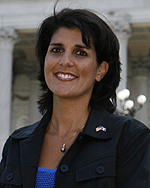
She’s cute, too.
Weekend reading
A husband had just finished reading a new book entitled, “You Can Be THE Man of Your House.“
He stormed to his wife in the kitchen and announced, “From now on you need to know that I am the man of this house and my word is Law. You will prepare me a gourmet meal tonight, and when I’m done eating my meal. You will serve me a scrumptious dessert. After dinner, you are going to go upstairs with me and we will have the kind of sex that I want.
“Afterwards, you are going to draw me a bath so I can relax. You will wash my back and towel me dry and bring me my robe. Then, you will massage my feet and hands. Then tomorrow, guess who’s going to dress me and comb my hair?”
The wife replied, “Our local funeral director would be my best guess.”

Harry Newton,who played wonderfully yesterday and spent time eying one interesting deal. But a bargain, it’s not.

The “Volker Rule” is imperative if we are ever going to rebalance the banking system. It would restore the Glass-Steagall mechanisms that were destroyed by the monopolists on Wall Street and in Washington. It will also put to rest, at long last, the myth of the “efficient market theory” cooked up by Milton Friedman of the Chicago School. You are right to point out the differences–and risks–between lending to businesses and the practice of proprietary trading by banks. Trading and lending are two different creatures. I wonder how many readers have actually encountered, face-to-face. a representative sampling of those who run bank trading desks. I believe most people would be shocked by their recklessness. Front-running and self-dealing are considered fine rules of the game. Sophists like Alan Greenspan and Robert Bork (remember him?) have no problem with proprietary trading in the banking system; they view it, in an overall sense, as part of the baseline of “efficient finance.” This is not the place to debate how someone like Phil Gramm, one of the delusional proponents of “free market efficiency,” helped lead us into the recent economic meltdown. The clear proof that proprietary trading is a time bomb is known to anyone who reads this column.
Volker Rule…is a bit hypocrtical if you ask me and so are your comments Harry. Banks by definition are in the risk taking business. Banks have always taken depositors money and made loans with them Dont you see the risk in lending a start up business money? Certain business like restaraunts have a 50% failure rate after 2 years. So when a bank lends money to a homebuyer, small business owner, inventor, or entreprenuer the bank is risking depositors money. I agree that plain gambling with high leverage should be banned but selectively prohibiting banks from taking risk is a dangerous route. Banks often must trade for their own account (prop trading) to hedge or lay off risk from other psotions and risk profiles. I am not advocating highly levergaed naked long and short risk taking but banning all of it is absurd. To be clear, the very nature of banks is to take risk by taking depositors money and lend it to others. They borrow and may or may not be able to pay it back. That is a risk. That risk and other portfolio risk must be managed (hedged) by trading other instruments.
Many banks eye the trading profits of Goldman Sachs and say “we can do that too.” But they can't. But they take money away from business and residential lending — their traditional businesses — and use it for trading.
No one denies the risks in conventional lending, but banks should not engage in gambling, also called “trading.” .
where does it end Harry? Do we forbid real estate speculators from buying and selling – taking risk? How many ordinary citizens got into the real estate speculation game – flipping houses. Some bought nothing more than blueprints of yet to be built houses and condos and flipped (traded) them. They were as much a part of the risk bubble as were the banks that gambled (bet) with and against housing. Had the speculation at the grass roots level been curbed – that includes John Q Public as well as small home builders and speculators – then the banks would not have had all those mortgages to securitize, bundle, trade, and turn into even more derrivitive products.
It's like placing a sin tax on soda but allowing M&M's and other equally sugary obessity/Diabetic prodcuing foods to get a pass. Why just pick on the banks for excess risk taking? Why just pick on the soda industry?
Maybe we should also prevent people from trading/flipping houses??? Should the governement say that one primary residence and one vacation home is allowed- after that you are a trader and speculator and bad for the stability of our banking syatem? You see where you are going here? Banks should be allowed to trade, should be allowed to hedge positions, and should be allowed to manage risk. The answer is in limiting leverage NOT in eliminating trading altogether. All you need to do is go to YouTube and search for Barney Frank discussing Fannie and Freddie to undertsand our financial mess. The same guys (Dodd too) who are calling for all this overregulation were the same cheerleaders telling us expanded home ownership should be encouraged (see ACORN) and that nothing was wrong with the extended subprime postions of FNM and FRE!