September is the worst month in the stockmarket. Yesterday 1% drop was, sadly, typical. Europe is awful today. Things here will probably be bad again. My take: It’s not a fundamentally bad market. It’s simply a very volatile one. If you eye your portfolio, you’ll find huge percentage drops in some stocks and big rises in others — e.g. big drop in Alibaba (BABA) and big rises in Mobileye (MBLY) and GoPro (GPRO) — both of which I like.
If this weakness continues we might see some seriously interesting bargains, e.g. Visa (V) and MasterCard (MA), both of which are being hurt by the mistaken theory that Apple Pay will hurt them. It actually should benefit them a little, since it uses them. But unless Apple Pay causes a flood of new consumer buying, it’s unlikely to benefit V or MA significantly.
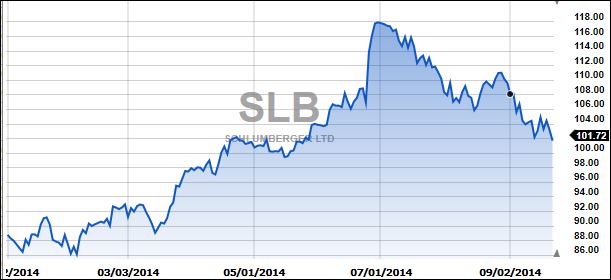
We are going through some big pricing changes — the biggest being the price of gas is plummeting. Have you noticed your price at the gas pump? It’s way down. Good for consumers. Not good for the oil companies like EOG, Halliburton (HAL) and (Schlumberger (SLB), e.g.
Rosh Hashanah begins this Wednesday evening. I think the old adage is sell on Rosh Hashanah. Buy on Yom Kippur, which is ten days later. Or is it Buy Rosh Hashanah. Sell Yom Kippur? My friends are confused. Suffice, traffic will be light in New York City on Thursday.
How should I take care of my children when I die? My mother claimed the reason my inheritance was zero was because she and my father had helped me with my graduate school education and buying an apartment in New York when I settled here. She said that my sister hadn’t benefited and deserved all the money. There is logic in her logic. The issue of inheritance for my children rattles around my head regularly. We’ve helped our kids with graduate school education and places to live. And they’re both hugely successful. Do we owe them more?
This raises the issue of life insurance for Susan and myself. Buy life insurance now, they tell us. It will pay the taxes on our estate when we both croak. That calculation has two problems: Life insurance is expensive and costs after-tax dollars. Maybe we will spend, lose or give away all the money before we croak and there won’t be any left. Why buy the insurance?
This piece from last week’s New York Times tackles this age-old question:
Estate Planning
Parents, the Children Will Be Fine. Spend Their Inheritance Now, by Ron Lieber
Once people hit retirement, they do not know how long they will live or how long their money will last. Still, the vast majority of retirees with children cling to an intention to leave something behind, even though many of those offspring have no expectation of receiving an inheritance.
This parental instinct might seem loving and generous, but there is another way to look at it. All of this devotion to the next generation may also be the height of foolishness. After a few decades of spending well into the six figures to rear and educate each child (and increasingly, years more backstopping young adults who are not quite financially independent), the parents probably ought to cease feeling this sense of obligation. Far better to spend their retirement money in the present on making meaningful memories with family members or on top-notch care that can help make aging more comfortable and graceful – in their own home if possible.
So how can we middle-aged kids convince our parents that they are officially off the hook?
First, consider the state of the generational disconnect. In an article that the journal The Gerontologist published last year, Kyungmin Kim and four colleagues took the unusual step of using polling data from both older Americans and their adult children about whether they expected to leave or receive an inheritance.
Ms. Kim, a postdoctoral fellow at the Population Research Center at the University of Texas, reported these results. Among the parents, ages 59 to 96, 86.2 percent expected to leave a bequest. But just 44.6 percent of the children, ages 40 to 60, thought they would get one. As for the most agonizing possible mismatch, where parents had no intention of leaving money behind but their children were expecting some, just 2.4 percent of the parent-child pairs had that disconnect.
Economists who study the motivation for inheritance intentions tend to probe two general areas. The first involves the moral obligation that parents feel toward their offspring, no matter how much support they may have given to them already. A subset of adult children seem to understand this innately. In Ms. Kim’s study, the adult children who were getting money from their aging parents while they were still alive had a higher expectation of getting more once they were dead than other adult children. Entitlement, anyone?
The other inheritance theory relates to exchanges. The assumption here is that parents wish to reward children who help them while they are still alive with an inheritance after they’ve died. They may even subtly (or not so subtly) dangle the prospect of a bequest in front of the children while they are still living to encourage the desired behavior or assistance. What Ms. Kim and her colleagues found, however, was that the adult children who were providing more support were less likely to expect an inheritance, even though their parents were indeed more likely to intend to give them one.
The message here would seem to be that aging parents are generous to a fault, if a bit manipulative on occasion. Adult children, meanwhile, accept their obligations to care for their parents with little expectation of receiving anything in return, though some who remain on the dole well into adulthood expect their parents to provide for them from the grave too.
The study’s yes-no questions, however, are relatively limiting. Many parents may be hoping to leave just a token amount, after all. Adult children might lie about their expectations to please the researchers, too. And besides, even if you expect nothing it doesn’t mean that you don’t badly want that very thing.
For more insight on this, I turned to an academic who has recently gotten into the business of trying to get older Americans to tap into their home equity during their retirement years. Christopher Mayer is an economist at Columbia Business School with an expertise in housing finance and policy. But he’s also the chief executive at a new reverse mortgage company called Longbridge Financial.
Reverse mortgages, which allow people 62 and older to tap some of the equity in their homes without having to make any loan payments until they die or move out, are roughly half as popular as they were before the housing crisis. Plenty of bad actors persuaded elderly homeowners to take lump sum loan distributions and plow them into inappropriate annuities or other financial products. As a result, protective adult children often come with their parents to discuss reverse mortgages with the person pitching the loan.
Lieber’s article seems founded more on guilt than any clear thinking. As expressed by other commenters, it is difficult to determine how…
I have been a self-employed free-lancer for over twenty years, and my career has had some real ups and downs. If it had not been for the…
I struggled my entire adult life as a single female with a college education to make more that $20 per hour. I had great credit, but a fair…
But who exactly are they protecting? “It’s hard to have more than three or four conversations with a family before the inheritance topic comes up,” Mr. Mayer said of the children who try to talk their parents out of tapping their home equity. “There are times when they say `Mom and Dad, that could be useful money for me.'”
Hoarding home equity certainly seems prudent. After all, the money tied up in a home can be awfully useful for people who suddenly need $200 a day for in-home care or to enter a nursing facility. Having that source of capital at hand means that they won’t be a financial burden to their children or have to take their chances with Medicaid. Anything left over can go toward an inheritance.
Mr. Mayer is fighting another fact, too, which is the significant percentage of people for whom real wages have not been rising much. “You can look at the next generation and wonder whether your kids will be in a position to do much better than you did,” Mr. Mayer said. So older people scrimp and save and aim to leave some money behind to try to give the younger set a boost.
Adult children who are trying to talk their parents out of a goal like this face long odds. “When people see their time horizon shrinking, they tend to focus on goals that are emotionally meaningful as opposed to more practical ones,” said Laura L. Carstensen, a psychologist who runs the Stanford Center on Longevity. “For the most part, it’s a focus on what or who matters most, and it’s family and family.”
So noted. But in the very least, the generational disconnect in expectations around inheritance need not exist. Ms. Kim chalks this up to the age-old problem of families having trouble initiating forthright conversations about money. And given that older people tend to be more old-fashioned about this sort of thing, it’s on us kids to declare our expectations and begin persuading our parents to worry less about having much of anything left over after they’re gone.
So here it goes. Mom and Dad: I expect nothing from you going forward except love, conversation, holiday meals and grandchild babysitting. Spend your money on your health and comfort and making the kinds of memories with close friends and family members that will last even as other, older ones, fade. Leave a bit aside for me or for charity if it truly makes you happy, requires no sacrifice or makes sense for tax reasons. But otherwise, spend what you have and have faith that the education and life skills you already gave me are more than enough.
I don’t want an inheritance, nor do I expect one. If any fellow adult children agree, go tell your parents the same thing this weekend.

Harry Newton, who promises no more pictures of grandchildren for a while.

Well said Sir……Inheritance is a huge issue in India and it is the parents who suffer at the end, mostly during the last phase of their life..with no hope of help and cooperation from their offspring.
The sorry truth is that most baby boomers have no care in the world what their children end up with. Let alone grandchildren.
Most are worried their money will not last until their 120 years old.
Infinite Banking by R. Nelson Nash. Use some funds to buy a “bank” for your heirs. Book is on Amazon. James Neathery and Dr. Eberhard Samlowski are a resource in Fort Worth, Texas
Harry…stop worrying about leaving your kids a huge inheritance…by the time you die “your” children will likely be as wealthy or wealthier than you are. Live it up now while you can…stop being so cheap all the time…go first class at everything you do…enjoy life every day…buy Susan that new Mercedes she has been wanting and buy yourself a new Ferrari…buy a winter condo in the California desert or on the Amalfi Coast.
Set-up an endowment to the Shriner’s Hospital for Crippled Children or St. Jude Hospital…create scholarships at Charter High Schools. All of these are guaranteed to help people in serious need and make you feel like the King that you are!
Good advice for all of us. Setting a good example as parents while bringing the “kids” up, giving them a top-knotch education and later be “fun” grandparents occasionally is what we “owe” our kids. If we’re wealthy after that, doing constructive investments, including meaningful charities, is a better more morale use of the excess wealth. And do it before the government gets their dirty hands on the funds, a grand waste of money.