Investing short-term money: The BIG myth and The BIG mistake. The story:
I’m the treasurer of our building. We have money for a rainy day. We like to put it into in one-year CDs.
I call JPMorgan Chase. They offer 0.10% for one year. I ask them to check further. After all, I’m a favored client (sic!). They promise to contact the “desk” and get back to me. They don’t.
Our building’s management company contacts their favorite bank, Morgan Stanley which produces .40% for Goldman Saks and .65% for Ally Bank. (We need to split the monies because of the FDIC limit).
I’m, of course, the world’s leading expert on investing short-term monies. I do my “research” and check the Internet. Here’s what I find. These are the best one-year CD rates in the U.S., according to the reputable site, Bankrate.
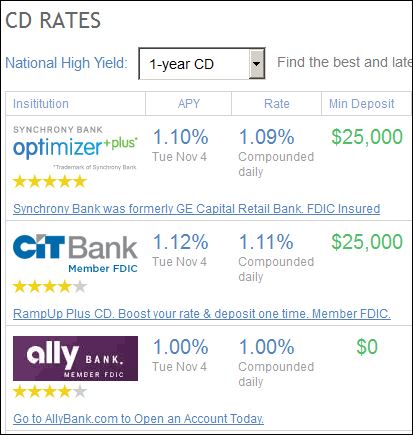
This is amazing stuff. It obviously makes no difference as to which bank you put your money in. It’s all FDIC insured. Second, if you give it to one bank to spread amongst others, that bank will take a piece of the action, a fee. Morgan Stanley gives us 0.65% for putting it with Ally. Yet Ally pays them a minimum of 1.00% for our money. That’s a 35% fee for Morgans for basically doing nothing!
As if you didn’t already know, no one should trust banks.
It’s an amazing difference between the 0.10% I first got quoted from JPMorgan Chase and the 1.10% from Synchrony. In case you’re wondering… yes, I called Synchrony to check. And they are paying 1.10%. For the Bankrate site, click here.
How to pay electronically. All about what they’re calling Mobile Pay.
If someone does something nice for me, I’d like to pay them instantly. I can’t instant-pay with checks since they are slow, cumbersome and old. Here’s my take of today’s alternatives:
+ The best way of sending people money is to wire it. There are two problems. Your bank may not have an app or a web site that allows you to do that. You might have to go into their branch and waste half-an hour. JPMorgan Chase has an Internet app that lets you send wires from your home computer. It’s a brilliant app. But, the person you send money to may be charged $15 by their bank to receive your wire. JPMorgan Chase doesn’t charge to send or receive a wire. Some banks even charge to send a wire. Some charge to receive it also. Some who do, might be begged out of the charge. If you wire someone $100, it irritates them to have their bank take a 15% fee.
+ PayPal is the leader in electronic payments. Everything I buy on eBay I pay with PayPal. Fine for me, but stinks for the seller, who has to pay huge fees to PayPal on top of the fees to eBay (though they’re presently owned by the same people).
+ Apple Pay, which just started, requires you to have a iPhone 6 or iPhone 6 Plus (I don’t yet) and a credit card and for the retail store to have an Apple Pay-compatible credit card-type machine at checkout. You can’t use Apple Pay to send money to pay for something you bought on eBay or over the Internet, yet. You’re stuck with PayPal.
+ Google Wallet seems to let you buy goods in stores, over the Internet, and send money to people. I just applied for a Google Wallet card — it seems to be like a credit card. Transactions seem to be free to me and the people or companies I send money to. But Google Wallet is new. And I haven’t tried it yet. Go here: www.google.com/wallet
+ The mail. You can send a check. Recently, I sent someone some cash in an envelope. It arrived safely. Snail small is safe, if slow.
+ If you’re a small retailer, the most exciting device is Square.It’s that little thingee sticking out the right of this iPad.
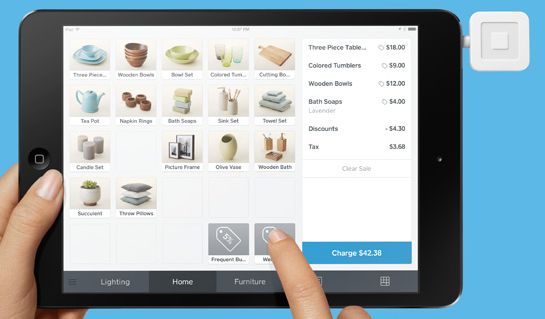
All my local restaurants and coffee shops use these things to take customers’ credit cards. The device is much cheaper than a traditional credit card machine, like those made by Verifone (PAY). Everyone who has Square seems to love it. Square is expanding its services daily. It’s an impressive operation. I wish it were public
Getting Better at Getting Better. The New Yorker’s James Surowiecki has done a great piece on “How the ‘performance’ revolution came to athletics — and beyond. He talks about athletes but then moves onto teachers and how to improve education. Check his conclusion:
These measures will cost money, although they may not cost more than constantly replacing struggling teachers (not to mention the long-term economic cost of churning out mediocre students). And there will be some teachers who will find all the feedback intrusive. But what’s happened in sports over the past forty years teaches that the way to improve the way you perform is to improve the way you train. High performance isn’t, ultimately, about running faster, throwing harder, or leaping farther. It’s about something much simpler: getting better at getting better.
You should read the piece. It’s really a whole new theory of management. Click here.
Correction:
Yesterday, I said you needed $100,000 for the Vanguard S&P 500 Fund, VFIAX. It’s really $10,000. Sorry.
Check, Check, Check!
Will Rogers on politicians
+ Everything is changing. People are taking their comedians seriously and the politicians as a joke.
+ Ninety percent of politicians give the other ten percent a bad reputation.
+ A fool and his money are soon elected.
+ There’s no trick to being a humorist when you have the whole government working for you.

Harry Newton, whose Republican friends are celebrating. The sadness of the campaign was its enormous cost (wasted money?) and the lack of debated serious issues — like the problems facing us — the Middle East, our education system, immigration, tax reform, our failing infrastructure (bridges, roads, trains, etc.) and some real fixes in healthcare. Still, I’m optimistic.

Harry — I spent several years as the treasurer of a condo. We had $1.4 M in reserves. Yes, you can run all over town (or the country) chasing CDs to get half a point. BUT… for the condo there is a potential huge problem. …. treasurers are not there forever… sometimes they aren’t even there for a year.
I took over the books and was comforted by all of the nice CDs shown in the statement from the management company. But then, when I REALLY dug through, I found a $100,000 CD listed as an asset that hadn’t paid any interest… in years! (it took a yellow legal pad and a pencil to do the cross checks!)
Sure enough, a previous treasurer, keen to get that extra half a point, had put money in a 36 month CD in an out of town bank. We had an account number, but no signature card, password, or access. The bank had changed hands twice, had two different names, and had declared the account “abandoned”. YET, the management company happily showed the CD as an asset on the books.
It took detective work to even find a branch of the re-named re-named bank. Then, we had to figure out who the Condo officers were nearly a decade ago when the CD was placed. Then, we had to track them down (not a single one still owned in the building) to see if any of them were on the bank’s old signature card.
We found one woman who was the condo board president for one year and, by luck, she was on the signature card (the bank still had it!). IF we hadn’t found that one woman, we would have had to hire lawyers, spend lots of money, and been in a real mess.
Harry… it is NOT WORTH YOUR TIME to chase a point of interest for a condo!! When you change board members, are YOU going to transport them around to all of the banks where you have stashed money in order to change all of the signatures?
What you do is to tuck ALL of your money into CDARs. http://www.cdars.com This is a bank service (why didn’t you invent this??) that takes your money and farms it out to banks in order to keep it all under FDIC limits. YES, they charge a fee. Yes, you wind up getting DUST and pocket lint as interest, BUT the condo’s money is safe from keen treasurers parceling out the condo’s money all around the town/country/world and then moving on and forgetting where they put it. When new officers come in there is one signature card operation for all money. The CDARs people take care of all rollovers and your owners KNOW where the money is. It is NOT worth HARRY’s time and energy (and liability and criticism) to be chasing all over town parceling out money and THEN trying to make the NEW INCOMING treasurer understand the structure you have devised.
Additionally, I don’t trust the incoming person! CDARs keep the condo’s money safe and that is the PRIME concern! … not chasing a damn .9% of interest. Keep it simple!
There are a huge number of differences between our situation and yours. I’m glad you got your money back.
Scotiabank, in Canada, charges me $1.00 to email funds from my checking account, within Canada. All done online from my home in Arizona.
I too pay for anything I can, online, with PayPal. However, rather than having it automatically deducted from my bank account I have it charged to my credit card (alternative payment). This gives me the benefit of credit card goodies (in my case AMEX Delta Skymiles)…or you might chose a higher “cash back” card than what PayPal pays. You do have to be very careful and “change” the payment method on every transaction or it is automatically charged against your bank account.
The Omaha based company “First Data” is going after the mobile payments market. Privately owned by KKR rumored to be going public maybe next year.
look at PopMoney from PNC. I can email you $100 and verify the transfer by text or phone and the recipient deposits it into their account . I don’t need their account infor or anything. Neat.