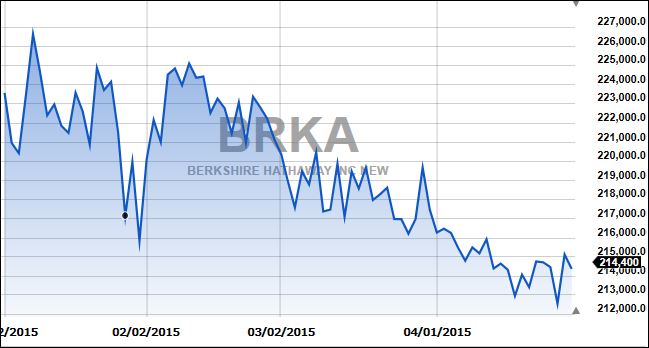
Too many bad surprises and big share price drops in this earnings season, e.g. Waste Management (WM), Wynn (WYNN), Lumber Liquidators (LL), UnitedHealth (UNH), Twitter (TWTR). Even Berkshire Hathaway (BRKA) has looked weak since early February. Even Apple has been weak, despite incredibly wonderful sales and earnings results. Some of the charts look positively gruesome:
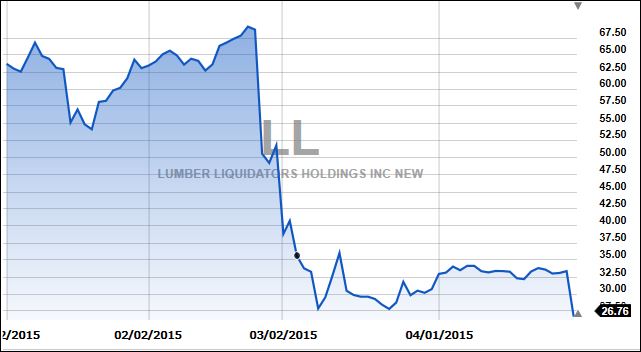
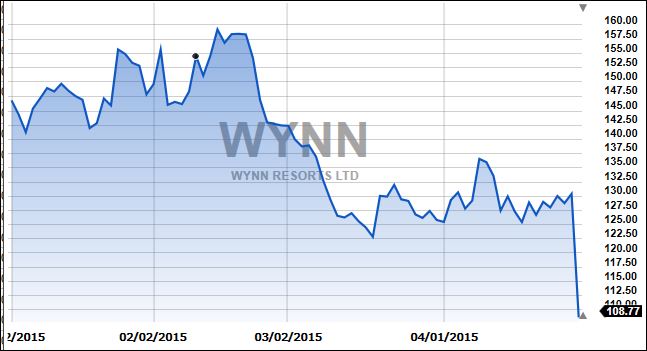
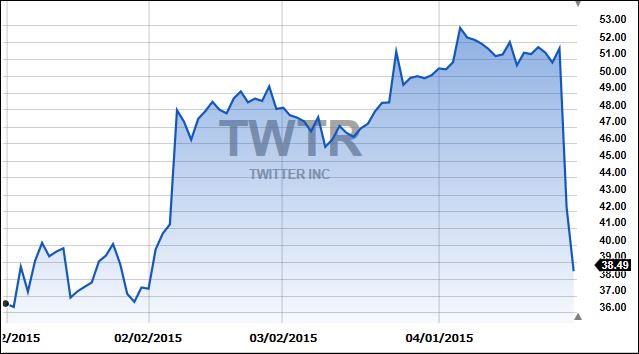
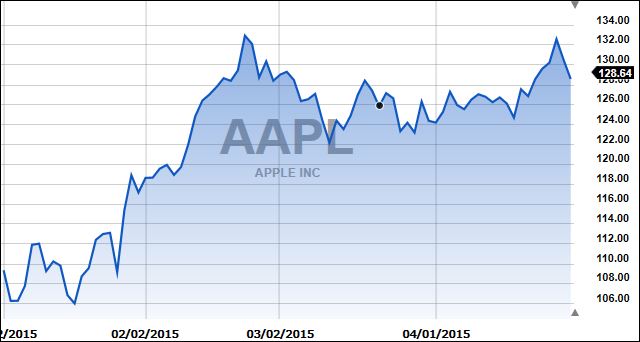
We are in an unforgiving market. Perhaps a time to tighten some stop loss order. Fortunately, there are some solid gainers, e.g.
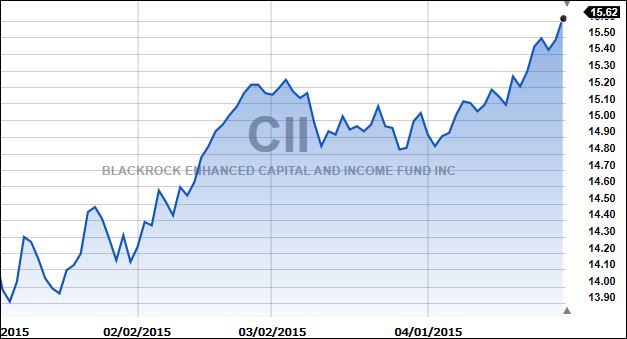
You’ll find more in this very useful chart of New Highs and New Lows on the NYSE, Nasdaq and Arca. Click here.
My dear friend has just upped his grandchildren’s Western European stock allocation from 15% to 25% due to “the expected positive results of Europe’s easy money stimulus plans.”
Goldman Sachs writes:
In our latest report “Strategy Espresso: Earning respect; growth finally picks up”, we emphasized our view that European equities have further room to rise. This is because over the next 12 months we think economic growth will begin to take hold, profits will recover, and more restructuring will take place at both the national and company level.
We also published our European earnings preview “Strategy Espresso: Earnings Preview: Europe should finally deliver a good season, but not a record breaker.” We expect earnings season to come in slightly positive, driven by stronger Euro area economic growth, continued FX tailwinds and downward earnings revisions. We do not expect any records to be broken as better European data is balanced against a slowdown in economic activity outside Europe and continued pressure across the commodity complex.
Baltimore continues a long pattern of inner city eruptions. Police brutality and overty, high unemployment are all to blame. There are no easy solutions. Reigning in the police would be a good beginning. Holding them accountable for killing kids would help. Here are two remarkable pieces. The first piece is remarkable because it’s published in the New York Times and it threatens more riots. See the last paragraph which I’ve highlighted.
In Baltimore, We’re All Freddie Gray by D. Watkins
BALTIMORE – AT the moment, what’s going on in Baltimore seems to be all about Freddie Gray, the 25-year-old black man who was viciously attacked by police officers on April 12 more or less because he looked at them. They subdued him; his spine was nearly severed, his voice box was smashed and he was hauled off in a police van, even after he requested medical attention multiple times. He died a week later as result.
But it’s not only about Freddie Gray. Like him, I grew up in Baltimore, and I and everyone I know have similar stories, even if they happened to end a little differently. To us, the Baltimore Police Department is a group of terrorists, funded by our tax dollars, who beat on people in our community daily, almost never having to explain or pay for their actions. It’s gotten to the point that we don’t call cops unless we need a police report for an insurance claim.
And it’s about more than just the cops. We’ve watched as Mayor Stephanie Rawlings-Blake, in conjunction with Police Commissioner Anthony W. Batts, spent over a week investigating what appears to be an open-and-shut case. I’d like to think that if I broke a person’s neck for no reason, I’d be charged in minutes. But the system – even when it’s run by a black mayor and a black commissioner, even when a majority of the City Council is black – protects the police, no matter how blatant and brutal they are.
I can easily skip right past the cases of innocent victims of police brutality who received a combined amount of nearly $6 million in settlements from the city over the last three years, or Tyrone West, Anthony Anderson, Freddie Gray and the more than 100 people killed by local police officers in the last decade, and dive straight into some of the random experiences I’ve had with cops because I’m black in Baltimore.
When I was 10, a group of thugs kicked in the door to my home, knocking it off the hinges, looking for drugs. They held my family and me at gunpoint for hours while they tore our house apart. When they left my mom called the cops; they arrived two hours later, treating us as if we were the crooks and complaining about writing the police reports.
When I was 12 I would play full-court basketball at Ellwood Park, on the city’s east side. One day the cops came through, saying they were looking for a robbery suspect. Suddenly about six officers entered the court from all four directions and made everyone lie on the ground, face down. A friend of mine, whom we called Fat Kevin, asked, “Why y’all treatin’ us like animals?” One of the cops shouted, “Because you are worthless!” though he also used a much more vulgar, and around here a much more common, term.
Then, when I was 14, a cop clothes-lined a kid named Rick off a moped. Rick hopped up, yelling, “What did I do?” and was instantly clubbed down by the cop and his partner. Rick’s face was badly bruised for weeks.
I can throw in stories from the years in between, or the years after, ranging from pre-K to graduate school. And whether they were marching, or torching a cop car, or cleaning up Tuesday morning, black Baltimoreans have almost all had similar stories.
The police officers in Baltimore, as in many places in the country with dense black populations, are out of control, have been out of control. One of the major reasons is that many Baltimore police officers don’t live in Baltimore City; some don’t even live in Maryland. Many don’t know or care about the citizens of the communities they police, which is why they can come in, beat us and kill us without a sign of grief or empathy.
Really, rise up and be violent, destroy your own community, burn and loot stores owned by blacks. You get no sympathy from me once you start…
Many other Baltimoreans feel the same way, which is why a diverse collection of protesters has taken to the streets every day since Freddie Gray’s death on April 19.
Most of the protests were peaceful. The first acts of violence didn’t occur until after a nonviolent, if agitated, protest Saturday night at City Hall. From there, a group of protesters, including myself, marched to Camden Yards, where the Orioles were playing the Boston Red Sox. As we passed a strip of bars, a group of white baseball fans, wearing both Baltimore and Boston gear, were standing outside yelling, “We don’t care! We don’t care!” Some called us monkeys and apes. A fight broke out, and people were hurt.
After that, it didn’t take much. Some people might ask, “Why Baltimore?” But the real question is, “Why did it take so long?”
The young uprisers of Baltimore have been paying attention to the peaceful protests in Sanford, Fla., Ferguson, Mo., and New York, only to be let down by the end result, over and over again.
We are all starting to believe that holding hands, following pastors and peaceful protests are pointless. The only option is to rise up, and force Mayor Rawlings-Blake to make what should be an easy choice: Stop protecting the livelihoods of the cops who killed Freddie Gray, or watch Baltimore burn to the ground.
D. Watkins is the author of the forthcoming books “The Beastside,” an essay collection, and “Cook Up,” a memoir.
This the second piece on Baltimore worth reading. Baltimore’s inner city problem is immensely complicated. But many cities have, or pulling themselves out of their mess (viz. Detroit). Read:
Don’t blame globalization, China, or outsourcing for the Baltimore riots by James Pethokoukis
Pro tip: If you’re a civic leader, and riots are sweeping your city, close your social networking apps. Put your smartphone down. It is probably not the best time to take to Facebook or Twitter and start offering a mini-manifesto about the downsides of U.S. trade policy.
Case in point: John Angelos, chief operating officer of the Baltimore Orioles. On Monday night, as Baltimore was besieged by rioters, Angelos let loose a 323-word, 2020-character tweetstorm. After his team’s game with the Chicago White Sox was canceled, Angelos decried the violence and looting, said due process must be respected, and then started channeling Elizabeth Warren:
That said, my greater source of personal concern, outrage and sympathy beyond this particular case is focused neither upon one night’s property damage nor upon the acts, but is focused rather upon the past four-decade period during which an American political elite have shipped middle class and working class jobs away from Baltimore and cities and towns around the U.S. to third-world dictatorships like China and others, plunged tens of millions of good, hard-working Americans into economic devastation, and then followed that action around the nation by diminishing every American’s civil rights protections in order to control an unfairly impoverished population living under an ever-declining standard of living and suffering at the butt end of an ever-more militarized and aggressive surveillance state. [John Angelos]
Angelos is a progressive Democrat, like his father, Peter, the Orioles’ long-time majority owner who made his millions suing big business. And here, perhaps predictably, Angelos the younger is offering a too-simple story of economic injustice perpetrated by Corporate America and its lackeys in Washington. If not for unfair trade deals and the job offshoring they promote, he seems to suggest, America’s immediate postwar era of good-paying, lifetime factory jobs would have never ended. This is a bit of economic nostalgia that even President Obama engages in from to time. As Obama said in a 2012 speech, “In the decades after World War II there was a general consensus that the market couldn’t solve all of our problems on its own. …This consensus, this shared vision led to the strongest economic growth and the largest middle class that the world has ever known. It led to a shared prosperity.”
That golden age could not last indefinitely, of course. Eventually the other advanced industrial economies recovered and began competing with American companies and workers. They were later joined by a rising Asia — first Japan and then South Korea, China, and India. American cities built around manufacturing — be it cars in Detroit or steel in Baltimore and Pittsburgh — suffered greatly. And as global competition increased, machines got better, allowing companies to generate more output with fewer workers. Manufacturing output as a share of GDP has actually been pretty stable since 1960, even as manufacturing employment has fallen by more than half.
The correct reaction to these macroeconomic forces — ones common to all post-industrial economies — was not to construct walls and smash machines but to try and adapt to this new environment. One way was to boost job market incomes through the tax code and government. America did just that, with some success. From 1979 through 2011, according to the Congressional Budget Office, inflation-adjusted household income for the broad middle class rose by 40 percent after taxes and government transfers. Income growth was even stronger in the bottom 20 percent, rising by 48 percent. Likewise, the share of Americans living in poverty has fallen by three-quarters since the mid-1960s thanks to an expanded safety net. American living standards certainly have not declined over the past four decades.
Nor have things gotten worse in those developing nations to which Angelos referred. In fact, they’ve gotten a whole lot better thanks to trade. In that “third world dictatorship” of China, global trade and investment have pulled some 700 million people out of extreme poverty. That reality, perhaps the biggest economic story since the Industrial Revolution, is a pretty big win for globalization.
But not everybody wins. These economic changes continue to buffet the American middle, especially at the lower end. For decades, the middle class shrunk because families were moving up the income ladder. Now it’s because they’re falling down it. Things are particularly tough for low-skill men — and maybe this is what Angelos was really getting at — whose wages are stagnant at best since the 1970s and whose labor force participation has declined sharply. Overall, the share of American men 25- to 54-years-old who are not working has more than tripled since the late 1960s. And of that group, according to one survey, 85 percent do not have a college degree, while a third have a criminal record.
So rather than railing at trade, maybe push for labor market reforms, such as expanding wage subsides, non-college pathways to the middle class, and making it easier for workers to avoid disclosing criminal records during the hiring process. Like a lot of other cities and rural areas in America, Baltimore needs more education and opportunity — not less trade with China.
Banks hate money. I thought they were interested in my money. But NO. Here’s an exercise.
Ask you favorite bank how much they’ll give you on an 18-24 month CD?
I got one quote yesterday at 25 basis points. That’s one quarter of one percent. One bank said, “Don’t give us money. The agony of opening a new account with us will drive you batty.” The other banks haven’t called back — despite promises.
I once ran a little bank. I thought my job was to be nice to customers and take their money.
Boy, was I naive!
Favorite Mexican vacation hotel. From another friend, who claims his favorite Mexican hotel is “six stars.” He goes every second year.


For its web site, click here.
How bad are things in China?
Housing developers are hiring foreigners to pose at their properties, project an international atmosphere and boost their flagging property sales. Clients looking to rent a foreigner can select from a menu of skin colors and nationalities.

Harry Newton who has found a wonderful video of beautiful Texas. Wyman Meinzer is the talented photographer. The music is by Doug Smith. Most of the pictures were taken in West Texas in the rolling plains (Caprock to Seymour ), the Fork, 6666, and Waggoner Ranches. There are some scenes in Palo Duro Canyon. Enjoy. Click here.

A big part of the solution is to change the federal tax code that taxes (punishes) production as in income, savings and investments. Production is what raises the standard of living. A tax code the taxes jobs at 15.3% of pay. The root of the problem is the 16th Amendment. It enables direct taxation of the individual and also enables the 2nd requirement for a communist state, a graduated income tax, per the Communist Manifesto by Karl Marx. The 16th Amendment must be repealed as it is enslaving all of us to our government. The solution is the FairTax bill HR 25. The FairTax bill would increase the minimum wage earner “take home pay” by 27% plus bring jobs, companies and capital to the USA resulting in a huge jobs and stimulus program without politicians picking winners and losers and no new government debt…simply by changing the federal tax code. The FairTax would also get the 16th Amendment repealed with companion legislation. Lean more, join the grass roots cause and contribute at fairtax.org.
would you accept the flat tax if it also applied to dividend and capital gains income?
Pretty pictures of West Texas…however, I have driven across Texas many times on both I-10 and I-20…not a fun trip…takes forever!
I agree we all need to work on the racial issues…maybe more mothers will take heed and follow the example of the one mother who boxed her son’s ears. To think…they wanted to jail the football player who took a switch to his son. I was switched plenty by mother when I was growing up. Also, I believe it would help if more black leaders would get off the race card kick and get involved in providing leadership and role models for the young people to follow. Unfortunately, once they escape the ghettos…they never go back to help those still struggling to get out…they just talk about it.
Harry,
Friday through Sunday I’ll be at the BRK shareholders meeting & plan to refer every user and big wig I encounter to your website. So, make sure Friday’s column is your best ever. First impressions are everything.
I will. You have any idea of what would be best to write about?
Air rights over New York City buildings. I’m kidding. I’d write about the stock market, pro or con, and not about techie stuff.
Thanks for highlighting the situation in Baltimore Harry, a mirror for the Nation.
One of the mind sets that’s held back progress is the delusional wishful thinking that racism is like a light switch that’s been flipped off and if there’s a problem it’s the fault of its victims, whose heads need cracking.
There has been progress no doubt, but let’s face the reality that there’s much more work to be done.
I don’t like it when cops are demonized but the reality is that they are the forward projection of society’s fears and biases. The meme of a few “bad apples” is nonsense when the apple tree itself is unhealthy.
And the apple tree is us.