This year’s dumbest bet. When interest rates rise, TBT will skyrocket and all my friends will get rich.
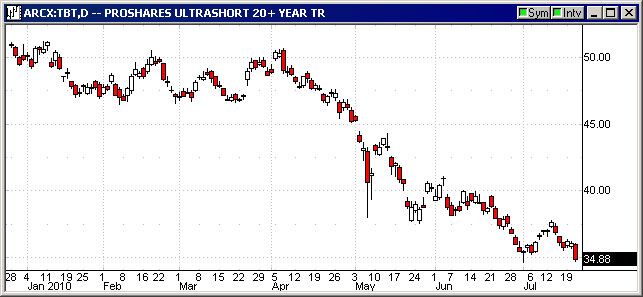
Meantime, they’re all losing their shirts.
According to ProShares,
ProShares UltraShort 20+ Year Treasury seeks daily investment results that correspond to twice (200%) the inverse (opposite) of the daily performance of the Barclays Capital 20+ Year U.S. Treasury Index. This ETF seeks a return of -200% of the return of an index (target) for a single day. Due to the compounding of daily returns, ProShares’ returns over periods other than one day will likely differ in amount and possibly direction from the target return for the same period. Investors should monitor their ProShares holdings consistent with their strategies, as frequently as daily.
In other words, stay away from TBT.
The second dumbest bet — gold.
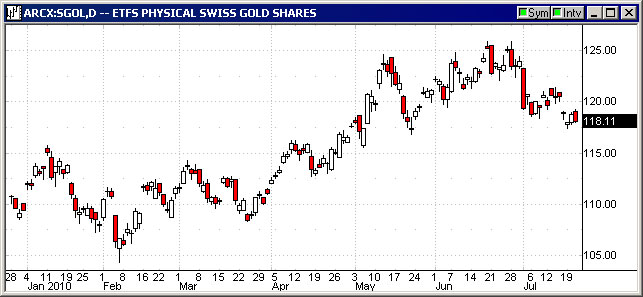
Like stocks, gold hit a bump in the road in mid-May. The “logic” for owning gold is
The economy will fall apart. Everyone will lose faith in fiat money, i.e. the dollar. They’ll all flock to the only thing that has any value, i.e. gold.
At least, that’s the theory.
Nouriel Roubini (Professor Doom) writes:
For the better part of 10 years running, all that glitters has, in fact, been gold. Since 2001, the precious metal has outperformed all of the core asset classes, gaining an average 15.3% per year in dollar terms since January 2001.
Gold is back in vogue for several reasons. Investors view it as an alternative to fiat money, as a hedge against extreme economic risks—which now include both high inflation and deflation—and as a measure of protection against financial meltdown. Given the intensity of the economic storm that has broken out over the past three years, in which all three fears have been invoked, gold and its fellow precious metals have spiked in price. …
The concerns propelling the price of gold specifically are very real and should not be ignored. But is now the time for investors to jump the gold bandwagon? We wouldn’t encourage it. Our logic and our precise investment recommendations are spelled out in a recent RGE Strategy View, “All That Glitters is Not Gold,” which was released to clients early last week.
Why aren’t we giddy about gold? In short, our core economic forecast scenario does not entail any of the extreme events that could result in a major gold price spike—and given the fact that the metal has already surged in price, we see several potential downside risks.
In the abstract, gold is most attractive as a hedge in one of three extreme scenarios: high inflation, persistent deflation, or when the risk of global financial meltdown is large.
We think high inflation in the near-term is unlikely, given lingering slack in advanced economies. For prices to rise, there must be buyers, and weak employment in the U.S. and Europe, coupled with murky economic prospects, has led consumers to retrench and tighten their purse-strings.
Should inflation eventually surface, it will do so only after balance sheets have been repaired. Unsterilized Fed intervention will have long since eased, and the Fed will be managing the money supply with respect to a rising money multiplier or by selling assets. In other words, an increasing money supply is not de facto currency debasement. The demand for money also matters.
Deflation risk remains, but Ben Bernanke has signaled in the past that the U.S. could pull out all stops—by printing more money—to prevent this dangerous outcome from materializing. For now, the U.S. dollar remains the preeminent safe-haven in times of severe stress—and a dip toward inflation would happen in such a time—so very much in line with Bernanke’s comments, the U.S. appears to have policy options at its disposal to stave off a period of sustained deflation.
Our core scenario is thus that once national balance sheets are repaired through a protracted and gradual deleveraging of household and public sectors (following the relatively rapid deleveraging of the financial sector, particularly in the United States), excessive deflation and inflation fears will subside.
In periods when the risk of global financial meltdown rises, the dollar exchange rate may appreciate against other currencies, but there also tends to be a flight to safety and gold prices appreciate even more. Gold prices tend to rise during periods of financial stress, up until the peak of market concerns—and then fall when the stress is resolved via bailouts or measures that restore market confidence.
There are certainly financial storm clouds to worry about—not least because of sovereign debt concerns in the Eurozone. Given this, we think it is possible that gold could continue to trend upward for a period. We still are not recommending it, however, due to what we see as significant downside risks.
These risks were succinctly outlined in a paper by our chairman, Nouriel Roubini, back in December 2009. They include: the possibility that the dollar-funded carry trade could unravel, popping asset prices—including that of gold—that have been bolstered by cheap borrowing in dollars; the concern that central banks will end quantitative easing and raise interest rates, again decreasing demand for risky investments like gold; and most basically the fear that gold prices have been driven up by herding behavior that could quickly turn the other way, prompting swift losses.
Similarly, even as gold spot prices rise due to demand for physical gold in times of severe financial distress, futures contracts and ETFs—the tools many investors now use to invest in gold—could suffer due to increased fears of counterparty risk.
Investors should thus take note—while gold and financialized gold products have posted consistent returns over the past decade, there are no guarantees that this golden goose will continue to lay eggs.
The third dumbest bet. When inflation appears, it will be nasty. Interest rates will soar. Like they did in the 1970s — to nearly 20%. Hence don’t buy fixed interest securities. Or only buy short-term (under two years duration). You can see the dumbness of this as interest rates have plummetted on short-term safe things like Treasurys which are now at all-time lows.
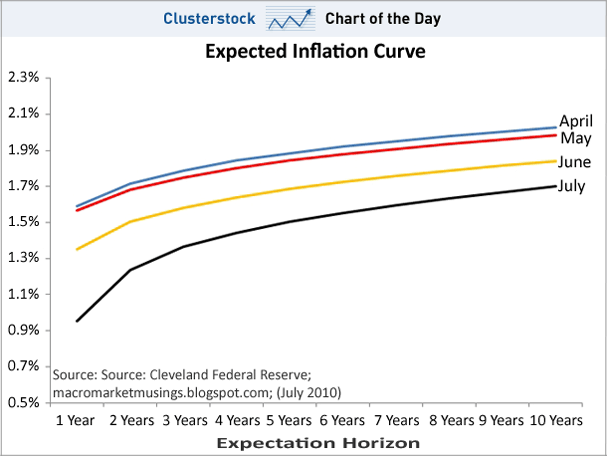
So, how much inflation will we have and when? Exhibit 1:
Clusterstock writes:
Despite expanding economic activity across the U.S., inflation expectations continue to drop. Month by month, expected inflation has dropped, not just for the near-term, but even for as far as ten-years out. This is shown in the chart from Macro Musings using Cleveland Fed data.
Usually the greatest check on a central bank’s ability to stimulate the economy is the threat of inflation. Yet this threat is at least perceived to be falling, even from the already puny levels of April. It’s charts like this that make Ben Bernanke feel disinflation (low, falling inflation) or deflation (falling prices) are a far greater threat than inflation. Which means the U.S. federal reserve probably doesn’t feel like its stimulus decisions are restricted by inflationary risks at all right now.
Inflation (and high interest rates) come because there’s much demand and little capacity to meet it, i.e. when the economy is in overdrive. So everyone raises prices. But that’s not where the economy is now and where it won’t be for many, many years. Unemployment is high. Factories are running at under 80% of their capacity. And China can gear up forever.
Hence, buying fixed interest securities — like bonds and some of the ultra-high yielders I’ve written about — makes huge sense. But you won’t hear this “logic” from the smart money.
The second thing that makes sense is earnings some shekels by writing covered calls on solid stocks. this strategy has worked well during the squirrelly May-June-July period. Look at BHP:
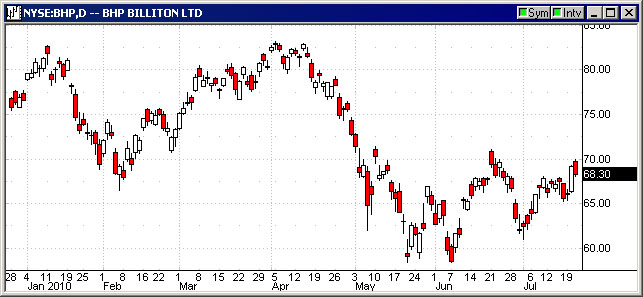
I bought it at $69. I’m losing money on it. Except that I wrote a covered call on it for January 2011. I sold the call for $7. That means I’m ahead. Which means I’m doing better than my friends in TBT and gold.
I’m not pushing this covered call strategy. It’s not “buy and sleep.” Remember the old mantra, “When in doubt, stay out.”
“Inception” is the movie. Some love it. Some hate it. Everyone is talking about it. Vanity Fair writes:
Q: What is inception?
A: Inception is the act of invading someone’s dreams for the sole purpose of planting an idea. It is the opposite of extraction, which is the process by which one gathers important information from the subject’s subconcious. Inception is thought by some to be impossible because the inceptee’s mind has an uncanny ability to trace the planted idea back to the person who planted it. For example, if someone tells you “Don’t think about elephants,” you may think of elephants, but this fails as inception because the originator—the person who ordered you not to think about elephants—can be traced as the source too easily.
Go figure.
Apple iPhone 4 is great. Everyone at the tennis club loves it. They’re most discriminating. OK, Harry will finally relent and get one.
No such luck. The Apple Store had them backordered for a month. The AT&T store “hadn’t seen one since the introduction.” They figure two weeks.
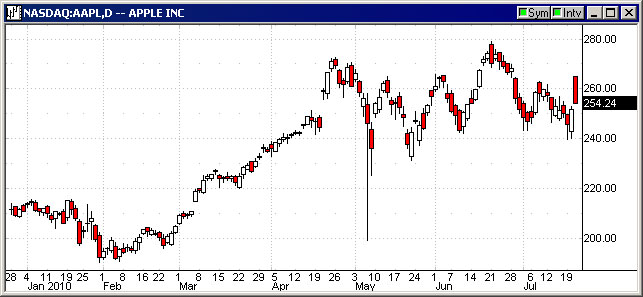
What a pleasure to have these problems. I’m guessing Apple will continue to do well — though its stock has hit a bump in the road since the beginning of May (like most others):

Harry Newton, who wishes he could buy an iPhone 4 today. Meantime, he’ll play tennis and ogle all the iPhones at the tennis club — none of which seem to be having antenna problems.

Harry is the one on the right:
http://www.youtube.com/watch?v=FL7yD-0pqZg
I should have mentioned, audio on that is NSFW.
And here's the HTC EVO vs. Apple Genius video response:
http://www.youtube.com/watch?v=UAOtC9QfXac
And if you got time to kill, the story behind these videos (i.e., the Best Buy employee who got fired for making them):
http://techcrunch.com/2010/07/21/tweet-fired
Difference is, the pro HTC one is accurate, the other isn't. 1 hour battery life? Pah I get at least and hour and a half as long as I don't turn it on or make calls. Just long enough to use the NASCAR app!
/sarcasm
Harry,
Welcome back. Also take a look at the Droid X on Verizon's network, which also has the 30 day trial. Massive screen that makes typing easy.
Alan
Droid 2 looks good too. Due out soon I believe.
Don't do it Harry! Resist the dark side. You never struck me as an iSheep.
Take the Evo 4g from Sprint for a months (absolutely free) trial. The bigger screen is a treat for older eyes.
Good idea. I'll testdrive the HTC EVO 4G. thanks