That was a nice bounce yesterday.

But in the great context, it was but a blip:

Note two things about these charts:
1. The market has gone nowhere in the past ten years. So “Buy and Hold” in equities sucks.
2. How you did in the past 10+ years was a function of when you entered and when you exited. For example, it wasn’t a good idea to enter in mid-2007, when things looked really rosy.
I still prefer to watch CNBC with the volume muted. I get to watch the cute female anchors and the aging male anchors. Eye candy for my tired eyes.
Eat your heart out, maybe. Verizon put in FiOS yesterday. I tested my new Internet speed at Speakeasy.

The numbers are phenomenal — the fastest I’ve ever seen on any Internet connection. The reality of this huge speed — ten times as much as I had before with Time Warner RoadRunner — is not what you expect. There are other factors in play — like how fast your web sites respond and how fast your own PC is, etc.
Streaming video is nice, perceptively faster. You can really watch movies in serious high definition.
Opening many web sites simultaneously (as I do with Firefox) is not faster, because that depends on the individual web sites. You can speed things up at speedtest.verizon.net. Do the test. And then install the FiOS Optimizer software.
FiOS includes Internet TV and phone — the so called “triple play.” Ultimately when it’s finally configured (and my printers work again), it should be less expensive than Time Warner/RoadRunner (the alternative) and be far faster and more stable.
The “BIG” hope with FiOS is something called MOCA — Multimedia Over Coaxial cable. It’s a local area network that runs between your first FiOS box — the one that connects you to the FiOS fiber optic line coming into your apartment — with the boxes on top of your TVs and your various PCs or laptops scattered around your house. One day, this new network, one day, will run zillions of useful apps. It’s a new platform. Think of it as iPhone for your TV. Think of ordering food from local restaurants via your TV’s remote gadget or your PC. Think of video calls via your TV. Think of buying things instantly that are advertised on TV. I have a list a mile long.
From my point of view (a Verizon customer’s point of view), life just become simpler, easier. From Verizon’s point of view, there’s the potential for gigantic new revenues. Think yellow pages. They’re dying. Advertisers are dumping the paper yellow pages for Google. But Google is vulnerable also — you pay per click before you make the sale. Under my new idea for Verizon, it would get paid when the sale is made. (Your food delivery would be paid via your Verizon bill. Bingo, Verizon becomes the new PayPal, Google, eBay and Craigslist all rolled into one. Wow!
Verizon just beat its earnings numbers. So, it’s popping. But, recently it’s been a lousy performer.
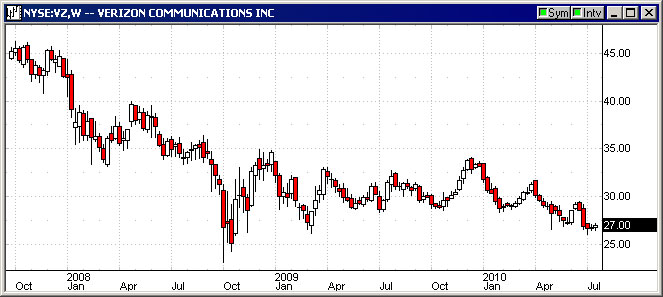
The good news is that at today’s depressed prices it’s yielding seven percent. Which, as they say in the old country, is better than a slap in the belly with a cold fish.
Finally an SMTP solution. I leave my office. Suddenly, my Outlook won’t send emails. (it will receive.) My solution has been to use Google’s Gmail visa a browser. Now a solution from Verizon’s Mike Leddy, the brilliant Verizon fellow who supervised my spectacularly clean FiOS installation: Change my outgoing email port from 25 to 587. Mike tells me many spammers use 25. To cut them off at the pass, Verizon and other ISPs (Internet Service Providers) have been blocking port 25. Hence my problems in France.
Don’t even think about it. If you’re using Outlook, change your port setting NOW. Go to Tools/Email Accounts/Change/More Settings/Advanced. You’ll see the 25. Change it to 587. And then thank Harry. You’ve finally learned something useful from this column.
How to buy a new cell phone. The bad news; I still don’t have my new iPhone 4. They’re backordered up the wazu. The good news: Every reader and their uncle urge me to try their favorite phone. For example, my lifelong accountant, Brendan Smith, urges that “before you drink the koolaid, stop by a Verizon store and take a look at the Droid X.” Some readers are loving Sprint’s HTC EVO 4G. My son even loves his new T-Mobile BlackBerry which is “the cheapest deal around.” My son, Michael, is a skinflint. He knows cheap, unless Daddy is paying.
U.S. Atheists Reportedly Using Hair Dryers to ‘De-Baptize’
American atheists lined up to be “de-baptized” in a ritual using a hair dryer, according to a report Friday on U.S. late-night news program “Nightline.”
Leading atheist Edwin Kagin blasted his fellow non-believers with the hair dryer to symbolically dry up the holy water sprinkled on their heads in days past. The styling tool was emblazoned with a label reading “Reason and Truth.”
Kagin believes parents are wrong to baptize their children before they are able to make their own choices, even slamming some religious education as “child abuse.” He said the blast of hot air was a way for adults to undo what their parents had done.
“I was baptized Catholic. I don’t remember any of it at all,” said 24-year-old Cambridge Boxterman. “According to my mother, I screamed like a banshee … so you can see that even as a young child I didn’t want to be baptized. It’s not fair. I was born atheist, and they were forcing me to become Catholic.”
Kagin doned a monk’s robe and said a few mock-Latin phrases before inviting those wishing to be de-baptized to “come forward now and receive the spirit of hot air that taketh away the stigma and taketh away the remnants of the stain of baptismal water.”
Ironically, Kagin’s own son became a fundamentalist Christian minister after having “a personal revelation in Jesus Christ.”
“One wonders where they went wrong,” he chuckled to the TV show.

By clicking here, you can see a bigger, high-resolution image of the Certificate. If you feel so inclined, you can print a Certificate, inscribe your name and frame it. This is another free, (useless?) benefit of reading this free column.

Harry Newton,who had dinner last night with a lady who’s got colon cancer. She’ll be OK because she caught it in time. Please have all your examinations regularly. That includes the dermatologist and the proctologist. You also need to start thinking ahead. My son now uses his cell phone with a small corded headset. By not speaking directly on his cell phone, he reduces exposure to radiation to his head. He knows he won’t get cancer tomorrow. But he worries — rightly so — about 20 years hence.
Now I’d like you to read this. My doctor told me to take Prilosec for the rest of my life. But, like my son, I’m afraid of the long-term consequences. This came from the latest issue of Bottom Line Health, an excellent monthly newsletter:
Beware of Heartburn Drugs from Leo Galland, MD, Foundation for Integrated Medicine
Avoid the dangers of these widely used medications with a safe, effective natural regimen.
The popular heartburn medications known as proton-pump inhibitors (PPIs) are the third-highest-selling class of drugs in the US with an estimated one of every 20 Americans taking them. However, new research shows that PPIs can be harmful—and frequently are overprescribed.
FDA warns of danger: Based on a review of several studies, the FDA has recently issued a warning about a possible increased risk for fractures of the hip, wrist and spine in people who take high doses of prescription PPIs or use them for more than a year.
Other important findings: A recent study of hospital patients treated for infection caused by the bacterium Clostridium difficile (which leads to severe diarrhea) found that those who took a PPI were 42% more likely to have a recurrence of the infection than those not taking the drug. A number of studies have also linked PPIs to possible increased pneumonia risk—the drugs make it more likely that pneumonia-causing microbes will survive in the stomach and migrate into the lungs.
The irony is that PPIs, such as esomeprazole (Nexium), omeprazole (Prilosec) and lansoprazole (Prevacid), don’t actually address the underlying cause of heartburn. Instead, these drugs work by shutting down production of stomach acid—but this acid is essential for absorbing nutrients as well as controlling harmful stomach bacteria. Reduced stomach acid can increase susceptibility to foodborne illness, such as salmonella, and can increase risk for small intestine overgrowth (which causes faulty digestion and absorption).
However, a number of natural remedies do attack the root cause of heartburn very effectively —without harming your health.
Heartburn occurs when the contents of the stomach back up into the esophagus (acid reflux), causing a sensation of burning and discomfort. Contrary to popular belief, heartburn is not caused by excess stomach acid. In fact, most people with heartburn have normal levels of stomach acid.
Instead, acid reflux occurs because the valve that is supposed to keep the stomach’s contents in the stomach—called the lower esophageal sphincter (LES)—relaxes at the wrong time.
Taking medications that neutralize stomach acid (as antacids do) or reduce production of stomach acid (as PPIs and similar drugs known as H2 antagonists do) makes the reflux from your stomach less acidic, but it does nothing to make the faulty valve work better.
What’s more, since acid reflux contains digestive enzymes—which can be just as irritating to the esophagus as stomach acid—your reflux may still cause you problems, such as heartburn, belching or sore throat, even after taking these acid-fighting medications.
If you use a PPI drug and want to stop, taper off gradually. Here’s how: Talk to your doctor about switching to a 20-mg dose of omeprazole, the mildest PPI, for several weeks. From there, switch to an H2 antagonist, such as cimetidine (Tagamet) or ranitidine (Zantac), for a week or two. These drugs are less potent acid inhibitors.
At that point, ask your doctor about stopping acid-suppressing medication altogether. While tapering off the drug, begin working on correcting the underlying problem of your leaky LES valve…
• Eat more frequent, smaller meals. Aim for five small meals daily. A distended stomach is the biggest stimulus for the LES to open.
• Chew your food well. The act of chewing signals the LES to stay closed. Chew each mouthful of food 10 to 20 times.
• Don’t eat within three hours of bedtime. This allows your stomach to empty into the small intestine before you go to sleep.
• Switch to a reduced-fat diet (no fried, fatty or greasy foods)—and minimize your intake of chocolate, coffee and alcohol. All of these foods can impair the function of the LES. These dietary changes help reduce symptoms in 70% to 80% of my heartburn patients. Try it for one week to see if it helps you. If the reduced-fat diet doesn’t improve your symptoms, try cutting back on carbohydrates instead. In about 10% of people with heartburn, the reflux is triggered by high-carbohydrate foods, such as bread, pasta and potatoes.
Follow these dietary changes until you have been totally off acid-suppressing drugs for at least six weeks. Then experiment to see if changing the diet provokes symptoms such as heartburn.
If the lifestyle changes described above don’t adequately ease your heartburn symptoms, a number of natural products can be very effective at improving LES function. After checking with your doctor, you can try the following supplements (available at most health-food stores or online) one at a time. If a supplement doesn’t improve symptoms after one week, discontinue it. If it does help but you need more relief, continue taking it while adding the next supplement on the list.
Continue taking these supplements for at least six weeks. Then try stopping the supplements to see if you still need them. They are safe to use indefinitely if necessary.
Calcium citrate powder. This is the most important supplement you can take for acid reflux. Calcium in your body’s cells stimulates the LES to close, but studies have shown that when the esophagus becomes inflamed from chronic reflux, the LES no longer responds to these cellular signals. This leads to even more inflammation, creating a vicious cycle.
To be effective in these cases, the calcium needs to have direct contact with the esophagus. That’s why I recommend a solution of calcium powder in water rather than pills. Typical dose: 250 mg mixed in two to four ounces of water after dinner and after other meals as needed (up to four doses per day). Good brands: NOW Foods (888-669-3663, www.NOWFoods.com)…ProThera, Inc. (888-488-2488, www.ProTheraInc.com).
Caution: People with kidney stones or chronic constipation should consult their doctors before taking calcium citrate powder.
Digestive enzymes. While these products help acid reflux in many people, it’s not completely clear why. One possible reason is that they help the stomach empty faster. Typical dose: One to two capsules or one-half teaspoon powder mixed with two to four ounces of water after each meal. Good brands: AbsorbAid (866-328-1171, www.iHerb.com)…NOW Foods Optimal Digestive System 90.
Betaine hydrochloride. This digestive aid is typically used by people who do not produce adequate levels of stomach acid. In people with heartburn, betaine hydrochloride helps the stomach empty, thus reducing the possibility of reflux. Typical dose: One to two capsules (typically 360 mg each) after meals. Good brands: Country Life (800-645-5768, www.Country-Life.com)…NOW Foods.
Deglycyrrhizinated licorice. This supplement appears to have a direct soothing effect on the esophagus, reducing inflammation—which, in turn, helps improve LES function. Typical dose: 150 mg to 300 mg, just before or after meals. Good brands: Integrative Therapeutics, Inc. (800-931-1709, www.IntegrativeInc.com)…NOW Foods.
Aloe liquid. Derived from the aloe vera plant, this supplement reduces heartburn by soothing the esophagus. Typical dose: Four ounces, just before or after meals. Good brands: George’s Aloe (254-580-9990, www.WarrenLabsAloe.com)…Lily of the Desert (800-229-5459, www.LilyOfTheDesert.com).
Sustained-release melatonin. Most people think of the hormone melatonin as a sleep aid, but it also affects a number of gastrointestinal functions, including tightening the LES. Typical dose: 3 mg to 6 mg, taken shortly before bedtime. Good brands: NutriCology (800-545-9960, www.NutriCology.com)…Jarrow Formulas (310-204-6936, www.Jarrow.com).
Caution: People with certain autoimmune diseases (including rheumatoid arthritis) should avoid melatonin.
Bottom Line/Health interviewed Leo Galland, MD, founder and director of the Foundation for Integrated Medicine in New York City. He is the author of numerous scientific papers on a range of medical topics as well as the book Power Healing (Random House) and The Heartburn and Indigestion Solution, an e-book available online at www.FatResistanceDiet.com.
Reprinted with permission from Bottom Line/Health. Copyright © 2010 by Boardroom Inc., 281 Tresser Blvd., Stamford, Connecticut 06901-3229. www.BottomLineSecrets.com
.

Why do you propose a corded headset? Why wouldn't a Bluetooth be sufficient? Does it transmit radiation?
Yes, Bluetooth has radiation, though much smaller than a cell phone. A corded headset has none.
Radio Shack has one for less than $10. It works fine. Check that the plug fits your phone. There are two sizes.
Harry,
Hi! I am interested in getting a corded headset. What brand does your son use? Where do you recommend buying one.
Thanks,
Bill
Radio Shack.