A dear friend lives by these ten rules. He sent them to me. Jonathan Clements had written them in a newsletter called Bottom Line Personal.
I have my quibbles (in bold). See what you think.
10 Things Not to Do With Your Money
1. I don’t carry life insurance. When my children were younger, I had some term-life insurance, which is the cheapest way to get short-term coverage. Once I had amassed enough savings so that my family would be OK financially if I went under the next bus, I ditched the policy, saving lots of money in annual premiums.
Agreed. Life is insurance is a bad investment for most people — unless all your assets are tied up in an illiquid business and you don’t want your death and Uncle Sam to force a fire sale to pay your estate taxes. I have plenty of stocks and bonds to sell quickly. I don’t need life insurance, which is very expensive.
2. I don’t use a financial adviser. I am comfortable managing my own money, partly because I’m knowledgeable and partly because I know that I won’t panic when the market next declines.
If you don’t fall into that camp, consider a fee-only financial planner rather than one who gets a commission every time you invest in something. You might search for an adviser through GarrettPlanningNetwork.com and/or the National Association of Personal Financial Advisors.
I don’t use a financial advisor, because I’m cheap and I suspect that most are not good, sticking to simple allocation formulas, like so much for bonds, so much for stocks.But I’m now thinking I’ve been short-sighted. I’m going to find a good one and pay him to look my holdings over and make some suggestions.
3. I don’t buy individual stocks. It’s risky to bet heavily on any one stock, and I don’t fool myself into thinking that I can create a collection of stocks that will outperform the overall market or the best mutual fund managers. That’s why all my stock market money is in mutual funds. I haven’t owned any individual stocks in 15 years except for a small amount of shares in various companies that I worked for — and I sold those stocks as soon as I was able to.
I can see his point. And I understand index funds have huge advantages. But there are wonderful stocks that, over the years, have screamed “Own me,” e.g. Apple, Berkshire Hathaway, Costco, Hain Celestial, Home Depot, Honeywell and WhiteWave Foods.
4. I don’t own municipal bonds. Based on my tax bracket, buying tax-free municipal bonds in my taxable account potentially makes sense. But I follow a different strategy that should deliver greater after- tax wealth. I keep taxable bonds-which yield more than munis-in my tax-sheltered retirement account.That way, I don’t have to pay income taxes on the interest I earn each year. Meanwhile, I use my taxable account to buy and hold stock index funds. (See below for the tax advantages of that strategy.)
Tax-free muni bonds were enormously profitable to me for years. But the idea of putting taxable bonds into a tax-sheltered retirement account is great. It’s a bit late for me now. And bonds are lousy investments — for now.
5. I don’t invest in actively managed mutual funds. There’s a mountain of evidence that most professional money managers fail to beat the market, once you factor in their investment costs. For instance, in 2014, just 13% of large-company stock funds outpaced the Standard & Poor’s 500 stock index, according to the investment research firm Morningstar, Inc. That won’t be true every year, but it’s true often enough that I stick with passively managed index funds, which allow me to capture the market’s performance while incurring low annual expenses.
Also, index funds generate modest annual tax bills because they don’t have a big turnover in their holdings each year, as many actively managed funds do, so they’re slow to realize taxable capital gains. And when they do, the gains will be taxed mostly at the lower rate that applies to long-term capital gains. Unless you’re in the top federal income tax bracket, your long-term capital gains and qualified dividends are likely be taxed at 0% for the lowest bracket or 15% for other brackets.
I agree. Most actively managed mutual funds stink. Warren Buffett does a much better job with Berkshire Hathaway.
6. I don’t pay attention to market pundits. Most of these folks simply do not know where stocks are headed or what will happen to interest rates-and yet they tell wonderfully convincing stories that can prompt investors to make big, unnecessary changes in their portfolios.
Agreed. Think market pundits on CNBC, aka Bubblevision.
7. I don’t act on investment opinions offered by friends and family. Don’t get me wrong-I listen to what friends and family say, but mostly to find out what investments other folks are excited about. Those are the investments that I’m often tempted to avoid or cut back on in my own portfolio because the enthusiasm of others often is a sign that the investments are overvalued.
Agreed Most ideas from friends and family have lost me money.
8. I don’t budget. I have never created a detailed written budget or tracked my daily spending. I know I’m being sensible with my spending, so why bother?
How to determine whether you’re spending sensibly enough to avoid creating a budget: If you’re in the workforce, do you save 12% or more of your pretax income toward retirement? If you’re retired, do you limit your annual portfolio withdrawals to 4% of your nest egg’s beginning-of-year value? If you answered “yes,” you’re probably being prudent with your spending, so you, too, don’t need to budget.
Agreed. Big events like weddings should have a budget, so they don’t bankrupt you. Good luck with that one.
9. I don’t carry debt. I avoid borrowing money-even mortgage debt. I took out a 30-year mortgage in 1992, when I bought my first home, and paid it off within a decade. I know that many people cannot afford to do this. And I readily concede that the mortgage-interest tax deduction is a great tax break. But even with the tax savings, I found that my mortgage was costing me more than I could earn on high-quality bonds, so my “bond buying” strategy was to make extra principal payments on my mortgage in order to escape the mortgage and its interest costs more quickly.
Agreed. I’ve only ever carried a mortgage once — on a building our business bought. I paid off the mortgage a year later when I figured out — with much horror — what the mortgage was costing it.
10. I don’t own a vacation home. You can think of a house as similar to a stock-there’s the price appreciation and the dividend.
In the case of a home, the price appreciation typically is modest and is more than offset by all the costs you incur, including property taxes, homeowner’s insurance and maintenance expenses. In contrast, the dividend on a house or an apartment can be huge. I’m referring to the rent you receive if you’re a landlord.
What if you buy a vacation property for your own use? Instead of rent checks, you collect so-called imputed rent-the pleasure you get from using the place. That can be a great thing — but it won’t put cash in your pocket.
The implication: Buying a second home for your own use may be a good way to spend your money if you like to vacation in the same place year after year. But don’t expect that vacation home to make you wealthier. I’d rather have the freedom to go wherever I want on vacation, so I have avoided the hefty cost of owning a second home.
When you have kids, a vacation home is nice, and expensive. It’s much cheaper to stay in five-star hotels. Vacation homes are a life-style decision. You’ll never make money on them — unless you vacation home is a New York penthouse overlooking Central Park.
Dumbest takeover bid this year (so far); Verizon is buying AOL for $4.4 billion. Ask yourself what can Verizon do for AOL that it has failed to do for itself, for so long?
AOL is an anachronism. At one stage they were the leading portal to the Internet. You paid them $10 a month and you got onto the Internet. It was the only way. Now, everybody gets on with links from WIFi in Starbucks, or cable lines to your house.
Who needs AOL any longer? No one. When was the last time you visited AOL boring web site? Five years ago. Ten years ago?
Lowell McAdam, Verizon chairman and CEO is smoking something when he said (referring to the AOL takeover):
“Verizon’s vision is to provide customers with a premium digital experience based on a global multiscreen network platform. This acquisition supports our strategy to provide a cross-screen connection for consumers, creators and advertisers to deliver that premium customer experience.”
Figure 24 months before Verizon writes off its entire $4.4 billion and maybe a little more.
What could Verizon do with $4.4 billion? Some ideas:
1. Invest in their spotty network, so we get reception in most places and fewer dropped calls. For example, Verizon cell phone service doesn’t work in many places between New York City and Hudson, 100 miles north and hasn’t worked for the past 25 years. And cell phone Internet service on that trip? (I do it twice a week.) A total fantasy. Thank you Verizon for your high bills and poor service.
2. Improve the (slow) Internet speeds it offers on FiOS, which is its fiber to the home/office service. That service used to be the fastest Internet service you could get. Now others, like Comcast, offer faster service on coaxial cable!
3. Encourage developers to use MOCA, Multimedia over Coax. MoCA is a closed local area network running over the coaxial cable in your home. Sort of an internal Ethernet. It’s useless because there are no apps.
4. Allow its cell phone customers (like me) to make and receive Verizon cell phone calls over WiFi. This would enormously improve experience for customers who have decent WiFi, but lousy Verizon through-the-air cell phone service.
Don’t get me started.
This takeover demonstrates all too clearly that Verizon management attention is focused on the wrong priorities.
Sell your Verizon shares.
Another new high in contemporary art. Pablo Picasso’s 1955 “Les femmes d’Alger (Version ‘O’)” just sold for a record $179.4 million at Christie’s.

The price tag easily surpassed the previous record, set in 2013 when Francis Bacon’s triptych “Three Studies of Lucian Freud” sold for $142.4 million.

People buy contemporary art because:
1. It’s a great investment.
2. They enjoy looking at it on their walls.
3. They impress their friends.
4. It’s a “feel good” and a good tax write-off when you give it to a museum.
5. If you need to flee, it’s easier to pack a painting than 1,420,000 $100 dollar notes.
Favorite recent New Yorker cartoons:
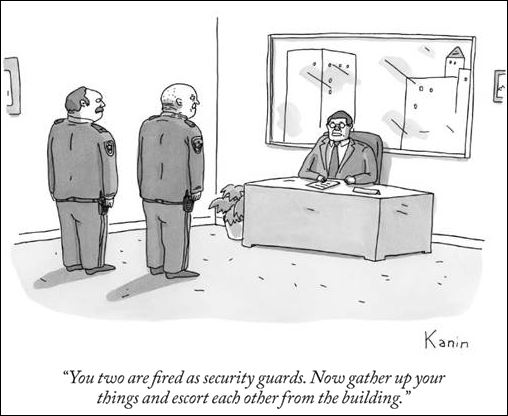

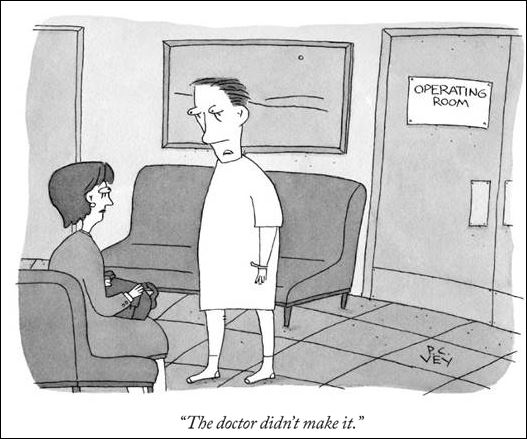

Harry Newton who hurt his leg trying to beat a 21-year old at tennis on a hard court. Better idea: next time play on clay or Har-Tru.
Higher bond yields are hurting stock prices. It’s hard to know what’s happening to bonds. I don’t believe interest rates are generally on the rise. But we do get little blips in bond prices and they spook share prices. Contemporary art looks like a better deal. I’m short EOG, but nothing else.

I agree life insurance is a huge waste of money if you have no serious financial obligations. I dropped mine several years back.
I much prefer real estate investments over stocks and bonds…more solid for the long term. If prices drop just wait for them to come back up. I did just make a modest 50K investment to fund a small factoring company in the Mental Health field, with a fellow that has made me a lot of money in that field in past years.