The statistics of world economic “growth” stink. Every country and their uncle are slowing down.
Greece is still a mess — though it will be solved — eventually. And it will be positive for stocksmarkets — but not right now.
My dearest friend emailed me:
Harry, I am changing my view on long term bonds today. I am going from bullish on bonds three notches down to neutral-bearish on bonds. The reasons are:
Inflation expectations are rising in Europe and the US.
Bond yields are rising in Europe anticipating a better economy and a pickup in inflation.
Oil prices and commodity prices have lost downside momentum and may find equilibrium here or higher.
Here’s the key point:
Further delay in raising the Fed Funds rate is now negative for bonds! Bond yields are rising because the Fed is waiting, not because Fed action is imminent.
Bond sentiment has shifted, and the market now expects inflation to rise inevitably as the labor market has tightened sufficiently. But the bond market knows that soft current conditions will keep the Fed from acting soon. And this allows inflation expectations to build. It explains why bond yields are rising even as the date of the first rate hike is getting pushed out due to soft economic data and low inflation data (depressed by oil and the dollar). Even though inflation in the US is still perfectly tame, inflation expectations are rising and that’s what matters to long term bonds.
Paradoxically, this is the signal the Fed has been waiting for to raise rates. But it will not act until it is sure that the sell-off in bonds in not just another head fake. Look at it this way: The Fed wants bond yields to rise when it lifts rates, not to fall. It does not want an inverted yield curve which could quickly trigger a recession. It wants the market to believe that it is just slightly behind the curve, reacting to and following rising inflation, not shutting it off. The ideal dynamic from the Fed’s standpoint would be a yield curve that is slowly rising – both long and short end together – but not inverting. The way to do that is to wait for bond yield liftoff, then shadow the rise slightly behind.
And I’m changing my stock view today too. I’m going from bullish on stocks down one notch to bullish-neutral. The reason is because bond yields are posing increasingly greater competition to stocks and because I think a sustained but gradual rise in Fed Funds will start within 3-6 months.
The organic food business remains hot, but now overly competitive. Whole Foods and Sprouts are down sharply this year.
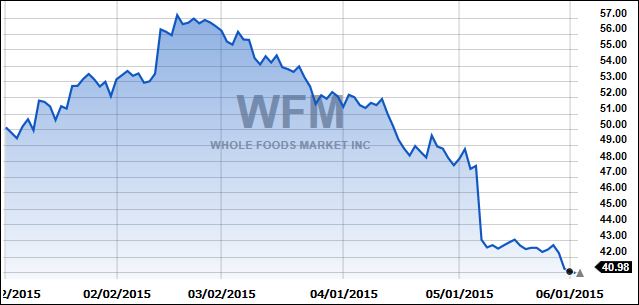
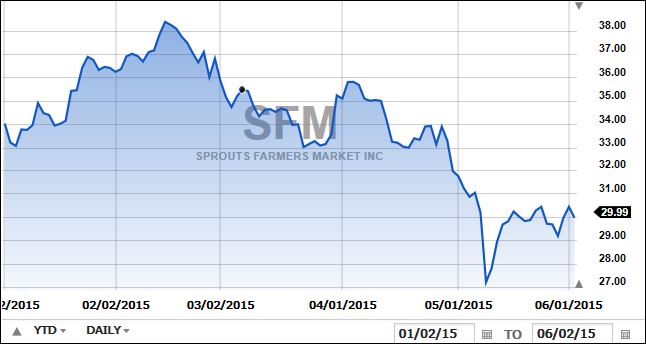
Costco has quietly surpassed Whole Foods to become the biggest organic grocer as it courts a younger demographic, according to one investment bank.
In an earnings call last week, chief financial officer Richard Galanti mentioned that the Costco’s sales of organic products exceeded $4billion annually – up from a previous $3?billion-plus estimate given last year — and now more than WFM.
More obsession with startups. This is a wonderful piece by favorite author New York Times David Brooks,
Is Motown Getting Its Groove Back?
Tom Kartsotis, the wealthy co-founder of Fossil, has no connection to the Motor City. He lives in Dallas, where he now oversees a handful of ventures he’s invested in. In early 2011, he decided to build a small watch factory that would sell high-quality watches that were priced, as he puts it, “at the entry point of luxury.”
He also wanted to make these watches in America. “So many big companies have sourcing infrastructures whose knee-jerk reaction is to head to China,” he said. He couldn’t compete with China at the low end of the market – nobody can. But he felt that the kind of watches he had in mind – priced between $450 and $600 at the low end, with a distinctive but classic design – could be made competitively in the United States. So he decided to put his new factory here in Detroit, a city once renowned for its manufacturing prowess that, in recent times, has needed all the help it can get.
That original idea turned into a company called Shinola. It has eight retail outlets and employs around 375 people, most of them in Detroit. Although those stylized watches are its biggest sellers – the company expects to sell between 150,000 and 180,000 this year – it also designs and makes bicycles, leather goods and other well-crafted, high-end products. Not only are those products built in Detroit, but Shinola also tries to buy the parts it needs from other American companies. Its leather, for instance, comes from the Horween Leather Company, a Chicago tannery more than a century old. Its bicycle frames are shipped from a company run by a fourth-generation Schwinn.
Although it was a philanthropic impulse that moved Kartsotis to set up shop in Detroit, it has turned out to be a very good business decision. The space Shinola needed to build its factory was cheap. There was also plenty of talent – engineers, for sure, but also former auto assembly-line workers, people eager to work who Shinola could train to be watchmakers. When I visited the watch factory recently, I saw rows of employees bent over their desks, focusing intently as they placed tiny, intricate parts inside the unassembled watches.
Indeed, to spend any time in Detroit these days is to be amazed at the extent to which it is humming with entrepreneurial activity. Dan Gilbert, the founder and chairman of Quicken Loans – which he relocated to Detroit – has bought more than 70 buildings and is converting some of them into office space for small businesses. There are other buildings with common work spaces and tools like 3-D printers than can be shared. The city’s government and, especially, its foundations are focused on helping people who want to start a new business. I spoke with a woman named Julie James, who, with her four sisters, manufactures a brand of juices they call Drought. It employs 32 people. Another company, The Floyd Leg, makes handsome, colorful legs for furniture; its work force is seven people. New companies like these are starting every day.
Kartsotis told me that “creating a few hundred jobs isn’t going to move the needle.” He’s right about that, of course. But, collectively, all these small companies do seem to be helping to bring Detroit back. Young people are moving in to the downtown and midtown areas. The unemployment rate is dropping. Once-abandoned buildings are being reoccupied. There are retail stores and restaurants that didn’t exist even a few years ago. Something very good is happening here, and it’s largely the result of private-sector activity. Kartsotis isn’t the only entrepreneur whose desire to come to the aid of a once-great city has turned out to be a smart business move.
If it seems clear that companies like Shinola are the way forward for Detroit, it is not so clear whether they are also the way forward for American manufacturing more generally. “I’m proud of what this company stands for,” Jacques Panis, Shinola’s president, told me. When I asked him just what that is, he replied: “High-quality manufacturing jobs for America.”
Shinola’s products are well-designed and made. They are selling briskly. But they are not cheap, and they’ll never be mass produced. I’ve written before about how even big manufacturers like Caterpillar and General Electric employ far fewer workers than they used to thanks to automation. Shinola offers a different twist on that idea. It’s not automation that is restricting the number of workers but rather the niche appeal of its products. I’m not sure its example is particularly replicable.
As for Shinola, Kartsotis is readying its next product: Shinola-style headphones that can compete with high-end models like those from Beats. He told me that he has just completed a round of financing and hopes to take the company public one day.
Which will be good for him – and Detroit.

Harry Newton who is at an angel seminar this morning. Neat stuff. The “cloud” (and some individual programming skills) allow the creation and growth of new companies. The cloud allows scalability — which every entrepreneur (and angel investor) want. It’s truly exciting.
