I don’t like funds. And I don’t like business cycles.
I can stay away from funds, not business cycles. (But I can handle business cycles with stop loss orders.)
Here’s yesterday’s notice from Goldman Sachs. It relates to my investment in their miserably -performing Vintage Fund IV LP.
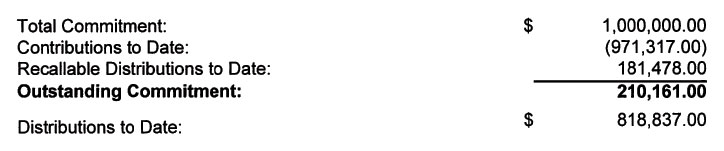
Now I’m not totally stupid. The pitch on this fund was two-fold. First, Goldman would invest in hedge funds they could buy interests in at a big discount. (Investors wanted out, but were locked in.) Second, previous Vintage funds had done well.
The fund closed on October 26, 2006. I put my first money in — $99,297 — on January 23, 2007. My last capital call was March 31, 2008.
Lehman Bros. declared bankruptcy on September 15, 2008. Most people see that date as the beginning of the Great Recession. My timing for my investment in Vintage IV could not have been worse.
But then, their “reporting” and performance has been even worse.
For example, I’ve gotten back 84% ($818,837 divided by $971,317) of my initial investment. How much is my remaining investment worth? Who knows? Will they ever tell me? They haven’t yet. They haven’t ever told me which funds they invested in. Which gives chutzpah a whole new meaning.
Think about Goldman’s miserable performance on this 9-year old fund. Look at the S&P over the past ten years. It crashed after Lehman crashed. But it’s back, big-time.
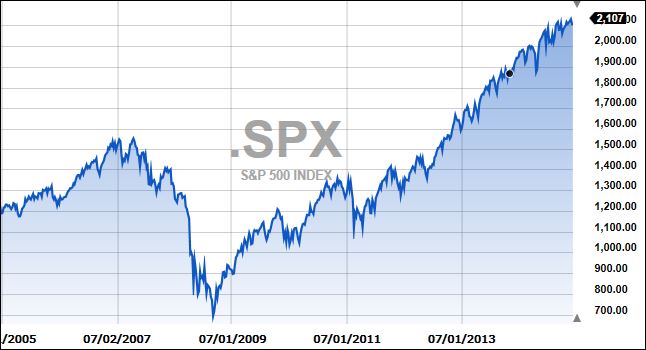
My Vintage investment should be way up. Maybe it is. But they’re not telling me.
That’s one of the benefits of running a fund — you don’t have to tell your investors anything. It’s called the mushroom strategy: Keep everyone in the dark, feed them a lot of organic bovine waste (i.e. bullsh**t) and harvest them (i.e. bring them into the real world) when they are truly ripe, i.e. when you’re ready to bring them out of their misery, or ignorance. The term derives from techniques used for growing mushrooms.
This morning my friend Waldo send me a clip from www.NakedCapitalism. Here’s the full piece:
CalPERS Admits It Has No Idea What it is Paying in Private Equity Carry Fees
As we’ve mentioned, many of the fees and costs that private equity investors bear are hidden from them by virtue of being shifted to the portfolio companies. For instance, private equity firms charge what Oxford professor Ludovic Phalippou has called “money for nothing” or “monitoring fees”. Many also charge “transaction fees” on top of the large fees they pay to investment bankers for buying and selling companies. The reason that those charges are opaque to private equity limited partners is that they have no right to see the books and records of the investee companies.
But surely limited partners like private equity investor heavyweight CalPERS know what they are paying in contractually specified fees, namely the annual management fee and the so-called carried interest fee, which is a profit share (usually 20%) which usually kicks in after a hurdle rate has been met (historically, 8%), right?
Think again. Private equity firms simply remit whatever they realize upon the sale of a company, net all those lovely fees and expenses (which include hefty legal fees) and any carry fee they think they think they are entitled to take.
Put it this way: if you were selling your house, would you hire a firm to provide a turnkey service (spruce up the house, negotiate the sale with a buyer, and take care of all the closing costs) and not demand an accounting of the gross price and what was deducted to arrive at your net proceeds? Yet it’s standard practice all across the industry for private equity investors simply to receive distributions with no explanation at all.
See the discussion from the investment committee section of the CalPERS board meeting. The presentation on cost management starts at 1 hour 55 minutes, and the section on carried interest begins at 2 hours 6 minutes, and the CalPERS staff member making the presentation is Wylie Tollette, Chief Operating Investment Officer.
Amusingly, Tollette starts his talk by referring to one of CalPERS’ investment principles, “Costs matter and need to be effectively managed.” You’ll see shortly how CalPERS is in flagrant violation of its own lofty beliefs.
Tolette discusses how CalPERS implemented a cost reduction effort in 2007 and the recent results on metrics the staff has defined as important. Board member JJ Jelincic leads off the questions at 2:06 (emphasis ours):
Jelincic: The external management fee, profit sharing line, second one down, that does not include private equity.
Tollette: That’s correct. That does not include private equity. That includes real estate and ARS for the Absolute Return Strategy, which was fully in effect through the fiscal years in question, and a few that exist in the Global Equity Program.
Profit sharing in the private equity market, in fact the whole private equity industry, it’s embedded in the return. It’s not explicitly disclosed or accounted for. We can’t track it today. That’s — as you know, that’s part of the effort around the PEARS project, which I’m going to touch on in a few slides, as well as requiring additional disclosure by the private equity managers in order to track incentive fees in the same way that we can across the other asset classes.
Jelincic: But if you can’t track them, they’re kind of hard to manage, and that kind of goes to costs matter and goes to the fact that we’re current on the fees.
Tollette: They — it’s an industry challenge in the private equity space, where the fees that — the carried interest or the profit sharing fees that are accrued and retained by the management firm, that’s not just a CalPERS issue, that’s an industry issue. And we’re trying to put in place the tools, so that we can have better disclosure and understanding of what they are.
Understand what is going on here. Tollette is trying to blunt Jelincic’s questions by saying that CalPERS is getting a new computer system in place that will have the data fields that will enable them to capture these fees. That’s an admission that the information service that CalPERS used and much of the industry still uses, Private Edge, didn’t even attempt to capture this information. Why have empty fields for information you don’t get? So Tollette is acting as if having the ability to record the data someday, down the road, is tantamount to actually getting it. There’s no reason to thing that the general partners will provide this information unless CalPERS starts demanding it in negotiations when it invests in funds. We’ve seen nothing in the private equity industry press reports or CalPERS board presentations to suggest that CalPERS has even tried to negotiate these changes, much the less had any success.
And these omissions are material. Jelincic again, at 2:20:30:
Jelnicic: It’s not even disclosure. It’s not knowing. It’s really hard to figure out what we are paying in carry. My guess for that year, based on tidbits here and there, is a rather narrow range of somewhere between 600 and 900 million dollars, which is at least twelve times what we are paying staff for the total fund. It’s a big number, and we don’t really know what we are paying, and I find that frustrating.
We’ve found it hard to convey how badly captured limited partners are, and this example hopefully provides a sufficiently vivid illustration. Here, CalPERS, supposedly the most seasoned and savvy investor in private equity, is flying blind on how much it pays in carry, while going through the empty exercise of meticulously tracking its woefully incomplete tally of visible charges. This is a garbage in, garbage out exercise as far as private equity is concerned. Moreover PE real (as opposed to visible) fees and costs are so high that it means that CalPERS claims about its fees and costs across its entire portfolio are rubbish.
Let us put it another way: if you found an aged parent had given money to a fund manager who had the same degree of latitude that private equity firms have to charge fees and expenses and not account for them, you’d not only seek as quickly as possible to get the money back from that manager, you’d seek to take that parent’s checkbook away because they were obviously incapable of managing their investments responsibly. Yet the same sort of recklessly trusting conduct is accepted as perfectly normal by major fiduciaries. Time for state legislatures to wake up, smell the coffee, and start asking some tough questions.
There’s a video clip in the article. To see it go to the article.
Impressions and tips (so far):
1. It’s light. It doesn’t weigh my arm down.
2. The screens are beautiful. I like the watch face I chose. There are many to choose from. Changing faces digitally is easier than buying a new watch.
3. Do not put a passcode on the watch. You have the choice. You don’t need it. A passcode is a total pain. It works fine without a passcode.
4. The shorter wrist band is easier. It comes with a “normal” and short band. It’s easy to change bands.
5. Notifications are essentially what the phone is about. Texting is unreal. A text comes into your watch. You feel a pleasant touch. You can respond with three boring canned messages. Or, far better, you can talk your message to the watch. You then send your message either as a voice file or — wait for this — a text file. The phone has magically converted your spoken words to text which your recipient can read. It’s not always 100% accurate. But it’s accurate enough for them to get your message. And it’s true magic.
6. When your phone rings, so does your Watch. You can actually answer the call and speak on your watch — Dick Tracy style. It’s not as clear as speaking on your iPhone. But, it’s a lot easier than dragging your iPhone out of your pocket or bag. It’s perfect for “I’m running late. See you in ten minutes” type of conversations.
7. Basically all your apps on your phone now work on your watch. Some work even better. Uber has an Apple Watch version of its software that’s just plain superb. Why anyone would use a taxi, when you have Uber beats me. We took Uber to the theater last night. It was cheaper than a yellow taxi. And Uber arrived fast — much faster than we could hail a taxi.
My Apple Watch is the space gray aluminum with a black band. It’s perfect. It’s light and comfortable. I don’t need the heavier steel or, God forbid, the gold one. it comes in two models.
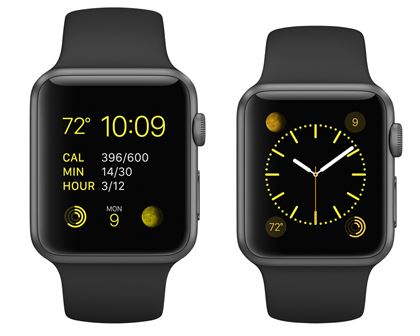
Mine is the bigger one. My face looks like the phone on the right. But I’ve made it brighter. It has the day and date. It shows my events today, the local temperature and how much battery is left. I like customizing.
I believe the Apple Watch will boost Apple’s earnings. But not until much later this year when they figure out how to deliver them quickly. To get mine, I had to beg an Apple VP with a barrage of snail-mail letters.
Just in: The New York Times reports:
On Monday, Apple will begin its annual developer conference, where the company is set to release new tools for software developers to create smarter apps that will gain deep access to the Apple Watch’s heart-rate and motion sensors, among other components.
“It feels like we have both our hands tied behind our backs, and that’s why you haven’t seen anything really impressive,” Phillip Ryu, a founder of a company that makes mobile games, said about apps for the watch, which was released with around 3,500 programs. Now, “it sounds like they plan on untying our hands.”
Apple (AAPL) is definitely going to $140.
The tick season is upon us. Ticks bring awful diseases. They are everywhere, not just in the North-East. Lyme Disease is horrible. It’s hard to diagnose. Its symptoms are debilitating. I know several people who’ve had it several times. Now they are but a shadow of their former selves. Read more about horrible tickborne diseases and how to protect your family. Click here.
You must see Fish in the Dark on Broadway.
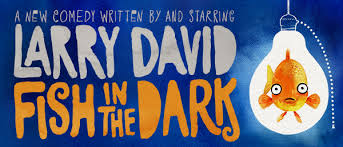
Sunday night is the last night to see Larry David in his hugely-successful comedy. We saw it last night. It’s wonderful.
Dick Fuld returns to Wall Street. This is Vanity Fair’s piece on Dick Fuld’s speech last week. It’s amusing, and very annoying. Remember this is the man who caused the biggest bankruptcy in American history, had a major hand in creating The Great Recession, which we’re only now pulling out of, and now lives in big-time luxury, with multiple houses, etc.
Dick Fuld’s Return to Wall Street Was Hard to Watch by William D. Cohan
Try as one might, there was no escaping the theater-of-the-absurd aspect of Dick Fuld’s appearance as the keynote speaker at a conference that he would not have been caught dead at when he was in his prime. Here, on May 28, in front of 1,500 or so small-time investors gobbling down filet mignon and chatting among themselves at the Grand Hyatt hotel, on 42nd Street in New York, was the former Wall Street titan attempting to relieve himself of the emotional and psychological burdens of wrecking his company. “And by the way, all of you, please continue to eat,” he said at the outset. “My children always ate all the time when I was talking, so I’m used to this.”
Looking none the worse for wear, nearly seven years after presiding over perhaps the most calamitous disaster in American financial history-the shocking bankruptcy filing (and subsequent liquidation) of Lehman Brothers (1850-2008, R.I.P.)-he still dressed in his signature starched white shirt and blue tie, and he still had the same stony-eyed glare that won him the nickname “The Gorilla” during his 14-year reign as chairman and C.E.O. of Lehman. Trying to justify the unjustifiable, he seemed nearly oblivious to the bizarre surroundings.
That’s what happens when you are a man on a mission. His goal? To say as little as possible about Lehman’s demise and his role in it, and yet justify the hype surrounding what Marcum LLP, the accounting and financial advisory firm that sponsored the event, billed as Fuld’s first public appearance since Lehman imploded. “I don’t include my wonderful time with Congress”-in October 2008-as a public event, he said, referring to the hostile grilling he got there. No one laughed. Fuld, now 69, has been aggressively unavailable since Lehman’s collapse, hiding behind his fortune-likely in the hundreds of millions of dollars-his mansion in Greenwich, Connecticut, and elegant spreads in Jupiter Island, Florida, and Sun Valley, Idaho, and behind his difficult-to-reach new firm, Matrix Advisors.
But here he was in the flesh. “I thought it was time,” he said. “You know? Time for me to raise my ugly head.” (Fuld donated his fee for the talk to the Harlem Children’s Zone.)
The key thing to remember about what happened to Lehman, Fuld said, was that everyone and everything else was to blame. “What led to the ’08 crisis?” he asked, rhetorically. “First, there’s the buildup of the U.S. bull-market mentality.” Hard to argue with that. “Now, I’m going to try to run through these quickly,” he continued. “It’s not just one single thing. All these things taken together-I refer to it as the perfect storm. But it starts with the government.”
The government? Yes, Fuld (and plenty of other financial leaders, it must be admitted) blames government policies that encouraged people to buy homes. “They wanted everybody to be able to fulfill their view of the American dream,” he chided. “We had low rates, easy access to credit. That led to increased home values, household debt, people borrowed a record amount of money, and as rates went down further, people refinanced, they used their homes and the increased value in their homes as ATM accounts.” Yes, the people were also to blame.
Not to mention the global economy. Between 2002 and 2007, Fuld said, there were “huge” increases in the prices of “hard assets” and “financial assets.” According to Fuld, global G.D.P. increased to $74 trillion in 2007, from $45 trillion in 1999, an increase of 65 percent. In the United States, G.D.P. increased to $14 trillion, from nearly $10 trillion, a 40 percent increase. “We had low unemployment, just 5 percent, and an increase in hourly earnings,” he said.
Fuld also noted that the swelling of the coffers of Wall Street’s Masters of the Universe far outpaced G.D.P. growth. Private-equity firms, he claimed, had $800 billion under management in 2008, up from $300 billion in 2000. There were 4,000 hedge funds with $500 billion in assets in 2000, Fuld said; eight years later, there were 10,000 hedge funds with $1.8 trillion under management. Sovereign-wealth funds exploded. All this money had to be put to work. That’s when investment banks, like Lehman, stepped up with “innovative” products. They expanded their balance sheets, offering loans and other investments. With interest rates so low, investors were looking for higher yields, which Wall Street was only too willing to provide as well. And guess what? “There was very little regulation or market supervision,” he said. He made no mention of the fact that Wall Street eagerly packaged up risky mortgages and sold them off as higher-yielding investments after paying the rating agencies to label them “AAA,” when, in fact, they were anything but. Indeed, Fuld made no mention of anything Wall Street did wrong in causing the crisis.
Instead he blamed the Fed for raising interest rates, choking off the party as it was just getting started. (Actually this is exactly what former Fed chairman William McChesney Martin said, in 1955, was the Fed’s main role.) Homeowners could no longer refinance their homes; worse, they could no longer pay their mortgages. Overleveraged banks stopped lending to companies, which in turn curbed hiring, capital expenditures, and acquisitions, Fuld said. Firms cut expenses and fired people. It was, he said, “a self-fulfilling economic loop” and “the rest is history.”
Fuld reviewed the collapse of Lehman as perfunctorily as he could manage. “Lehman was not a bankrupt company,” he said. Then there was a none too subtle jab at former Treasury secretary Hank Paulson, and then president of the New York Fed, Tim Geithner, who would not bail out Lehman, as they did the giant insurer A.I.G. a few days after Lehman failed, claiming that Lehman did not have assets against which a loan could have been secured. “Time to move on,” Fuld said, reaching for a glass of what appeared to be Diet Coke. “God, there’s so much I’d love to say,” he added. But he didn’t.
He did reminisce about his career at Lehman, especially the overarching sense of camaraderie and partnership among the top men at the firm. (Alas, there were very few women.) “The real success for the firm, the real success for Lehman Brothers in my view,” he said, “and the key differentiator, was our culture. And for me and for all those that participated, it was all about the team. My people were in it together and our clients knew it. There was no turf. There was no, `It’s my account.’ There was no, `I’m the star so pay me.'”
Fuld delivered this idyll without the slightest bit of irony, even though, as was documented in Ken Auletta’s classic book about Lehman, Greed and Glory on Wall Street, the firm was notorious for its infighting. Fuld became infamous for feathering his nest while at the firm, to the tune of some $550 million in overall compensation, between 2000 and 2007, according to Oliver Budde, a former Lehman attorney turned whistle-blower. Budde, who has documented Fuld’s greediness and his deception about his overall compensation, e-mailed me: “Fuld’s comments were the plaintive cries of a man begging to be understood. Or the ravings of a madman. . . . Same lying, deluded asshole he’s always been.”
Later, in the brief question-and-answer period, Fuld realized there was a discrepancy between the reality that was Lehman Brothers and his gauzy recollection of it. “It’s wonderful for me to talk about the culture and how it was and how terrific it was and my people were in it together and we were a team,” he said, “but then you have the right to ask me, `Then, O.K., if it was so great, then what happened at the end? What happened at the end where the fabric of that team got frayed?’ . . . All I can say to that is that survival instinct took over.”
After reading from a list of homilies that included “Do your homework and take smart risks,” he conflated a famous quotation from Vince Lombardi with one from Rocky Balboa. “What did Rocky say? `It’s not how hard you hit, but whether you get up after you’ve been knocked down.’ I love Rocky.” He continued, “It’s about losing and then being lost or losing and learning from that. . . . What does Sigmund Freud say? `You can say whatever you want about me. I’m O.K. because I know my mother loves me.’ My mother still loves me. She’s 96.”

Harry Newton who’s seen a huge number of impressive startups in recent days. More on some tomorrow. Sorry, I’m late this morning. This stuff often comes together at the last moment. Stocks are down today. Good buying opportunity. Greece will be solved — either they stay in or get out. Then markets will pop nicely. Today’s uncertainty takes it toll on squeamish investors.
