Payroll data this morning was good. Normally, good payroll would be good for the market.
But the Greek mess festers, Europe is slow, China is slowing down. The dollar is high. Interest rates are skyrocketing. Bond yields are rising. Bond prices are plummeting, and the Fed is dithering about inching up interest rates.
Hence we have uncertainty. Stockmarkets don’t like uncertainty.
This weakness won’t last. Stocks are on sale. Go shopping.
I nibbled at Dow, CRM and more of FEYE. I’m eyeing weak stocks, but good companies. That does not include BRKA, which is good, but I have enough of. It does include Apple, which is cheap.
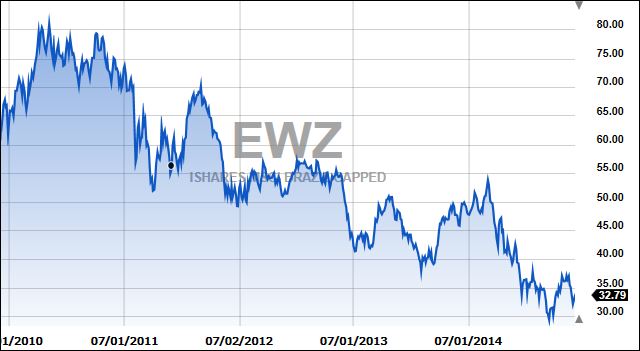
Brazil is in a funk. Possibly coming back, according to my friends. Perhaps worth a small gamble?
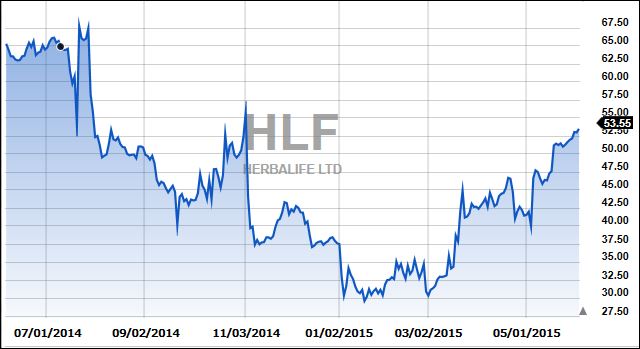
Herbalife scam or real company? The company says it’s not.Hedge fund guru Bill Ackman says it is an illegal Ponzi scheme, He’s made a huge short bet against Herbalife. Lately the company is winning and he’s losing.
This is Bill Ackman. He’s young, and succcessful (a billionaire) and very impressive. I heard him pitch his case against Herbalife at the Robin Hood Conference It was impressive, chock full of amazing research. the Times captioned this photo “William A. Ackman has lobbied federal authorities to bring Herbalife to its knees, an outcome that would reap a windfall for his hedge fund. “

The battle between the company in Ackman has recently gone all out. For a blow-by-blow, read the New York Times’ piece on piece on it, called “Bruised Herbalife Swings Back at an Accuser.” Click here. I’m staying well away from this. My motto remains: When in doubt, stay out.
I completely missed the recent China stock boom. But then I’ve never understood Chinese stocks. Recently they’ve exploded unbelievably. Here’s the amazing story from the New Yorker’s James Surowiecki:
Market Madness at the Shenzhen Exchange
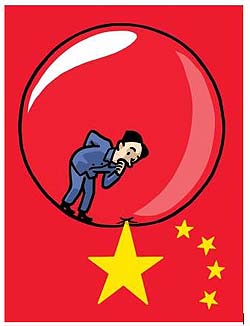
Last week didn’t start well for Beijing Baofeng Technology Company. An online-video company whose products include a cheap virtual-reality headset, it saw its stock tumble twelve per cent over two days of trading, after Chinese regulators said that they were looking into possible share-price manipulation on the ChiNext board of the Shenzhen Exchange, where Baofeng trades. Still, Baofeng shareholders can’t really complain. The company went public just two months ago, and in the first thirty-four days of trading its stock rose by ten per cent every single day except one. Even after the recent stumble, Baofeng is up twenty-five hundred per cent this year.
Baofeng isn’t an outlier, either. Of seventeen hundred stocks on the Shenzhen Exchange, only four have fallen this year, and more than a hundred have seen their shares rise more than five hundred per cent. The Shenzhen Index as a whole has doubled since January, and is up more than two hundred per cent in the past year. The action on China’s other major stock exchanges—in Shanghai and Hong Kong—hasn’t been quite as torrid, but they’ve had their share of extraordinary winners. The Shanghai Composite Index has risen a hundred and forty per cent since this time last year. In Hong Kong, Jicheng Umbrella Holdings (which makes, yes, umbrellas) went public in February: its shares are up almost seventeen hundred per cent.
There’s something weird about these success stories, because these are tough times for the Chinese economy. The government has pegged this year’s G.D.P. growth rate at seven per cent—the slowest rate in decades—and independent studies suggest that the real number is well below that. Exports, which are almost forty per cent of the economy, fell fifteen per cent in April. Industrial earnings fell, too, in the most recent quarter. The country is also facing the fallout from a huge borrowing spree—between 2007 and 2014, the total debt load quadrupled. A McKinsey study suggests that Chinese companies are currently spending more on interest payments than they are earning in profits. This should all be bad news for stocks. Yet prices just keep going up.
Why the disconnect? “China has never been a market driven by economic fundamentals,” Michael Pettis, a professor of finance at Peking University, told me. “It’s always been a speculative market.” In most markets, you have a mixture of fundamental investors, arbitrageurs, and speculators. But in China the dearth of reliable macroeconomic and corporate data makes it very hard to be a fundamental investor. As a result, Pettis said, “the market is dominated by speculative investors. They buy when they think something is going to happen that may drive prices up tomorrow.” Right now, credit is easy, and the government is doing all it can to keep the market booming, by cutting interest rates and increasing spending. So speculators are buoyant, and they’re buying.
Speculative markets can meander along, as China’s did between 2010 and 2014. The danger is that, when they start to boom, they take on a life of their own and you end up with a bubble. As Robert Shiller, a professor of economics at Yale and the author of “Irrational Exuberance,” puts it, during a bubble “news of price increases spurs investor enthusiasm, which spreads by psychological contagion from person to person,” drawing in more and more investors, who buy simply because they believe that others will buy, at even higher prices, tomorrow.
That sounds a lot like China today. The market’s ascent has been propelled by a flood of new money, much of it from inexperienced investors. Fourteen million new trading accounts were opened last year, and, according to one study, two-thirds of those who opened accounts never finished high school. Investors are also increasingly relying on borrowed money to buy stocks, which hugely amplifies the risk of investing. Either these investors don’t see the Chinese market as precarious at all—a quintessential sign of a bubble—or they believe they’ll be quick enough to avoid the crash. Pettis told me about acquaintances who have been speculating: “They’re aware of the risks, but, as one said, ‘I’m going to get out before it starts to fall.’ ” Then, too, Shiller has argued, the media plays an important role in inflating bubbles, and, sure enough, last fall China’s government-controlled press ran a series of pieces claiming that the Chinese stock market was undervalued and due for a rally.
Some observers have made the case that the boom will continue, because Chinese investors have notably few places to put their money. Their ability to invest abroad is sharply restricted, and Beijing has recently made it harder to invest in real estate. Be that as it may, once stock prices start tumbling, money will quickly head elsewhere, even if it’s just under the nearest mattress. And, while the government has been doing all it can to support the market, there’s a limit to what it can achieve. In 2007, prices on the Shanghai Composite Index were higher than they are today. But even though the government was firmly behind the market, and there was plenty of liquidity, the boom ended, and the following year stock prices fell sixty-five per cent. Even if the government succeeds in keeping the Chinese economy on a steady growth path—no mean feat—the fact remains that Chinese stocks are no longer priced for steady growth. They’re priced for a huge boom that will likely never come. In the end, even in speculative markets, fundamentals have a way of asserting themselves, and, when they do, no umbrella maker in China is going to be worth $1.2 billion.
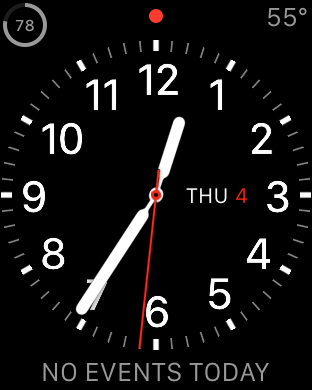
My Apple Watch face: Pretty neat? The 78 means 78% charged.
I love its notifications: Texts come in full. Emails are truncated. You can see the full text on your phone. Maps are amazingly clear and useful. Uber is great. Weather forecasting is great. You can set alarms. You can make and receive phone calls on the Apple Watch. That’s truly amazing. Like Dick Tracy. There are dozens of apps I’m still playing with and there’ll be more coming out in coming months.
This is a video game for adults. Endless fiddling, fun (and time wasting). All my friends are jealous I have one and they don’t. Not for long. The Watch will be available for sale (and delivery) in Apple stores in a couple of weeks.
Useful tips:
+ Email addresses and log-on IDs are not case sensitive. But passwords are. Keep a file of your passwords and email addresses.
+ 100 Ways to live to 100. Some of these tips from Men’s Journal are useful. Like eat more nuts. Click here.
+ My Fujitsu ScanSnap scanner is increasingly useful. Best investment I’ve made in eons.
+ Never pay retail — especially at Gap stores, like Banana Republic which I like. Want 40% off from June 10-14? Use the code SUNSHINE at checkout.
+ You can always cut your cable or wireless bill by telling the phone operator you’re considering switching to their competitor.
My favorite Henry Kissinger quote:
There cannot be a crisis next week. My schedule is already full.

Harry Newton who’s looking forward to a peaceful weekend catching up on reading, and playing plenty of tennis.

fwiw, we got rid of our scanner after my wife got genius scan on her phone. You may have more technical needs but it’s all we need. We send pdf docs over the phone all the time with it, super handy. Cheers, RickH
Discount: which one Harry? Gap or BR?
all.