When things look good to everyone, it’s the worst time to buy. However the market is climbing a wall of worries — chiefly unemployment, deflation, sovereign debt and Europe — and some people are loading the boat:
An example of a bear turned suddenly bull: Richard Russell writes:
Question — Russell, how can yo be bearish and in a few weeks change your mind?
Answer — I base my opinions on the action of the stock market. When the stock market changes its position, I change mine. To do anything else would be a nasty disservice to my subscribers. When the facts change, I change. That’s a major part of my job, and why I’ve been able to stay in business since 1958.
Many speculative-minded subscribers may think it very worthwhile to speculate here. For them I recommend a position in DIAs with a mental stop loss around 8% below your purchase price.
Meantime, my man Pete Rawlings emails me, “VectorVest’s market timing indicator has been climbing up the wall of worry again along with the market. Today it just went back over the tenth step of the 20 step ladder, so I believe VV will be giving a buy signal soon, so get your shopping list ready. If you’re still not confortable buying and selling covered calls just buy a little of what you like and use tight stops because IMO this market is going higher. Most companies are kicking butt making profits in this economy. Go figure!”
What’s going on with corporations? Thjis is James Surowiecki’s latest financial piece from the New Yorker.
Blame Games
The U.S. economy is limping along. The job market is in rotten shape, and business investment is hitting historic lows. And, if you’re looking for a culprit for this dismal state of affairs, many businesspeople would be happy to point you to the White House. Companies aren’t hiring or investing, businessmen say, because the combination of Barack Obama’s anti-corporate attitude and a blizzard of new regulations and proposed taxes has created what Ivan Seidenberg, the C.E.O. of Verizon, calls “an increasingly hostile environment for investment and job creation.” In a recent Newsweek column, Fareed Zakaria pointed to the fact that Fortune 500 companies are sitting on a cash hoard of $1.8 trillion, and suggested that a “profound sense of distrust” might be why they weren’t spending it.
There’s no doubt that Obama is unpopular in the business world. On Wall Street, he’s persona non grata, thanks to his push for financial reform and his rhetorical sallies against fat-cat bankers. Private-equity managers hate him for trying to take away their lucrative carried-interest tax break. The Chamber of Commerce has attacked him for having “vilified industries” and enacted “job-destroying regulations,” while the publisher and real-estate investor Mort Zuckerman declared that Obama heads “the most hostile administration to business . . . in decades.” Some of this is just political posturing—when haven’t businesses wanted less regulation?—but it also reflects a real conviction among American businesspeople that Obama has made profit seem like a dirty word.
Set aside the question of whether there’s anything to these charges. From an economic perspective, the important question is whether such perceptions are really what’s keeping the economy in neutral. Those who think that they are say that “uncertainty surrounding regulations and taxes,” as Zakaria puts it, is making business hold back. But uncertainty is a fact of business life, and the impact of new regulations on most companies has been overhyped: unless you’re a financial-services or health-care company, Obama’s initiatives aren’t remaking your business. In fact, Wall Street and health care are among the few industries currently adding jobs, which suggests that new regulatory burdens aren’t the cause of sluggishness. In surveys, meanwhile, fewer small businessmen cite regulation as their biggest problem today than did in the boom years of the nineteen-nineties.
There’s also a pervasive feeling that Obama’s tone—as evidenced by tough rhetoric against Wall Street and BP—is dampening the spirits of business leaders, making them unwilling to take risks. The implicit idea here is that when businesspeople feel poorly treated they’ll just take their ball and go home, even if that means giving up chances for profit. This isn’t a completely crazy idea: as Keynes argued, “animal spirits” play an important role in driving business decisions, and there are historical examples of so-called “capital strikes”—where investors pulled capital out of an economy in reaction to anti-business policies. But there’s no evidence that anything like this is happening in the U.S. right now. Corporate profits are healthy. Investment may be low, but, given how slowly the economy is growing, it’s about where you’d expect. If businesses truly were holding back on hiring new workers or building new plants in the face of real opportunities, we’d see them working their current employees and factories to the limit. But they aren’t: weekly hours worked have scarcely budged in two years, and factory usage is at just seventy per cent of capacity, which is historically quite low.
If businesses aren’t hiring or investing, in other words, it’s because they don’t need to: they have enough workers and factories to meet the demand for their products. And there are few signs that this is going to change any time soon: consumer demand remains weak, economic indicators—inflation rates, consumer confidence, the stock market, bond rates—aren’t forecasting a quick return to boom times, and, just last week, the Fed chairman, Ben Bernanke, told Congress that the state of the U.S. economy was “unusually uncertain.” So it’s no wonder that companies are feeling cautious. The uncertainty that’s keeping businesses from spending or hiring isn’t uncertainty about what Barack Obama is doing or saying. It’s uncertainty about whether the economic recovery is going to stick.
As for that $1.8-trillion pile of cash that companies are sitting on, it isn’t a new phenomenon but part of a long-term trend. Companies have been saving more and spending less: according to a study by the economists Thomas Bates, Kathleen Kahle, and René Stulz, cash holdings doubled relative to assets between 1980 and 2006. Global competition has made business riskier, and companies remember all too well the pain of the recent credit crunch, when even the safest companies found it hard to borrow money. At a juncture like this, who wouldn’t want a cash cushion?
The impulse to blame Obama for all this corporate timidity is understandable: aside from the fact that plenty of businesspeople don’t like his policies, it would make things so much easier if a President could jump-start the economy just by making the suits feel better. But the attacks reflect the same blind faith in Obama’s powers that the hero worship of his election campaign did. As the political scientist George Edwards showed in his masterly study “On Deaf Ears,” people vastly overrate the influence of the bully pulpit: in most cases, the capacity of a President to change voters’ opinions is slim, and there’s no reason to think that he has any more influence over corporate executives. A different President isn’t going to get businesses off the mark. Only a different economy will.
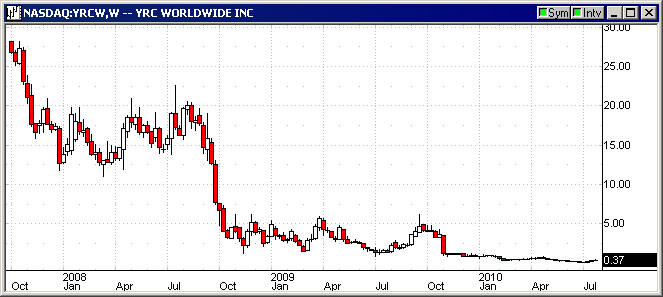
Speculation of the week: YRC Worldwide Inc. (YRCW) is the old yellow trucking company. It hasn’t been a pretty ride. But it’s back from the brink. This is a weekly chart.
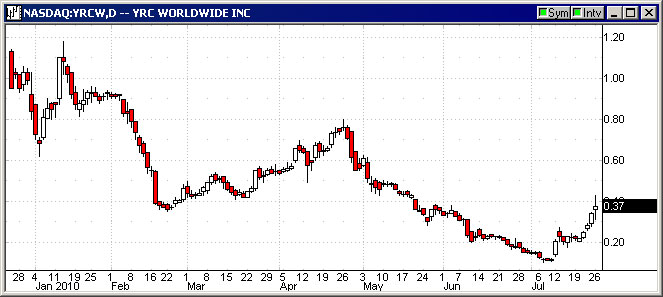
This is a daily chart, showing the recent bounce.
Tranport companies like FedEx are doing well. Read more about YRCW at the Wall Street Journal.
Ten things I’ve learned recently:
1. The less I eat, the better I feel.
2. The more exercise I do, the better I feel and the better I function.
3. I should do all the things my family tells me, including giving up Coca Cola (too much sugar), standing up straight (because crooked looks “old man”) and eating “properly” (which means vegetables and rabbit food).
4. Saying No still works. It saves time in the future. Every time I say Yes, it takes five times as long as I originally thought.
5. The first time takes forever. The second time is quick. Unfortunately, there’s often not a second time.
6. The more technology I have, the more there is to go wrong. And it happily obliges. Modern, expensive cars are unreliable.
7. I don’t have all the answers. In fact, I don’t have all the questions. But Michael, my all-knowing son, has accepted Daddy’s recommendation to wear a corded headset when using his BlackBerry. He’s worried about what his BlackBerry’s radiation might do to his brains 20 years out. Good thinking. Good news: Daddy will be here in 20 years to continue nagging.
8. Buying overseas investments carries huge exchange risks. I sent money to an Australia bank when the Australian dollar was 96 cents. Despite climbing back to 90 and despite the 6% interest rate I’m getting from Westpac, I’m now just breaking even — many years later. Stupid!
9. I should stop rebuking myself for being dumb. I should stop trying to be smart. Muni bonds remain a great dumb investment.
10. No investment advice I’ve ever received has ever panned out — with rare exceptions. My friends have no idea what they’re doing. Gurus who go on BubbleVision are trying to sell me something, Otherwise why would they waste their time appearing on CNBC when they could be playing tennis in the Hamptons?
Bonus tip: Agonizing about doing it is much worse than actually doing it. Just do it. Nike was right.
Your children should learn about sales, and (God Forbid) marketing. They teach pretty useless skills in school. They don’t teach you how to sell yourself and your products, or deal nicely with your customers. Every kid ought to be forced to read Dale Carnegie’s “How to win friends and influence people,” amongst other classic sales books. I deal with companies who are nice to me. I run away from companies who aren’t. Why don’t they learn?
So the iPhone 4 has antenna issues? Maybe deliberately so? Apple’s antenna issues have generated more PR buzz than Carter had Liver Pills.
Latest: Some wag is selling stickers you affix to your iPhone’s antenna — the part you’re not meant to touch. He’s selling three stickers for $4, allegedly.

Meantime, the best part of his sticker is the photo. It’s funny.
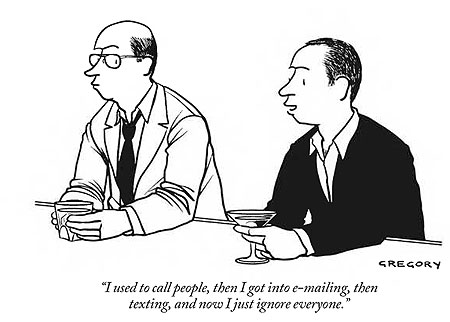
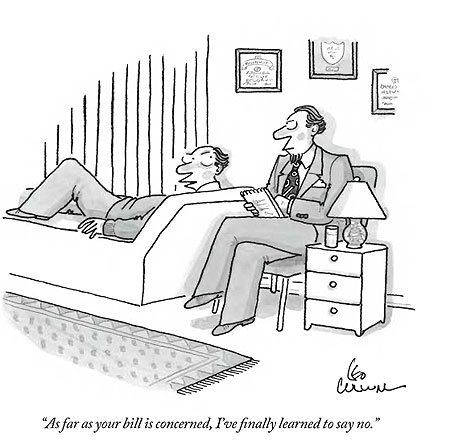
Best of this week’s New Yorker cartoons:

Harry Newton is having a wonderful time re-sending the IRS his 2008 return, again and again and again. They won’t take it electronically. Does the Obama administration also own the paper industry?

But it gives you is a GPS device that covers the basics very well, is very affordable, and has been updated with more features than the models of entry-level competition. So, if you have a GPS mode, which is probably the father of all need right now.
Poor Harry,
As Written on 4/6/2009
“The IRS lost one our returns, too.
Got the check, but lost the return.
Had to resend it at least six times over three years.
You might as well make extra copies now and have them ready for mailing,
so when you get the semi-annual notice you can just drop the return in the mail.
Alternatively, you could offer them carbon credits if they make the effort to find the first one you sent.”
Sooo…
How many copies did you make on 4/6/2009?
In Texas, grinning while commiserating with your misery.
P
I think that was for a different year. Someone is going to get rich selling the IRS a filing system.