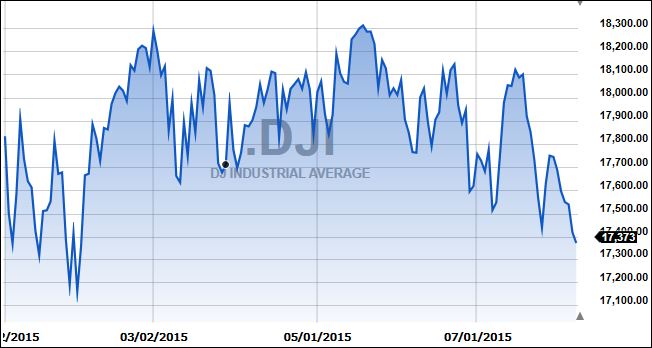
I don’t like what I’m seeing. Should I sell all my stocks and go 100% to cash? That’s the thought I wrestled with all weekend. I made a list of all the messes in the world — from slumping commodities to slowing China — and concluded the flow of money that has buoyed our stockmarkets since 2009 is evaporating and will no longer be with us. That means our markets must fall. Whether our markets will drop 23% in one day (e.g. 1987) or whether they just keep sliding I don’t know. This is Dow year to date. Note the slide:
I don’t want to lumped with people who make a living out of doom and gloom, also called “pessimism porn.” I read all their amazing forecasts on the weekend. Everyone is forecasting a huge drop some time in the Fall. One of them even picked a date.
Let’s call The Flow of Money macro-stock market economics. Let look at some of the micro-elements affecting it:
+ Slowing China’s economy and the drop in the Shanghai stock market. At one stage the Chinese were huge buyers of real estate in Western Canada, California and New York.
+ The precipitous drop in commodities prices. Oil. Coal. Copper. Gold. Iron ore. Nickel. I could fill a book showing awful charts.
+ When commodities prices fall, lots of awful things happen — including a default on bonds (15% of junk bonds are energy related), bankruptcies of producers (several coal producers have already gone Chapter 11). When one quadrant of our economy suffers, the other quadrants no longer enjoy their excess monies.
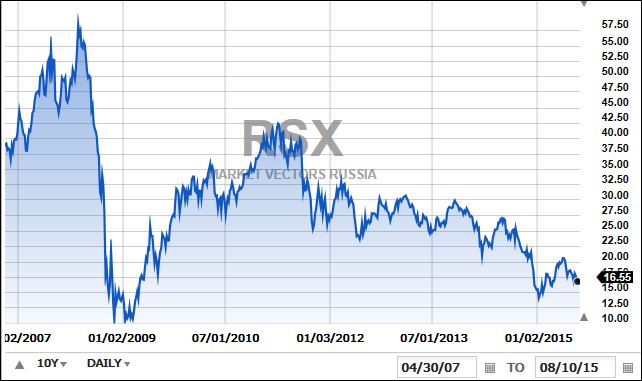
+ Erstwhile fast-growing economies are now in big trouble. Check out the the ETFs of Brazil (EWZ), South Korea (EWY), Malaysia (EWM) and Russia (RSX). I’ll publish these charts tomorrow. Suffice, many are below their awful 2007-2008 levels. Here’s Russia, for example:
+ The dollar has climbed and climbed. It’s nice if you’re an American tourist in Australia, or Europe. It’s cheap. But it’s awful if you’re a European who wants to buy American stocks. They’ve suddenly become very very expensive.
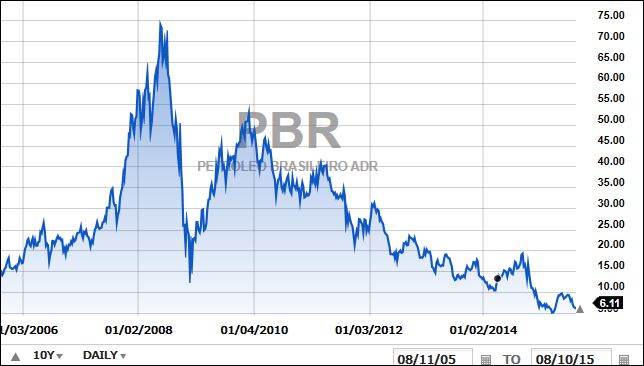
+ Stocks in the miners have not done well. Freeport-McMoRan, the copper giant, down 69% in the last five years. BHP, the big diversified miner, down 45%. Vale, the Brazilian giant, down 80%. Teck Resources, once an $80 stock, trades for just $7. Here’s my favorite short, the Brazilian Petrobras:
+ American earnings aren’t hot. According to Mitch Zachs, senior portfolio manager, As of this writing (a few days ago) 399 of the S&P 500 companies have reported and total earnings in aggregate are down -2.3% from the same period last year on -4.2% lower revenues – not the picture we want to see.
+ And of course, QE (quantitative easing) is over and there is talk of an early Fed Reserve inspired hike in interest rates.
On Sunday Jeff Sommer published a piece in the New York Times. Excerpts.
A Cheer and a Half for Cheap Commodities
Commodities markets have taken a beating this summer. Oil, coal, coffee, soybeans, copper, iron and nearly every other commodity has fallen sharply in price, upending currency markets and inflicting pain in large parts of the world economy.
But few Americans are complaining. Unless you are trading soybeans or have been focused on the battered shares of companies like Exxon Mobil and Chevron, or on sinking currencies like the Brazilian real or South African rand, you may not have noticed the commodities debacle.
The collapse in oil prices is all too evident in oil shale states like North Dakota and Oklahoma, as well as in nations like Canada, Mexico, Brazil, Russia, Norway and Saudi Arabia – but it has not intruded into the daily experience of many Americans.
For many of us, in fact, the commodities rout hasn’t been perceived as a crisis at all: It has seemed to be welcome news. That is understandable, though that view may be shortsighted.
Consider gasoline, probably the most closely monitored commodity in America, one whose price is posted prominently at filling stations all over the country. Compared with the recent past, gas is still very cheap.
Gas prices typically rise when the summer driving season gets underway, and that pattern held true this year. But over the last three weeks, prices have been dropping again. On Friday the average price of a gallon of regular was only $2.62 – nearly 25 percent below the $3.48 level on the same date last year, the AAA says. But people aren’t rejoicing, AAA surveys suggest. Since 2013, as gas prices have dropped, the common view of a “fair price” has shifted downward, too, said Michael Green, an AAA spokesman. Certainly there is no national movement to raise prices to help gas and oil producers.
Nor are consumers demanding an end to low inflation. The “headline” Consumer Price Index, including energy and food, was virtually flat in the 12 months through June; the “core” number, which excludes those items, rose 1.8 percent over 12 months, the Labor Department said.
Declines in the commodities markets have already had a damping effect on inflation in the United States and are likely to restrain it in future data releases, said Azhar Iqbal, an econometrician with Wells Fargo Securities.
How much of an effect has the decline in the commodities market had on inflation? As a rough guideline, note that the widely followed CRB Commodities index has declined more than 18 percent since May 2014. Every 10 percentage point drop in that index shaves 0.4 percentage point from the annual headline C.P.I. number in America, and a lesser amount, less than 0.1 percentage point, from the core inflation index, Mr. Iqbal’s economic model shows. “The fall in commodity prices has had a measurable effect in the United States,” he said.
The price declines have complicated matters for the Federal Reserve, which has said that after nearly seven years it will begin to raise short-term interest rates from their near-zero level, if data on inflation and unemployment justify the move.
The unemployment rate held steady at 5.3 percent in July, its lowest level in years, the Labor Department said on Friday. “The low inflation rate, which is connected to commodities, may have induced the Fed to have waited this long to raise interest rates,” said Jay Bryson, a global economist with Wells Fargo Securities. Low interest rates are generally thought to be bullish for the stock market, and while the shares of commodities producers have been hammered, the overall American stock market has undoubtedly been helped by that commodities market effect, he said.
But even if Americans outside the oil patch haven’t been hurt directly, there are important reasons for them to be concerned about the damage in the commodities markets.
“Historically, commodities have been very sensitive indicators of global economic activity,” said Edward Yardeni, an independent economist and strategist. Big declines in the CRB index have typically presaged recessions and bear markets in stocks, he said.
He is not expecting that to happen now partly because the imbalances in commodities markets seem largely to have resulted from miscalculations that led to excess supply. “It’s not that demand is that weak,” he said, which would be more serious. “The problem is mainly with global supplies.”
A significant factor behind the current imbalances is a slowdown in the rate of growth of the Chinese economy – and perceptions of even greater problems in China, set off by the sharp drop in that country’s stock market since late June and by the Chinese government’s intervention in that market, said Michael Pearce, a global economist with Capital Economics in London. “I think some of this is overblown,” he said. “I’m not expecting a hard landing for the Chinese economy. But these perceptions have had powerful effects.”
China is the world’s biggest commodity consumer, HSBC figures show. It accounts for 12.8 percent of all global commodity imports. (The comparable figure for the United States, the second-biggest global consumer, is 10.3 percent.) And these days, when China sneezes, the commodity markets run for cover.
Each country and each commodity has its own story, and many countries are enduring significant pain. For example, in South Africa, a major producer of commodities ranging from platinum and gold to iron and coal, the entire mining industry “is in trouble” because of falling commodity prices, the minister of economic development, Ebrahim Patel, said on Wednesday, Reuters reported.
Currency markets have responded to the changes in the terms of trade, weakening the currencies of commodity producers and strengthening the American dollar. (The Chinese renminbi, which the government keeps in a narrow band linked to the dollar, has strengthened against other currencies, too.) That will make imports to the United States cheaper, and it will make exports more expensive, helping rebalance global supply and demand, Mr. Yardeni said. It can be expected to slow American economic growth and speed up growth in commodity-producing countries that are in dire need of stimulus, he said. “We need to keep our fingers crossed and hope that all works out.”
He added that there was a good chance that it would work out for the United States. Enjoy the quiet and the low prices, by all means, he said. But be aware that unstable and declining global markets can be quite dangerous.
Much discussion on Apple’s new iPhone 7. It will have a screen you can push as the iPhone Watch does now. It will be announced in the second week of September. The feature is exciting developers because it’s like having a right mouse click, in addition to the present left mouse click — the touch feature. There’s talk that Apple is building a TV streaming device. Since none of the youngems (e.g. my children) subscribe to cable TV, having a streaming video service (like Netflix) is a good idea.
Greece, what more can you say? Plenty, it seems:
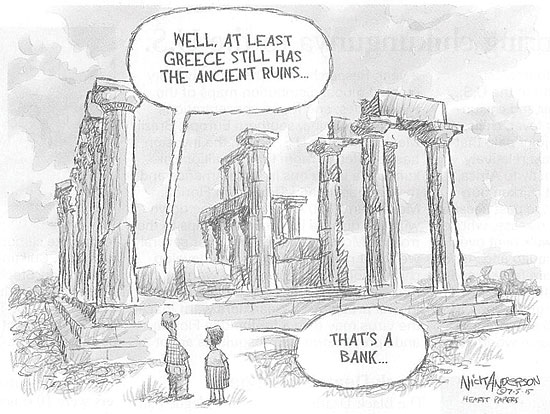
The Week Magazine’s contest: Visit Greece

Greece recently missed a $1.7 billion loan repayment to the International Monetary Fund, and could soon default on other debts and be forced out of the Eurozone. In seven words or fewer, come up with a slogan that the Greek government could use to attract big-spending tourists to their almost bankrupt nation.
RESULTS:
THE WINNER: Come help a Grecian earn — Simon Morse, Greenwood, Ind.
SECOND PLACE: Greece: Now with more ruin –Jared Edwards, Weatherford, Okla.
THIRD PLACE: Experience a real Greek tragedy — Jim Bertram, St. Cloud, Minn.
HONORABLE MENTIONS:
See The Ruins… Then Visit The Parthenon! — Andrew Tuite, Chicago
Come to Greece: Interest is growing rapidly — Arnie Silverman, Murrysville, Pa.
Greece is for loaners! — Arthur Kretchman, Warren, N.J.
See Greece before it becomes South Germany — Susan Strauss, Pacific Palisades, Calif.
Come take pita on us — James Gifford, East Greenbush, N.Y.
Love history? We are history! — Mandy Smith, Cincinnati
Visit Greece and learn German! — Jack O’Brien, Fairfax, Va.
Greece, your default vacation nation — Evelyn Crofts, Long Beach, Calif.
See the Acropolis before we sell it — Carmen Finestra, Lemoyne, Pa.

Harry Newton. I love what The Donald is bringing us: pure irrelevant,but amusing entertainment.
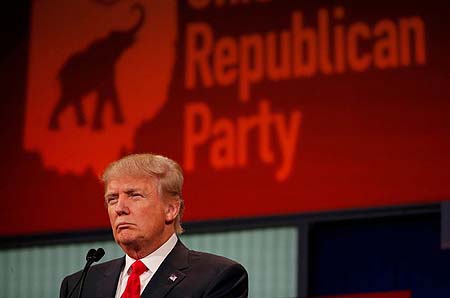
We have over 440 days to go before the election. What’s happening now is totally irrelevant to what will happen then. The Donald is amusing on stage. He’s also amusing on Twitter. Click here.
Maureen Dowd of the New York Times wrote a remarkably balanced piece on him (my bolding):
Trump the Disrupter
Washington – I’VE been hesitant to start writing about Donald Trump.
I was worried that if I wrote something that made him mad, he would send out one of his midnight mordant tweets about me, something like “She started as a 3. Now she’s a 1.”
I’d be upset, of course. And relieved that I wasn’t a 0. But I’ve known Trump a long time. That’s how he talks about women. I remember when he sadly broke the news that Heidi Klum was no longer a 10.
He offered this clinical breakdown about Halle Berry to Howard Stern: “From the midsection to the shoulders, she’s a 10. The face is a solid 8. And the legs are maybe a little bit less than that.”
As he once told me: “Certain guys tell me they want women of substance, not beautiful models. It just means they can’t get beautiful models.”
So when Fox News’s Megyn Kelly grilled Trump during the Republican debate, asking him about his sometimes vicious Twitter account and noting, “You’ve called women you don’t like `fat pigs,’ `dogs,’ `slobs’ and `disgusting animals,’ ” I knew what the glamorous former litigator was up to.
It was Tom Cruise taunting Jack Nicholson in “A Few Good Men.” Kelly was trying to get Trump to lash out in a misogynist way. But he restrained himself in the hall, staying away from the slob-to-supermodel rating system he likes to use. He showed his irritation later, tweeting that the anchor “bombed” and was “totally overrated” and “angry,” and he retweeted a post calling her a “bimbo.”
There was something amusing about Fox News, which is a daily Miss Universe pageant, chockablock with glossy beauties as anchors, reporters and even “experts,” giving The Donald a hard time about focusing on women’s looks.
I came away from the debate thinking three things: Roger Ailes is a television genius. It’s no coincidence that he presided over the ninth-most-viewed show ever on cable, after college football, with the extra kick of eclipsing his nemesis Jon Stewart’s big finale.
Kelly has a lot of Tim Russert in her: She knows how to set up mesmerizing Gunfights at the O.K. Corral, loaded for a follow-up after every salvo.
And Trump is, as always, the gleefully offensive and immensely entertaining high-chair king in the Great American Food Fight. He is, as Kurt Andersen wrote in 2006, “our 21st-century reincarnation of P. T. Barnum and Diamond Jim Brady, John Gotti minus the criminal organization, the only white New Yorker who lives as large as the blingiest, dissiest rapper – de trop personified.”
The novelist Walter Kirn tweeted post-debate: “Trump is simply channeling the bruised petty enraged narcissism that is the natural condition of Selfie Nation.”
After all, as James Gleick has tweeted, “Running for president is the new selfie.”
I enjoy Trump’s hyperbolic, un-P.C. flights because there are too few operatic characters in the world. I think of him as a Toon. He’s just drawn that way. And his Frank Sinatra lingo about women aside, he always treated me courteously and professionally.
Back in 1999, when he was flirting with a presidential run, I asked the ladies’ man how he would do with the women’s vote.
“I might do badly,” he said with a smile. “They know me better than anybody else. Women are much tougher and more calculating than men. I relate better to women.”
This campaign is more raw and rude than usual, reflecting the off-with-their-heads Twitter sensibility. But it can not only be wickedly fun but wildly useful to have an id agitating amid the superegos.
After covering nine presidential races, I have concluded that it is really hard to know who you’re electing – even after attenuated campaigns with an absurd amount of exposure for candidates.
That’s because you can’t foresee what crises will crop up, or what gremlins of insecurity and perversity the White House will inevitably elicit in presidential psyches.
You can have a candidate like W., after sincerely telling us he will have a “humble” foreign policy, proceed to stumble jejunely into decades-long wars in the Middle East. You can have a charming newcomer like Barack Obama, ascending like a political Pegasus, who loses altitude because it turns out he disdains politics.
It will cause winces and grimaces at times and Trump can go badly astray, as he did with the president’s birth certificate. His jibes at women may hurt the Republican Party with some women.
His policy ideas are ripped from the gut instead of the head. Still, he can be a catalyst, challenging his rivals where they need to be challenged and smoking them out, ripping off the facades they’ve constructed with their larcenous image makers. Trump can pierce the trompe l’oeil illusions, starting with Jeb’s defense of his brother’s smashing the family station wagon into the globe.
Consider how Trump yanked back the curtain Thursday night explaining how financial quid pro quos warp the political system.
“Well, I’ll tell you what, with Hillary Clinton, I said be at my wedding and she came to my wedding,” he said. “You know why? She had no choice because I gave. I gave to a foundation that, frankly, that foundation is supposed to do good. I didn’t know her money would be used on private jets going all over the world.”
Sometimes you need a showman in the show.

Trump didnt go wildly astray with the Obama BC fraud. Here:
https://www.youtube.com/watch?v=dEFq-eVqObA
The BC provided by the WH is examined here. Photoshop 101.