America added 215,000 jobs in July. Economists, who aren’t very good at predicting (who is?), predicted 225,000.
Despite their miss, the number was “respectable,” according to the New York Times.
The market is in “blood in the water” territory, according to MarketWatch. I suspect it may get cheaper still. More blood coming.
WhiteWave Foods reported it did better than expected in the U.S. , slightly worse in Europe. Who knows what today’s market will do with it. However, we’re up 43% which is fine. It’s been on our list (see right hand column) for a while.
Berkshire Hathaway reports after the close today. Results should be OK, though its railroad biz is weak. And the stock has been doing awfully.
Netflix continues to do well as the millennials cancel their pricey cable deals and watch TV online. Same trend as cancelling landlines in favor of cell phones.
Apple got a nice boost from Morgan Stanley. To read the entire page, click on it, please:
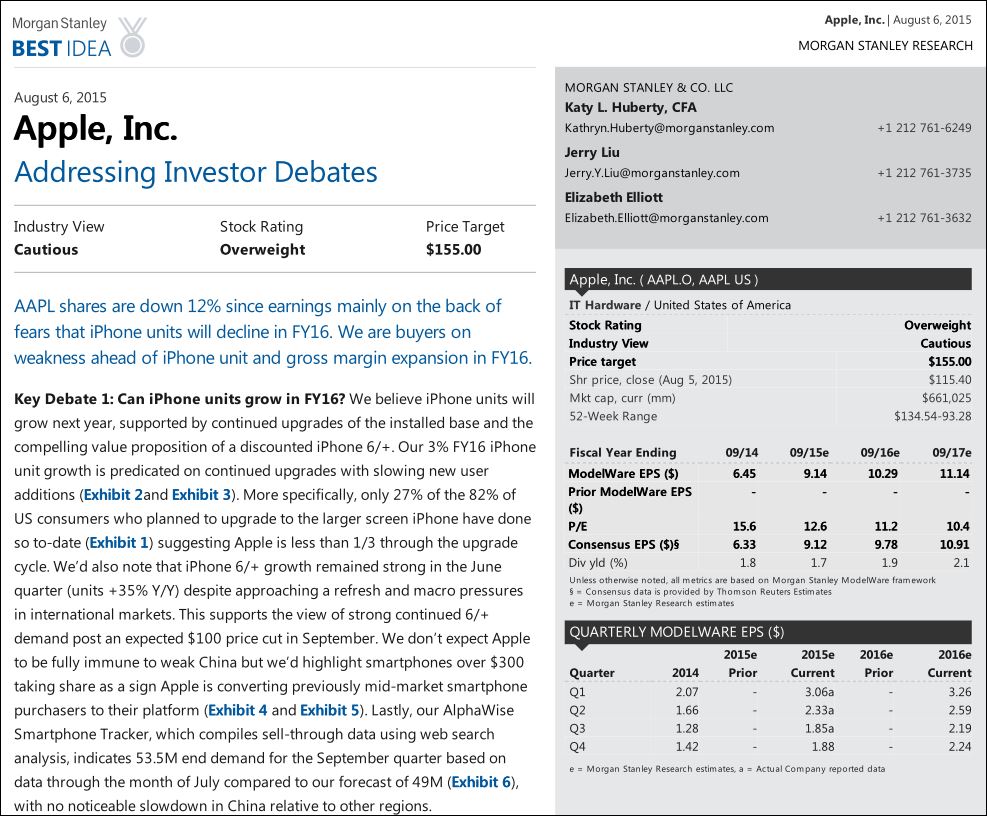
To read the entire piece, click Apple from Morgan Stanley
This morning I received an email from Apple: Buy a Mac for college. Receive a pair of Beats headphones. Unusual promotion from Apple. Should help sales.
Why didn’t I sell the coal miners short? This one was bleeding obvious:
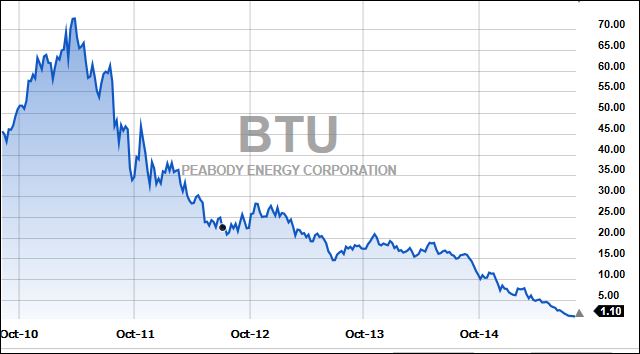
Yesterday the New York Times did a fascinating piece on coal:
Coal Industry Wobbles as Market Forces Slug Away
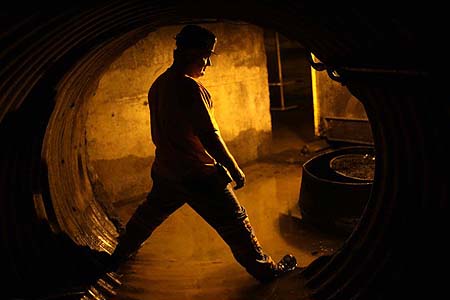
A miner at a coal processing facility near Gilbert, W.Va. This year the number of coal miners in the United States dropped more than 10 percent, to just over 80,000 workers. Credit Robert Galbraith/Reuters
In April 2005, President George W. Bush hailed “clean coal” as a key to “greater energy independence,” pledging $2 billion in research funds that promised a new golden age for America’s most abundant energy resource.
But a decade later, the United States coal industry is reeling as never before in its history, the victim of new environmental regulations, intensifying attacks by activists, collapsing coal prices, and – above all – the rise of cheap alternative fuels, especially natural gas.
This week President Obama slammed the industry with tougher-than-expected rules from the Environmental Protection Agency limiting power plant carbon emissions, which will accelerate an already huge shift from coal to natural gas and other alternatives.
“Clean coal” remains an expensive and thus far impractical pipe dream. Coal is the world’s biggest source of carbon emissions by far and the leading culprit in global warming. Coal advocates like Mitch McConnell, the Kentucky senator and Republican majority leader, have accused the president of an out-and-out “war on coal.”
But it’s collapsing prices and heavy debt loads that are driving the industry into bankruptcy. Alpha Natural Resources, the nation’s fourth-largest coal producer after it doubled down on coal two years ago in acquiring Massey Coal for $7.1 billion, filed for bankruptcy protection on Monday. It follows Walter Energy, which filed last month; Patriot Coal, which sought court protection in May; and numerous smaller mining companies.
The demise of the two biggest surviving publicly traded coal companies – Peabody Energy and Arch Coal, the nation’s two largest producers – may just be a matter of time, based on their recent stock performance. Peabody shares, which traded at more than $16 less than a year ago, hit 99 cents this week, and Arch shares have fallen to $1 from more than $33, making them among the biggest losers this year in the Standard & Poor’s 500-stock index.
“This has been a storm gathering for a very long time,” said Jeff Goodell, author of the 2006 book “Big Coal: The Dirty Secret Behind America’s Energy Future.” “When I wrote my book, coal looked indomitable. But below the surface you could see all these issues coming at them. You can only hold off the larger forces of progress and science for so long. The bottom line is that it’s a 19th-century fuel very badly suited for the 21st century. There’s no way you can wash or scrub coal to make that essential fact go away.”
Market forces have accomplished in just a few years what environmentalists and social advocates have struggled for decades to achieve. Coal prices have plunged about 70 percent in the last four years. This year the number of underground and surface coal miners in the United States dropped more than 10 percent, to just over 80,000 workers. There are now more than twice as many workers in the fast-growing solar power industry than there are coal miners.
Mountaintop removal, the poster child for environmental destruction, has all but ground to a halt as coal companies continue to close mines, lay off workers and slash capital spending on expensive new mining operations. Meantime, natural gas production has soared and electric utilities have built up gas-fired generation to replace aging coal-fired power plants.
“It’s kind of the ultimate irony that market forces, and not the administration or environmentalists, have displaced coal,” said Jorge Beristain, head of Americas metals and mining equity research for Deutsche Bank. “It’s human ingenuity that found a cheaper, cleaner way to skin the cat, which is by producing natural gas from fracking. They’re both fossil fuels, of course, but burning natural gas puts out a lot less carbon than coal.”
Burning coal produces nearly twice as much carbon dioxide as does natural gas, according to the United States Energy Information Administration.
Anthony Young, a mining analyst at the Macquarie Group, agreed. “There have been a lot of protests and animosity towards the coal industry, but lo and behold, it was the natural gas industry that has stopped many of the worst mining practices,” he said. “There are concerns about fracking, but it’s way better than cutting down mountains.”
Environmentalists are starting to notice that financial arguments may prove more effective than moral or social ones at persuading major investors to shun coal. Stanford University, which announced last May that it would divest itself of direct investments in coal producers, looks at least as much like a shrewd investor as an environmental steward, given the subsequent plunge in coal prices and coal company stock prices, and other big investors have taken notice.
In June, Norway’s government pension fund – considered the world’s largest sovereign wealth fund with $890 billion in assets, much of it generated from oil revenue – said it would divest itself of coal holdings. A spokeswoman for the fund said this was a financial decision, not a political one, with the goal of “building financial wealth for future generations.”
“I think you’re seeing a generational shift where the activists are getting more market-savvy,” said Mr. Beristain of Deutsche Bank. “They’re targeting Wall Street and the analysts. It’s becoming part of the environmental agenda to kneecap the coal sector at the source of its cash.”
Carbon Tracker, a London-based think tank, is among those trying to use financial data to affect climate change. “We try to stay out of the political discussion,” said Luke Sussams, a senior researcher and co-author of “The US Coal Crash,” a report arguing that coal faces a long-term, and not just cyclical, decline. “We look at it purely from a risk versus return perspective,” he said. “Our stance is: It’s a bad investment.”
Environmentalists still have their work cut out for them. The coal industry may be in dire straits, but it’s not going to vanish overnight. In 2013 the United States produced 985 million tons of coal, although it was the first time in 20 years that production fell below one billion tons. The United States consumed 924 million tons, 93 percent of it accounted for by the electric power industry, according to government statistics. In 2011, the United States consumed 1.1 billion tons.
“It’s premature to say the industry is dead,” said Mr. Young, the Macquarie analyst. He estimated the industry needs to shrink by about 25 percent to meet current demand, and more if electric utilities accelerate the shift to natural gas. But as coal companies “go through bankruptcy, their assets aren’t going to shut down. Mismanagement will be addressed, and their balance sheets will be restructured, but viable assets will re-emerge and be profitable.”
But it seems safe to say that the coal industry will never wield the enormous economic and political clout that it had even 10 years ago. “In the aftermath of the Bush-Cheney administration, there was this resurgence of the idea that coal was the American rock,” Mr. Goodell said. “America’s industrial strength was built on burning coal. No politician wanted to mess with coal.”
But with the shrinking of the industry, coal interests “are losing their clout, and they’re not going to get it back,” Mr. Goodell said. “It’s becoming clear where the future is going. The politically smart thing is to jump on the renewables bandwagon.”
The key takeaway is that technology’s impact is faster and deeper than ever before. To be a successful investor, you need to pick the “impacts.” They include online TV viewing, huge progress in biotech and cyber security. Every presidential candidate is into boosting the U.S. military. Which should be good for LMT, Raytheon and others. The U.S.’s top 25 defense contractors are here.
The really big earthquake to hit the Pacific Northwest.
The Really Big One
An earthquake will destroy a sizable portion of the coastal Northwest. The question is when.
If you haven’t read the New Yorker piece, you should. Click here.
I never could figure out what bathtubs had to do with sex. Still, it’s a nice image:

What they should be advertising is:
The Penis Poem, allegedly by Willie Nelson
My nookie days are over,
My pilot light is out.
What used to be my sex appeal,
Is now my water spout.
Time was when, on its own accord,
From my trousers it would spring.
But now I’ve got a full time job,
To find the f***in’ thing.
It used to be embarrassing,
The way it would behave.
For every single morning,
It would stand and watch me shave.
Now as old age approaches,
It sure gives me the blues.
To see it hang its little head,
And watch me tie my shoes!!

Harry Newton who eyes a sea of red on his screen early this morning. Not exciting. Apple, FIT, Visa and PayPal are up a little.
Time to turn the screen off and go play tennis.
Carly Fiorina is surprisingly impressive.

DONALD TRUMP NOW. DONALD TRUMP TOMORROW. DONALD TRUMP FOREVER!