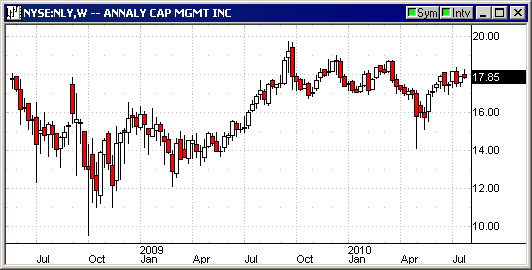
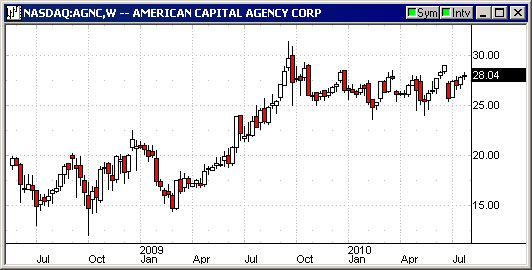
Two ultra-high yielders I own. Nice charts:
Annaly (NLY) is yielding 15.24%.
American Capital Agency (AGCN) is yielding 19.97%.
This morning, Deutsche Bank wrote
Annaly (NLY.N),USD17.85 Buy Price Target USD22.00
Stephen Laws: EPS $2.41 to $2.57. While 2Q core earnings beat our estimate, core earnings declined sequentially due to faster prepayments. We expect this trend to reverse in 2H10, as core earnings benefit from slower prepayment speeds. We would be buyers ahead of the improving 2H10 earnings, especially if shares are weak due to the 2Q core earnings being below the 2Q dividend. Given the recent capital raise as well as a reduction in our funding costs assumptions, we are increasing our 2010 and 2011 core earnings estimates. Reiterate Buy and maintain target of $22 per share.
NLY may fall today. Good time to pick up some shares. You can write call options on both NLY and AGNC
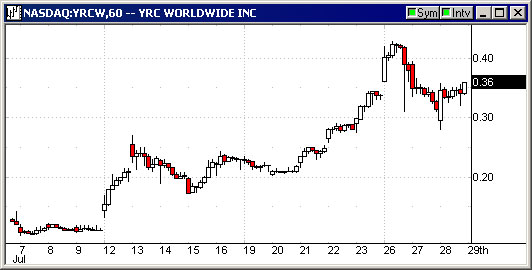
CNBC talks YRCW today on Squawk, beginning at 9 AM. Meantime, YRCW is volatile. Or as they say in Australia, its stock moves up and down faster than a whore’s drawers.
How housing prices have moved. This chart from the New York Times is really interesting:

If you want to see it actual size, click here.
Search your computer. Many of us run our lives on our laptops. Finding things is often irksome. Here’s Harry’s Searching Tips:
1. Make sure you name all your files descriptively.
2. Organize your files into logical folders. For example. “My photos/Family/Thanksgiving2009.
3. You can rely on Microsoft, maybe. It has now baby search engines in Outlook 2007 and Outllook 2010 and in Windows 7. If you’re using Outlook 2003 (as I am) I prefer the old Lookout. If you want a copy, send me an email. Microsoft bought the company and messed it up. It will only work on Outlook 2003.
4. I use Everything to find files, but not what’s in them. Everything, like Lookout, is flawless.
5. I don’t use software to be able to search inside files. If I were, I’d use X1 Professional Client or dtSearch. The reason I don’t is that these comprehensive search engines work all the time. They make huge indexes — as big as 20% of your entire hard drive. They just slow things down. They’re overkill for most of us.
If you want to read more (and you really don’t), Network World magazine has a big piece “Data mining for your desktop.“
Inception, the movie, got a huge applause. I slept and puzzled. It’s a loud, long movie — 2 1/2 hours. Rotten Tomatoes sums it up:
In a world where technology exists to enter the human mind through dream invasion, a single idea within one’s mind can be the most dangerous weapon or… In a world where technology exists to enter the human mind through dream invasion, a single idea within one’s mind can be the most dangerous weapon or the most valuable asset.
The New York Times wrote in typically flowery, obtuse language. (Read if you plan on seeing Inception.)
The relationship between movies and dreams has always been — to borrow a term from psychoanalysis — overdetermined. From its first flickerings around the time Freud was working on “The Interpretation of Dreams,” cinema seemed to replicate the uncanny, image-making power of the mind, much as still photography had in the decades before. And over the course of the 20th century, cinema provided a vast, perpetually replenishing reservoir of raw material for the fantasies of millions of people. Freud believed that dreams were compounded out of the primal matter of the unconscious and the prosaic events of daily life. If he were writing now, he would have to acknowledge that they are also, for many of us, made out of movies.
And movies, more often than not these days, are made out of other movies. “Inception,” Christopher Nolan’s visually arresting, noir-tinged caper, is as packed with allusions and citations as a film studies term paper. Admirers of Ridley Scott’s “Blade Runner” and Stanley Kubrick’s “2001” will find themselves in good company, though “Inception” does not come close to matching the impact of those durable cult objects. It trades in crafty puzzles rather than profound mysteries, and gestures in the direction of mighty philosophical questions that Mr. Nolan is finally too tactful, too timid or perhaps just too busy to engage.
So “Inception” is not necessarily the kind of experience you would take to your next shrink appointment. It is more like a diverting reverie than a primal nightmare, something to be mused over rather than analyzed, something you may forget as soon as it’s over. Which is to say that the time — nearly two and a half hours — passes quickly and for the most part pleasantly, and that you see some things that are pretty amazing, and amazingly pretty: cities that fold in on themselves like pulsing, three-dimensional maps; chases and fights that defy the laws that usually govern space, time and motion; Marion Cotillard’s face.
Ms. Cotillard, her most famous movie role evoked by occasional eruptions of Édith Piaf on the “La Vie en Rose” soundtrack, is the film’s principal enigma and its chief signifier of emotion. She is not, however, exactly a character in “Inception.” Rather, at least as far as a first-time viewer can guess, she is a projection in the subconscious of her husband, a specialist in corporate mental espionage known as Cobb and played by Leonardo DiCaprio with some of the same twitchy melancholy he brought to “Shutter Island.”
To say too much about their marriage would be to risk compromising some of the pleasures of discovery tucked into a carefully crosshatched, multilayered story. Better to explain what Cobb does for a living, since that exhaustive enumeration of the metaphysical rules of his profession occupies an awful lot of the dialogue in Mr. Nolan’s script. Using a combination of drugs, wires and other vaguely Matrix-y methods, Cobb and his co-workers penetrate the minds of their slumbering targets, usually for the purpose of extracting hidden information. But a wealthy client named Saito (Ken Watanabe) induces them to try the much more difficult trick known as inception, which involves planting an idea someone else’s mind that will bear fruit in the real world. “That’s impossible!” more than one person has occasion to exclaim.
In any case, Cobb and his team are trying to induce a young man (Cillian Murphy), whose father (Pete Postlethwaite) is a business rival of Saito’s, to break up the company he is about to inherit. This bit of commercial intrigue provides the fairly banal material foundation on which Mr. Nolan’s phantasmagorical world is built. The pursuit of competitive advantage by well-dressed, emotionless men is hardly the stuff that dreams are made of, Humphrey Bogart’s observations at the end of “The Maltese Falcon” notwithstanding.
And the content of those dreams, once Cobb and company have dropped into their mark’s sleeping mind, is often curiously pedestrian. Most of the time, one group of guys with guns chases another, in cars across the rain-soaked streets of Los Angeles, on foot through the corridors of a retro-elegant hotel, and on skis and snowmobiles through an icy Alpine landscape from which James Bond might recently have departed.
A lot of this is — what is the critical term of art I’m looking for? — pretty cool. And the heist-movie cast of mind-cracking technicians is also cool. Dileep Rao is the shaggy, anxious nerdy one. Tom Hardy and Joseph Gordon-Levitt are a pair of wisecracking specialists in something-or-another, and Ellen Page is the architect. This means that she designs the physical environments in which the dreams take place, and also that, like a precocious sophomore in a graduate seminar, asks the right questions and spells out the obvious connections.
She also notices that Cobb’s personal issues are clouding his ability to work, and putting the rest of them at a vaguely defined but serious risk — a graver danger than just waking up. (The conceit that they’re all dreaming takes some of the edge off the movie’s violence, since it’s hard to grieve for extras who are just “projections” in some else’s mental theater. On the other hand, that is pretty much what all movie characters are. This is what I meant by overdetermined.)
Cobb, whose life depends on suppressing emotions and memories that he cannot control, is thus a typical Christopher Nolan hero. His air of guilt and sorrow — the sense of unfinished psychic business pushing against his conscious intentions — marks his kinship with Christian Bale’s Batman, with the detective played by Al Pacino in “Insomnia” and with the anguished amnesiac played by Guy Pearce in “Memento.” Mr. DiCaprio exercises impressive control in portraying a man on the verge of losing his grip, but Mr. Nolan has not, in the end, given Cobb a rich enough inner life to sustain the performance.
The accomplishments of “Inception” are mainly technical, which is faint praise only if you insist on expecting something more from commercial entertainment. That audiences do — and should — expect more is partly, I suspect, what has inspired some of the feverish early notices hailing “Inception” as a masterpiece, just as the desire for a certifiably great superhero movie led to the wild overrating of “The Dark Knight.” In both cases Mr. Nolan’s virtuosity as a conjurer of brilliant scenes and stunning set pieces, along with his ability to invest grandeur and novelty into conventional themes, have fostered the illusion that he is some kind of visionary.
But though there is a lot to see in “Inception,” there is nothing that counts as genuine vision. Mr. Nolan’s idea of the mind is too literal, too logical, too rule-bound to allow the full measure of madness — the risk of real confusion, of delirium, of ineffable ambiguity — that this subject requires. The unconscious, as Freud (and Hitchcock, and a lot of other great filmmakers) knew, is a supremely unruly place, a maze of inadmissible desires, scrambled secrets, jokes and fears. If Mr. Nolan can’t quite reach this place, that may be because his access is blocked by the very medium he deploys with such skill.
And the limitations of “Inception” may suggest the limits not only of this very talented director, but also of his chosen art form at this moment in its history. Our dreams feed the movies. The movies feed our dreams. But somehow, our imaginations are still hungry.
Susan loved the movie. So did the Manhattan audience, which applauded enthusiastically. Me? I sort of get it, though who was shooting at whom and why totally escaped me.
Check. Check. Check. At the time IBM had “Think,” my company had “CHECK. CHECK. CHECK.” It was much more effective. Any time you change anything, check. Verizon added my voice lines to my new FiOS. They didn’t hunt them and they turned on their voice mail, killing mine. This confused the few callers I have, who thought I’d died or, worse, not paid my phone bills.
The big “check” is changing or “upgrading.” Repeat after me:
Newer is not always better.
Change is not always.
Change brings consequences, most of dubious value and all time-consuming.
Capping the financial gusher.

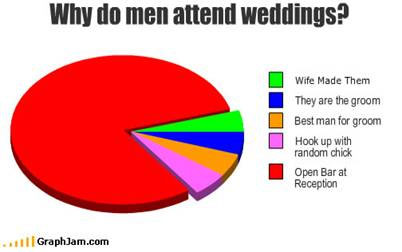
You can make your own silly graphs at GraphJam.com.

Harry Newton, who’s happy that a few more people seem to be getting jobs. This morning the people applying for initial state unemployment insurance benefits fell 11,000 to 457,000. Sadly, there are still 8.3 million people collecting some type of unemployment benefit. Where these people (and all the new ones coming into the workforce) are going to get real jobs in coming years beats me.

Try XOBNI (http://www.xobni.com) for outlook. Not only can you search for people or mails, but it uses online services (Facebook, linkedin etc) to gather contact info and other data. It also shows links between your contacts and is brutally fast once it has indexed your emails. The basic version is free and all you're likely to need, but the PRO version add useful things like an extended auto-complete when addressing email.
While you're looking at outlook plug-ins, take a look at yousendit (http://www.yousendit.com) It jumps in when you have a large attachment and uploads the file to its servers. The email recipient receives a link to download the file. It's a great way to get around attachment size limits, and Gmail's restriction on .exe and .zip attachments if you are using their servers.
I once used XOBNI. But I didn't find it useful, since I'm not big on Facebook, linkedin, etc. I don't need yousendit.com at present, since I have a fast Internet connection and GMAIL transfers huge files flawlessly.
Understood on Xobni. I don't make much use of the social network features either, but as a search tool, it's pretty good. I'm running Outloook 2010 on my desktop and many of the advanced search features are now included.
Gmail does indeed send and receive huge files, but there's no guarantee your recipient's service will be able to receive them. Very annoying after a long upload, and even worse for them if they are receiving the email on a cell phone. Gmail also will not allow outgoing .zip and .exe files (and many others) for instance. It's not an everyday thing, but a useful tool to keep in the background.
Being lazy and wanting to keep my life simple, I ask my friends to whom I'm sending large files to get gmail accounts. If not, I have FTP sites they can use. What's so good about Outlook 2010 versus 2003 (which works flawlessly).
As far as I can tell, Microsoft just did their usual interface change-around. Some commonly used features have been brought to the front, but otherwise, probably not worth the upgrade yet. I like Word better though.