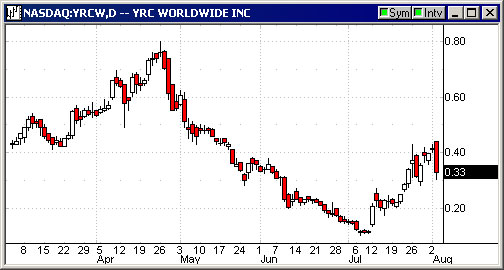
I pumped YRCW, the trucking company, as a rampant speculation. My idea was threefold: the economy was picking up; it had worked a deal with its major unions, it had re-arranged its burdensome financing. Hence its second quarter earnings, reported this week would be better. They were, but not good enough for Mr. Market’s expectations and the stock tanked.
First chart shows daily movements.
Second chart shows the last couple of days.
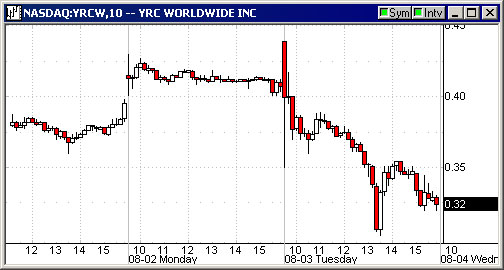
The clear message here is: When the stock didn’t respond positively to its earnings, sell and sell quickly.
Figuring your time frame is critical. Why did you invest? What’s the target? When to pull the trigger? In a rampant spec like YRCW, the key is to jump instantly, if not sooner.
Take your lumps. But take small ones. Move on.
Barnes and Noble is up for sale. I wanted to sell B&N short eons ago. I didn’t because I had figured out ways how I would save them. I even contacted them with my brilliance. Of course, they never listened. And I didn’t play investor (and sell short), but played amateur entrepreneur (got rebuffed). In fact, I suspect that Leonard Riggio, its founder and chairman, is a tryant, who was riding high for a long time — until technology (electronic books) blindsided him big-time.
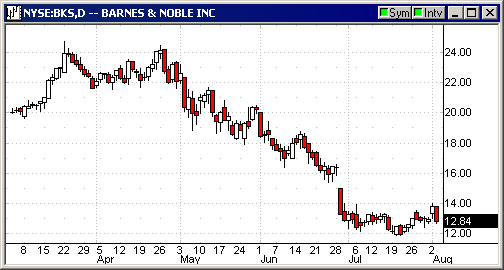
It’s critical for Harry to focus on being an investor, not a smart-ars, know-it-all. I suspect this is an occupational hazard of once being an active entrepreneur, and now being a passive investor — a role I’m clearly not comfortable with.
This is a conspiracy of the Federal Government. Every time I send a letter to the IRS, the Post Office returns it “postage due.”
I checked. The Post Office is getting sneaky. It now charges by size, not just by weight.
If you send the IRS a two ounce letter in a number ten envelope, it will cost you 61 cents.
If you send it in a 9″ x 12″ envelope, it will cost you $1.05 — 72% more. Same weight, Bigger envelope.
I’m still on Windows XP. I rejected Windows 7 because too many of my old apps don’t work and because I didn’t need or like the visual candy. Computerworld, the magazine, says I shouldn’t feel guilty:
Windows XP, at nine years old ancient by operating system standards, still leads by a large margin, and will do so for many years. Here are five reasons XP will continue to rule the desktop.
1. It just plain works.
Windows XP has proved to be an exceptionally stable operating system that makes efficient use of what is now considered low-end hardware. It’s not prone to unexplained system crashes or oddball slowdowns. Year after year, it keeps plugging away. As the old Timex ad says, ‘It takes a lickin and keeps on tickin’. Many people figure there’s no reason to upgrade to a new operating system if their old one works fine.
2. Who needs frou-frou?
Windows 7 features some exceptional eye candy — Windows Aero, Aero Flip 3D, live taskbar thumbnails, and smoother desktop animations. But does all that make you more productive or make life better at the keyboard?
For many people, the answer is clearly no. So they’re staying with XP.
3. Two words: Web apps
In earlier days of computing, the most interesting and exciting apps were written for an operating system. In order to run them, you needed the newest operating system, and so were essentially forced to upgrade.
Today the most interesting apps for computers are on the Web, not the desktop. You don’t need a fancy new operating system to take advantage of them. A browser and basic hardware work just fine. So people don’t need to upgrade from XP if they want to run them.
4. Enterprises are conservative
Enterprises are by nature and necessity conservative organizations. They don’t like to court risk. If they’ve built a computing infrastructure and applications around XP, they need a compelling reason to risk to upgrade to a newer operating system. Many have yet to find that compelling reason and are happy to stay with XP.
5. Smartphones are where the action is
Plenty of people want to be where the tech action is — to be on the forefont of the newest apps, cutting-edge consumer hardware, and innovative services. That’s no longer primarily the PC. Smartphones have supplanted the desktop computer as the most innovative platform. There’s no excitement to upgrading from Windows XP to Windows 7. There’s plenty of excitement in getting a new Droid X or iPhone 4. So that’s where people are spending their time and money, not on upgrading their operating systems.
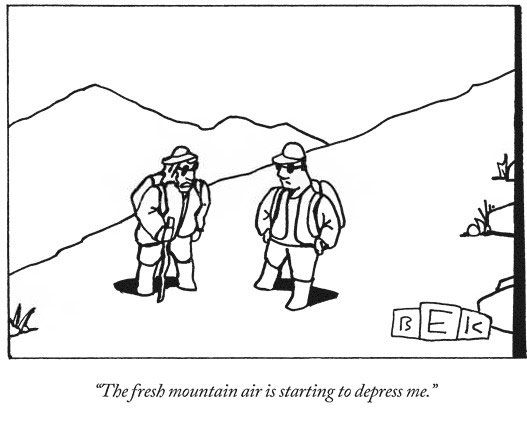
Favorite recent New Yorker cartoons.
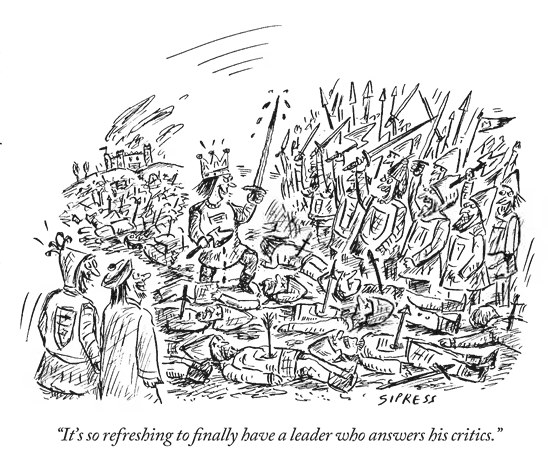
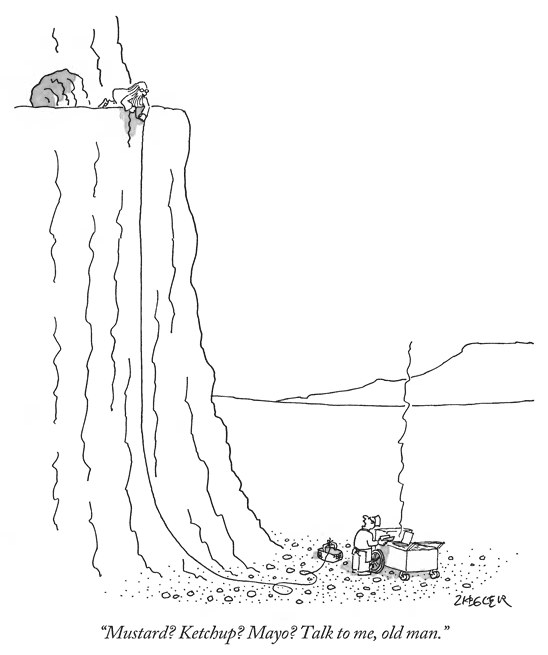

Harry Newton,who’s pleased he canceled his print subscription to the Wall Street Journal. With Rupert’s acquisition, the magazine has been “dumbed down” and “life styled up.” I want to read serious stuff. I don’t want to know where I can buy the best mushrooms in lower Slobivia.
