There is nothing more beautiful than a dividend.
In the old days, we owned things that didn’t pay dividends. We made a profit when we sold them. This used to work with stocks, funds (see below) and real estate.
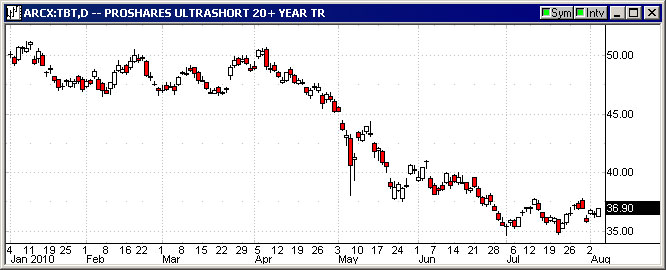
No more. Everyone is looking for a cash dividend — irrespective how small. Whatever you receive as a dividend will be better than nothing, which is what you effectively get in a money market fund today. You can see this trend most clearly with treasurys. Cash pays nothing. Interest rates are not going up. Pile into anything that is safe and pays something, anything. 10-year treasurys are yielding their lowest in eons.Waiting for rates to rise has been a losing game. See the TBT chart below.
Faced with a horrible economy, the Fed can’t drop rates lower. But it can do something called “quantitative easing,” also called printing money. Here’s Wikipedia’s definition:
The term quantitative easing (QE) describes a form of monetary policy used by central banks to increase the supply of money in an economy when the bank interest rate, discount rate and/or interbank interest rate are either at, or close to, zero.[citation needed] A central bank does this by first crediting its own account with money it has created ex nihilo (out of nothing).[1] It then purchases financial assets, including government bonds and corporate bonds, from banks and other financial institutions in a process referred to as open market operations. The purchases, by way of account deposits, give banks the excess reserves required for them to create new money by the process of deposit multiplication from increased lending in the fractional reserve banking system. The increase in the money supply thus stimulates the economy. Risks include the policy being more effective than intended, spurring hyperinflation, or the risk of not being effective enough, if banks opt simply to pocket the additional cash in order to increase their capital reserves in a climate of increasing defaults in their present loan portfolio.
“Quantitative” refers to the fact that a specific quantity of money is being created; “easing” refers to reducing the pressure on banks.[2] However, another explanation is that the name comes from the Japanese-language expression for “stimulatory monetary policy”, which uses the term “easing”.[citation needed] Quantitative easing is sometimes colloquially described as “printing money” although in reality the money is simply created by electronically adding a number to an account. Examples of economies where this policy has been used include Japan during the early 2000s, and the United States and United Kingdom during the global financial crisis of 2008–2009.
Everyone used to think that by now interest rates (and inflation) would be rising. But they’re not. They’re falling. Interest rates and inflation are usually driven by labor shortages. If there’s low unemployment, wages and inflation go up. But not today. Here’s a picture of an around-the-block line yesterday in Manhattan (courtesy my iPhone 4). The people are lining up for a Job Faire.

I’m buying some bond funds today, including ENX, BNY and PNF (which I already own). They’re all paying a 6.5% triple tax-free dividend.
Here’s a reason to hate Citigroup. Their arrogance is unbelievable. The disdain for their clients is even more unreal.
In olden days, when I had more money, I was naive. (Some would say stupid.) I truly believed that places like Citigroup and Goldman Sachs could invest my money and make me rich beyond my wildest dreams. They had these things called “funds.” They take my money, combine it with other fools’ money, buy companies, manage them well and sell them in a few years for far more than they had paid. Bingo, instant riches.
Of course, it was all bullshit. It worked in the very early days but by the time I got in, the bloom was off the rose.
Fast forward today. I’m in the toilet with all my investments with Citigroup and Goldman, but I’m wiser. I figured the real reason for these funds is to make them — not me — rich. It’s called fees. they get lots of them, irrespective of how well I do. I do bad. They do good. This realization — which everyone reading this column will say is bleeding obvious — came to me initially when Goldman recently made a large capital call — the sole purpose of which was to pay itself fees, not to buy companies for me.
The second realization happened yesterday. FedEx brought me an “Important Notice” from Citigroup Alternative Investments LLC. It seems that Citigroup “is transferring management of my fund to something called StepStone Co-Investment Funds and “under certain circumstances” to affiliates of Lexington Partners Advisors L.P. The reason for this?
This transaction is consistent with Citigroup’s strategy of reducing its portfolio of non-core operating businesses and assets held within Citi Holdings in an economically rational manner while working to generate long-term profitability and growth from the core businesses within Citigroup.”
In other words, Harry’s investment can go hang. Does this piss me off? Yes, for several reasons:
First, it’s not the first time Citigroup has shown utter disdain for clients. I remember very clearly that the reason I invested in this fund originally was because of a brilliant fellow called John Barber, who was managing my fund. Well he left shortly after I invested. So much for that sales pitch and all those conversations with Mr. Barber.
Second, the package of material I received yesterday asks for my approval of this transfer. I’m meant to fax them my signed Consent. If I don’t? Well, they don’t lay out any benefits to me. But they do lay out this incredible threat:
If the Transaction is not consummated, then employees of Citi working with the CPE businesses may become more likely to terminate their employment with Citi and accordingly, the ability of Citi to continue to manage the Fund effectively may be substantially impaired.
In other words, if I don’t consent, they’re going to fire all the people managing my fund. and deliberately fuck me.
Third, let’s say I want to ask a question on this, like “What’s in this for Harry?” The documents I received yesterday came without a cover letter. The ONLY name in the entire documents is Gitanjali Workman, who works the fax machine (for my Consent) at the law firm of Paul, Weiss, Rifkind, Wharton and Garrison LLP.
Fourth, there may be no benefits for Harry — at least none I can find in the docs. But there are plenty of risks spelled out. My favorites:
+ No assurances can be given that StepStone and/or Lexington will perform their duties in respect of the Fund successfully.
+ StepStone manages assets for numerous clients. As a result StepStone may at times face a conflict of interest in making investment decisions on behalf of the Fund.
Note to my readers: There’s a lesson here. Don’t ever think about investing in a private equity, leveraged buyout, fund of funds, or like ilk fund managed by a Wall Street house. I have not made a nickel on any fund managed by any Wall Street house. But they have. Lots of nickels.
A final note: Most of my funds are still running. If a miracle happens, I may get my money back. And if a BIG miracle happens I may make a few nickels. Yup, and pigs will fly.
Survival Skills by David Mamet. These came from August Men’s Journal magazine.
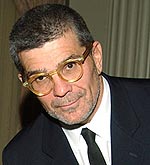
David, What’s the best advice you’ve ever received?
When I was a kid in Chicago, I knew this woman named Frannie who’d take photos of people at Wrigley Field for $10 and get their addressess to mail the photos, but there wasn’t even any film in her camera. Anyway, I’d just had my heart broken by some girl, and Frannie told me, “It’s all in a lifetime.” She meant that things happen, but you get over it. I’ve always treasured that advice.
What should every man know about money?
As the old Yiddish proverb had it, “Rich or poor, rich is better.”
What advice would you give the younger you?
Another Chicago writer, Nelson Algren, said to never play cars with a man called Doc, nevr eat at a place called Mom’s, and never sleep with a woman whose troubles are worse than your own. I would add one to that list: Never trust a Jew in a bow tie.
What’s your biggest regret?
Not serving in the Vietnam War. It was the 60s. I thought I shouldn’t go and wasn’t smart enough to realize that it was too easy an excuse because a lot of people were going in my place. It’s a young man’s responsibility to defend his country.
Finally a useful product.From China:

Drink this stuff, not booze, beer or Coca Cola and I bet you’ll lose weight.

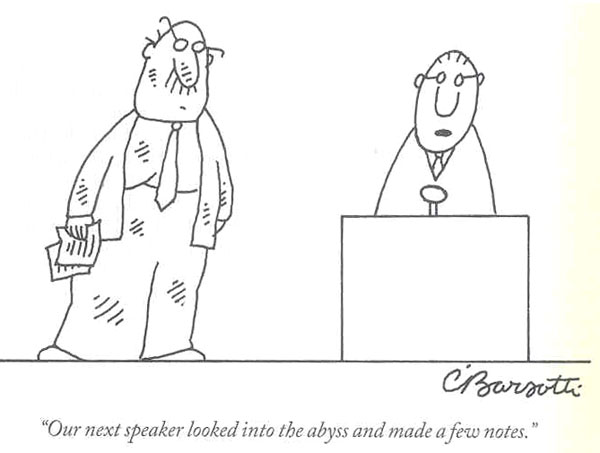
Harry Newton, who is always reminded of these two images when he talks about the future of interest rates. First, the TBT — the continuing graveyard for all the “smart money” in recent times:
And a favorite New Yorker cartoon:

Mamet's biggest regret: “Not serving in the Vietnam War. …It’s a young man’s responsibility to defend his country.”
I wish the Vietnam generation would get over their guilt about not serving and spend more time finding out if the cause for whatever the current war is, is just. I supported the Vietnam War at the time, but history has proven that I was a dupe …supporting the fuck-ups of politicians. Supporting the war of your generation does not always equate with “defending your country” …or with being a patriot.
My favorite post yet!
harry – interesting speculation on the political blogs today that the GSEs may be oprdered to forgive a portion of the mortage debt for underwater borrowers as a last ditch effort to buy votes in the mid-terms. collateral damage to NLY??
Harry,
Please refrain from dropping f-bombs or I will stop reading your column. Absolutely no need for that kind of language.
RW
You haven't dealt with Citigroup.
I have dealt with Citi- you're wrong on that. As for my initial point, I don't think it is asking too much to keep the vulgar language off your blog. I have two small children at home and choose not to fill my mind with words that might be accidently repeated. If you can't respect that simple request- and choose a policy of narcissism rather than decency- then I will no longer read your blog on a daily basis.
Actually, I think that's the first time I used the f word this year. Maybe in 2 years. I'm not too sure that you understand the shabby treatment Citigroup has put me and its other equity fund investors through. The lesson is loud and clear. And I hope everyone got it. Don't deal with these Wall Street houses as regrds investments. Your chances of ever making a nickel are slime to none.
You'v got to be kidding! Seems like the problem is you can't control yourself (or your mind) You know what … I bet no one really cares whether you read the blog or not. Get a grip.
Harry,
The folks in finance are out there busting their humps, and deserve those fees. In fact, we really WANT them to be getting those fees, if you can follow the logic displayed in this video from Sky News: http://bit.ly/financiers
the video and the story are great. My favorite quote:
It's been a very hard few years. I have had to survive on my bonus and only one Maserati – that's how it is.
City banker
Lets come up with another word or series of words to replace the f-bomb that takes the seriousness of the situation and puts it into words.
Would you have preferred sodomize? I don't think that in this case that screw, damage, or hurt would have cut it.