Technology has been booming — stocks and startups. Energy and commodities have been falling. There is talk of the top of the tech bull market. There is recession talk.
No one is ever right about the timing of a stock bust or a recession.
The good news is that many stocks keep making new highs – including Broadcom, Costco, Callaway Golf, Hawaiian Holdings, Netgear, Nuance, Tyson Foods and Verisign. You can see the full list every day by going to Barchart. Click here.
Stay careful.
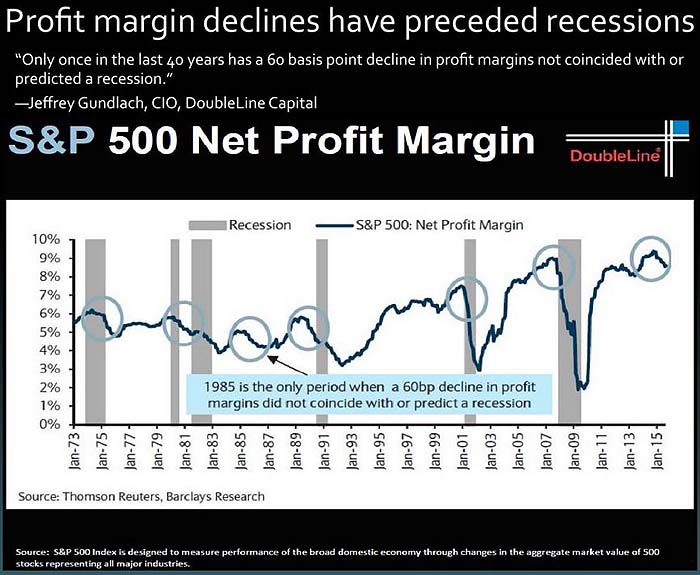
This chart from Business Insider has me concerned:
The Week magazine has a piece Is America creeping toward another recession?

It begins:
It’s been seven years since the 2008 collapse. And if you look at the timing of recessions in recent decades, we’re due for another one awfully soon.
Now, predicting recessions is an exceedingly tricky business. Almost by definition, you can’t see them coming: Markets are dynamic systems, defined by actions and reactions and ever-shifting balances of forces. So if actors in a market spot the early signs that could indicate a recession, their natural self-interest will lead them to take actions that should head off the recession. The economic short-circuits that actually cause a recession are the ones nobody spots.
Still, you can at least keep an eye on the circumstantial evidence. And the data points that suggest the economy is taking a wrong turn are building up.
The first chart is:
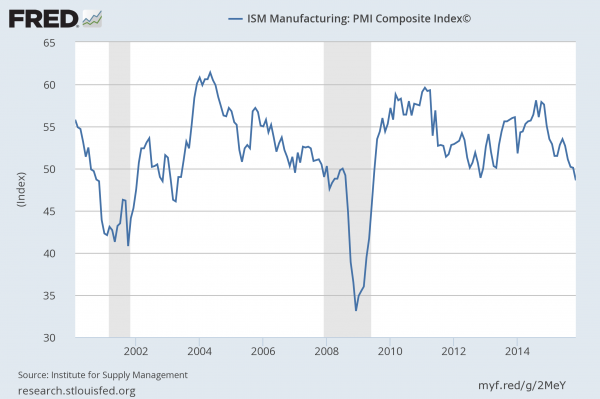
The chart’s words are:
Let’s start with the Institute of Supply Management’s manufacturing index, which comes out every month. The release for November arrived on Tuesday, and at 48.6, it’s the worst we’ve seen since June 2009. More importantly, any number under 50 means the manufacturing sector is actually contracting. In recent years, this index has only dropped below 50 during the Great Recession, and then in one very brief blip in late 2012.
You can read the full article here.
The most interesting piece came in this morning from:

How Bull Markets End
Many people think that they ring a bell at the top of a bull market. Ding-a-ling-a-ling.
That is indeed often the case. The bell was rung in 2000 at the top of the dot-com bubble-I like to think it was 3Com spinning off Palm that broke its back.
But sometimes there is no bell, no catalyst, no story to tell. A bull market becomes a bear market, and it happens just like that.
Silicon Valley has been in a food fight for about three years now. Everyone knows it’s going to end, except for the folks in Silicon Valley. These guys are funny. I met a few of them in the last cycle. They really thought it was going to go on forever.
There are now 145 unicorn companies (private companies with a valuation of $1 billion or more), with a total combined valuation of $506 billion.
We are watching the top happen right before our eyes.
Square
If you were paying attention a couple of weeks ago, you might have read the news about a company called Square going public. Jack Dorsey is the CEO of Square. He is also the CEO of Twitter. I think of this sometimes whenever I complain that I’m too busy.
Square got a round of financing in 2014 at a $6 billion valuation, and now it’s a public company. If you pull up SQ on Yahoo! Finance, you will see that the market cap is $4 billion.
As Square was making the rounds in the roadshow, investors decided they didn’t want to overpay just to make the mezzanine round investors rich. So there wasn’t much demand for Square at a $6 billion market cap. It eventually went public at a $3 billion market cap, or $9/share. (The deal performed well in the aftermarket, at least. The stock is trading at $12.)
No catalyst. No bell ringing. The price simply got too high, and people pulled back. But you know what this means. If one deal can trade below private valuations, they can all trade below private valuations.
On to the next data point.
Fidelity
You may not know this, but Fidelity owns shares of private companies in some of its funds (like Contrafund). Fidelity has to figure out how to value these things.
In general, venture capital firms have to mark their investments to “market,” whatever that means. To do this, they use the services of third party valuation firms. Those valuation guesses are probably subject to mood or opinion, and as you can imagine, there are a lot of bad guesses. The valuations don’t mean much-if you’re an LP (limited partner), at the end of the day, you care about cash in and cash out. But mark-to-market creates some interesting short-term incentives.
As for Fidelity, they also have to mark things to market, and they also use valuation firms. But valuation firm A that Sequoia is using is different than valuation firm B that Fidelity is using. And Fidelity perhaps wants its valuation firm to be more conservative.
So Fidelity has been marking its private investments to market at levels that are below the most recent funding rounds. This puts the VCs in a bit of a pickle. Do they copy Fidelity or do they press on with their own, higher valuations in the face of dissenting opinions?
None of this makes people very bullish on startups.
Uber
Uber is the biggest unicorn of all, with a $50 billion valuation. Side note: they don’t make any money.
Uber is trying to raise another billion-at a $70 billion valuation.
Now, the only reason you would invest in Uber at a $70 billion valuation is if you thought they would go public at $80 billion or more. But looking at what happened to Square, that will almost definitely not happen.
And why would you pay $70 billion for Uber when Fidelity is going to mark it in your mush? Another great question.
I don’t think anyone is in the mood to pay $70 billion for Uber. Uber is stuck. They will have to go public or take a down round if they really need the cash.
And this, folks, is how bear markets start.
Brainstorming Session
So let’s do some brainstorming on what this could mean if it really were the end of the line for Silicon Valley (at least in the medium term).
Since tech has been going up while energy/mining has been going down, could this trend reverse?
Could value start to outperform growth? (If I’m not mistaken, it already is.)
Could large cap start to outperform small cap? (Boy, is it ever.)
If you lived in the Bay Area, would you want to sell your house and rent?
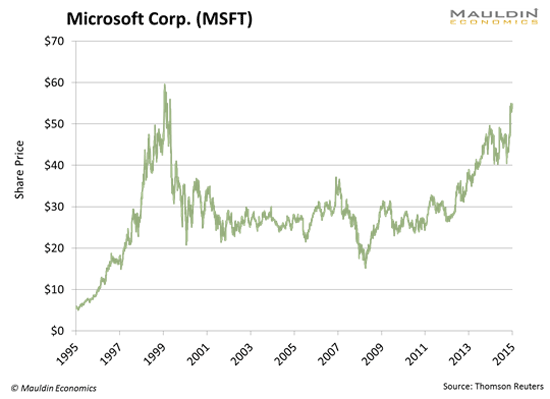
As new tech is in the process of topping, have you seen what old tech has been doing? Check out the chart of Microsoft, at 15-year highs:
For full disclosure, I started calling the top (or at least asking hard questions) on Silicon Valley about a year and a half ago. But I think most dedicated observers saw what happened with the Square IPO and said, “Yep, that might be the top.”
The other thing I’ve learned is that even when people recognize the top, they vastly underestimate how bad the pain is going to be on the downside. “Oh, it’ll just be a quick correction.” Never is.
One last riposte: Anyone who invested at these valuations will richly deserve what’s coming to them. Those prices were cuckoo.
Somewhat useful stuff
+ Everyone is having a major sale — Uniqlo, Eddie Bauers, Lands End, etc. On second thought you don’t need more clothes or more anything.
+ The best Christmas present you can buy your kids or grandkids is a print subscription to the Economist.
+ Keeping many windows or tabs open in your browser? Close many of them. Then close youre brower and open it. You’ll free up precious RAM and improve reliability.
+ Every tech site is pushing Christmas gifts. Most popular are Fitbit — get the $99 one — and the $20 BLU Tank II unlocked cell phone. Enormously useful for overseas travel or as a spare phone:

Note: This is not an iPhone. This is a cheap simple phone for making and receiving calls using SIM cards you buy overseas (or here). Click here.

Harry Newton, who’s in Indian Wells, California, a few miles from San Bernardino where two people used weapons like this one to kill 14 people.

Politicians and presidential aspirants sent their prayers and thoughts to the families of the victims. But prayers and thoughts aren’t going to stop the next mass shooting, or the next one. We have seat belts to make driving safer. We have rules to make swimming pools and ladders and meat safer. But not for guns.
The New York Times Nicholas Kristof wrote a piece yesterday — On Guns We’re Not Even trying. The piece includes:
Astonishingly, it’s perfectly legal even for people on the terrorism watch list to buy guns in the United States. More than 2,000 terrorism suspects did indeed purchase guns in the United States between 2004 and 2014, according to the Government Accountability Office and The Washington Post’s Wonkblog. Democrats have repeatedly proposed closing that loophole, but the National Rifle Association and its Republican allies have blocked those efforts, so it’s still legal.
While Republicans in Congress resist the most basic steps to curb gun access by violent offenders, the public is much more reasonable. Even among gun owners, 85 percent approve of universal background checks, according to a poll this year.
Likewise, an overwhelming share of gun owners support cracking down on firearms dealers who are careless or lose track of guns. Majorities of gun owners also favor banning people under 21 from having a handgun and requiring that guns be locked up at home.
These are reasonable steps that are, tragically, blocked by the N.R.A. and its allies.
To read the full article, click here.

Harry, the government is giving more arms to terrorists than they could ever buy in the United States. Did you know that in the old West, that as the town grew in size, that the local authorities inacted gun laws where no one could carry. An interesting thing happened. Only the criminals had firearms and the populace had no way to defend themselves. The local law ended up having to allow all citizens to carry firearms and in turn the crime rate dropped to what it was before the gun laws were put into place. How do I know this? My Great Great Grandfather was a sheriff in one of those towns.
Why do you think our history is not being taught!
Obama and the Democrats just keep the borders wide open letting these terrorists that are buying those guns just walk right in. Do you actually think terrorists and criminals buy their guns legally at some gun shop or show? Stopping American citizens from legally purchasing guns to protect their families from the criminal element that this administration keeps importing into our country MAKES NO SENSE. But liberals think how liberals think.
Pretty soon all of the United States will demand to be able to carry firearms to protect themselves from the criminals that are crossing our borders.
Just ask yourself why our federal government would release an unprecedented number of the worst kind of criminals in the face of the growing threat of unknown people flooding into our borders.
Your anti gun rhetoric doesnt include the possibility that these perps got their guns illegally which even with tougher gun control laws, is always probable. No, what mass shooting used to represent are crazies who are on psychotropic drugs that had access to guns. Now, we can add Islamic domestic terrorism to the list of root causes. Neither of which will diminish if America is less armed. If you want to get mad at someone, how about big pharma for those drugs that cause depression and craziness, and of course, at Islam, whose sole purpose to for the infidel to submit or die. Harry, you being Jewish, should resonate with the latter…they hate Jews even more than Americans.