Should you catch falling knives?
Should you reach for yield?
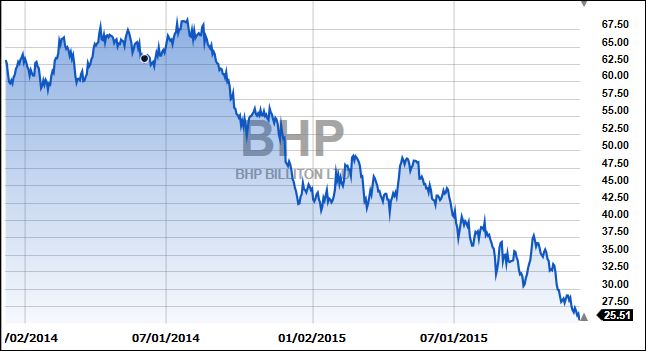
BHP is yielding 9.72%. But you can see why:
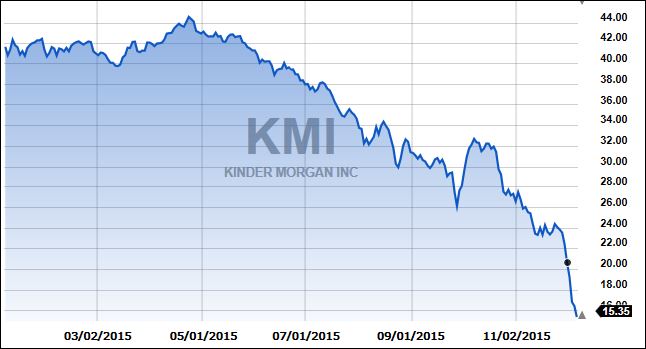
KMI is yielding 12.42%. You can see why:
Three things are affecting commodities:
+ Too much supply. Think fracking, OPEC pumping relentlessly.
+ Warm weather.
+ Lower demand from ebbing countries like China.
Strategies friends (and myself) are adopting:
+ Stay largely out. Loosen up on up days, like last Friday.
+ Look at real estate syndications.
+ Buy favorite stocks on weakness. My favorites include GE, GOOGL, SNA and HD. Friends like old tech favorites like Expedia, Priceline, FB, Amazon and defense names like LMT. But buy only on big weakness.
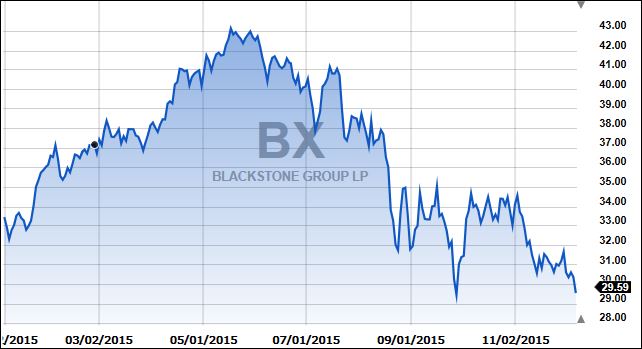
This morning an old crazy, low buy limit on BX filled at $29.51 — a ridiculous price when I put the limit order in eons ago. But look, a nice dividend yield of 9.54%!
Today is probably a good day to day trade — if you have the time.
No-brainer Christmas present. This is called the Jake:
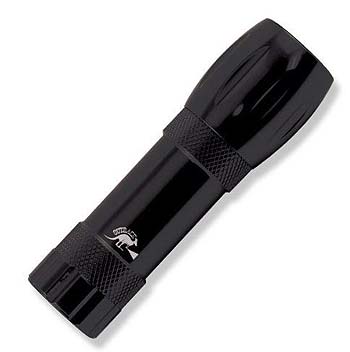
It’s the best $10 flashlight around. It’s metal. It’s LED and ultra- bright. Your friends will love it. Click here. Buy several. They have a flat $4.95 shipping charge.
More fraud. The crooks are getting creative. From reader and friend, Lucky Marr,
I had a call at midnight, last week, advising my BankAmericard had been locked. Press 1 to be transferred to Security. I hung-up and called BofA security who confirmed nothing was amiss with my account.
Don’t do stupid.
A relative lifted some heavy garbage tins. He got a hernia and needed an operation. He’s sore, OK and feeling a little stupid.
Airports are the worse. You can throw your back out by jerking your heavy bag onto the TSA conveyor belt or lifting your heavy bag into the overhead bin.
Don’t do stupid.
Fantastic Richard Sidey expedition video. I’ll never visit all the beautiful places in the world. I’ll never be the photographer I’d like to be. But meantime I can thrill on what I find online. Here’s one of the best animal and scenic videos I’ve ever seen. First some excerpts:





You can watch the video here. Please do.
How terror hardens us. That’s the title of a NYTimes piece from Sunday by a law professor. Excerpts:
The theory says that when people are reminded of their mortality — especially if the reminder doesn’t register consciously, as happens after a brutal act of terror — they will more readily enforce their cultural worldviews. If our cultural worldview is xenophobic, nationalistic or moralistic, we are prone to become more so. Hundreds of experiments, all over the world, have confirmed these findings.
If we believe guns will protect us from harm, a terrorist strike will further strengthen our views. If we blame Muslims or white supremacists or the government for whatever is wrong in our world, we will become more fearful and more certain about who is to blame. For example, psychological experiments found that being reminded both of one’s own mortality and the attacks of Sept. 11 increased support for military interventions in the Middle East among people who identified as politically conservative. It had no effect on people who identified as liberal.
An attack can reinforce our certainty in our beliefs even — especially — before anything is certain about what happened in the attack itself. As of this writing, what we know about San Bernardino attacks, which were carried out by a husband and wife, is that the male shooter reportedly knew some of the 14 victims, and may have had a dispute with a colleague immediately before the rampage. The couple had acquired a large arsenal of weaponry. Authorities revealed that the female shooter had pledged allegiance to the Islamic State, or ISIS, in a Facebook posting. They also said that the man had been in contact, years before, with individuals who were believed to have terrorist ties. The F.B.I. is treating the shooting as an act of terrorism.
But we don’t know why these two people brutally attacked an office holiday gathering on Wednesday morning. And if, as it seems, they were working alone — so-called lone actors — without formal connection to a larger group, it may be difficult to parse their motivations.
Lone actors or a pair of actors often combine religious or political grievances with their own personal vendettas to form a way of viewing the world. In such pairs, we often see one person leading another. As I noted in my book “Terror in the Name of God,” for example, John Allen Muhammad, who, together with a 17-year-old protégé, carried out a series of sniper shootings in suburban Washington, D.C., in the fall of 2002, appears to have been motivated by a mixture of the personal and political. He reportedly told a friend that he endorsed the Sept. 11 attacks, and he expressed admiration for the small group that had managed to cause more damage to the United States than an army could have done. But he also appeared principally to have been driven by anger at his ex-wife.
Another example is Mir Aimal Kansi, who shot five C.I.A. employees in 1993, two of whom died. When I interviewed him in 1999, three years before he was executed by lethal injection, he mentioned a wide variety of motivations — some of them political and some personal. He was described by friends and family as brooding and a loner. A number of studies by terrorism scholars have shown that lone actors are significantly more likely to suffer documented mental illness than are terrorists who are part of groups.
LONE actors are especially difficult for law-enforcement authorities to stop because they generally do not communicate directly with a group. There is a limit, though, to the damage a lone actor can cause. An individual or small group can terrorize a city, as recent events made clear. But they are unlikely to be able to carry out a Sept. 11-type attack, which required coordination among a large number of operatives. As technology continues to improve and spread, virtual networks and even lone-wolf avengers could become a major threat.
After the Sept. 11 attacks we as a nation asked, how did we let this happen. With attacks on Paris and now San Bernardino, the question has morphed: It’s not how did this happen, but how often it will.
The answers may be grim. Terrorism analysts have long observed imitative or “copycat” crimes, as well as hoaxes. There are many reasons to believe that violence — even terrorist violence — is at least partly contagious. Just as ordinary suicide often appears in clusters, and is understood to be spread by social contagion, the same may be true of suicide-murder and other forms of mass violence.
People often wonder, how afraid should we be? My answer is that it depends on who you are, where you live, and what you do. But even with a rise in the number of mass-casualty attacks, the likelihood that any given individual will be caught in such an attack is vanishingly small. Statistically speaking, you are far more likely to die in a car accident than in a terrorist attack, especially if you don’t wear a seatbelt.
In many years of studying this subject, I have come to understand that a mass shooting or terrorist attack evokes a powerful sense of dread. It is a form of psychological warfare whose goal is to bolster the morale of its supporters and demoralize and frighten its target audience — the victims and their communities. Terrorists aim to make us feel afraid, and to overreact in fear.
The good news is that when people are reminded of what they value most, such as the divine, before being reminded of their inevitable death, the negative impact is reduced. And when people are reminded of values such as tolerance or their commitment to individual rights, their awareness of mortality increases these commitments.
If we are to prevail in the war on terrorism, we need to remember that the freedoms we aspire to come with great responsibilities. And these responsibilities involve not just fighting terrorists, but also managing our own terror.
To read the entire piece, click here.

Harry Newton has a philosophy: When God closes a door, he (or she?) opens a window. If the window doesn’t open fast enough, go for a long walk, or play tennis.

Harry, Living in New York I would have thought one would want a LED Flashlight with built-in taser.
why do you think new yorkers need to walk around armed?
Harry, what is your recent obsession with day trading? I’m beginning to think you have serious mental problems.
It’s not an obsession. It’s one strategy among many. You might wish to keep your insults to yourself. They’re a little hurtful.
Harry you are a sane and healthy adult and don’t need coddling or protection from anyone.
But reading your column and other sites with comments I’ve learned that the way some people post comments is similar to the way they drive- it’s used as an inappropriate way to vent frustrations with life, by cowardly attacking others and hiding behind the anonymity.
There’s road rage, and now web rage.
Fortunately…web rage is gun free!
I didn’t intend to insult. But recommending day trading to the average investor is a little like recommending that a middle school kid try crack. It is potentially VERY harmful. The typical investor, and your typical reader, would get crucified if he attempted day trading. He’d be competing against those with better knowledge and vastly more experience than himself, as profiled by Aaron Sorkin and others.
Americans are even unable to grasp the concept of buy & hold. They buy high and then sell low, when they should be buying more. (You are a prime example of this, Harry.) Harry only has 15% of his money in stocks which is way too conservative. I worry about investors listening to him about this too.
As for Bruuno below, before he hurls his insults he needs to consider the gravity of somebody recommending day trading. It’s potentially very harmful to the average unskilled investor. Bruuno, you sound like a very simple man who doesn’t understand investing and prove my point that Harry’s typical reader is not educated enough to try day trading.