It’s been busy this morning. Had breakfast with a nice gentleman who explained how Greece works. More about that tomorrow. Then I rushed off to see an apartment that just — like 20 nanoseconds ago — came on the market. Fantastic location. Within 15 minutes we bid on it. If they accept our bid, it’s cash flow positive to the grand return of 2% a year. Cash on cash. But there’s appreciation. Fingers crossed.
In today’s volatile world you can make gobs of money one day and lose it the next.
Everyone says the key is to diversify. My father used to say “take some home.”
If you control it — it’s your business — you can “diversify” within your own business. Like sell harder. Fire people, etc.
If you don’t control, then you need intelligent diversification. Which doesn’t mean owning drek, like commodities. See down below.
Here’s a fascinating piece on how fortunes of the super rich often reverse. From Saturday’s New York Times:
Your Money
The Bad Fortune of Some Ultrawealthy People
DOV CHARNEY, the founder of the now-bankrupt retailer American Apparel, and Sam Wyly, who has bought and sold a dozen companies over the decades, from computer companies to steak houses, were both larger-than-life characters with checkbooks to match.
But the two self-made men have something else in common. In less than 18 months, their individual net worth fell by over 50 percent, according to research conducted for The New York Times by Wealth-X, which provides data and insights on the world’s wealthiest individuals.
They were not alone. Wealth-X found that from July 2014 to July 2015, 45 percent of the ultrawealthy in the United States lost some part of their wealth; 11 percent lost more than half of it.
The reasons for the drop in wealth differed. But why so many ultra-wealthy people – defined as those with more than $30 million – lost so much of their wealth so quickly offers lessons in financial management, no matter how much money you have.
Sure, this group still has a lot of money. But those who lost a lot of money made similar mistakes: Too much of their money was tied up in one investment and too little of their money was in cash or some other liquid investment. And too often, they didn’t think enough about the likelihood that something could go wrong.
To put this loss of wealth into dollars and cents, the 11 percent who were superlosers lost $760 billion in all in the 12-month period examined by Wealth-X, a sum that is more than the gross domestic product of Switzerland.
The average individual net worth of members of this group dropped to $34 million per person, from $133 million. The most common sources of wealth for these people who lost so much were finance and oil and gas.
(During that same period, 12 percent lost 25 to 50 percent of their net worth; 22 percent saw declines of up to 25 percent.)
These drops serve as a reminder that what goes up doesn’t always stay up. And in an age when technology moguls are lauded for striking it rich quick – think Mark Zuckerberg – it’s easy to forget that there are others from previous booms who are still rich but not as rich as they once were, like Steve Case of AOL and Craig McCaw, who sold AT&T the company that became AT&T Wireless. There are still others whose wealth, big as it once was, is gone.
“A lot of people have this view that wealth is inherited,” said Mykolas Rambus, chief executive of Wealth-X. “That’s very much not the case.” Most are successful entrepreneurs who built fortunes, he said, “And most of their money is in privately held companies, not your Googles and Facebooks.”
He said 75 percent of the world’s wealth, when real estate is included, was privately held.
In the period examined by Wealth-X, overconcentration and illiquidity were big factors when someone lost a fortune.
Curtis James Jackson III, better known as the rapper 50 Cent, was worth $240 million in May 2014 and about $50 million last month, according to Wealth-X. The precipitous drop was caused almost entirely by the falling values of four of his companies, with interests ranging from clothing to film production. They declined to $7.2 million from $150 million in 12 months, according to Wealth-X’s research.
The same could be said for Mr. Charney, who was ousted from his company American Apparel, which later filed for bankruptcy protection. His share of the company was estimated at over $65 million in May 2014 and is now virtually worthless. At American Apparel’s height, in 2007, Forbes put Mr. Charney’s stake at $550 million.
“Every financial adviser in the United States says you’ve got to diversify,” Mr. Rambus said. “There is a lesson here about volatility and concentration. Rewind to the dot-com crash. There were plenty of folks who were seriously overexposed to tech and lost their shirts.”
But there’s a paradox here. Generally, it was overconcentration in one, illiquid company – whose value rose exponentially – that made people ultrawealthy in the first place.
In this, Mr. Zuckerberg may be a model. According to Wealth-X, he has a net worth of $46.2 billion from his stake in Facebook, but $1.1 billion of that is in cash and another $108.5 million is in real estate – his home in Palo Alto, Calif., and land in Hawaii. With a rainy-day fund like that, Facebook could go the way of Myspace and he would still live well.
Market cycles were another cause of precipitous drops in wealth. William Herbert Hunt made his first fortune when he and his brother Nelson Bunker Hunt amassed 15 percent of the world’s silver in the 1970s – worth $9.6 billion, according to Wealth-X. The brothers subsequently went bankrupt in 1980 when the price of silver fell 80 percent and they were inundated with lawsuits.
Mr. Hunt went on to make another fortune, this time in oil. In January 2014, his net worth was $4 billion; it was $1.7 billion last month, because of the fall in global oil prices.
Joyce Chen, content marketing director at Wealth-X, pointed out that this time around, Mr. Hunt had far more money set aside, including some $960 million in cash as of last month. He also transferred ownership of his Dallas home to his wife earlier this year.
On the positive side, some of the reasons that a person’s wealth drops can be chalked up to the kind of estate planning everyone should undertake.
Pamela Diane Wright, an heiress to the Mars candy fortune, had a net worth of $16.6 billion at the start of 2014. It fell over 85 percent to $1.9 billion last month, according to Wealth-X.
Ms. Chen said the decline came from a decrease in Ms. Wright’s ownership stake in Mars to 2.5 percent, from 30 percent, that was probably part of a strategy to shift her ownership to a younger generation. The Mars family was collectively still worth $76 billion last month, which shows the power of properly structured trusts to hold on to wealth.
The same could be said for Gayle Karch Cook, who founded a medical device company, the Cook Group, with her husband in 1963. After her husband’s death in 2011, she owned 80 percent of the company. Her net worth was $4.8 billion in October 2013 and fell to $760 million in May.
In doing this transfer in her lifetime, Ms. Cook, 81, made sure that she had more than enough money to live out her days while getting her ownership interest in the company out of her estate, where it could appreciate and possibly lower her estate’s eventual tax bill.
On the other side, those very wealthy people who maintained or increased their wealth this last year exhibited a series of traits common to any mindful investor: They were well diversified across real estate, cash and publicly traded securities, which insulated them from any volatility in the business that created their wealth.
As for Mr. Wyly, 81, his drop in wealth is a combination of selling out of businesses and running afoul of the Securities and Exchange Commission and the Internal Revenue Service. His net worth fell to $470 million from $970 million at this point last year.
But he is also under court order to pay $198.1 million to the S.E.C. as a penalty for hiding money in offshore entities and engaging in securities fraud. Perhaps the greatest risk to his remaining wealth is the I.R.S., which said in April that he owes $2.03 billion in back taxes from his offshore entities. (Mr. Wyly responded by saying he had paid $160 million in taxes over the last 22 years and that was enough.)
Chances are the I.R.S. and Mr. Wyly will reach a settlement, but there will not be as much money to leave to his heirs.
“If you’re looking for people in the gutter, this isn’t exactly it,” Ms. Chen said. Most, she added, are still quite wealthy.
News from the commodities front:
This is a professionally managed fund, with superb managers. They did a superb job when commodities and minerals — like gold, silver, iron ore, oil — were buoyant. But no more.
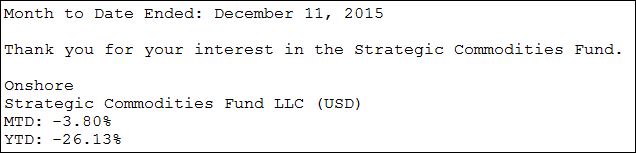
Note: I did have some money with them. But years ago, when they started ebbing, I got out. My patience is thin.
John Oliver’s Holiday Re-Gifting Tips. This Christmas you’ll receive gifts you don’t want. The solution? Re-gift them. There are rules. This video explains all.
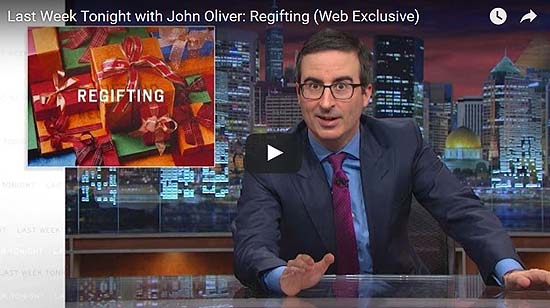
For the video, click here.
They’re building this at 111 West 57 Street. Full floor condominiums start at $16 million. Amazing image. The George Washington Bridge is way in the distance on the left river, the Hudson River.

This is a chastity belt.

The belt features in a Conde Nast Traveler article on What Not To Pack in Your Carry-on Bag.
Caption on the chastity belt:
That’s right. This 19th-century contraption sold for a record price at auction, but as recently as 2012 a flyer admitted to wearing a more modern one (sans key).
Tip: They’re not technically prohibited, but be prepared for awkward questioning and a couple of phone calls before boarding any flight. And you’d better pray you don’t have to use the bathroom.
The other stuff not to pack is fairly mundane. For all the other items not to pack in your carry-on bag, click here.
The story of the hapless suicide bomber:
A suicide bomber completed his mission and went to Paradise, as foretold.
When he arrived there he said to Allah that he was ready to claim his 72 virgins, as promised. Out of curiosity he asked Allah why there were so many virgins in heaven.
Allah regarded him for a moment, then replied, “Actually, the 72 virgins are here in heaven because people like you murdered them before they could experience the pleasure of sex. So you’re here to service them. Since they’re virgins, they’re quite sexually ravenous and, frankly, you’ll be on constant, exhausting duty. I shall banish you from Paradise should you fail!”
The bomber responded, “Well, I guess I can deal with that. How hard can it be to keep 72 women satisfied for all eternity?”
Allah replied, “Who said they were women?”

Harry Newton, who walked to breakfast this morning in shirt-sleeves. No jacket. No pullover. Just a shirt. It’s 70 in the sun in New York. The sky is azure blue and crystal clear. You can see the George Washington Bridge from our building. No smog. The wind has blown it all away. The locals, who are wearing their heavy Winter jackets, are perplexed. There’ll be big sales on parkas shortly. But who will ever need them?

The trouble with that building, and others like it, is that they sway like mad in heavy weather (no thanks), and are lovely targets for terrorists, i.e., the World Trade Centers.
111 W. 57 is a joke right? Did that building really get approved and is getting built? That condo you put a bid on is an investment property? Therefore, I assume you plan or renting it out? How did you calculate 2% return. Is that after maintenance and taxes? I guess a good purchase if you truly think it will appreciate, which it should but better to buy residential real estate properties with more than a 2% return…
Welcome to Harry’s bizarro investment world where everything is always about to crash, cash yielding 0 % is good and a 2 percent return is amazing. HE is the worst investor on the planet.
If I’m the worst investor on the planet — which I’m not because I’m up for 2015 — why do you bother to read my blog? And why do you not reveal your name and your investment record? And your advice?
I would never live in that building.
As for the weather, just wait
Single story is just right for me…can you imagine having to walk down in case of an emergency!!
Imagine having to walk up.
Parachutes are optional