What Buffett doesn’t pay attention to:
+ Economists.They don’t make money buying and selling stocks. Keynes apparently went broke a couple of times.
+ Daily stock prices. They don’t make any difference to the long-term value of a good business.
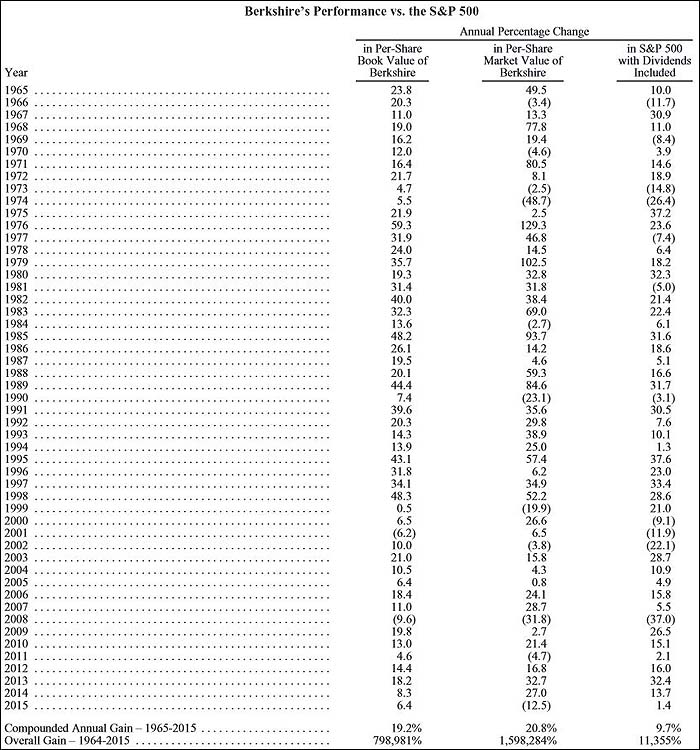
Here’s the chart which each year begins his letter to shareholders. Pretty darn good record:
In recent years, Buffett has changed Berkshire from a company investing in stocks, to one buying companies. That strategy makes huge sense: Owning your own business gives you a lot more control over the outcome. They’ll listen to you if you own it.
Most people don’t listen — unless your signature is on the check. If they have your money, they’ll do what they want to make themselves rich, not you.
This reality is why I don’t like funds. (To be clear, Buffett doesn’t run a fund.)
The theory of investing in funds is that you get “experts” to manage your money. They’ll do a better job than you would, or a simple S&P 500 index fund would. Look at the results of the S&P 500 in the chart above — 9.7% a year average over 51 years. Not bad. Not as good as Buffett’s 20.8%. But, as they say in Australia, better than a slap in the belly with a cold fish. And certainly better than muni bonds.
You can read Buffett’s 2015 full letter here.
The big boom in 1980s and 1990s was in specialty funds — private equity, leverage buy-out, venture capital and other concoctions of Wall Street. There was a time — in the 1980s and 1990s and early 2000s — when the things did well, with some funds earning over 30% a year. But the 2008 Great Recession killed all that. One fund I was in dropped its book value from over $1 to 60 cents. That wasn’t uncommon. The last few years have been catch-up. It’s been a slog and many funds are still suffering.
What has been en eye-opener for many investors in the funds (like me) has been the extent of fees created by the managers. Many funds actually charge the companies they invest in a fee for “managing” them. Imagine buying shares in Coca Cola — what’s called your portfolio company — and then charging it a fee, which your investors often don’t know about. A nice double whammy.
All this brings me to a piece by Gretchen Morgenson in this weekend’s Business Section of the New York Times. Read on. You’ll be horrified:
Keeping Investors on a Need-to-Know Basis
Fair Game
By GRETCHEN MORGENSON FEB. 26, 2016
Trust, but verify.
That’s certainly a timeless investing rule. But for anyone interested in vetting regulatory filings made by investment advisers with the Securities and Exchange Commission, it can be easier said than done.
Large investment advisers, under S.E.C. rules, must give their clients extensive information about their operations and update it regularly. These materials are, in turn, published online in the Investor Adviser Public Disclosure database for all to view.
Two types of documents appear on this website: Part 1 is a factual questionnaire completed by money managers that includes their regulatory records, assets under management and other facts.
Part 2 is a descriptive and lengthy brochure explaining crucial aspects of an investment adviser’s operations. Included in this document is a narrative outlining the risks, fee arrangements and potential conflicts that investing with the money manager involves.
This brochure, according to the S.E.C., is “designed to promote effective communication” between an investment adviser and its clients. Toward that end, the regulator requires investment advisers to highlight any material changes made to the same document issued previously.
A look through these filings shows that investment advisers regularly report that their filings contain no such changes. But checking on previous brochures filed by some advisers raises questions about these statements.
Since 2014, for example, Apollo Global Management – the giant private equity firm that owns, among other things, the teenage retailer Claire’s, Norwegian Cruise Line and the gambling concern Caesars Entertainment – has amended three of its investment adviser brochures in meaningful ways. But in each filing, the firm contended that it had made “no material changes” to the document since its last annual update.
A spokesman for Apollo declined to comment.
Digging into Apollo’s filings shows that some changes involve a central issue: fees the firm levies on portfolio companies its funds invest in. Costs borne by these companies are ultimately paid by private equity investors, including pension funds and endowments.
One charge levied by private equity firms is for watching over the operations of companies in their funds’ portfolios. Known as monitoring fees, these charges are typically subject to yearslong contracts. When a portfolio company is sold, it often pays a lump sum consisting of the remaining monitoring fees owed under the contract.
This practice of accelerating monitoring fees essentially charges portfolio companies for services that are never actually rendered. And while this has been an all-too-common industry practice, these fees came under S.E.C. scrutiny in early 2014.
In a filing that September, Apollo’s brochure discussed its practice of collecting accelerated monitoring fees for the first time. But it did not highlight the change.
Why not? Apollo isn’t saying, but the notice may yet be found to be a material change. In fact, regulators are looking at Apollo’s practice in this area. When it announced its 2015 earnings this month, the company said it had set aside $45 million related to an S.E.C. inquiry concerning “the acceleration of fees from fund portfolio companies.”
Apollo also added new information to a March 2015 Form A.D.V., as they are called, regarding fee-sharing arrangements through which private equity firms reduce the management fees they charge to investors by deducting other fees levied on portfolio companies. Management fee offsets, as these are called, include charges for financial advice or merger-and-acquisition transactions.
In the March 2015 brochure, Apollo acknowledged that its affiliates may collect fees from portfolio companies that are not subject to the typical offset arrangements.
A third change involved disparities between what the firm pays for legal services and what its private equity clients pay for some of that work. The May 2014 brochure noted in a new disclosure that Apollo receives discounts for legal services while its investors may pay a premium.
From a 2014 Apollo Brochure:
“To the extent such law firms also provide legal services to Clients with respect to such matters, such Clients also enjoy the benefit of such fee discount arrangements. Legal services rendered for investment transactions, however, are typically charged to the Apollo Private Equity Managers, their affiliates and Clients on a “full freight” basis or at a premium. Legal fees for transactions that are not consummated are also typically charged at a discount.”
This unlevel playing field on legal fees came up in a $39 million settlement the S.E.C. struck last October with Blackstone, another private equity giant. The S.E.C. said Blackstone had not informed its clients that it received greater discounts from an outside law firm than those provided to its funds.
Other private equity firms have also changed their investment adviser brochures without highlighting the modifications. Bain Capital, for example, has made two relatively recent changes having to do with conflicts of interest faced by its investors.
One emerged in March 2013, when the firm described how it might allow an investment opportunity to be purchased by an unaffiliated person – perhaps a limited partner or a broker on a transaction – even though such an opportunity need not be made available to other fund investors.
And in an A.D.V. from March 2015, Bain made a new disclosure related to how the firm determines what a portfolio company pays in fees for advisory services. In certain cases, Bain said, an independent third party may not be involved, creating a conflict of interest.
A spokesman for Bain declined to comment.
One would think such disclosure practices might raise red flags at the S.E.C. True, the private equity firms, if challenged, would probably argue that their changes were immaterial or that their investors have access to past brochures, so they can easily identify changes as they appear.
But such an exercise is much harder for teachers, firefighters and other beneficiaries of pension funds whose retirement money is invested in private equity firms. That’s because the S.E.C.’s database of investment adviser brochures, unlike its corporate filing system, provides no archives of past documents. Anyone interested in getting previous investment adviser brochures must request them from the S.E.C.
It’s time for this to change, said Betty Yee, the California state controller. In late January, she wrote a letter to Mary Jo White, the chairwoman of the S.E.C., asking the commission to post past brochures on its investment adviser website.
The S.E.C. said it was looking into the matter.
In a recent interview, Ms. Yee explained her position.
“There’s been a lot of attention recently on broadening transparency in the disclosure of private equity fees and costs,” she said. “Given how complicated the fee structures are in private equity, we need the ability to look at historic filings so we can see how those fee structures have changed. The current filings would be much more useful if they could be compared.”
The most beautiful travel photos of 2016. This is Adriano Neves, Eden’s Garden, Portugual

For the others, click here.

Harry Newton, who’s off to California this evening feeling good. A Goldman Sachs private equity fund from 2007 just sold a bunch of its investments and is sending me a cash dividend. It ain’t brilliant. It’s not the 1990s. But I’ve been waiting a long time. And money is money.

Hi Harry,
The travel photo was taken in Torres del Paine National Park in Southern Chile (Patagonia). I recently spent a wonderful family vacation there and hiked up into that valley. Conde Nast Traveler must have cited the photographer and where they are from.
Enjoy California!