The first thing you learn about the FBI/Apple fight is that if you forget your 4-digit iPhone password, you’ve only got ten tries before your phone is locked forever, and your life goes bye bye.
Banks will lock you out of your account if you screw up three times. But you can call them and they’ll unlock your account and give you a new password.
They can do this because your information is physically on their computers and not on the device you’re accessing it with — your phone, your tablet, your computer, etc.
Apple’s iPhone is different. If you screw up ten times, the phone locks, the information on it is wiped out and there’s nothing anyone can do to get at what’s on the phone.
Apple designed the system to protect you and me against bad guys.
The FBI (and other law enforcement agencies) want a way to get into an iPhone — if they don’t know the 4-digit password.
The typical way computers hack into accounts is to bombard with one password after another until they find the one password — say 7859 — that works. Apple has protected this “forced entry” by simply destroying the information on the phone after ten attempts. Many online accounts don’t have this protection. Check with your bank that it does.
The FBI wants Apple to write software to go around this and let the FBI find out what’s on the phone — even though it doesn’t know the correct password.
As a user of an iPhone, I don’t want the FBI (or anyone else) getting the information on my iPhone, or my computer, or my bank account. I remember when my son Michael’s identity was stolen. It took work to explain that an 18-year old didn’t have mortgages of hundreds of thousands of dollars, etc. Had he been older we’d still be dealing with the mess.
There’s a lot more to this. If the government can get Apple to provide it with a “back door entry”, it’s only a matter of time before every other government and crook gets his hands on the back door software. They’ll be selling the software on the Internet — like they do stolen credit cards today.
Worse, we will then have a precedent that can be used for even more government intrusion into our lives. What’s to stop the FBI from asking Samsung to build software into its refrigerators that records what you’re saying and photographs what you’re doing in your own (once private) kitchen?
Reports the New York Times:
In a mob case more than a decade ago, the F.B.I. asked a company that made an in-dash roadside assistance device – something like OnStar, which uses a cellular phone to connect to an operator in case of an emergency – to secretly record the private conversations of people inside a car. A court ruled against the F.B.I.’s request, but only on the very narrow grounds that bugging the car would have interfered with the proper functioning of the in-dash device.
“The court left open the door to surveillance as long as the primary function of the device was intact,” Mr. Soghoian said. “So as long as Amazon Echo can tell you what temperature it is or can still play music, that case seems to suggest that the government might be able to force Amazon to spy on you.”
Mr. Soghoian was referring to Amazon’s handy digital assistant, a device that is constantly listening to your household conversations to try to offer you friendly help. The Echo listens for a keyword – “Alexa!” – which prompts it to start streaming your voice to Amazon’s servers to decipher your request. Amazon, which declined to comment on how the Apple case might affect Echo users’ privacy, has said it is not constantly recording people’s voices, and that it keeps voice recordings only to help the system learn to better understand you.
Chris Soghoian is the principal technologist at the American Civil Liberties Union.
I don’t know what’s on my iPhone (or my computer) that I don’t want the FBI to know. But I’m guessing I have a file at the FBI from the time I gave speeches against the Vietnam War when I was at Harvard in the late 1960s. I don’t want stuff added to that file. Nor do I want the FBI to go on a fishing trip because I was once an alien — an Australian.
I’d rather live confident that the material I share with my iPhone and my computer is private, and that all the other Internet of Things devices (like my refrigerator) I will be buying in coming years are not sending my every thought back to some government person who can distort my thoughts and intent.
As Soghoian said, “”By and large you get very little constitutional protection for data housed by third parties, and that’s mostly a result of a Supreme Court case from the 1960s — before email, before search engines, before social networks.”
In short, if you have sensitive stuff, don’t trust it to “the Cloud.” Something local with a password seems a letter bet — like an encrypted external hard disk, e.g. one made by Apricorn. That’s what I use.
I side with Apple on this. The Government should not be allowed to force Apple to build a back door into my iPhone — or anyone else’s iPhone.
You can read a little more on this in “The Apple Case Will Grope Its Way Into Your Future” by Farhad Manjoo. Click here.
Update: This morning’s Wall Street Journal sides with me this morning with a piece, “Apple Is Right on Encryption The FBI doesn’t want merely one phone, and its warrant is legally suspect.” The Journal concludes:
“Mr. Comey (the FBI director) may be leading the government to defeat, which makes the White House’s incoherence-backing this unnecessary showdown while claiming to oppose back doors-all the stranger. If this debate really is critical to protecting public safety, then Mr. Comey should appeal to Congress to change the law, rather than insist that the courts should resolve a major policy dispute in his favor.”
Read the Journal’s piece here.
Getting better and better. Trump did well yesterday. You must watch this video:
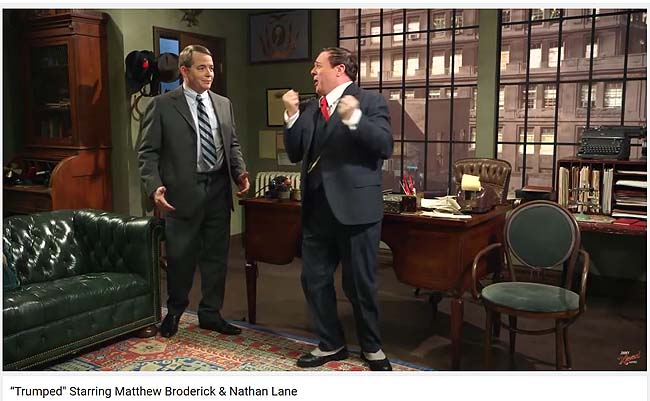
To watch, click here.

Harry Newton, who’s playing tennis in ten minutes and has to run. Maybe the market will go do nicely today — like it did yesterday? Make sure you watch the video. It’s brilliant. It’s not anti-Trump. It’s actually a celebration of Trump.
Final thought: The FBI probably screwed up royally when it got access to the terrorist’s iCloud account (Apple gave it the access). And then the FBI proceeded to change the password — without changing it on the iPhone whose material was backed up on Apple’s servers. That has to be one of the dumbest computer moves you could make. Heh, FBI, hire yourself some people who know about computers.

I’m sure you have many rational and civilized readers, Harry, which is a reflection of your temperament. But you get your share of commenters who are anything but that.
The fact is, the US is a major force in the world but news to many of its inhabitants, there are other significant nations and cultures in the world.
Millions of Americans are clueless when it comes to history and politics. We have two right of center parties. Our major media (NY Times included) is right of center and/or establishment oriented. It would be funny were it not sad, that there are many who think that our problems stem from Left “Liberal” institutions, which makes about as much sense as a nation of blondes complaining that there are too many redheads.
Harry, I know you get mostly critiques. Great column today. Correct in all aspects. Thank you! [Well, okay, you did quote the NYT… but that’s what you do… so one can’t come here and expect that to change!]
Harry, it’s hard to picture you doing anything without screwing up at least 10 times.