On Thursday, Great Britain will vote on whether to leave the European Union.
If the vote is YES to leave, nothing will happen on Friday, or for probably two years.
The original idea of the EU was to stop another World War. For that goal, it’s worked spectacularly.
The EU was not designed to create a United States of Europe. And it hasn’t. One Seeking Alpha guru writes:
Rather than one central bank (like the U.S.), the euro-zone has nineteen national central banks, nineteen national tax regimes, nineteen national defense authorities, nineteen national bank deposit regimes, nineteen national old-age and disability regimes — all with varying degrees of coordination and with vastly different national credit ratings. Former Secretary of State Henry Kissinger’s prescient quip as to whom do you call in the event of a European crisis — almost 50 years after its utterance — retains its eerie resonance. There is no Euro-bond or notion of cross-border transfer union to channel aid or assistance to member states in need or facing financial or natural adversity. Quite to the contrary, there is strong political opposition that keeps such a federal solution well at bay. Keynesian deficit spending remains heresy. When crises erupt, the immediate reaction for investors and policy makers alike — is to mitigate contagion.
The European Union has grown into a gigantic cumbersome bureaucracy, setting zillions of regulations on small and large matters. The Leave voters in the U.K. are fed up with the bureaucracy. They see going it alone to bring them advantages of flexibility — sort of like running your company versus running a division of a huge one.
It’s impossible to predict whether staying or leaving will benefit or hurt Great Britain in the long run. Many corporate spinoffs do well. Their managements discover they have new flexibility.
I’ve been mulling bets: Short the U.K. pound? Short the Euro? Buy more gold? Buy the U.K. pound? Go long the Euro?
I’m actually in this thing “big-time.” I have some gold, and I have all my money in U.S. dollars. Turmoil in Europe and Great Britain is good for the U.S. The Europeans bring their money here because it’s safe and predictable. It’s a lot easier (and probably more profitable) to run a business here than there. We have one country for 320 million people. The European Union has 508 million people — but split that nineteen ways and you see the problem. Who do you call in the event of a crisis? Like Greece? Or Portugal?
The British pound is a little cheaper, or was last week. Maybe I should buy some of the largest U.K. companies. Forbes ran a piece on the Forty Largest U.K. companies.
The ten largest are HSBC, Royal Dutch Shell, BP, Royal Bank of Scotland, Barclays, HBOS (a bank), BHP (an Australian/British miner), Lloyds, GlaxoSmithKline, and Aviva (insurance).
I’m sort of attracted to the oils and miners, down big-time but now inching back. That obviously has nothing to do with Brexit and everything to do with the slow recovery in commodities.
On Brexit, my conclusion from all my weekend reading is: Long-term it won’t make any difference. Short-term we may be in for some volatility. But it’s not something I can predict. Hence, as Todd said, “When in doubt, stay out.”
Here’s the best stuff to read on Brexit:
+ The Forbes list of the 40 largest U.K. companies. Click here.
+ The UK’s EU referendum: All you need to know. The BBC answers its readers questions on many subjects from immigration to work visas. Click here.
+ Forex (foreign exchange trading) Should Be Lively This Week Amid Imminent Brexit Vote. From Seeking Alpha. Click here.
Son Michael loves Vanguard. And so do many others.
A little while ago, I looked at Fidelity index Funds which apped (copied) Vanguard index funds. According to this ad the Fidelity funds had cheaper expense costs. Yet, when I checked their performance against Vanguard ones, the Vanguard ones did better for an investor. I don’t know why (yet).

Here’s last week’s Economist piece on Vanguard, Worth reading:
Asset management: Index we trust
Vanguard has radically changed money management by being boring and cheap
WHEN John Bogle set up Vanguard Group 40 years ago, there was no shortage of scepticism. The firm was launching the first retail investment fund that aimed simply to mimic the performance of a stock index (the S&P 500, in this case), rather than to identify individual companies that seemed likely to outperform. Posters on Wall Street warned that index-tracking was “un-American”; the chairman of Fidelity, a rival, said investors would never be satisfied with “just average returns”; and the Securities and Exchange Commission (SEC), Wall Street’s main regulator, opposed the firm’s unusual ownership structure. The fund attracted just $11m of the $150m Vanguard had been hoping for, and suffered net outflows for its first 83 months. “We were conceived in hell and born in strife,” Mr Bogle recalls.
Vanguard now manages over $3.5 trillion on behalf of some 20m investors. Every working day its coffers swell by another billion dollars or so. One dollar in every five invested in mutual or exchange-traded funds (ETFs) in America now goes to Vanguard, as does one in every two invested in passive, index-tracking funds, according to Morningstar, a data provider. Vanguard’s investors own around 5% of every public company in America and about 1% in nearly every public company abroad. Although BlackRock, a rival, manages even more money, Vanguard had net retail inflows of $252 billion in 2015, more than any other asset manager.
Impressive as they are, however, these statistics still understate Vanguard’s influence. By inventing index-tracking, and providing it at very low cost, the firm has forced change on an industry known for its high margins and overcomplicated products. Delighted investors and disgruntled money managers speak of “the Vanguard effect”, the pressure that the giant’s meagre fees put on others to cut costs. Some rivals now sell passive products priced specifically to match or undercut it.
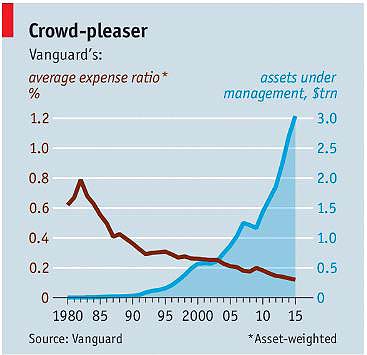
Ask any employee for the secret of Vanguard’s success, and they will point to its ownership structure. The firm is entirely owned by the investors in its funds. It has no shareholders to please (and remunerate), unlike the listed BlackRock or Fidelity, a privately owned rival. Instead of paying dividends, it cuts fees. Mr Bogle’s rationale for this set-up is simple: “No man can serve two masters.” The incentives of the firm and its customers are completely aligned, he says. Competitors implicitly agree. “How are we supposed to compete when there’s a non-profit disrupting the game?” complains one.
Bill McNabb, Vanguard’s current CEO, says the ownership structure permits a virtuous cycle, whereby its low fees improve the net performance of its funds, which in turn attracts more investors to them, which increases economies of scale, allowing further cuts in fees. Even as the assets Vanguard manages grew from $2 trillion to $3 trillion, its staff of 14,000 or so barely increased. Meanwhile, fees as a percentage of assets under management have dropped from 0.68% in 1983 to 0.12% today (see chart). This compares with an industry average of 0.61% (or 0.77%, when excluding Vanguard itself). Fees on its passive products, at 0.08% a year, are less than half the average for the industry of 0.18%. Its actively managed products are even more keenly priced, at 0.17% compared with an average of 0.78%.
The index-trackers account for over 70% of Vanguard’s assets and over 90% of last year’s growth. Investors are gradually absorbing the idea that, in the long run, beating the market consistently is impossible, Mr McNabb says. That makes being cheap more important than being astute. Last year investors in America withdrew $145 billion from active funds of different kinds and put $398 billion into passive ones.
“In an industry with serious trust issues, Vanguard has proven an exception to the rule,” says Ben Johnson of Morningstar. Its investors stay with it roughly twice as long as the industry average. The firm actively shuns short-term “hot money” because it brings extra trading costs. Mr McNabb tells the tale of the CEO of a foundation who wanted to park $40m with a Vanguard fund for a few months. When the fund turned him away, he “went ballistic”, complaining to the SEC, but Vanguard did not budge.
Vanguard also insists on keeping things simple. It offers only 70 different ETFs, compared with 383 at BlackRock. It steers clear of voguish products, such as funds of distressed energy firms. It refused, presciently, to set up an internet fund in the late 1990s.
But Vanguard’s conservatism can also be a weakness. It has been slow to expand abroad: its customer base is 95% American. It was slow to get into ETFs as well, allowing BlackRock to become the biggest provider, although Vanguard is catching up. BlackRock is also a one-stop shop for all manner of investments, including alternatives such as private equity and hedge funds, whereas Vanguard caters only to the mainstream. This may be one of the reasons why it does less well with the biggest institutional investors, which want lots of investment options and the kind of bespoke service that Vanguard does not offer.
There is always a chance that a clever fintech startup, or a tech giant like Apple, might create a cheaper or simpler way for individuals to invest, luring away some of Vanguard’s customers. As it is, it is getting harder for Vanguard to keep cutting fees: to shave its average fee by a hundredth of a percentage point, it needs to attract an extra $560 billion in assets under management. And heavier regulation is always a risk. Last year the industry’s giants won an important battle when they convinced regulators that, unlike banks, fund managers should not be subject to more onerous rules simply because they are big. But talk of rules intended to stem panic in collapsing markets has not gone away.
Nonetheless, there is plenty of room for Vanguard to keep growing. Only a third of American equities are held by index-tracking funds, and a smaller share elsewhere. Regulators in America and beyond are discouraging or barring financial advisers from receiving commissions from firms whose products they recommend-a move that should push even more money to Vanguard as advisers lose the incentive to offer expensive products (Vanguard refuses to pay commissions).
As the move from defined-benefit to defined-contribution pensions continues, and as Asia sets up its retirement systems, there will be growing demand for the sort of “DIY” investing that has underpinned Vanguard’s success. With interest rates and investment returns expected to be low for years to come, keeping fees down will be more important than ever. As Tim Buckley, the firm’s chief investment officer, puts it: “The biggest advantage Vanguard has, aside from its structure, is the greed of our competitors.”
Quotes to have fun with:
+ I have never hated a man enough to give his diamonds back. – Zsa Zsa Gabor
+ My luck is so bad that if I bought a cemetery, people would stop dying. – Rodney Dangerfield
+ Money can’t buy you happiness But it does bring you a more pleasant form of misery. – Spike Milligan
+ We could certainly slow the aging process down if it had to work its way through Congress. – Will Rogers
+ I never drink water because of the disgusting things that fish do in it. – W. C. Fields

Harry Newton who notes it’s beginning to feel like summer. Enjoy: