“Gloom and Doom” is fashionable, and most importantly, sells. Many gloom and doomers make their money by selling newsletters. They give rarely give concrete investment advice, like “short JNJ” or “buy TBT.” But the “signs” tell me otherwise — like buoyant shipping numbers (on BubbleVision this morning) to the fact that John Paulson just bought $200 million of lower level debt in a bunch of overleveraged vacation properties. He paid seven cents on the dollar for debt that, today, theoretically is worthless. He’s figuring that real estate that can’t be easily duplicated will appreciate in coming years. Real estate that can be easily duplicated — like suburban housing — will not rise in value. There’s a surplus of it.
So, here is the best of the Gloom and Doom. Don’t believe it all. But don’t rush out and buy overpriced stocks on margin:
Richard Russell:
September 7, 2010 — During the coming five or six years, the emphasis will not be on making money (increasing purchasing power) — instead the emphasis will be on not losing money (loss of purchasing power).
I just finished a three-day weekend, and the good part of it was — that three days allowed me time to think. And to tell you the truth, I’ve been doing a lot of thinking.
To start, let’s agree that the major movements of the stock market are meaningful. The stock market is made up of the hopes, worries, research and aspirations of millions of people in every sector of life. As such, the stock market possesses a strange, almost eerie, ability to discount the future. To put it another way, everybody knows more than any one person or any group of people.
If this is true, then what are we to make of the last 10 years, the so-called “Lost Decade?” This is a decade that started with widely-held doubts about the future of the nation along with almost ingrown pessimism about stocks. Yet stocks began to climb in 1982, and they continued to climb year after year. Optimism increased as the stock market headed ever-higher. Toward the end of the ’90s we experienced the great tech boom or should we call it the great tech mania. In 2000-2001, the tech mania collapsed — companies that were valued at over $100 million ended up selling in single digits.
Next came the housing boom. People placing little or no money down bought two and three houses on spec. The Dow had climbed from 850 in 1982 to 14,000 in 2007. In late-2007 the great bull market ended. Suddenly,the bottom fell out of the housing market, as the stock market headed down. The year 2008 amounted to one long stock market crash. By the end of 2008, investors had seen something that most had never seen before. It was a “lost decade.” Stock-holders had lived through one of the worst decades for equities in market history. Anyone holding a “good,” diversified portfolio of stocks during 2008 had lost money.
What was the stock market telling us by handing us a decade of losses? The answer is that the stock market was telling us that the era of frivolity and good times in the US had come to an end. Something very fundamental had changed.
First Americans piled into equities. That ended in 2008 with horrendous losses. At the same time, due to ridiculously low interest rates, Americans rushed into housing. The housing frenzy ended in tears (and it’s still going on) amid thousands of foreclosures and losses.
By 2009 the optimism of the ’80s and ’90s turned into fear and pessimism. The phrase that emerged was “safe haven.” The key question was, “Where can I put my money where it is safe, and how can I be sure that my money will be returned to me?” The widely-accepted solution was cash and Treasuries and high-grade bonds. The rush into bonds was amazing. Over the last two years investors have poured $400 billion into bond funds. In the all-out frenzy to buy bonds, yields on bonds declined to historic lows.
Suddenly, every class of investment is suspect. Stocks didn’t pay off. Housing is still overpriced and dangerous. But bonds are loved. Today currencies are the current “happy home” for traders. Trading in currencies now amounts to the staggering figure of $4 trillion a day.
The danger areas of today are now DEBT and UNEMPLOYMENT. Meanwhile, a clueless President Obama is depending on two clueless advisors to avoid a “double dip” recession. The two advisors are — Larry Summers and Timothy Geithner.
But let’s go back to the meaning of the “lost decade” in the stock market. To wipe out 10 years of stock gains is a most unusual feat. I think it means the end of equities as the magic and guaranteed road to riches. It’s the end of Warren Buffet’s thesis that you should “buy good stocks and hold ’em forever.” What this means is that Americans can no longer be certain of their retirement. It means the end of the time-honored American dream that “My kids will have a better life than I had.”
It may also herald the end of America’s leadership on the world’s stage. America will be just a republic as the Founding Fathers wanted it to be — not an empire.
In the big picture here’s what we’ll be watching: (1) The action and direction of Treasuries. This is our window to the debt of the United States. The market’s appraisal of a nation’s debt tells you a lot about that nation. (2) The action and direction of the US dollar. The world’s appraisal of a nation’s currency tells you most of what you have to know about the health of a nation.
Conclusion — We’ve already received an initial warning from the US equities market. Next, we’ll keep a sharp eye on both the Treasury market and the currency market.
Financial Armageddon:
September 07, 2010
‘I Love the Delusion of the Markets at this Point in the Cycle’
Since I started publishing Financial Armageddon in late-2006, I’ve often railed against the incompetence and tomfoolery of highly-paid Wall Street “strategists” (note the double quotes). Many of these so-called experts are clueless data-regurgitators or ivory tower economists with above average communications skills. Indeed, it seems to me that most of the “stars” of the forecasting game are simply being rewarded for having the gift of gab, rather than their ability to look past the trees and size up the layout of the forest.
But as with most generalizations, there are exceptions. Surprisingly — yes, I am cynical — a very small number of those who know what they are talking about, have something intelligent to say, and know how to translate their insights into clear and interesting prose have been recognized as such. I am referring in particular to Albert Edwards, the number-one ranked global strategist for I-don’t-know-how-many-years running, and his sidekick Dylan Grice, who placed second overall in the 2010 Thomson Reuters Extel Survey, both of whom are members of the strategy team at Societe Generale.
In his most recent Global Strategy Weekly, Mr. Edwards touches upon two topics near-and-dear to my heart: the real state of the economy and the utter cluelessness of most equity investors [italics mind]:
The current situation reminds me of mid 2007. Investors then were content to stick their heads into very deep sand and ignore the fact that The Great Unwind had clearly begun. But in August and September 2007, even though the wheels were clearly falling off the global economy, the S&P still managed to rally 15%! The recent reaction to data suggests the market is in a similar deluded state of mind. Yet again, equity investors refuse to accept they are now locked in a Vulcan death grip and are about to fall unconscious.
The notion that the equity market predicts anything has always struck me as ludicrous. In the 25 years I have been following the markets it seems clear to me that the equity market reacts to events rather than pre-empting them. We know from the Japanese Ice Age and indeed from the US 1930’s experience, that in a post-bubble world the equity market merely follows the economic cycle. So to steal a march on the market, one should follow the leading indicators closely. These are variously pointing either to a hard landing or, at best, a decisive slowdown. In my view we are poised to slide back into another global recession: the data is slowing sharply but, just like Japan in its Ice Age, most still touchingly believe we are soft-landing. But before driving off a cliff to a hard (crash?) landing we might feel reassured when we pass a sign that reads Soft Landing and we can kid ourselves all is well.
I love the delusion of the markets at this point in the cycle. It bemuses me why investors cannot see what is clear as the rather large nose on my face. Last Friday saw the equity market rally as August’s 67k rise in private payrolls and an upwardly revised July rise of 107k beat expectations. But did I miss something? When did we switch from looking at headline payrolls to private jobs? Does the fact that government is shedding jobs not matter? Admittedly temporary census workers do mess up the data, but hey, why not look at nonfarm payroll data ex census? Why not indeed? Because the last 4 months run of data looks notably weaker on payrolls ex census basis than looking only at the private payroll data (ie Aug 60k vs 67k, July 89k vs 107k, June 50k vs 61k and May 21k vs 51k). But these data, on either definition, look dreadful compared to the 265k rise in April and 160k in March (ex census definition). If someone as pathologically lazy as me can find the relevant BLS webpage after a quick call to the BLS (link), why can’t the market? Because it is bad news, that’s why.
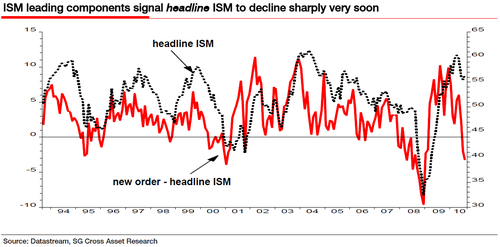
August’s rebound in the US manufacturing ISM was an even bigger surprise. This is a truly nonsensical piece of datum as it was totally at variance with the regional ISMs that come out in the weeks before. The ISM is made up of leading, coincident and lagging indicators. The leading indicators new orders, unfilled orders and vender deliveries all fell and point to further severe weakness in the headline measure ahead (see chart above). It was the coincident and lagging indicators such as production, inventories and employment that drove up the headline number. Some of the regional subcomponents (eg Philadelphia Fed workweek) are SCREAMING that recession is imminent.
The real reason why markets reversed last week was that they got ahead of themselves. Aside from the end of 2008, government bonds were the most over-bought they had been over the last decade. And in equity-land the AAII two weeks ago recorded a historically low 20% of respondents as bullish. These technical extremes will now be quickly worked off before the plunge in equity prices and bond yields resumes.
Steve Keen
What Bernanke Doesn’t Understand
Bernanke’s recent Jackson Hole speech didn’t contain one reference to the key force driving the American economy right now: private sector deleveraging. The reason the US economy is not recovering from this crisis is because all sectors of American society took on too much debt during the false boom of the last two decades, and they are now busily getting themselves out of debt any way they can.
Debt reduction is now the real story of the American economy, just as real story behind the apparent free lunch of the last two decades was rising debt. The secret that has completely eluded Bernanke is that aggregate demand is the sum of GDP plus the change in debt. So when debt is rising demand exceeds what it could be on the basis of earned incomes alone, and when debt is falling the opposite happens.
I’ve been banging the drum on this for years now, but it’s a hard idea to communicate because it’s so alien to the way most economists (and many people) think. For a start, it involves a redefinition of aggregate demand. Most economists are conditioned to think of commodity markets and asset markets as two separate spheres, but my definition lumps them together: aggregate demand is the sum of expenditure on goods and services, PLUS the net amount of money spent buying assets (shares and property) on the secondary markets. This expenditure is financed by the sum of what we earn from productive activities (largely wages and profits) PLUS the change in our debt levels. So total demand in the economy is the sum of GDP plus the change in debt.
I’ve recently developed a simple numerical example that makes this case easier to understand: imagine an economy with a nominal GDP of $1,000 billion which is growing at 10 percent a year, due to an inflation rate of 5 percent and a real growth rate of 5 percent, and in which private debt is $1,250 billion and is growing at 20% a year.
Aggregate private sector demand in this economy—expenditure on all markets, including asset markets—is therefore $1,250 billion: $1,000 billion from expenditure from income (GDP) and $250 billion from the change in debt. At the end of the year, private debt will be $1,500 billion. Expenditure is thus 20 percent above the level that could be financed by income alone.
Now imagine that the following year, the rate of growth of GDP continues at 10 percent, but the rate of growth of debt slows from 20 to 10 percent. GDP will have grown to $1,100 billion, while the increase in private debt this year will be $150 billion—10 percent of the initial $1,500 billion total and therefore $100 billion less than the $250 billion increase the year before.
Aggregate private sector demand in this economy will therefore be $1,250 billion, consisting of $1,100 billion from GDP and $150 billion from rising debt—exactly the same as the year before. But since inflation has been running at 5 percent, aggregate demand will be 5 percent lower than the year before in real terms. So simply stabilising the debt to GDP ratio results in a fall in demand in real terms, and some markets—commodities and/or assets—must take a hit. …
Notice that nominal aggregate demand remains constant across the two years–but this means that real output has to fall, since half of the recorded growth in nominal GDP is inflation. So even stabilising the debt to GDP ratio causes a fall in real aggregate demand. Some markets–whether they’re for goods and services or assets like shares and property–have to take a hit.
Now let’s apply this to the US economy for the last few years, in somewhat more detail. There are some rough edges to the following table—the year to year changes put some figures out of whack, and some change in debt is simply compounding of unpaid interest that doesn’t add to aggregate demand—but in the spirit of “I’d rather be roughly right than precisely wrong”, at your leisure please work your way through the table below (removed by Harry).
Its key point can be grasped just by considering the GDP and the change in debt for the two years 2008 and 2010: in 2007-2008, GDP was $14.3 trillion while the change in private sector debt was $4 trillion, so aggregate private sector demand was $18.3 trillion. In calendar year 2009-10, GDP was $14.5 trillion, but the change in debt was minus $1.9 trillion, so that aggregate private sector demand was $12.6 trillion. The turnaround in two years in the change of debt has literally sucked almost $6 trillion out of the US economy….
That sucking sound will continue for many years, because the level of debt that was racked up under Bernanke’s watch, and that of his predecessor Alan Greenspan, was truly enormous. In the years from 1987, when Greenspan first rescued the financial system from its own follies, till 2009 when the US hit Peak Debt, the US private sector added $34 trillion in debt. Over the same period, the USA’s nominal GDP grew by a mere $9 trillion.
Ignoring this growth in debt—championing it even in the belief that the financial sector was being clever when in fact it was running a disguised Ponzi Scheme—was the greatest failing of the Federal Reserve and its many counterparts around the world.
Though this might beggar belief, there is nothing sinister in Bernanke’s failure to realize this: it’s a failing that he shares in common with the vast majority of economists. His problem is the theory he learnt in high school and university that he thought was simply “economics”—as if it was the only way one could think about how the economy operated. In reality, it was “Neoclassical economics”, which is just one of the many schools of thought within economics. In the same way that Christianity is not the only religion in the world, there are other schools of thought in economics. And just as different religions have different beliefs, so too do schools of thought within economics—only economists tend to call their beliefs “assumptions” because this sounds more scientific than “beliefs”.
Let’s call a spade a spade: two of the key beliefs of the Neoclassical school of thought are now coming to haunt Bernanke—because they are false. These are that the economy is (almost) always in equilibrium, and that private debt doesn’t matter.
One of Bernanke’s predecessors who also once believed these two things was Irving Fisher, and just like Bernanke, he was originally utterly flummoxed when the US economy collapsed from prosperity to Depression back in 1930. But ultimately he came around to a different way of thinking that he christened “The Debt Deflation Theory of Great Depressions” (Fisher 1933).
You would think Bernanke, as the alleged expert on the Great Depression—after all, that’s one of the main reasons he got the job as Chairman of the Federal Reserve—had read Fisher’s papers. And you’d be right. But the problem is that he didn’t understand them—and here we come back to the belief problem. The Great Depression forced Fisher—who was also a Neoclassical economist—to realize that the belief that the economy was always in equilibrium was false. When Bernanke read Fisher, he completely failed to grasp this point. Just as a religious scholar from, for example, the Hindu tradition might completely miss the key points in the Christian Bible, Bernanke didn’t even register how important abandoning the belief in equilibrium was to Fisher.
To know this, all you have to do is read Bernanke’s summary of Fisher in his Essays on the Great Depression:
The idea of debt-deflation goes back to Irving Fisher (1933). Fisher envisioned a dynamic process in which falling asset and commodity prices created pressure on nominal debtors, forcing them into distress sales of assets, which in turn led to further price declines and financial difficulties. His diagnosis led him to urge President Roosevelt to subordinate exchange-rate considerations to the need for reflation, advice that (ultimately) FDR followed.
Fisher’s idea was less influential in academic circles, though, because of the counterargument that debt-deflation represented no more than a redistribution from one group (debtors) to another (creditors). Absent implausibly large differences in marginal spending propensities among the groups, it was suggested, pure redistributions should have no significant macroeconomic effects. ” (Bernanke 2000, p. 24)
There’s no mention of disequilibrium there, and though Bernanke went on to try to develop the concept of debt-deflation, he did so while maintaining the belief in equilibrium. Compare this to Fisher himself on how important disequilibrium really is in the real world…
We may tentatively assume that, ordinarily and within wide limits, all, or almost all, economic variables tend, in a general way, toward a stable equilibrium… But the exact equilibrium thus sought is seldom reached and never long maintained. New disturbances are, humanly speaking, sure to occur, so that, in actual fact, any variable is almost always above or below the ideal equilibrium…
It is as absurd to assume that, for any long period of time, the variables in the economic organization, or any part of them, will “stay put,” in perfect equilibrium, as to assume that the Atlantic Ocean can ever be without a wave. ( Fisher 1933, p. 339)
We might not be in such a pickle now if economics had started to become more of a science and less of a religion by following Fisher’s lead, and abandoning key beliefs when reality made a mockery of them. But instead neoclassical economics completely rebuilt its belief system after the Great Depression, and here we are again, once more experiencing the disconnect between neoclassical beliefs and economic reality.
I truncated the Kern piece. You can download his post here.
The Best Investment Advice You Will Ever Get — from Mark Cuban, billionaire:
I’m going to simplify what I consider to be the best investment advice I have ever been given and share it with you. Here you go:
1. If you have any credit card or other type of consumer debt on which you pay 5pct or more interest, pay it off. Compound interest is your enemy. The chances of you earning more on your money than you are paying in consumer interest rates are slim. Pay it off.
2. Cash is King. Now that Madoff is in jail, no investment can offer returns with zero risk. If you don’t fully understand the risks of an investment you are contemplating, it’s ok to do nothing. In times of massive uncertainty like we are facing today, doing nothing is a valid and IMHO preferable investment strategy. Just put your money in the bank.
3. Cash Creates Transactional Returns. What does this mean ? It means that you should analyze what you spend money on over the course of a year. You will get a better return on your money by being a smart shopper and taking advantage of cash, quantity or other types of discounts than you will in the stock market. Saving 15pct on the $1k dollars worth of items you know you will absolutely spend money on is a better return on your money than making 15pct in a year on a $1k investment because you don’t pay taxes on it.
If you have under 100k dollars in liquid assets, your net worth will be higher in one year if you follow this advice than if you follow ANY other investment advice any broker or banker will give you this year.
This is a scam. Do not send money.
I’m writing you because i really need your help,my family and I came down here to Cardiff,Wales (United Kingdom), for a short vacation unfortunately we were mugged at the park of the hotel where we stayed,all cash,credit cards and cell were stolen off us but luckily for us we still have our passports with us.
I have been to the embassy and the Police here but they’re not helping issues at all and our flight leaves pretty soon from now but we’re having problems settling the hotel bills and the hotel manager won’t let us leave until we settle the bills. your contribution will go along way here. Please be so kind to reply back so i can tell you what to do and how to get some cash to us…
Your friends’ Facebook accounts was broken into by a thief. That’s how you got emailed.
Where is the recession? I know it’s there. But … last night we went to the U.S. Open. Our tickets were $178 a piece. The Open is apparently sold out and having one of its best years — much better than last. Several people have paid as much as $3,000 for one ticket for one session — for the semi-finals or the finals. You can watch tennis much cheaper on TV — try the Tennis Channel, ESPN2 or CBS.
Here’s the main stadium last night — packed at 11 PM to watch a relatively boring match — Nadal versus Lopez.

Djokovic plays Monfils this afternoon. Federer plays Soderling this evening. They should be good matches.
“Logic” has its charms:
A young Law student, having failed his Law exam, goes up to his crusty old professor, who is renowned for his razor-sharp legal mind.
Student: “Sir, do you really understand everything about this subject?”
Professor: “Actually, I probably do. Otherwise I wouldn’t be a professor, would I?”
Student: “OK. So I’d like to ask you a question. If you can give me the correct answer, I will accept my marks as it is. If you can’t give me the correct answer, however, you’ll have to give me an “A”.
Professor: “Hmmmm, alright. So what’s the question?”
Student: “What is legal but not logical, logical but not legal, and neither logical nor legal? “
The professor wracks his famous brain, but just can’t crack the answer. Finally he gives up and changes the student’s failing mark into an “A” as agreed, and the student goes away, very pleased.
The professor continues to wrack his brain over the question all afternoon, but still can’t get the answer. So finally he calls in a group of his brightest students and tells them he has a really, really tough question to answer: “What is legal but not logical, logical but not legal, and neither logical nor legal? “
To the professor’s surprise (and embarrassment), all the students raise their hands.
“All right” says the professor and asks his favourite student to answer
“It’s quite easy, sir” says the student “You see, you are 75 years old and married to a 30-year-old woman, which is legal, but not logical. Your wife has a 22-year-old lover, which is logical, but not legal. And your wife’s lover failed his exam but you’ve just given him an “A”, which is neither legal, nor logical.”

Harry Newton who played three hours of tennis — singles no less — yesterday and feels unbelievably healthy. Exercise is a good substitute for thinking, for now. Cash and bonds are still king.

The stink always begins at the head.
Uncle Sam overspends so it must be okay for us little taxpaying units to do the same.
__________________________________________________________________*
*Politically incorrect comments deleted.
But wait there is a solution for only $93.75.
http://www.penguinmagic.com/product.php?ID=S10895
35 second demo video.
An investment opportunity not to be missed!
Your profits will begin in just one day!