Beware of Greeks Bearing Bonds
As Wall Street hangs on the question “Will Greece default?,” the author (Michael Lewis) heads for riot-stricken Athens, and for the mysterious Vatopaidi monastery, which brought down the last government, laying bare the country’s economic insanity. But beyond a $1.2 trillion debt (roughly a quarter-million dollars for each working adult), there is a more frightening deficit. After systematically looting their own treasury, in a breathtaking binge of tax evasion, bribery, and creative accounting spurred on by Goldman Sachs, Greeks are sure of one thing: they can’t trust their fellow Greeks.
Michael Lewis is my favorite business writer. Vanity Fair is the world’s most extravagant, most successful and my favorite gossip magazine. It dispatched Michael to Greece to find out what’s happening. The result will blow your mind, make you laugh and make you cry. The title of the piece is Beware of Greeks Bearing Bonds. The main illustration for the article is this photo:
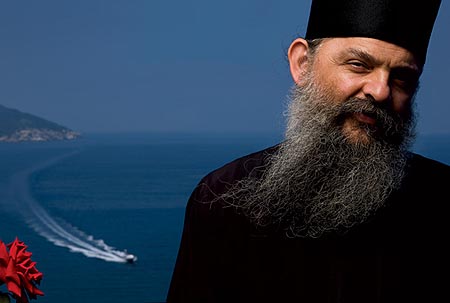
VOW OF PROPERTY
Father Arsenios at the Vatopaidi monastery, overlooking the Aegean Sea, in Mount Athos, Greece. He is considered by many to be Vatopaidi’s C.F.O., “the real brains of the operation.”
Here are some choice excerpts from Michael’s long piece:
+ After an hour on a plane, two in a taxi, three on a decrepit ferry, and then four more on buses driven madly along the tops of sheer cliffs by Greeks on cell phones, I rolled up to the front door of the vast and remote monastery. The spit of land poking into the Aegean Sea felt like the end of the earth, and just as silent. It was late afternoon, and the monks were either praying or napping, but one remained on duty at the guard booth, to greet visitors. He guided me along with seven Greek pilgrims to an ancient dormitory, beautifully restored, where two more solicitous monks offered ouzo, pastries, and keys to cells. I sensed something missing, and then realized: no one had asked for a credit card. The monastery was not merely efficient but free. One of the monks then said the next event would be the church service: Vespers. The next event, it will emerge, will almost always be a church service. There were 37 different chapels inside the monastery’s walls; finding the service is going to be like finding Waldo, I thought.
“Which church?” I asked the monk.
“Just follow the monks after they rise,” he said. Then he looked me up and down more closely. He wore an impossibly long and wild black beard, long black robes, a monk’s cap, and prayer beads. I wore white running shoes, light khakis, a mauve Brooks Brothers shirt, and carried a plastic laundry bag that said eagles palace hotel in giant letters on the side. “Why have you come?” he asked.
How on earth do monks wind up as Greece’s best shot at a Harvard Business School case study? I work up the nerve to ask.
That was a good question. Not for church; I was there for money. The tsunami of cheap credit that rolled across the planet between 2002 and 2007 has just now created a new opportunity for travel: financial-disaster tourism. The credit wasn’t just money, it was temptation. It offered entire societies the chance to reveal aspects of their characters they could not normally afford to indulge. Entire countries were told, “The lights are out, you can do whatever you want to do and no one will ever know.” What they wanted to do with money in the dark varied. Americans wanted to own homes far larger than they could afford, and to allow the strong to exploit the weak. Icelanders wanted to stop fishing and become investment bankers, and to allow their alpha males to reveal a theretofore suppressed megalomania. The Germans wanted to be even more German; the Irish wanted to stop being Irish. All these different societies were touched by the same event, but each responded to it in its own peculiar way. No response was as peculiar as the Greeks’, however: anyone who had spent even a few days talking to people in charge of the place could see that. But to see just how peculiar it was, you had to come to this monastery.
I had my reasons for being here. But I was pretty sure that if I told the monk what they were, he’d throw me out. And so I lied. “They say this is the holiest place on earth,” I said.
I’d arrived in Athens just a few days earlier, exactly one week before the next planned riot, and a few days after German politicians suggested that the Greek government, to pay off its debts, should sell its islands and perhaps throw some ancient ruins into the bargain. Greece’s new socialist prime minister, George Papandreou, had felt compelled to deny that he was actually thinking of selling any islands. Moody’s, the ratings agency, had just lowered Greece’s credit rating to the level that turned all Greek government bonds into junk—and so no longer eligible to be owned by many of the investors who currently owned them. The resulting dumping of Greek bonds onto the market was, in the short term, no big deal, because the International Monetary Fund and the European Central Bank had between them agreed to lend Greece—a nation of about 11 million people, or two million fewer than Greater Los Angeles—up to $145 billion. In the short term Greece had been removed from the free financial markets and become a ward of other states.
That was the good news. The long-term picture was far bleaker. In addition to its roughly $400 billion (and growing) of outstanding government debt, the Greek number crunchers had just figured out that their government owed another $800 billion or more in pensions. Add it all up and you got about $1.2 trillion, or more than a quarter-million dollars for every working Greek. Against $1.2 trillion in debts, a $145 billion bailout was clearly more of a gesture than a solution. And those were just the official numbers; the truth is surely worse. “Our people went in and couldn’t believe what they found,” a senior I.M.F. official told me, not long after he’d returned from the I.M.F.’s first Greek mission. “The way they were keeping track of their finances—they knew how much they had agreed to spend, but no one was keeping track of what he had actually spent. It wasn’t even what you would call an emerging economy. It was a Third World country.”
As it turned out, what the Greeks wanted to do, once the lights went out and they were alone in the dark with a pile of borrowed money, was turn their government into a piñata stuffed with fantastic sums and give as many citizens as possible a whack at it. In just the past decade the wage bill of the Greek public sector has doubled, in real terms—and that number doesn’t take into account the bribes collected by public officials. The average government job pays almost three times the average private-sector job. The national railroad has annual revenues of 100 million euros against an annual wage bill of 400 million, plus 300 million euros in other expenses. The average state railroad employee earns 65,000 euros a year. Twenty years ago a successful businessman turned minister of finance named Stefanos Manos pointed out that it would be cheaper to put all Greece’s rail passengers into taxicabs: it’s still true. “We have a railroad company which is bankrupt beyond comprehension,” Manos put it to me. “And yet there isn’t a single private company in Greece with that kind of average pay.” The Greek public-school system is the site of breathtaking inefficiency: one of the lowest-ranked systems in Europe, it nonetheless employs four times as many teachers per pupil as the highest-ranked, Finland’s. Greeks who send their children to public schools simply assume that they will need to hire private tutors to make sure they actually learn something. There are three government-owned defense companies: together they have billions of euros in debts, and mounting losses. The retirement age for Greek jobs classified as “arduous” is as early as 55 for men and 50 for women. As this is also the moment when the state begins to shovel out generous pensions, more than 600 Greek professions somehow managed to get themselves classified as arduous: hairdressers, radio announcers, waiters, musicians, and on and on and on. The Greek public health-care system spends far more on supplies than the European average—and it is not uncommon, several Greeks tell me, to see nurses and doctors leaving the job with their arms filled with paper towels and diapers and whatever else they can plunder from the supply closets.
+ When Papaconstantinou arrived here, last October, the Greek government had estimated its 2009 budget deficit at 3.7 percent. Two weeks later that number was revised upward to 12.5 percent and actually turned out to be nearly 14 percent. He was the man whose job it had been to figure out and explain to the world why. “The second day on the job I had to call a meeting to look at the budget,” he says. “I gathered everyone from the general accounting office, and we started this, like, discovery process.” Each day they discovered some incredible omission. A pension debt of a billion dollars every year somehow remained off the government’s books, where everyone pretended it did not exist, even though the government paid it; the hole in the pension plan for the self-employed was not the 300 million they had assumed but 1.1 billion euros; and so on. “At the end of each day I would say, ‘O.K., guys, is this all?’ And they would say ‘Yeah.’ The next morning there would be this little hand rising in the back of the room: ‘Actually, Minister, there’s this other 100-to-200-million-euro gap.’ ”
This went on for a week. Among other things turned up were a great number of off-the-books phony job-creation programs. “The Ministry of Agriculture had created an off-the-books unit employing 270 people to digitize the photographs of Greek public lands,” the finance minister tells me. “The trouble was that none of the 270 people had any experience with digital photography. The actual professions of these people were, like, hairdressers.”
By the final day of discovery, after the last little hand had gone up in the back of the room, a projected deficit of roughly 7 billion euros was actually more than 30 billion. The natural question—How is this possible?—is easily answered: until that moment, no one had bothered to count it all up. “We had no Congressional Budget Office,” explains the finance minister. “There was no independent statistical service.” The party in power simply gins up whatever numbers it likes, for its own purposes.
Once the finance minister had the numbers, he went off to his regularly scheduled monthly meetings with ministers of finance from all the European countries. As the new guy, he was given the floor. “When I told them the number, there were gasps,” he said. “How could this happen? I was like, You guys should have picked up that the numbers weren’t right. But the problem was I sat behind a sign that said GREECE, not a sign that said, THE NEW GREEK GOVERNMENT.” After the meeting the Dutch guy came up to him and said, “George, we know it’s not your fault, but shouldn’t someone go to jail?”
As he finishes his story the finance minister stresses that this isn’t a simple matter of the government lying about its expenditures. “This wasn’t all due to misreporting,” he says. “In 2009, tax collection disintegrated, because it was an election year.”
“What?”
He smiles.
“The first thing a government does in an election year is to pull the tax collectors off the streets.”
“You’re kidding.”
Now he’s laughing at me. I’m clearly naïve.
+ The systematic lying about one’s income had led the Greek government to rely increasingly on taxes harder to evade: real-estate and sales taxes. Real estate is taxed by formula—to take the tax collectors out of the equation—which generates a so-called “objective value” for each home. The boom in the Greek economy over the last decade caused the actual prices at which property changed hands to far outstrip the computer-driven appraisals. Given higher actual sales prices, the formula is meant to ratchet upward. The typical Greek citizen responded to the problem by not reporting the price at which the sale took place, but instead reporting a phony price—which usually happened to be the same low number at which the dated formula had appraised it. If the buyer took out a loan to buy the house, he took out a loan for the objective value and paid the difference in cash, or with a black-market loan. As a result the “objective values” grotesquely understate the actual land values. Astonishingly, it’s widely believed that all 300 members of the Greek Parliament declare the real value of their houses to be the computer-generated objective value. Or, as both the tax collector and a local real-estate agent put it to me, “every single member of the Greek Parliament is lying to evade taxes.”
On he went, describing a system that was, in its way, a thing of beauty. It mimicked the tax-collecting systems of an advanced economy—and employed a huge number of tax collectors—while it was in fact rigged to enable an entire society to cheat on their taxes. As he rose to leave, he pointed out that the waitress at the swanky tourist hotel failed to provide us with a receipt for our coffees. “There’s a reason for that,” he said. “Even this hotel doesn’t pay the sales tax it owes.”
+ In 2001, Greece entered the European Monetary Union, swapped the drachma for the euro, and acquired for its debt an implicit European (read German) guarantee. Greeks could now borrow long-term funds at roughly the same rate as Germans—not 18 percent but 5 percent. To remain in the euro zone, they were meant, in theory, to maintain budget deficits below 3 percent of G.D.P.; in practice, all they had to do was cook the books to show that they were hitting the targets. Here, in 2001, entered Goldman Sachs, which engaged in a series of apparently legal but nonetheless repellent deals designed to hide the Greek government’s true level of indebtedness. For these trades Goldman Sachs—which, in effect, handed Greece a $1 billion loan—carved out a reported $300 million in fees. The machine that enabled Greece to borrow and spend at will was analogous to the machine created to launder the credit of the American subprime borrower—and the role of the American investment banker in the machine was the same. The investment bankers also taught the Greek-government officials how to securitize future receipts from the national lottery, highway tolls, airport landing fees, and even funds granted to the country by the European Union. Any future stream of income that could be identified was sold for cash up front, and spent. As anyone with a brain must have known, the Greeks would be able to disguise their true financial state for only as long as (a) lenders assumed that a loan to Greece was as good as guaranteed by the European Union (read Germany), and (b) no one outside of Greece paid very much attention. Inside Greece there was no market for whistle-blowing, as basically everyone was in on the racket.
That changed on October 4 of last year, when the Greek government turned over. A scandal felled the last government and sent Prime Minister Kostas Karamanlis packing, which perhaps is not surprising. What’s surprising was the nature of the scandal. In late 2008, news broke that Vatopaidi had somehow acquired a fairly worthless lake and swapped it for far more valuable government-owned land. How the monks did this was unclear—paid some enormous bribe to some government official, it was assumed. No bribe could be found, however. It didn’t matter: the furor that followed drove Greek politics for the next year. The Vatopaidi scandal registered in Greek public opinion like nothing in memory. “We’ve never seen a movement in the polls like we saw after the scandal broke,” the editor of one of Greece’s leading newspapers told me. “Without Vatopaidi, Karamanlis is still the prime minister, and everything is still going on as it was before.” Dimitri Contominas, the billionaire creator of a Greek life-insurance company and, as it happens, owner of the TV station that broke the Vatopaidi scandal, put it to me more bluntly: “The Vatopaidi monks brought George Papandreou to power.”
After the new party (the supposedly socialist Pasok) replaced the old party (the supposedly conservative New Democracy), it found so much less money in the government’s coffers than it had expected that it decided there was no choice but to come clean. The prime minister announced that Greece’s budget deficits had been badly understated—and that it was going to take some time to nail down the numbers. Pension funds and global bond funds and other sorts who buy Greek bonds, having seen several big American and British banks go belly-up, and knowing the fragile state of a lot of European banks, panicked. The new, higher interest rates Greece was forced to pay left the country—which needed to borrow vast sums to fund its operations—more or less bankrupt. In came the I.M.F. to examine the Greek books more closely; out went whatever tiny shred of credibility the Greeks had left. “How in the hell is it possible for a member of the euro area to say the deficit was 3 percent of G.D.P. when it was really 15 percent?” a senior I.M.F. official asks. “How could you possibly do something like that?”
Just now the global financial system is consumed with the question of whether the Greeks will default on their debts. At times it seems as if it is the only question that matters, for if Greece walks away from $400 billion in debt, then the European banks that lent the money will go down, and other countries now flirting with bankruptcy (Spain, Portugal) might easily follow. But this question of whether Greece will repay its debts is really a question of whether Greece will change its culture, and that will happen only if Greeks want to change. I am told 50 times if I am told once that what Greeks care about is “justice” and what really boils the Greek blood is the feeling of unfairness. Obviously this distinguishes them from no human being on the planet, and ignores what’s interesting: exactly what a Greek finds unfair. It’s clearly not the corruption of their political system. It’s not cheating on their taxes, or taking small bribes in their service to the state. No: what bothers them is when some outside party—someone clearly different from themselves, with motives apart from narrow and easily understood self-interest—comes in and exploits the corruption of their system. Enter the monks.
Among the first moves made by the new minister of finance was to file a lawsuit against the Vatopaidi monastery, demanding the return of government property and damages. Among the first acts of the new Parliament was to open a second investigation of the Vatopaidi affair, to finally nail down exactly how the monks got their sweet deal. The one public official who has been strung up—he’s had his passport taken away, and remains free only because he posted a bail of 400,000 euros—is an assistant to the former prime minister, Giannis Angelou, who stands accused of helping these monks.
In a society that has endured something like total moral collapse, its monks had somehow become the single universally acceptable target of moral outrage. Every right-thinking Greek citizen is still furious with them and those who helped them, and yet no one knows exactly what they did, or why.
Monk Business
Father Arsenios looks to be in his late 50s—though who knows, as their beards cause them all to look 20 years older. He’s about as famous as you can get, for a monk: everyone in Athens knows who he is. Mr. Inside, the consummate number two, the C.F.O., the real brains of the operation. “If they put Arsenios in charge of the government real-estate portfolio,” a prominent Greek real-estate agent said to me, “this country would be Dubai. Before the crisis.” If you are kindly disposed to these monks, Father Arsenios is the trusted assistant who makes possible the miraculous abbacy of Father Ephraim. If you are not, he’s Jeff Skilling to Ephraim’s Kenneth Lay.
+ In the late 1980s, Vatopaidi was a complete ruin—a rubble of stones overrun with rats. The frescoes were black. The icons went uncared for. The place had a dozen monks roaming around its ancient stones, but they were autonomous and disorganized. In church jargon they worshipped idiorrhythmically—which is another way of saying that in their quest for spiritual satisfaction it was every man for himself. No one was in charge; they had no collective purpose. Their relationship to their monastery, in other words, was a lot like the relationship of the Greek citizen to his state.
That changed in the early 1990s, when a group of energetic young Greek Cypriot monks from another part of Athos, led by Father Ephraim, saw a rebuilding opportunity: a fantastic natural asset that had been terribly mismanaged. Ephraim set about raising the money to restore Vatopaidi to its former glory. He dunned the European Union for cultural funds. He mingled with rich Greek businessmen in need of forgiveness. He cultivated friendships with important Greek politicians. In all of this he exhibited incredible chutzpah. For instance, after a famous Spanish singer visited and took an interest in Vatopaidi, he parlayed the interest into an audience with government officials from Spain. They were told a horrible injustice had occurred: in the 14th century a band of Catalan mercenaries, upset with the Byzantine emperor, had sacked Vatopaidi and caused much damage. The monastery received $240,000 from the government officials.
Clearly one part of Ephraim’s strategy was to return Vatopaidi to what it had been for much of the Byzantine Empire: a monastery with global reach. This, too, distinguished it from the country it happened to be inside. Despite its entry into the European Union, Greece has remained a closed economy; it’s impossible to put one finger on the source of all the country’s troubles, but if you laid a hand on them, one finger would touch its insularity. All sorts of things that might be more efficiently done by other people they do themselves; all sorts of interactions with other countries that they might profitably engage in simply do not occur. In the general picture the Vatopaidi monastery was a stunning exception: it cultivated relations with the outside world. Most famously, until scandal hit, Prince Charles had visited three summers in a row, and stayed for a week each visit.
Relationships with the rich and famous were essential in Vatopaidi’s pursuit of government grants and reparations for sackings, but also for the third prong of its new management’s strategy: real estate. By far the smartest thing Father Ephraim had done was go rummaging around in an old tower where they kept the Byzantine manuscripts, untouched for decades. Over the centuries Byzantine emperors and other rulers had deeded to Vatopaidi various tracts of land, mainly in modern-day Greece and Turkey. In the years before Ephraim arrived, the Greek government had clawed back much of this property, but there remained a title, bestowed in the 14th century by Emperor John V Palaiologos, to a lake in northern Greece.
By the time Ephraim discovered the deed to the lake in Vatopaidi’s vaults, it had been designated a nature preserve by the Greek government. Then, in 1998, suddenly it wasn’t: someone had allowed the designation to lapse. Shortly thereafter, the monks were granted full title to the lake.
And Michael’s conclusion (of sorts):
+ The crowd begins to chant and march toward the vastly outnumbered police: the police stiffen. It’s one of those moments when it feels as if anything might happen. Really, it’s just a question of which way people jump.
That’s how it feels in the financial markets too. The question everyone wants an answer to is: Will Greece default? There’s a school of thought that says they have no choice: the very measures the government imposes to cut costs and raise revenues will cause what is left of the productive economy to flee the country. The taxes are lower in Bulgaria, the workers more pliable in Romania. But there’s a second, more interesting question: Even if it is technically possible for these people to repay their debts, live within their means, and return to good standing inside the European Union, do they have the inner resources to do it? Or have they so lost their ability to feel connected to anything outside their small worlds that they would rather just shed themselves of the obligations? On the face of it, defaulting on their debts and walking away would seem a mad act: all Greek banks would instantly go bankrupt, the country would have no ability to pay for the many necessities it imports (oil, for instance), and the country would be punished for many years in the form of much higher interest rates, if and when it was allowed to borrow again. But the place does not behave as a collective; it lacks the monks’ instincts. It behaves as a collection of atomized particles, each of which has grown accustomed to pursuing its own interest at the expense of the common good. There’s no question that the government is resolved to at least try to re-create Greek civic life. The only question is: Can such a thing, once lost, ever be re-created?
You can read the entire wonderful Michael Lewis piece here.
The tennis ends this weekend. I’m guessing the men’s final will be Nadal and Federer, which should be a good match. You can watch tennis on the Tennis Channel, ESPN2 or CBS. The Little Racquet that Changed Tennis. It’s Nadal’s racquet and the article is in the Wall Street Journal. Click here.

Harry Newton who wonders how in all conscience CNBC can put Mario Gabelli on TV and glorify him by calling Super Mario? Read about Super Mario on Wikipedia. Click here.
My yesterday was all about real estate loan restructuring and investing in startups. More on those tomorrow.

Thanks Harry, really good reading. I particularly liked the insights into the “clean” Mario…
So, what are the chances that Greece is a one-off? How big are the others out there??
Portugal, Spain, Ireland… maybe.