Gold is used in jewelry and in industry. But most is stockpiled as a store of value, or to protect its owner against an ultra-lousy day.
Gold goes up because of an upcoming lousy day. Typically gold goes up when the stockmarket goes down. But not always. Lately it’s gone up while the market has gone up.
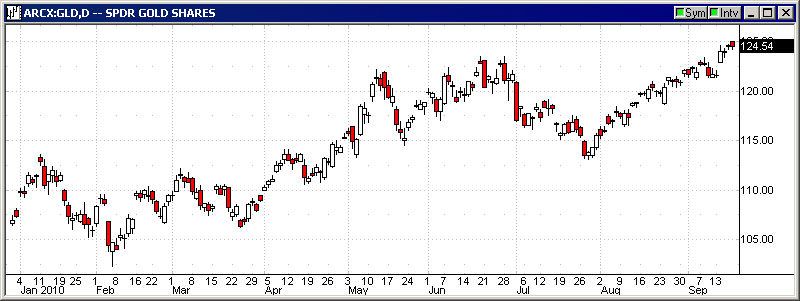
Can (or will) gold go further up? From Bloomberg:
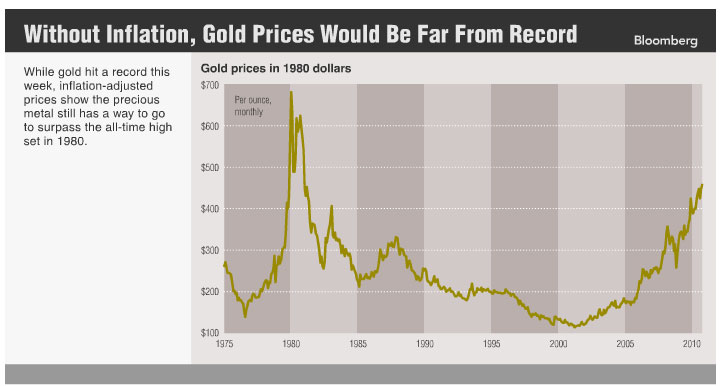
Gold is still far below its inflation-adjusted high after a record rally, and at least one indicator suggests the precious metal won’t approach that peak any time soon.
The CHART OF THE DAY shows the gold price relative to January 1980, when the metal reached $873 an ounce. Yesterday’s record close in New York trading equals $454.88 an ounce in real terms, reflecting an increase in the U.S. consumer price index, according to data compiled by Bloomberg.
Gold would have to rise above $2,435 an ounce to exceed its high from three decades ago, based on the CPI’s current reading. That’s 91 percent higher than the closing price of $1,272.20 in New York trading yesterday.
The price may climb as high as $10,000 an ounce, according to a Sept. 6 projection by Egon von Greyerz, a managing partner at Matterhorn Asset Management. George Soros, on the other hand, told Reuters two days ago in an interview that gold has become “the ultimate bubble.”
“This is the type of environment in which one would expect to find extreme volatility,” Bill Luby, editor of the VIX and More newsletter and financial blog, wrote yesterday. “Instead, the exact opposite has been happening.”
Luby cited the performance of Chicago Board Options Exchange’s Gold Volatility Index, derived from the prices of options on the SPDR Gold Trust exchange-traded fund. The gold index, comparable to the so-called VIX index for U.S. stocks, closed three days ago at 16.69. This reading was the lowest since the CBOE’s calculations began in June 2008.
There are lots of ways to play this. My friend bought some GDX last week. Now he’s looking to sell some calls against it — i.e. covered calls. He could make as much as 13% for a six month trade.
The Chances of a Double Dip. Gary Shilling is a talented economist, who writes well. He has written a long piece on the chances of double drip, i.e. a second recession. I’ve excerpted bits of it:
Deleveraging
Although investor views of the economy have reversed in the last five months, the reality probably hasn’t. The good life and rapid growth that started in the early 1980s was fueled by massive financial leveraging and excessive debt, first in the global financial sector, starting in the 1970s and in the early 1980s among U.S. consumers. That leverage propelled the dot com stock bubble in the late 1990s and then the housing bubble. But now those two sectors are being forced to delever and in the process are transferring their debts to governments and central banks.
This deleveraging will probably take a decade or more – and that’s the good news. The ground to cover is so great that if it were traversed in a year or two, major economies would experience depressions worse than in the 1930s. This deleveraging and other forces will result in slow economic growth and probably deflation for many years. And as Japan has shown, these are difficult conditions to offset with monetary and fiscal policies.
The deleveragings of the global financial sector and U.S. consumer arena are substantial and ongoing. Household debt is down $374 billion since the second quarter of 2008. The credit card and other revolving components as well as the non-revolving piece that includes auto and student loans are both declining. Total business debt is down, as witnessed by falling commercial and industrial loans.
Evidence of recent consumer retrenchment is rampant. Consumer confidence has flattened as people worry about employment and income prospects as well as losses on their stocks and houses. Credit card loans outstanding fell 10% last year and promise to fall further as consumers repay debt, lending standards tighten and the new federal law cuts the profitability of credit card lending. Meanwhile, banks report that demand for consumer loans continues to drop, although at declining rates. …
On the spending side, vehicle sales in July were at an 11.5 million annual rate, up from the sub-10 million levels of 2008-2009, but well below the pre-recession levels. Consumer spending on TVs, computers, videos and telephone equipment rose 1.8% in the first half of 2010 compared with a year earlier while appliance purchases fell 3.6% and furniture outlays dropped 11%. Apparel sales also lost out to electronic gadgets. This shift reflects two forces. First, consumers are saving more and spending less on equipping their houses that are no longer appreciating but now depreciating assets. Second, they still want the satisfaction of buying iPads and other Small Luxuries, an investment theme we identified years ago and explained fully in our August Insight. …
The housing sector is an important generator of the normal economic recovery even though residential construction only accounts for 4.7% of GDP on average in the post-World War II years. It’s the volatility that matters. Residential construction was 6.3% of GDP at its recent peak in the fourth quarter of 2005, but fell to 2.4% at its low in the first quarter of 2010. This 3.9 percentage point decline is very significant, considering that a 3% top to bottom decline in real GDP constitutes a major recession. …
Spending by state and local governments is not one of the sources of economic revival after recessions end because it has been such a steady 12% to 13% share of GDP since the early 1970s. In the early post-World War II decades, it grew rapidly to finance the education of the postwar babies and the growth of mushrooming suburbs. Municipalities have also provided a steady source of jobs since, until recently, many fewer employees were laid off or fired than in the private sector and relatively few quit. Years ago, the “social contract” held that those employees received lower wages than private sector workers, so early retirement provisions and lush pensions allowed them to catch up in their later years. But since the early 1980s, the private sector has been globalized with very little growth in real incomes. Meanwhile, state and local government employees have continued to receive pay raises in excess of inflation and now have wages that are 34% higher than for private sector employees (Chart 8). …
It obviously takes a lot of gnashing of teeth in the outer darkness for state and local government to flatten, much less cut, their spending after a decade of 6% to 7% annual growth rates. Jumping municipal employment is the main reason for mushrooming spending in earlier years, and cutting often unionized state and local workforces is very difficult. Since the Great Recession started in December 2007 through April, private payroll employment has dropped 6.8%. Still, state and local jobs have declined but by much less, only 1.4%. In July, state and local governments, which employ 9.5 million, cut 48,000 jobs, 102,000 in the past three months and 169,000 so far this year. …
Double Dip Recession?
We’ve made our case for very slow U.S. economic growth in the quarters, indeed the years, ahead. The economic rebound due to the inventory cycle is over. Employment and consumer spending remain weak. Housing is too overburdened with excess inventory and the resulting price weakness to revive any time soon. State and local government spending and employment are retreating. And meaningful export gains are unlikely as economic growth abroad slips. Interestingly, the consensus forecast is moving toward our position as growth estimates have been reduced rapidly in recent months. In both April and June, the Wall Street Journal’s poll of economists (not including us) expected 3% economic growth in the second half of this year. We wonder if they still do.
Slow Growth to Recession
We’re on record for a 50% or higher probability of a second dip or another recession, whatever it would be called. …
In the current economic and financial climate, it’s highly unlikely that the Fed will tighten credit for years. In fact, the central bank has shifted from planning last spring to withdraw liquidity as the economy grew to renewing quantitative easing and worrying about deflation and subpar growth. It said after its August 10 policy meeting that household spending is being retarded by high unemployment, slow income growth, lower home equity and tight credit conditions while bank lending “has continued to contract.” …
Pushing On A String
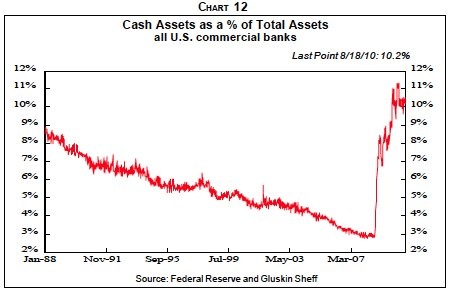
Conventional monetary ease is now impotent with the federal funds rate close to zero , the money multiplier collapsed and banks sitting on hoards of cash (Chart 12) and over $1 trillion in excess reserves. Sure, large banks report to the Fed that they are easing lending standards for small business, but after the intervening financial crisis, many fewer potential borrowers are deemed creditworthy than in the loose lending days. Furthermore, the small business trade group, the National Federation of Independent Business, reports that 91% of small business owners have had their credit needs met or business is so slow that they don’t want to borrow. The Fed is pushing on the proverbial string.
Other Shocks
If the Fed is highly unlikely to shock slow growth into recession, what could? This brings us back to the series of seemingly isolated events that are occurring on the deleveraging road, such as further financial woes in Europe, a crisis in commercial real estate, a nosedive in the Chinese economy and a slow motion train wreck in Japan. They are all possibilities – as are other shocks here or abroad that we don’t foresee. Maybe the exhausting of federal stimulus will be enough to trigger an economic downturn. Keep your eyes pealed, however, because it won’t take much disruption to push the fragile global economy back into decline.
You can read Shilling’s entire piece and enjoy his many other prescient charts here.
Dividend paying companies are holding up well. Ones that increase their dividends consistantly are doing even better. Here’s an interview with Vahan Janjigian, chief investment officer at Greenwich Wealth Management about companies that are growing dividends. Click here.
How to bust through those endless “service” queues? Don’t push any buttons on your phone. Simply wait. If you’re lucky, the machine will despair and connect you to a live person.
Steve Jobs on marketing. Classic video. Click here.
Now this is a wedding. Click here.
What an expensive camera can do. This picture of the excellent Dave Rawlings Machine (band) was taken with a $5,000 Canon EOS 1D Mark IV digital single lens reflex (DLSR).

This picture was taken with a cheap point-and-shoot.

They were both taken at the recent TakeRoot Festival, Groningen, Netherlands using the light on stage only. No flash.
Now you know why you should spend $5,000 on a camera. Personally, I’m eyeing the new Nikon D7000, which costs “only” $1,200. That’s body only. No lenses.
What God could do, if only He (or She) had the money.
Republican gubernatorial nominee Meg Whitman has surpassed New York Mayor Michael Bloomberg for the highest personal contribution in American campaign history.
According to new figures posted on the California secretary of state’s website, Whitman, the former CEO of eBay, contributed $15 million more to her campaign war chest Tuesday. That brings her self-funding total to $119 million.
Bloomberg, also a tech billionaire, spent $109.2 million to win re-election last year.
Whitman — who, like Bloomberg in 2001, was a political novice when she entered the race — has vowed to spend up to $150 million to win the governorship.
Her opponent, Democrat Jerry Brown, has raised $28 million to $30 million and only recently started a statewide TV ad campaign.
Confucias say…
Man who eat many prunes get good run for money.
Wife who put husband in doghouse soon find him in cathouse.
Woman who lie outside synagogue overnight likely to wake up with heavy dew on top.

Harry Newton who wonders why so many things around the house break. Is that because we have too many things? Certainly too many things with electronic circuits no human can diagnose any longer. Top frustration: I still can’t beat Skip at tennis. I’ll buy some GDX today. Hopefully it will pull back a little. I’ll add it to our list — the one on the right.

If you think gold is going to go up a lot why write covered calls? Also, if the VIX is low you get less premium when you sell. Might be better to buy calls.
Jerry's number look smaller than they are because the Union is running negative Meg ads, and they do not count as Jerry's money. Lobsided still, but not as much as it looks. Chris