Diversification is investment’s “free lunch.”
It’s not. It’s laziness — an excuse for for not putting the research time in.
Presently I reject many times as many “investments” as I invest in. I wish I had been more vigorous earlier.
The big key is always asking the question, “Can I lose my principal?”
If yes, stay out.
Silver is rising.
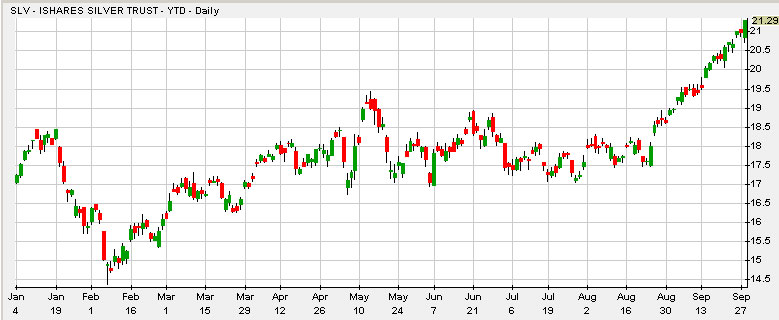
So, is Gold.
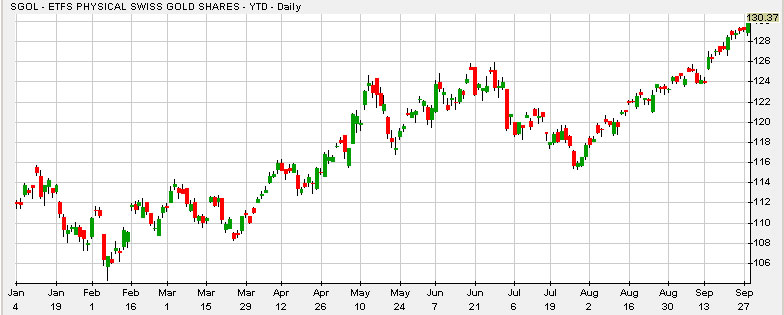
Both have further to run. It’s a squirrely world.
What’s with Research in Motion? I keep thinking these guys will finally do something right and the falling stock will finally be worth buying.
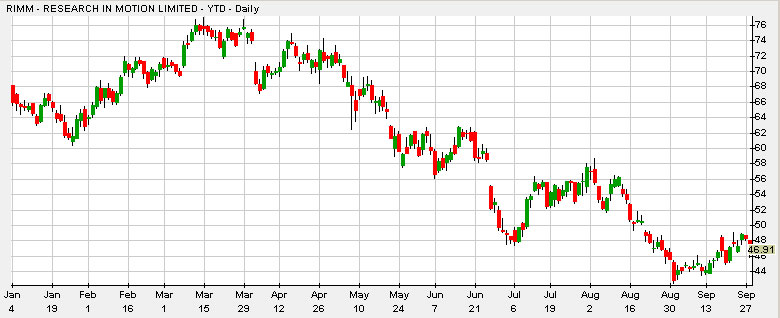
Not yet. BusinessInsider did a piece on BlackBerry’s latest innovation:
The Good News About RIM’s BlackBerry PlayBook. We’ve had a chance to digest yesterday’s BlackBerry PlayBook tablet unveiling, and the bottom line is that we’re relieved that it’s not a total joke, and that there’s actually a chance it could be decent.
The good news is that RIM seems to understand that it needs to offer a tablet experience that is fast and powerful, because there isn’t going to be much room in the market for underpowered junk. (Especially among RIM’s corporate buyers.)
We haven’t been able to test the device in the real world, but at least the specs on the PlayBook look good, and it sounds like RIM’s new operating system is more ready for the future than the current BlackBerry OS.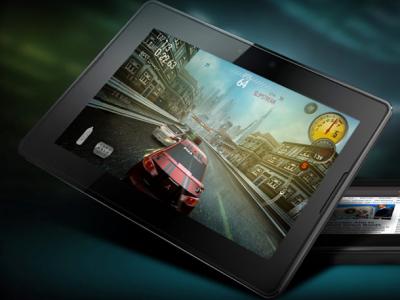
There are still many unanswered questions that will help dictate whether this will be worth buying or not:
* How well does Adobe Flash actually perform on the PlayBook?
* Will the user experience actually be any good? Or will it be lousy?
* How long will the battery last?
* How much will the PlayBook cost?
* How and where will it be distributed?
* Will developers want to make apps for this thing? Or will they focus on iPad and Android?
But perhaps the worst news is that because the PlayBook won’t launch until early 2011, it will have to compete with Apple’s next iPad, and not the current one.
By then, Apple will have all sorts of upgrades in place — higher-res display, multitasking, cameras, FaceTime, presumably more speed — that could keep the iPad far ahead of anything from RIM.
I like my new LuluLemon shorts. And I like its growth.
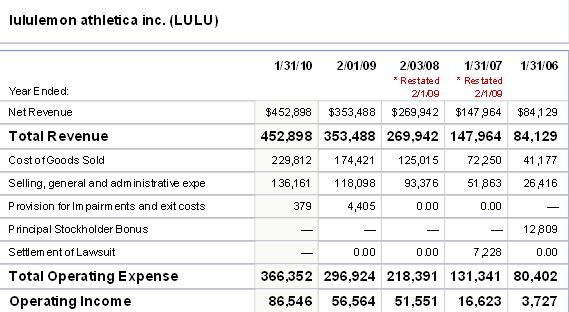
But its P/E is 39. And the stock acts weirdly.
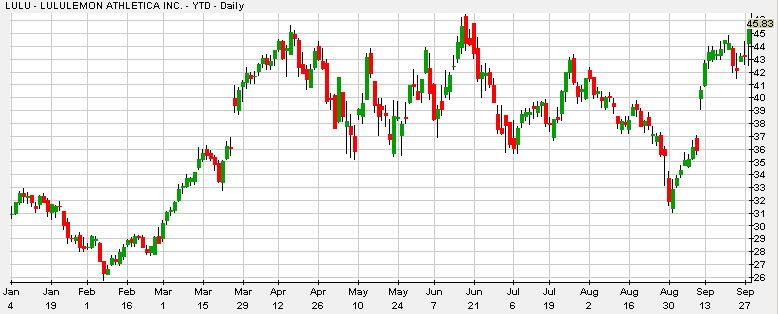
I got interested in LuluLemoon, which sells “yoga wear”, because Cramer pounded the table for them a day or two ago. My shorts were on sale at $34, down from an overpriced $58. For my taste, everything else in the store is overpriced, though the service was great and the salespeople really helpful. The stock might be fun at $35, but like the merchandise, it’s way overpriced for my taste.
Wind was a fad. Like ethanol, LuluLemon, Crocs, and dot-com companies, wind may also have been a fad. Here’s a piece from the September 25 Economist:
Wild is the wind. Wind power is in the doldrums
STORMS have brought alternating ruin and fortune to the small German town of Husum. A 14th-century gale flooded and destroyed parts of the town. Yet it also carved an inland harbour, allowing the survivors to build a prosperous market. These days the town still depends on the weather. Wind turbines are built in its shipyards and every second year it plays host to the world’s biggest gathering of wind-energy companies.
Two years ago, windmill-makers were fretting about their inability to meet a surge in global demand. Last year the industry installed 37,500 megawatts of electricity-generation capacity, increasing the total installed base by almost a third. Capacity in China doubled. Wind firms’ main worry was a shortage of components.
That typhoon of demand has now passed. Installations this year in America could be little more than half what they were last year, predicts the American Wind Energy Association, an industry club (see chart). In Europe demand for new windmills will fall by 14-15%, say analysts at HSBC, a bank. The only big market that continues to grow, albeit slowly, is China. Wind firms face their first recession.
The credit crunch does not help. Some 40% of wind parks in America and Europe are built by small operators that finance their projects through debt. Lehman Brothers, the bank whose collapse was the starter’s gun for global panic, was a big financier of wind power. “Lehman Brothers was a sort of a switchboard for the industry,” says Peter Kruse of Vestas, the world’s biggest wind-turbine manufacturer, “and they didn’t pick up the phone any more.” A study funded by the German government found that the availability of ten year debt for wind parks had fallen by as much as 40% while the cost of debt relative to benchmark interest rates more than tripled in 2009. The credit squeeze has eased in America, but less so in Europe. Wind farmers in Spain and Portugal find it hard to borrow because of worries that their governments may default or trim subsidies.
Out of puff
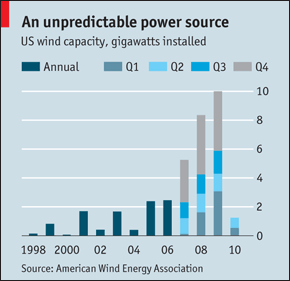
The credit crunch may blow over, but two more persistent eddies are also wafting through this market. The first is that the recession has curbed electricity consumption in Europe, both by shuttering plants, some permanently, and by encouraging firms to use power more efficiently. All this will make it easier for most European countries to meet their renewable-energy targets by 2020. Germany and most southern European countries will exceed their targets if they keep building windmills at the current pace, so analysts at HSBC predict cuts in clean-energy subsidies. In America, meanwhile, a proposed cap-and-trade bill got nowhere this year. New wind installations are likely to remain lower than last year’s for the next five to ten years, predict analysts at HSBC and Bernstein Research. Low natural-gas prices are also undermining the case for wind power.
Amid the gloom, however, is some respite for the biggest manufacturers. During the boom of the past five years there was a proliferation of small manufacturers and a fragmentation of the market. The market share of Vestas, for instance, slipped from 28% in 2005 to 15% last year. In these leaner times, buyers in Europe and America are placing orders mainly with the biggest firms, since they seem less likely to go bust.
The next year or two will doubtless see mergers and takeovers. Some of the weaker manufacturers will die. Mortality is nothing new in other industries, nor indeed for the birds who blunder into whirling windmill blades. But it comes as a shock to an industry that until now has had a gale in its sails.
Such brilliant Amex thinking. Because of the recent family wedding, our American Express bill was $31,820.96. Amex didn’t send a Thank You. Instead they said if we only fronted the minimum payment for the next 35 years, over that time we will pay an estimated total of $70,669. Which actually works out to an incredibly low and very surprising 2.31%.
It hit 113 in LA yesterday — the hottest day ever recorded. Some cracks:
+ It’s so hot in Los Angeles that Mel Gibson ran into a synagogue just for the air conditioning. — Craig Ferguson.
+ It’s so hot that the Dodgers gave everyone the day off and no one noticed. — Craig Ferguson.
+ Today was the hottest day ever in Los Angeles. It was so hot, you could fry a contaminated egg on the sidewalk. — Jimmy Kimmel

Harry Newton who wonders why he has to keep saying NO.

Harry,
Hi! I just want to thank you for this column. I have been a faithful reader since 2002.
You taught me that while I cannot time the stock market, I can spot the economic macro trends and act accordingly.
In November 2007, you saw assessed the state of the economy and wrote that the market could only lose value. No, I did not go to all cash. I had read about MPT and asset allocation. I lost a lot of money, but I learned not to automatically believe the popular financial press.
Today, I use a variety of ETFs in which to invest. I like them because I do not have to deal with the often capricious rules that mutual funds have. Also, I can instantly sell if there is a crisis.
I am into gold. Out of US large caps. Yes, I have US small cap and foreign small ETFs. It is not a perfect mix. However, if the market starts to tank, I will sell in an instant.
You have to taught me to use my judgment and not blindly follow a rigid asset allocation.
Thank you!
Best regards,
Bill