How to add health to your wallet. Invent a great product. Customers will flock to your door. I love this thing. It’s called “I‘m not a paper cup.”
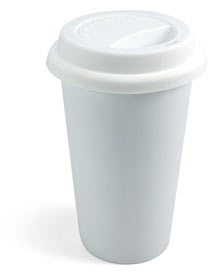
It’s designed to look like the cups you get from fancy, pricey coffee shops. This cup is porcelain. It actually keeps your drink warm or cold. It costs $16 from Uncommon Goods.
There are four good thing sabout inventing a product today:
1. There’s plenty of distribution — like the Internet. Amazon and others will basically sell anything.
2. TV is full of free time. Plenty of time for infomercials. You only pay when you sell your shiny new thing.
3. China will make anything cheap. Can you imagine the markup on a $16 — more if you buy from Amazon — plain white cup?
4. Everyone is always looking for a cheap, clever gift. That’s how we got our cup.
Ten Things You Can Do to Improve Your Healthcare. This comes from The Nation Magazine. It makes sense.
1 Wash your hands! It may seem ridiculously simple, but according to the Centers for Disease Control and Prevention, it is the best way to reduce infection and the spread of illness. The Mayo Clinic provides details.
2 Carry with you at all times a list of your medications (including vitamins and supplements). It should include the drugs and dosages, how often you take them and the conditions they are treating. Also have on you your blood type, your emergency contact and your doctor’s phone number, plus any drug allergies or special information (if, for example, you’ve had a hip replaced or have a pacemaker). You’ll benefit in an emergency.
3 Do not choose a primary-care physician simply because his/her office is near your home. Find one who has privileges at the best hospital in your vicinity, can refer you to the best specialists and treats you with compassion. And make sure he/she follows hand-washing guidelines.
4 The Surgical Safety Checklist is reducing bad outcomes around the world. If you have to have an operation, ask the surgeon if the checklist will be used. And don’t have elective surgery without getting a second opinion–preferably from a doctor who does not do surgery. The New England Journal of Medicine found that a vertebroplasty (where bone cement is injected into vertebrae) is no better than a placebo, and the same is true for arthroscopic “clean-out” of the knee, just to name two of many interventions that have no detectable benefit. If back surgery is suggested, first read Dr. John Sarno‘s books.
5 If you are pregnant or looking for an obstetrician, keep in mind that the US rate of C-sections is more than double what the World Health Organization considers acceptable. You should not have this major surgery–with all its risks–simply for the sake of convenience. Read more at thebirthsurvey.com.
6 Beware of the overuse of diagnostic imaging procedures such as MRIs and CAT scans. They add to costs and radiation exposure. If a doctor owns an MRI, he/she may want to use it to pay for it.
7 Most end-of-life care is too aggressive and expensive. Without improving or changing patient outcomes, it lets patients with incurable illnesses die in hospitals separated from loved ones and suffering from invasive procedures. Choosing hospice and palliative care gives people more tolerable deaths while saving millions of dollars.
8 Choose dietary supplements carefully. Look for the USP seal on products. Go here and click on the logo of each supplement to see if it is USP verified.
9 Prepare yourself for catastrophic illness by reading AfterShock by Jessie Gruman. Get a healthcare proxy or some form of advance directive in place.
10 Education is key. When Japanese public schools began telling students to brush their teeth after every meal, the decline in tooth and gum disease was dramatic. More should be done in schools, but since we probably can’t get adequate sex education in our public schools soon, parents or doctors must inform kids before sexual activity begins how to avoid STDs and use contraception. Right now, one out of four young American women has an STD. Go to Michigan HIV News for more teen health.
The focus turns to salt. Jane Brody is the New York Times’ health editor. Here’s her piece this week, “After Smoking and Fats, Focus Turns to Salt.“
In decades past, when companies wanted to test-market a product meant to enhance health and well-being, they often tried it first in California — where people were reputed to be the most health-conscious in the country. But now companies might be wise to consider field-testing their wares in New York City.
If he can take credit for nothing else, the city’s mayor, Michael R. Bloomberg, can rightfully claim to have launched a national effort to help people live more healthfully. He began with a prominent campaign to curtail smoking, the single leading killer of Americans, by banning it in restaurants and bars, and followed that with a campaign to get heart-damaging trans fats out of packaged and restaurant foods.
Next Mr. Bloomberg attacked rampant obesity (though New York, being a walking city, is leaner than most other metropolitan areas) by promoting a requirement that chain restaurants prominently display the calorie content of all their offerings.
And at his urging, the city health department is seeking to curtail consumption of sugary soft drinks, with subway advertisements that ask riders, “Are you pouring on the pounds?”
Now Mr. Bloomberg has called on restaurant chains and food producers to lower the amount of salt in their products by 25 percent over the next five years. The goal is to reduce the incidence of high blood pressure, a major contributor to heart attacks, strokes and kidney disease.
If the mayor has his way, this could well be the year when salt, once a form of legal tender, is finally devalued as a prized condiment in the American diet. As happened with trans fats and calorie listings, other cities and states may follow New York’s example, if for no other reason than to control rapidly rising public health costs.
In a scientific analysis published last week in The New England Journal of Medicine, researchers at the University of California, San Francisco; Stanford University; and Columbia University College of Physicians and Surgeons calculated that if Americans reduced their salt intake by half a teaspoon a day, or three grams (the equivalent of 1,200 milligrams of sodium, the health culprit in salt), the nation would save up to $24 billion a year in health care costs.
The research team, led by Dr. Kirsten Bibbins-Domingo, an epidemiologist and biostatistician at U.C.S.F., concluded that even a much more modest reduction — one gram a day, achieved gradually by the year 2019 — “would be more cost-effective than using medications to lower blood pressure in all persons with hypertension.”
And money is not the only thing that would be saved. The researchers calculated that the half-teaspoon reduction would “reduce the annual number of new cases of coronary heart disease by 60,000 to 120,000, stroke by 32,000 to 66,000, and myocardial infarction [heart attack] by 54,000 to 99,000, and reduce the annual number of deaths from any cause by 44,000 to 92,000.”
That, dear reader, would be a very big bang for a relatively small buck. The researchers’ suggested salt reduction would hardly render food tasteless, especially if the reduction is done gradually, as Mr. Bloomberg has proposed. Currently, the average American man consumes 10.4 grams of salt a day, and the average American woman consumes 7.3 grams.
“This is a classic example of a lifestyle change that has a modest effect on individuals but a huge effect on the population over all,” Dr. Lee Goldman, a cardiologist at Columbia’s medical school and co-author of the new study, said in an interview.
“With our current high-salt diet, all our blood pressures are increased, and the risk of heart disease with each rise in blood pressure is continuous.”
About 80 percent of the salt in the American diet comes from processed and restaurant-prepared foods, the main targets of Mr. Bloomberg’s proposal. But for some people, including the mayor, meaningful cutbacks in how much salt they consume will also require restraint at the table.
The mayor is reported to add salt to almost everything, even saltine crackers, already-salted popcorn and bagels. If so, he is probably well above the amounts of sodium recommended by federal health authorities: 2,300 milligrams a day for otherwise healthy individuals; 1,500 milligrams for the elderly, those who already have high blood pressure and African-Americans, who are especially prone to developing high blood pressure.
Salt has escaped federal regulatory action because it is classified as GRAS, or “generally recognized as safe.” The Center for Science in the Public Interest, a health advocacy group based in Washington, has been urging the Food and Drug Administration for three decades to change this classification and instead regulate salt as a food additive that requires proof of safety for the amounts used.
Failing that, in 2005, the center petitioned the agency to set maximum levels of salt in various categories of food. A public hearing was held in 2007, but no regulatory action has been taken.
Meanwhile, millions of Americans continue to get sick and die of ailments caused or complicated by salt in the foods they eat.
The average daily intake of sodium exceeds 4,000 milligrams — nearly double what a healthy person should consume. The explosive growth of fast foods has not helped matters. Last year, the Washington center published the sodium content of a number of popular restaurant meals that each provided 4,000 or more milligrams of sodium.
For example, at Olive Garden, a meal of chicken parmigiana, one breadstick, salad with house dressing and raspberry lemonade totaled 5,735 milligrams of sodium, the equivalent of two and a half teaspoons of salt.
At Chili’s, a meal of Buffalo chicken fajitas with tortillas, condiments and a Dr Pepper totaled 6,916 milligrams of sodium, or three teaspoons of salt. Even the rather innocent-sounding Dairy Queen meal of a spicy chili bowl, a side salad with fat-free ranch dressing and a Mountain Dew added up to 4,500 milligrams of sodium.
City health officials acknowledged that it would be hard to legislate a reduction in salt, as finally happened with trans fats when a call for voluntary elimination fell on deaf ears.
But several companies have already expressed support. The supermarket chain A.& P. plans to follow the city’s recommendation to reduce salt in the hundreds of store-brand products it sells. And the fast-food chain Subway announced its commitment to the guidelines at its nearly 23,000 stores nationwide.
Consumers, meanwhile, would be wise to check the sodium content per serving on food labels and select lower-sodium brands. When eating out, consider asking that salt not be added to the foods you order. You can always sprinkle on a little at the table. If you cut back gradually, your taste buds will adapt painlessly.
Sleep more, especially women. Arianne Huffington is obsessed with it. She writes.
Stay with us here for a minute. Americans are increasingly sleep-deprived, and the sleepiest people are, you guessed it, women. Single working women and working moms with young kids are especially drowsy: They tend to clock in an hour and a half shy of the roughly 7.5-hour minimum the human body needs to function happily and healthfully. Cindi admits that between her work, her two young children and her wicked TV addiction, she averages only five and a bit; as for Arianna, she had a rude (and painful) awakening two years ago when she passed out from exhaustion, broke her cheekbone and got five stitches over her eye. Ever since then, she’s been working on bringing more balance, and more sleep, into her life with varying degrees of success.
For her full article, go to the Huffington Post.
Clone. Clone. Clone. Things go awry with computers all the time, and for no reason. On the weekend, my Microsoft Word 2003 started messing up, giving error messages every five minutes and, worse, wanting to report them to Microsoft. I tried to fix the problem. I checked Microsoft’s site. It had “remedies,” but they didn’t work on my laptop. Better solution: Move all my working files to a hard drive I’d cloned a week ago and forget trying to fix the problem. this morning it’s working perfectly.
This strategy requires two external hard drives — one for copying daily working files, and one for cloning. The good news is that the hard drives are totally cheap. For cloning, you need the same size drive as the one inside your PC or laptop. For backing up,the bigger the better. You can also use that drive for archiving stuff you don’t want on your working drive. For cloning, I’m using Acronis (but remembering to put the drive to be cloned inside the laptop) and FileSync for backing up day-to-day files.
Where to have dinner
A group of 40 year old buddies discuss and discuss where they should meet for dinner. Finally it is agreed upon that they should meet at Gasthaus Gutenberger restaurant because the waitress’s there have low cut blouses and nice breasts.
10 years later, at 50 years of age, the group meets again and once again they discuss and discuss where they should meet. Finally it is agreed upon that they should meet at the Gasthaus Gutenberger because the food there is very good and the wine selection is good also.
10 years later at 60 years of age, the group meets again and once again they discuss and discuss where they should meet. Finally it is agreed upon that they should meet at the Gasthaus Gutenberger because they can eat there in peace and quiet and the restaurant is smoke free.
10 years later, at 70 years of age, the group meets again and once again they discuss and discuss where they should meet. Finally it is agreed upon that they should meet at the Gasthaus Gutenberger because the restaurant is wheel chair accessible and they even have an elevator.
10 years later, at 80 years of age, the group meets again and once again they discuss and discuss where they should meet. Finally it is agreed upon that they should meet at the Gasthaus Gutenberger because that would be a great idea because they have never been there before.

Harry Newton, who tried to watch the tennis through the night. And managed only to get snippets of tennis and snippets of sleep. Dumb idea.

Harry,
Apple's new iPad is still on AT&T. But you can use your Verizon MiFi as your iPad connection. It will work better than AT&T and the iPad will cost less without the 3G modem. Should be fun to see in person.
Alan