Washington’s latest dithering.
+ The president told his Democrats “not to run for the hills;” they were still in charge. Meanwhile, he offered not one new action to fix what’s ailing the economy — jobs. You can read his entire boring speech here.
+ The Fed kept interest rates unchanged at basically nothing. This has two pernicious affects. First, it screws people living on a fixed income, like retirees. Second, it forces encourages rampant speculation with cheap borrowed funds and the lack of safe simple investment alternatives, like savings banks. The Fed’s cheap interest rates caused at least three boom-and-busts in the past ten years. The worst part is that cheap interest rates don’t encourage businesses to borrow and create jobs. Opportunities do that.
How bad was the last boom-and-bust?
Three years ago, investors and lenders couldn’t get enough of the the record-breaking $5.4 billion deal to buy the largest apartment complexes in Manhattan: Stuyvesant Town and Peter Cooper Village. Now the properties are worth less than $2 billion. That’s a drop of at least 63% in three years. That’s mindblowing.
The property owners Tishman Speyer Properties and BlackRock Realty have handed the keys back — like in — walked away from the property. Many entities — including the Government of Singapore, The Church of England, Calpers, Calstrs, the Fortress Investment Group — will lose their entire investment. the total is in the billions.
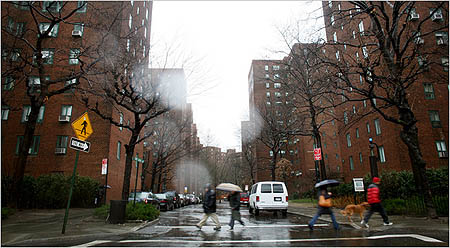
Stuyvesant Town contains 11,227 apartments. The complex was built in the 1940s by Metropolitan Life which received tax breaks and other incentives in exchange for keeping rents low, initially for the World War II veterans who were the first tenants.
You can read the entire gruesome story in this New York Times piece, Wide Fallout in Failed Deal for Stuyvesant Town. I’m pleased to report that this is one failed real estate deal I wasn’t part of.
Jeremy Grantham’s latest quarterly newsletter. Grantham is one of our most respected professional investment managers, with over $100 billion in client assets. Here are excerpts from his latest quarterly letter.
I just returned from a long vacation in Patagonia. I took long hikes that gave me lots of time to think about life and death and Bernanke. It was an ideal time to have an inspiration, and I had one. This is it: sometimes, whatever the situation and however hard you try, you will not have an inspiration! This is not to say that insights are not available, just that someone else is having them. There is always a great temptation to convince yourself that you have an insight, and then to push it. It can be very, very expensive.
It is easy today to be confused, for this is a remarkably complex time. I argued two years ago that we were all part of an elaborate experiment, the inputs to which were completely new. We had an unprecedentedly low risk premium on every asset class and a stew of new and badly understood fi nancial instruments. That was bad enough, but isn’t the picture even more complicated and without precedent now? We have never in our lifetime seen a fi nancial and economic bust such as the one we just had. We have never had two great asset bubbles break in the same decade. We have never wiped out so much wealth in all asset classes as we have this time: $20 trillion at its worst point, on our reckoning. We have never experienced such rapid deterioration in the government’s budget and in the balance sheet of the Fed, nor witnessed such moral hazard, with bailouts fl ying around like this. What hope do we really have in making accurate predictions of how the world will recover from all of this, and in what ways it will be changed? Very little.
My view of the economy’s future is boringly unchanged: “Seven Lean Years.” I still believe that after the initial kick of the stimulus, we will move into a multi-year headwind as we sort out our extreme imbalances. This is likely to give us below-average GDP growth over seven years and more than our share of below-average profi t margins and P/E ratios, so that it would feel more like the bumpy (bumpy, but not so disastrous) 1970s than the economically lucky 1990s and early 2000s. …
But the bigger danger is that once again the Fed is playing with fire!
Whenever the Fed attempts to stimulate the economy by facilitating low rates and rapid money growth, the economy responds. But it does so reluctantly, whereas asset prices respond with enthusiasm. In our studies of the Presidential Cycle we have shown that, historically, where modest Fed stimulus and some moral hazard hardly move the dial on the economy in the third year of the cycle, they push stocks up almost 15% a year above normal and risky stocks even more. …
I thought in return for the pain we had all learned some lessons. I was naïve. Congress will probably stay in the pocket of the fi nancial world, and few useful changes will be made. Investors, traditionally reluctant to burn their fi ngers badly twice in a generation, line up to buy risk and bid down spreads as if eager to suffer for a third time in a decade.
Scientists believe that some wild animals that are threatened constantly by predators quickly forget the worst episodes lest they become so completely traumatized that they dare not return to nibbling grass. Normally, investors appear to have longer memories than rabbits, but not this time! And the Fed, having learned nothing, still worships at the Greenspan altar.
So all investors should brace for the chance that speculation will continue for longer than would have seemed remotely possible six months ago. I thought last April that the market (S&P 500) would scoot up to 1000 to 1100 on a typical relief rally. Now it seems likely to go through 1200 and possibly higher. The market, however, is worth only 850 or so; thus, any advance from here will make it once again seriously overpriced, although the high quality component is still relatively cheap. EAFE equities seem a little overpriced, emerging markets more so, and fi xed income seems badly overpriced, especially cash, which is awful.
The real trap here, and a very old one at that, is to be seduced into buying equities because cash is so painful. Equity markets almost always peak when rates are low, so moving in desperation away from low rates into substantially overpriced equities always ends badly. So this is a dilemma. In 2010, value purists will have to struggle increasingly with the Fed’s continued juicing of the markets. In order to control real risk – the risk of losing money – they will be forced to take the increasing career and business risk of lagging a rising market.
Our choice – by no means a “solution” – is to only very slightly underweight global equities on the grounds that, when tilted to quality, they are still adequate in terms of return potential. We also have to swallow our distaste for parking the rest in unattractive fi xed income. And if the equity markets are indeed driven higher in the next six months, which, unlike my view of last summer, now looks to be at least 50/50, we will very slowly withdraw equities: eight times bitten, once shy, so to speak, for in these situations we typically beat a much too rapid and enthusiastic retreat. If we do see a substantially higher market in the next few months, we will probably underperform, but likely not by much. …
For the longer term, the outperformance of high quality U.S. blue chips compared with the rest of U.S. stocks is, in my opinion, “nearly certain” (which phrase we at GMO traditionally defi ne as more than a 90% probability).
Jeremy Grantham’s Lessons Learned in the Decade. From the same newsletter:
+ The Fed wields even more fi nancial infl uence than we thought.
+ Low rates have a more powerful effect on driving fi nancial assets than on driving the economy.
+ The Fed is capable of being extremely out of touch with the real world – “what housing bubble?” – plus more doctrinaire – “no, the low rates had no effect on housing” – than anyone could have imagined.
+ Congress is nearly dysfunctional, primarily controlled by large corporations, and hamstrung by the supermajority now routinely required in the Senate.
+ Government administrations can be incompetent for long periods.
+ Poor leadership can really damage a country’s hardwon reputation in a mere 10 years.
+ Obama is not a miracle worker!
+ The leadership of major corporations can be very lacking in insight and competence on a fairly routine basis.
+ The two time-tested investment tools, value (P/E ratios and P/B ratios) and price momentum, are now much more heavily used and not so reliable as they once were, say from 1977 to 1997.
+ Asset classes really are more ineffi ciently priced than individual stocks on average, and therefore offer greater opportunities for adding value and reducing risk.
+ Developed countries, including the U.S., are past their prime compared with developing countries: it is indeed a new world order.
+ Education and training are the keys to increasing wealth on a sustainable basis and the U.S. is in danger of losing its once large edge here.
+ We all live on an island, which can be overexploited and turned into a barren Easter Island if we are not careful. Resources are fi nite and biodiversity is fragile, and both must be protected. Carbon emissions are the single greatest threat.
+ Being a global policeman is expensive, and somewhere between difficult and impossible.
+ The Fed learns no lessons!
Banks are getting increasingly stupid. My bank, Sovereign Bank, is charging me $13 for each incoming wire — no matter how big or small. Strikes me they’d want the money. In the old days, I could email my local manager, Chris Toole, and he’d reverse the charges. Today he has no latitude. They’ve removed all his customer-pleasing tools. What a bunch of dummies.
But, wait, it gets worse. Banks are charging even more for outing wires. Recently I received $972 for a $1,000 invoice of mine. The client had wired me the $1,000. His bank had deducted $28 in fees and sent me the difference.
It’s not a lot of money. But it’s irksome. My taxpayer money saved these guys.
Ironically, none of the online brokers seem to charge for incoming wires.
Frank Sinatra goes to the airport. They should play this non-stop at all airports. This is totally wonderful, and totally tasteless. Click here.
Not a funny joke. I don’t feel funny this morning.

Harry Newton, who now doesn’t eat salt, sugar, cheese, or meat. What he now eats gives boredom (and tastelessness) a whole new meaning.

What ad? All I saw was “eye candy.” 🙂
Hi Harry,
Chin up. Spring and a trip to warm, sunny California are in your future.
I appreciate Jeremy Grantham's essay.
Jeremy's reference to the '”7 lean years” caught my eye as the story was referenced in one of our 'surviving the current economy' discussions yesterday. It is impressive to meet people who prepared for the event without having a crystal ball to reveal when it was coming. They are out there.
Re: We all live on an island, which can be over exploited and turned into a barren Easter Island. For more on collapse of societies read:
~Jared Diamond's “Collapse: How Societies Choose to Fail or Succeed”
~Joseph Tainter's “Collapse of Complex Societies”
On bank fees – My Bank charges $20.00 to send wire transfers. My Credit Union does NOT charge to send wire transfers. My daughter's Credit Union charges $5.00 to receive a transfer. She is very anti-bank after getting fee-ed to death by three different college town banks in two years. Credit Unions are the way to go.
Harry…I am sure you will find that “EverBank” does not charge for wire transfers and you can do them online. You can also hold funds in many foreign currency's. I have done both quite successfully.
Related to your comments on bank fees are what prompted me to go to a local credit union years ago for my personal finances. Similar federal deposit insurance and online banking services. My local savings bank pays 1.25% Money Market for a $500 minimum.
Harry –
Have you no SHAME??? Your blog has an advertisment for a weight lose product with tyhe trainer from “The Biggest Loser” reality show. We are saturated with that trash TV reality stuff and I wont watch it. Now I see it on your “business/investing” webiste. Looks like a sell-out to me!
I have no influence on which ads run. Google' s robots make that decision. If it seriously offends, I can drop Google. The money is not significant. Trust me.
Hi Harry,
I just wanted to say that I really enjoy reading your investing website — I look forward to it every morning. Please keep doing what you're doing. I also don't mind any ads google puts up.
Thanks!!!
Harry,
All people have to do is install the Firefox web browser with the Ad-block plug-in. I haven't seen a web ad for years.
Besides, no one with any sense should be using Internet Exposer any more anyway.
Rick – lighten up. Or instead why don't you send Harry a check for all the work he does?