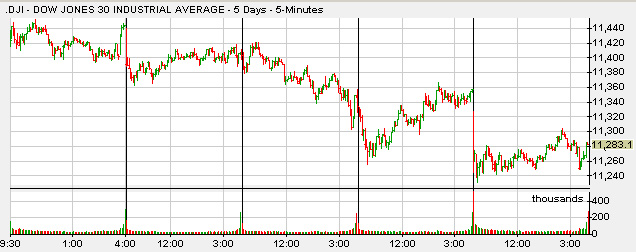
This morning’s future suck. The last five days have looked awful:
No one can predict this market. Some readers feel the sure-fire predictor is to do exactly the opposite of what I recommend.
If I’m positive, they sell. If I’m negative, they buy.
I continue to feel positive for four reasons:
1. Corporate earnings are doing well.
2. I don’t fight the Fed, though QE2 makes no sense.
3. There’s no place else for people to put their money.
4. The statistics show people putting their money into stocks, not into bonds.
There are several strategies I recommend:
1. Take a little money off the table before December 30. Taxes will rise next year. A bumbling Congress will continue to bumble.
2. Tighten your trailing stop losses, especially on “hot” stocks.
3. If some of your favorite stocks dip, buy some. That doesn’t include Cisco or Microsoft. Both stocks are going nowhere fast.
4. Gold and silver continue to make sense. I own SGOL, GLD and SLV.
Don’t get pissed if you get stopped out and your stock goes higher. Don’t be shy. Buy it back. I’ve been stopped out of several that have gone higher, especially Ford. Idiot me.
An inviolate stop loss will always save you money in a bear market. Are we moving into a bear market? I don’t know. Play it safe. Keep your stops tights.
All business class across the pond. You can now fly from downtown London to New York on an all-business class British Airways flight. Benefits: small aircraft, good service, reliable bag check, faster on and off aircraft because it’s smaller. A friend recently came across on a flight with only 14 passengers. He said it was “Heaven.” Equating flying to Heaven may be stretching it. But you get the idea. Read more here.
Harry’s “brilliance” with Outlook. My idea was to have my email appear on my iPhone and my Outlook. So I told Outlook to leave messages on the server. That was brilliant. I now received messages on my iPhone — except Outlook could never figure it out if it had already sucked the message off the server. So it just sucked my messages off again and again. Before I figured the problem, Outlook had added 12,000 messages to my inbox. I knew I was popular. Not that popular. Now, to get messages on my iPhone, my Outlook should be turned off.
More fun dental stuff: After $2,000 and two days at the dentist, I’ve learned:
1. Trident gum with xylitol sweetener allegedly kills tooth decay. Orbit doesn’t have it. Get your teeth into Trident.
2. The Doctor’s BrushPicks are really useful for cleaning in and around crowns and bridges.
3. Everyone raves about WaterPiks.
4. The newest Oral-B SmartSeries 5000 electric toothbrush is meant to be much better than previous versions.
5. Prospec MI Paste allegedly stops your saliva destroying your teeth while you sleep. Rub it on your teeth before you sleep.
My teeth are not perfect. But they keep looking better as God’s work is replaced by Man’s work. God should wonder what He could do if only he had the money.
Matt Taibbi strikes again. His latest brilliant Rolling Stone piece is headed “Courts Helping Banks Screw Over Homeowners. Retired judges are rushing through complex cases to speed foreclosures in Florida.” It’s a long piece. I recommend you read all of it. Here’s a choice extract:
Now all of this – the obviously cooked-up documents, the magically appearing stamp and the rest of it – may just seem like nothing more than sloppy paperwork. After all, what does it matter if the bank has lost a few forms or mixed up the dates? The homeowners still owe what they owe, and the deadbeats have no right to keep living in a house they haven’t paid for.
But what’s going on at the Jacksonville rocket docket, and in foreclosure courts all across the country, has nothing to do with sloppiness. All this phony paperwork was actually an essential part of the mortgage bubble, an integral element of what has enabled the nation’s biggest lenders to pass off all that subprime lead as AAA gold.
In the old days, when you took out a mortgage, it was probably through a local bank or a credit union, and whoever gave you your loan held on to it for life. If you lost your job or got too sick to work and suddenly had trouble making your payments, you could call a human being and work things out. It was in the banker’s interest, as well as yours, to make a modified payment schedule. From his point of view, it was better that you pay something than nothing at all.
But that all changed about a decade ago, thanks to the invention of new financial instruments that magically turned all these mortgages into high-grade investments. Now when you took out a mortgage, your original lender – which might well have been a big mortgage mill like Countrywide or New Century – immediately sold off your loan to big banks like Deutsche and Goldman and JP Morgan. The banks then dumped hundreds or thousands of home loans at a time into tax-exempt real estate trusts, where the loans were diced up into securities, examined and graded by the ratings agencies, and sold off to big pension funds and other institutional suckers.
Even at this stage of the game, the banks generally knew that the loans they were buying and reselling to investors were shady. A company called Clayton Holdings, which analyzed nearly 1 million loans being prepared for sale in 2006 and 2007 by 23 banks, found that nearly half of the mortgages failed to meet the underwriting standards being promised to investors. Citi-group, for instance, had 29 percent of its loans come up short, but it still sold a third of those mortgages to investors. Goldman Sachs had 19 percent of its mortgages flunk the test, yet it knowingly hawked 34 percent of the risky deals to investors.
D. Keith Johnson, the head of Clayton Holdings, was so alarmed by the findings that he went to officials at three of the main ratings agencies – Moody’s, Standard and Poor’s, and Fitch’s – and tried to get them to properly evaluate the loans. “Wouldn’t this information be great for you to have as you assign risk levels?” he asked them. (Translation: Don’t you ratings agencies want to know that half these loans are crap before you give them a thumbs-up?) But all three agencies rejected his advice, fearing they would lose business if they adopted tougher standards. In the end, the agencies gave large chunks of these mortgage-backed securities AAA ratings – which means “credit risk almost zero.”
Since these mortgage-backed securities paid much higher returns than other AAA investments like treasury notes or corporate bonds, the banks had no trouble attracting investors, foreign and domestic, from pension funds to insurance companies to trade unions. The demand was so great, in fact, that they often sold mortgages they didn’t even have yet, prompting big warehouse lenders like Countrywide and New Century to rush out into the world to find more warm bodies to lend to.
In their extreme haste to get thousands and thousands of mortgages they could resell to the banks, the lenders committed an astonishing variety of fraud, from falsifying income statements to making grossly inflated appraisals to misrepresenting properties to home buyers. Most crucially, they gave tons and tons of credit to people who probably didn’t deserve it, and why not? These fly-by-night mortgage companies weren’t going to hold on to these loans, not even for 10 minutes. They were issuing this credit specifically to sell the loans off to the big banks right away, in furtherance of the larger scheme to dump fraudulent AAA-rated mortgage-backed securities on investors. If you had a pulse, they had a house to sell you.
As bad as Countrywide and all those lenders were, the banks that had sent them out to collect these crap loans were a hundred times worse. To sell the loans, the banks often dumped them into big tax-exempt buckets called REMICs, or Real Estate Mortgage Investment Conduits. Each one of these Enron-ish, offshore-like real estate trusts spelled out exactly what kinds of loans were supposed to be in the pool, when they were to be collected, and how they were to be managed. In order to both preserve their tax-exempt status and deserve their AAA ratings, each of the loans in the pool had to have certain characteristics. The loans couldn’t already be in default or foreclosure at the time they were sold to investors. If they were advertised as nice, safe, fixed-rate mortgages, they couldn’t turn out to be high-interest junk loans. And, on the most basic level, the loans had to actually exist. In other words, if the trust stipulated that all the loans had to be collected by August 2005, the bank couldn’t still be sticking in mortgages months later.
Yet that’s exactly what the banks did. In one case handled by Jacksonville Area Legal Aid, a homeowner refinanced her house in 2005 but almost immediately got into trouble, going into default in December of that year. Yet somehow, this woman’s loan was placed into a trust called Home Equity Loan Trust Series AE 2005-HE5 in January 2006 – five months after the deadline for that particular trust. The loan was not only late, it was already in foreclosure – which means that, by definition, whoever the investors were in AE 2005-HE5 were getting shafted.
Why does stuff like this matter? Because when the banks put these pools together, they were telling their investors that they were putting their money into tidy collections of real, performing home loans. But frequently, the loans in the trust were complete shit. Or sometimes, the banks didn’t even have all the loans they said they had. But the banks sold the securities based on these pools of mortgages as AAA-rated gold anyway.
In short, all of this was a scam – and that’s why so many of these mortgages lack a true paper trail. Had these transfers been done legally, the actual mortgage note and detailed information about all of these transactions would have been passed from entity to entity each time the mortgage was sold. But in actual practice, the banks were often committing securities fraud (because many of the mortgages did not match the information in the prospectuses given to investors) and tax fraud (because the way the mortgages were collected and serviced often violated the strict procedures governing such investments). Having unloaded this diseased cargo onto their unsuspecting customers, the banks had no incentive to waste money keeping “proper” documentation of all these dubious transactions.
“You’ve already committed fraud once,” says April Charney, an attorney with Jacksonville Area Legal Aid. “What do you have to lose?”
Sitting in the rocket docket, James Kowalski considers himself lucky to have won his first motion of the morning. To get the usually intractable Judge Soud to forestall a foreclosure is considered a real victory, and I later hear Kowalski getting props and attaboys from other foreclosure lawyers. In a great deal of these cases, in fact, the homeowners would have a pretty good chance of beating the rap, at least temporarily, if only they had lawyers fighting for them in court. But most of them don’t. In fact, more than 90 percent of the cases that go through Florida foreclosure courts are unopposed. Either homeowners don’t know they can fight their foreclosures, or they simply can’t afford an attorney. These unopposed cases are the ones the banks know they’ll win – which is why they don’t sweat it if they take the occasional whipping.
That’s why all these colorful descriptions of cases where foreclosure lawyers like Kowalski score in court are really just that – a little color. The meat of the foreclosure crisis is the unopposed cases; that’s where the banks make their money. They almost always win those cases, no matter what’s in the files.
This becomes evident after Kowalski leaves the room.
“Who’s next?” Judge Soud says. He turns to Mark Kessler, the counsel for the big foreclosure mills. “Mark, you still got some?”
“I’ve got about three more, Judge,” says Kessler.
Kessler then drops three greenish-brown files in front of Judge Soud, who spends no more than a minute or two glancing through each one. Then he closes the files and puts an end to the process by putting his official stamp on each foreclosure with an authoritative finality:
Kerchunk!
Kerchunk!
Kerchunk!
Each one of those kerchunks means another family on the street. There are no faces involved here, just beat-the-clock legal machinery. Watching Judge Soud plow through each foreclosure reminds me of the scene in Fargo where the villain played by Swedish character actor Peter Stormare pushes his victim’s leg through a wood chipper with that trademark bored look on his face. Mechanized misery and brainless bureaucracy on the one hand, cash for the banks on the other.
What’s sad is that most Americans who have an opinion about the foreclosure crisis don’t give a shit about all the fraud involved. They don’t care that these mortgages wouldn’t have been available in the first place if the banks hadn’t found a way to sell oregano as weed to pension funds and insurance companies. They don’t care that the Countrywides of the world pushed borrowers who qualified for safer fixed–income loans into far more dangerous adjustable-rate loans, because their brokers got bigger commissions for doing so. They don’t care that in the rush to produce loans, people were sold houses that turned out to have flood damage or worse, and they certainly don’t care that people were sold houses with inflated appraisals, which left them almost immediately underwater once housing prices started falling.
The way the banks tell it, it doesn’t matter if they defrauded homeowners and investors and taxpayers alike to get these loans. All that matters is that a bunch of deadbeats aren’t paying their fucking bills. “If you didn’t pay your mortgage, you shouldn’t be in your house – period,” is how Walter Todd, portfolio manager at Greenwood Capital Associates, puts it. “People are getting upset about something that’s just procedural.”
Jamie Dimon, the CEO of JP Morgan, is even more succinct in dismissing the struggling homeowners that he and the other megabanks scammed before tossing out into the street. “We’re not evicting people who deserve to stay in their house,” Dimon says.
There are two things wrong with this argument. (Well, more than two, actually, but let’s just stick to the two big ones.)
The first reason is: It simply isn’t true. Many people who are being foreclosed on have actually paid their bills and followed all the instructions laid down by their banks. In some cases, a homeowner contacts the bank to say that he’s having trouble paying his bill, and the bank offers him loan modification. But the bank tells him that in order to qualify for modification, he must first be delinquent on his mortgage. “They actually tell people to stop paying their bills for three months,” says Parker.
The authorization gets recorded in what’s known as the bank’s “contact data-base,” which records every phone call or other communication with a home-owner. But no mention of it is entered into the bank’s “number history,” which records only the payment record. When the number history notes that the home-owner has missed three payments in a row, it has no way of knowing that the homeowner was given permission to stop making payments. “One computer generates a default letter,” says Kowalski. “Another computer contacts the credit bureaus.” At no time is there a human being looking at the entire picture.
Which means that homeowners can be foreclosed on for all sorts of faulty reasons: misplaced checks, address errors, you name it. This inability of one limb of the foreclosure beast to know what the other limb is doing is responsible for many of the horrific stories befalling homeowners across the country. Patti Parker, a local attorney in Jacksonville, tells of a woman whose home was seized by Deutsche Bank two days before Christmas. Months later, Deutsche came back and admitted that they had made a mistake: They had repossessed the wrong property. In another case that made headlines in Orlando, an agent for JP Morgan mistakenly broke into a woman’s house that wasn’t even in foreclosure and tried to change the locks. Terrified, the woman locked herself in her bathroom and called 911. But in a profound expression of the state’s reflexive willingness to side with the bad guys, the police made no arrest in the case. Breaking and entering is not a crime, apparently, when it’s authorized by a bank.
The second reason the whole they still owe the fucking money thing is bogus has to do with the changed incentives in the mortgage game. In many cases, banks like JP Morgan are merely the servicers of all these home loans, charged with collecting your money every month and paying every penny of it into the trust, which is the real owner of your mortgage. If you pay less than the whole amount, JP Morgan is now obligated to pay the trust the remainder out of its own pocket. When you fall behind, your bank falls behind, too. The only way it gets off the hook is if the house is foreclosed on and sold.
That’s what this foreclosure crisis is all about: fleeing the scene of the crime. Add into the equation the fact that some of these big banks were simultaneously betting big money against these mortgages – Goldman Sachs being the prime example – and you can see that there were heavy incentives across the board to push anyone in trouble over the cliff.
…Leonard now has a job and could make some kind of reduced payment. But instead of offering loan modification, the bank’s lawyers are in their fourth year of doggedly beating her brains out over minor technicalities in the foreclosure process. That’s fine by the lawyers, who are collecting big fees. And there appears to be no human being at the bank who’s involved enough to issue a sane decision to end the costly battle. “If there was a real client on the other side, maybe they could work something out,” says Charney, who is representing Leonard. In this lunatic bureaucratic jungle of securitized home loans issued by trans-national behemoths, the borrower-lender relationship can only go one of two ways: full payment, or total war.
The extreme randomness of the system is exemplified by the last case I see in the rocket docket. While most foreclosures are unopposed, with homeowners not even bothering to show up in court to defend themselves, a few pro se defendants – people representing themselves – occasionally trickle in. At one point during Judge Soud’s proceeding, a tallish blond woman named Shawnetta Cooper walks in with a confused look on her face. A recent divorcee delinquent in her payments, she has come to court today fully expecting to be foreclosed on by Wells Fargo. She sits down and takes a quick look around at the lawyers who are here to kick her out of her home. “The land has been in my family for four generations,” she tells me later. “I don’t want to be the one to lose it.”
Judge Soud pipes up and inquires if there’s a plaintiff lawyer present; someone has to lop off this woman’s head so the court can move on to the next case. But then something unexpected happens: It turns out that Kessler is supposed to be foreclosing on her today, but he doesn’t have her folder. The plaintiff, technically, has forgotten to show up to court.
Just minutes before, I had watched what happens when defendants don’t show up in court: kerchunk! The judge more or less automatically rules for the plaintiffs when the homeowner is a no-show. But when the plaintiff doesn’t show, the judge is suddenly all mercy and forgiveness. Soud simply continues Cooper’s case, telling Kessler to get his shit together and come back for another whack at her in a few weeks. Having done this, he dismisses everyone.
Stunned, Cooper wanders out of the courtroom looking like a person who has stepped up to the gallows expecting to be hanged, but has instead been handed a fruit basket and a new set of golf clubs.
I follow her out of the court, hoping to ask her about her case. But the sight of a journalist getting up to talk to a defendant in his kangaroo court clearly puts a charge into His Honor, and he immediately calls Cooper back into the conference room. Then, to the amazement of everyone present, he issues the following speech:
“This young man,” he says, pointing at me, “is a reporter for Rolling Stone. It is your privilege to talk to him if you want.” He pauses. “It is also your privilege to not talk to him if you want.”
I stare at the judge, open-mouthed. Here’s a woman who still has to come back to this guy’s court to find out if she can keep her home, and the judge’s admonition suggests that she may run the risk of pissing him off if she talks to a reporter. Worse, about an hour later, April Charney, the lawyer who accompanied me to court, receives an e-mail from the judge actually threatening her with contempt for bringing a stranger to his court. Noting that “we ask that anyone other than a lawyer remain in the lobby,” Judge Soud admonishes Charney that “your unprofessional conduct and apparent authorization that the reporter could pursue a property owner immediately out of Chambers into the hallway for an interview, may very well be sited [sic] for possible contempt in the future.”
Let’s leave aside for a moment that Charney never said a word to me about speaking to Cooper. And let’s overlook entirely the fact that the judge can’t spell the word cited. The key here isn’t this individual judge – it’s the notion that these hearings are not and should not be entirely public. Quite clearly, foreclosure is meant to be neither seen nor heard.
After Soud’s outburst, Cooper quietly leaves the court. Once out of sight of the judge, she shows me her file. It’s not hard to find the fraud in the case. For starters, the assignment of mortgage is autographed by a notorious robo-signer – John Kennerty, who gave a deposition this summer admitting that he signed as many as 150 documents a day for Wells Fargo. In Cooper’s case, the document with Kennerty’s signature on it places the date on which Wells Fargo obtained the mortgage as May 5th, 2010. The trouble is, the bank bought the loan from Wachovia – a bank that went out of business in 2008. All of which is interesting, because in her file, it states that Wells Fargo sued Cooper for foreclosure on February 22nd, 2010. In other words, the bank foreclosed on Cooper three months before it obtained her mortgage from a nonexistent company.
And his conclusion?
When you meet people who are losing their homes in this foreclosure crisis, they almost all have the same look of deep shame and anguish. Nowhere else on the planet is it such a crime to be down on your luck, even if you were put there by some of the world’s richest banks, which continue to rake in record profits purely because they got a big fat handout from the government. That’s why one banker CEO after another keeps going on TV to explain that despite their own deceptive loans and fraudulent paperwork, the real problem is these deadbeat homeowners who won’t pay their fucking bills. And that’s why most people in this country are so ready to buy that explanation. Because in America, it’s far more shameful to owe money than it is to steal it.
You can read Taibbi’s entire piece in the November, 2010 issue of Rolling Stone. Or you can read it online here.
This is not Harry Newton. It is just the way he feels this morning.
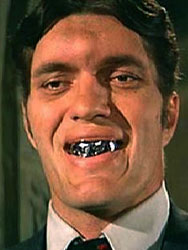
This is the real Harry Newton, genuine fake teeth and all.

Harry wonders why, after spending four hours in the dentist’s chair yesterday, he can’t think of a single bad (or good) joke. I am loving Jello once again.

Reader and great dentist, Anthony Onofreo DMD emailed me:
I need to correct your stated belief that saliva is destructive to teeth. In fact, it is the calcium and phosphates in our saliva that buffer the acid attacks which our teeth must endure each and every day. Tooth decay is an infectious disease known as dental caries. Oral bacteria metabolize ANY fermentable carbohydrate (not just the sugary stuff we all associate with “cavities”) and then release acid as a byproduct.
This acid literally dissolves the tooth structure. Initially, this process is reversible and is known as remineralization. The MI paste you mentioned is intended to augment this natural process. However, the other essential ingredient is time. If the mouth remains acidic (i.e. a pH below neutral) for prolonged
periods, this process cannot effectively repair teeth. Any acid, both exogenous (from foods such as citrus fruits, or beverages — particularly sports drinks {Gatorade, Powerade, Vitamin Water}) and endogenous (acid
reflux, “heartburn”) will negatively affect this natural repair process.
So, bottom line: remove oral bacteria mechanically, using electric brushes which are 4 times more efficient than manual (the Oral-B Vitality model at $20 uses the same brush head as the more expensive model you mentioned)along with interdental cleaning using some combination of floss, Proxybrushes, and/or the BrushPicks you mentioned; and chemically, using Listerine or Crest Pro-Health rinses.
Limit the frequency of eating/drinking which is more important than the amount. Consider adjuncts such as high strength prescription F- toothpaste (Prevident), along with xylitol gum. Make sure you do not have GERD, and if
so, get it controlled with one of the many medicines s available to control stomach acid.
Virtually all dental disease is preventable, so hopefully you can fiqure out where you are going wrong. Hopefully you find it helpful to understand the physiologic process behind “cavities”, or at least will no longer disparage
saliva.
Harry,
FYI: Check out the “H2Oral Irrigator” its a Shower Flossing Unit – works like a water pic but connects to your shower and you use it there – adding about 5 minutes to your shower experience. My hygienist (Sp?) recommended this as I have the begininnings of gum problems and it is helping. Can get it for about $15 on Ebay and takes 15 minutes install. Highly recommended.
Harry
Please consider rinsing your mouth out after you eat each time with warm to
hot water. In doing this, the warm water will immediately remove the
food residues from the teeth so that no decay can start because there would
be nothing to start from once the food residues are removed. I have been
doing this for several years and rarely have my teeth cleaned. If in a
restaurant, just order hot water and after rinsing your mouth out, swallow
the water. If no warm water is available, then use cold water. Rinsing two
to three times after each meal would be good. However, also continue to
brush and floss.
Benjamin
At my dentist's recommendation I started chewing on average 2-3 sticks of Trident with xylitol tropical twist flavor for over two years with no problems.
Horrors Harry!
Do not do anything, like the paste you recommended, to stop or reduce the flow of saliva. Saliva is part of a very complex biochemical system in your mouth which helps rejuvenate the dental enamel surface of your teeth. Keeping that surface hard is critical to protecting the tooth structure. Trust me, you do not want to interrupt that flow!
….coming from a former dental research scientist.
Reader Glenn Zeitz VMD writes this morning:
Be careful with xylitol around your dog. It is highly toxic to dogs, they cannot process it. It hurts their liver and causes potentially fatal drop in their blood glucose. I treat 1-2 a yr. The dogs get the used gum out of the trash can or grab the package off the table and eat it.
Glenn zeitz VMD
I wonder if it helps their teeth? — Harry
Try Icebreakers Ice Cubes gum. Great taste and #1 ingredient is Xylitol.
Harry, seriously; Look into the IMAP mail protocol.
All your devices will show the same messages, and a change made on one will reflect on all. All your messages stay on the server, so if you have a problem and need to wipe your computer, all your mail will come back when you set up your email program.
I don't know which service you use for email, but most support IMAP these days.
You can read about it here: http://lifehacker.com/110333/why-imap-is-better-than-pop
You'll never look back and it takes about 30 seconds to set up.