On Thursday I called my fixed income maven. My two New York muni bond funds — ENX and BNY — were cratering. What the hell were going on? An example:
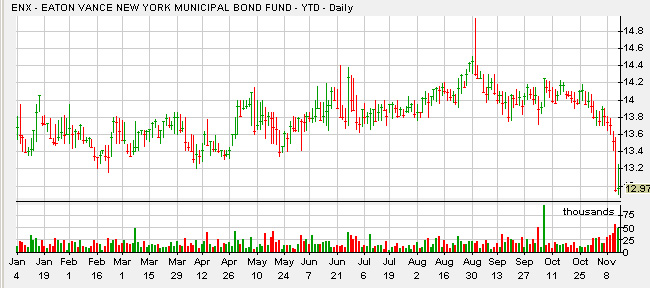
He assured me everything was just lovely and he’d be a buyer since the yield on ENX had now risen and was 6.38% triple-tax-free for me (a fool living in high-tax New York City). He was wrong. The next day the Wall Stteet Journal came out with a negative piece on muni-bond funds and both ENX and BNY dropped further. I should have gone with my gut. Somehow the market knew the Journal was going to publish. (Isn’t’ that interesting?) Here’s an excerpt from the Journal:
Municipal Bond Market Shudders
Has the reckoning arrived for municipal bonds?
That is the question investors are asking after munis — those old faithfuls of investing — took their biggest hit since the financial collapse of 2008.
Concern over the increasingly strained finances of states and cities and a growing backlog of new bonds for sale overwhelmed the market last week. After performing so well for so long, munis and funds that invest in them fell hard. One big muni fund, the Pimco Municipal Income Fund II, for instance, lost 7.5 percent. The fund is still up 6.75 percent so far this year.
While the declines were relatively small given the remarkable gains in these bonds over the last two years, the slump was swift enough to leave investors wondering if this was a brief setback or the start of something worse. For months, some on Wall Street have warned that indebted states and cities might face a crisis akin to the one that brought Greece to its knees.
“I think it’s too early to say that it’s more than a correction,” said Richard A. Ciccarone, the chief research officer of McDonnell Investment Management.
“The facts just don’t support a serious conclusion that the whole market’s going downhill,” he said. “They could. We’ve got some serious liabilities out there.”
The causes of the week’s big decline are clouded by unusual factors like the looming end of the Build America Bonds program, which has prompted local governments to race new bonds to market before an attractive federal subsidy is reduced.
But the big question confronting this market is how state and local governments will manage their debts. Many are staggering under huge pension and health care obligations that seem unsustainable.
Certainties are impossible because governments do not have to disclose the pension payouts they will have to make in the coming years, as they do for bond payouts.
California, for example, will have to sell nearly $14 billion of debt into the falling market this month, because of its record delay in getting a budget signed this year. The warnings keep coming. On Friday, Fitch, the credit ratings agency, issued a report saying that ratings downgrades for municipal bonds outnumbered upgrades for the seventh consecutive quarter.
And a few prominent defaults have made the market jittery. …
Standard & Poor’s, meanwhile, issued a report last Monday observing that even troubled cities like Detroit were still able to bring debt to market at what the rating agency considered favorable rates. It said most government officials seemed determined to honor their general obligations.
Analysts like Mr. Ciccarone said much of the decline was concentrated among longer-maturity bonds and bonds with lower credit ratings. Their values fell more sharply as investors watched the Federal Reserve buying hundreds of billions of dollars of Treasury bonds and concluded the Fed’s move would be inflationary over the longer term. That made some investors less willing to hold long-term municipal bonds, so the prices of the bonds fell.
Until two weeks ago, the municipal bond markets had been frothy, thanks in part to the intensifying interest of wealthy individuals in tax-sheltered investments as the sunset date on the Bush administration’s tax cuts looms. People seek a tax shelter like municipal bonds because the interest is usually not taxed, and the bonds are considered very safe.
This year, however, tax-exempt municipal bonds have been harder than usual to find, because the governments that normally issue them have switched over to taxable bonds.
So investors were bidding up the prices. Mr. Fabian said that had fed into the prices of all of the municipal bonds held by mutual funds, which are assigned a value each day on the basis of a model because they may not trade.
The reason for scarcity of tax-exempt bonds has been, in part, the Build America Bonds program, created as part of the fiscal stimulus program. That federally subsidized program is scheduled to expire at the end of this year, so states and cities have been rushing to take advantage of it.
Yet the values of tax-exempt munis fell, defying those who said it was all a matter of supply and demand. The last week also brought some large tax-exempt bond issues, including one by a public authority in Massachusetts for Harvard University, which was reduced because of poor investor demand.
Mr. Fabian said the downdraft could continue next week.
“The risk is that you don’t know,” he said.
“You have an awful lot of money, including from households, that simply follows momentum.”
There are two lessons here: Be very wary of funds. Listen to your gut when it says SELL.
What is quantitative easing (QE)? It’s a fancy name for printing money, usually done by a government for the purpose of paying bills it doesn’t have the money to pay, or to stimulate the economy by putting more money out. Such “printing” can be by paper (i.e. the printing press) but these days it is done digitallly — by creating entries on the government’s central bank’s balance sheet. One side of the balance sheet would represent the magically-created money (a.k.a. equity) and the other side would be treasury bonds bought with the new money. In the U.S., quantitative easing is done by the Federal Reserve. QE was used twice by the U.S. during 2009-2010 as a way to stimulate the economy, keep interest rates low, attack deflation and stimulate employment. It failed on all counts. However, because there is widespread belief in an old Wall Street adage, “Don’t fight the Fed“, QE has somehow been good for stock prices, which have risen — until last week, when they fell almost 3% last week.
For a full explanation of QE2’s total idiocy, please watch this brilliant video. Please watch it. You’ll see how Goldman Sachs is profiting from QE.
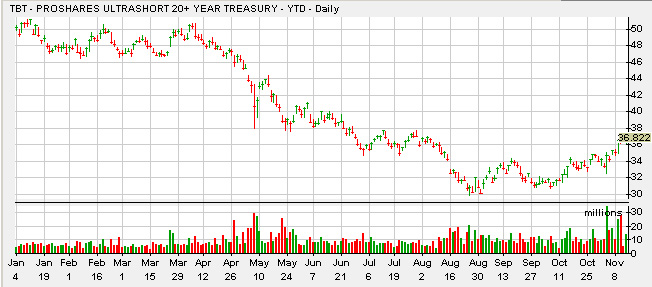
Are interest rates rising?The Fed can keep short-term rates low. It cannot affect long-term rates. What affects them is money sloshing around looking for a place to park. Recently TBT — the bet on the long-term 20-year treasury has rising dramatically. My “smart-money” friends are finally getting their comeuppance for me calling dumb all these month. This is TBT in the past ten days.
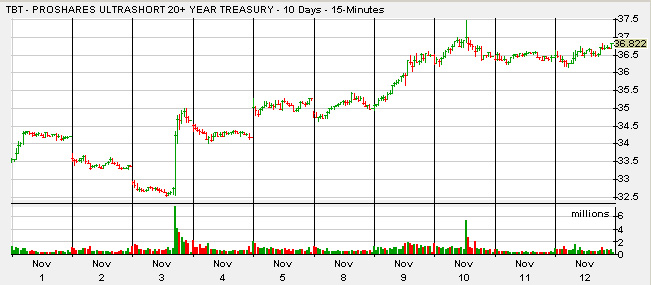
It clearly has a way to go, since TBT has been a big loser this year. And my opinion is that it won’t go much higher. Long-term rates are unlikely to skyrocket while the Fed is trying so hard to hold the line on short-term ones. But I’ve been wrong before — though not in the last ten minutes.
The precious hat
An “older” jewish woman was standing at the railing of the cruise ship holding her hat tight so that it would not blow away in the wind.
A gentleman approached her and said, “Pardon me, madam.. I do not intend to be forward but did you know that your dress is blowing up in this high wind?”
“Yes, I know,” said the lady. “I need both my hands to hold onto this hat.”
“But madam, you must know that you are not wearing any panties and your privates are exposed!” said the gentleman in earnest.
The woman looked down, then back up at the man and replied, “Sir, anything you see down there is 70 year’s old. I just bought this hat yesterday!”

Harry Newton, who has found some good news. He owns 100 shares of BUCY, which CAT is buying. Hehe, that’s better than a slap in the belly with a cold fish.

Those computers are quick, eh Harry?
Maybe the only way to win is to not play at all.
Quantitative Easing seems to me just like another way to tax people without letting them realize they are being taxed. By printing more money to put into circulation the Fed can pay off debt either with the printed money or the cheaper devalued money. The way we are taxed is that if you have $1000 it may only be worth $800 or $900 after the Fed prints up a bunch of money. In effect we have been “taxed” $100 to $200 dollars or more without even raising the tax rates. What a great bunch of leaders we have in this country.
Harry,
Speaking of gut… What would happen if companies with large reserves were given 'guidelines' to declare a portion as dividends (either by markets or regulators)?
Would this lessen speculation? Lessen Wall Streets esoteric product development? Put more money into the economy in the right places, the shareholders/investors? Per Cuban and others, have we limited re-investment and increased risk by allowing companies to keep all the proceeds their shareholders have invested in? Is it considered to be built into the price of the stock when you purchase? Obviously some is needed for M&A or as a hedge against product risk, e.g. FDA, but several companies seem to be over-reaching. If dividends are paid, they are taxable and can be used for re-investment, both of which seem to be legitimate economic stimuli.
Why do some post dividends and others not? Are they mandated? Is there a defined risk?
Just wondering. I hear there are trillions on the sidelines. Perhaps if companies were required to declare dividends, they may put more money to work productively…