This is the story of a big building that was bought for $1.35 billion in November, 2007 — right at the top. The first chart shows how the money was put together to buy the building.
|
How it was bought – aka. the capital stack
|
|
| Senior Debt |
$600,000,000
|
| Mezzanine Debt |
$500,000,000
|
| Equity |
$350,000,000
|
| Total capitalization |
$1,450,000,000
|
The second chart shows how the building’s value (as measured by appraisals) has fluctuated. Some of the debt is now due. Some of the lenders are not doing well. Some are reluctant to renew the loans on a building whose value has dropped so much.
|
How the building’s value has fluctuated
|
|
| Bought November 2007 |
$1,350,000,000
|
| End 2007 |
$1,450,000,000
|
| June 2008* |
$1,300,000,000
|
| December 2008** |
$800,000,000
|
| June 2009 |
$700,000,000
|
| Today, maybe |
$900,000,000
|
* Before Lehmann bankruptcy
** After Lehmann bankruptcy
What now? Put the building up for sale? Who’s got the money to buy it? Try to convince the lenders to renew, but take a little loss. Meanwhile the equity owners, who are wiped out, are managing the building. This stuff gets complicated. Negotiations go on for months and months.
I have no idea if the banks — owners of the senior and mezz debt — have marked their loans to market on their balance sheets. I bet they haven’t.
There are thousands of commercial buildings in a mess all over the country. They will make banks’ balance sheets a total mess if the messes are ever recognized.
Meantime, the prevailing strategy is called Egypt, after “De-Nile.”
I have a little piece of the equity on this handsome building. Today, I am wiped out. Yet another reason to dislike borrowing, aka leverage. The only benefit is that you get to learn from my misery.
What good is Wall Street? That’s the title of a long piece in the November 29 issue of the New Yorker by John Cassidy (who’s really good). His conclusion: Much of what investment bankers do is socially worthless. Here are some excerpts:
+ Since the market collapsed, far fewer credit-default swaps have been issued. But the insidious culture that allowed Wall Street firms to peddle securities of dubious value to pension funds and charitable endowments remains largely in place. “Traditionally, the relationship between Wall Street and its big clients has been based on the ‘big boy’ concept,” Schlosstein explained. “You are dealing with sophisticated investors who can do their own due diligence. For example, if CALPERS”—the California Public Employees Retirement System—“wants to buy something that a major bank is selling short, it’s not the bank’s responsibility to tell them. On Wall Street, this was the accepted way of doing business.” Earlier this year, the Securities and Exchange Commission appeared to challenge the big-boy concept, suing Goldman Sachs for failing to disclose material information about some subprime-mortgage securities that it sold, but the case was resolved without Goldman’s admitting any wrongdoing. “This issue started to get discussed, then fell to the wayside when Goldman settled their case,” Schlosstein said.
+ Despite Pandit’s efforts to remake Citi’s culture, the firm remains heavily involved in trading of various kinds. Its investment-banking arm, which has grown rapidly over the past decade, still accounts for about three-tenths of its revenues (close to twenty billion dollars in the first nine months of this year) and more than two-thirds of its net profits (upward of six billion dollars in the same period). And within the investment bank about eighty cents of every dollar in revenues came from buying and selling securities, while just fourteen cents of every dollar came from raising capital for companies and advising them on deals. Between January and September, Citigroup’s bond traders alone generated more than twelve and a half billion dollars in revenues—more than the bank’s entire branch network in North America.
+ But liquidity, or at least the perception of it, has a downside. The liquidity of Internet stocks persuaded investors to buy them in the belief they would be able to sell out in time. The liquidity of subprime-mortgage securities was at the heart of the credit crisis. Home lenders, thinking they would always be able to sell the loans they made to Wall Street firms for bundling together into mortgage bonds, extended credit to just about anybody. But liquidity is quick to disappear when you need it most. Everybody tries to sell at the same time, and the market seizes up. The problem with modern finance “isn’t just about excessive rents and a misallocation of capital,” Paul Woolley said. “It is also crashes and bad macroeconomic outcomes. The recent crisis cost about ten per cent of G.D.P. It made tackling climate change look cheap.”
+ During the credit boom of 2005 to 2007, profits and pay reached unprecedented highs. It is now evident that the bankers were being rewarded largely for taking on unacknowledged risks: after the subprime market collapsed, bank shareholders and taxpayers were left to pick up the losses. From an economy-wide perspective, this experience suggests that at least some of the profits that Wall Street bankers claim to generate, and that they use to justify their big pay packages, are illusory. Such a subversive notion has recently received the endorsement of senior figures at the Bank of England. Andrew Haldane, the executive director of financial stability at the Bank, gave a speech in July titled “The Contribution of the Financial Sector: Miracle or Mirage?” It concluded, “Because banks are in the risk business, it should be no surprise that the run-up to the crisis was hallmarked by imaginative ways of manufacturing this commodity, with a view to boosting returns to labour and capital. . . . It is in bank managers’ interest to make mirages look like miracles.”
You can and should read entire article. Click here.
What’s happening in Europe? Roubini Global Economics (“Dr Doom”) writes this morning:
Contagion has taken hold of Spain, with respect to both the sovereign and the banking system, in the wake of Ireland’s financial troubles and bailout application. In contrast with Greece, where the key vulnerabilities are in the public sector, both Spain and Ireland have run up large private sector imbalances following real estate booms and busts. In “Comparing Spain With Ireland and Other PIIGS: Better in Some Ways, More at Risk in Others,” available exclusively to clients, we shed light on Spain’s balance sheet vulnerabilities to assess liquidity and solvency risks in comparison with Ireland and the other PIIGS (Italy, Greece and Portugal).
Spain shares some of Ireland’s key vulnerabilities, including a housing bubble more pronounced than that in the United States and large nonperforming loan overhang in the banking sector. Though Spain’s housing bubble is less severe than Ireland’s, and though the Spanish banks’ commendable loan-loss provisioning system is providing a buffer, a comparison of price-to-rent ratios shows that the bulk of the housing price correction and loss recognition has not yet come. Thus, the pressure on the banking system is bound to increase going forward.
Plus, unlike Ireland, Spain’s economy is subject to structural rigidities that prevent a fast return to growth and a quick competitiveness adjustment through internal devaluation. While this year’s fiscal performance is largely on track, the 2011 fiscal target of 6% will be more challenging amid fiscal austerity. In some dimensions Spain’s macro and financial fundamentals (e.g. national savings and public debt levels) are better than those of other periphery countries. But in many dimensions, fundamentals are worse and financial vulnerabilities more severe (e.g. unemployment and financing needs).
As the flow of excess savings from abroad has receded after the investment bust, Spain’s private losses are being socialized, with dire consequences for the public sector balance sheet—although not to the same extent as in Ireland. Ireland’s outsized banking sector in comparison to GDP and its decision to stand behind banks that are too big for it alone to save have accelerated the unsustainable debt dynamics. But one must ask: Is Spain in a fundamentally different situation? Investors seemed willing to give Spain the benefit of the doubt, but market dynamics since Ireland’s application for external support show that a reassessment is taking place.
If the current liquidity pressures don’t abate and Spain, alongside Ireland and possibly Portugal, is forced to turn to the EU funding mechanism, the €500 billion of EU resources (in addition to the not-yet-committed €250 billion in potential IMF funds) would be strained. With Spain too big to fail but also effectively too big to save, a bailout request would open the door to speculation against the cohesion of the eurozone. Indeed, German Bundesbank President Axel Weber’s comment that the €500 billion bailout fund could be increased if necessary to prevent a breakup of the currency union shows that this concern is shared among even the most vocal bailout skeptics.
The alternative to a bailout is a bail-in of private investors. The inclusion of collective action clauses on new debt issues starting in mid-2013, as part of the new European Stabilization Mechanism, is meant to facilitate this process in those cases where insolvency has been established. While useful, such legal technology is not necessary to achieve an orderly restructuring of sovereign debt—previous instances illustrate that market-based restructurings via exchange offers are sufficient.
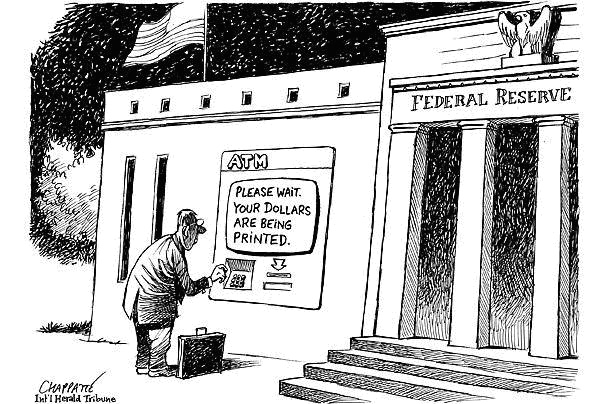
It’s called quantitative easing. It’s also called printing money, which the Fed uses to buy treasuries. We’ve got another $600 billion of it in coming months.
Some people don’t like QE. They say it debases the dollar, making it cheaper. This is the best cartoon:

Harry Newton who warns about upgrading the operating system on your iPhone. I upgraded one iPhone 4 yesterday to OS 4.2. It took over two hours. It went flawlessly. But it’s not exciting watching a screen for hours. Upgrade yours in the middle of the night.

If the recession ended in June 2009 and the economy is on the mend, why are we still seeing depressing news coming from the banks, eurozone, etc. Maybe I am gun shy. However, I still am lacking confidence in the overall economy. Please someone educate me and tell that I am wrong.
Dear Rd,
You are politically incorrect. Have a nice day.
J.