My favorite money manager Scott Udine writes on the weekend:
The markets have once again shrugged off terrible employment numbers and after opening much lower are now working their way towards a positive close. Keep in mind, employment numbers are lagging indicators while the markets action is a leading indicator. As I always say, it is not the news that matters, rather the reaction to that news that is important and right now there are buyers underneath and the markets have a strong bid to it. As we approach year-end there are many mutual fund and hedge fund managers that are lagging terribly and most likely will be chasing performance. Right, wrong or indifferent, it is what it is and for now we ride it until it ends and we just make sure we have a strategy in place for when it does come to an end.
With the above said, and yes, I know all the negatives out there lurking, including the fact that there are 4-7 million homes waiting to go into foreclosure and an unemployment rate that has moved up from 9.6% to 9.8%, the old saying comes into play and that is “don’t fight the Fed”. Now, more than ever that is in effect. At some point, the negatives will matter and those not prepared will feel the brunt of it but for now, they want them higher.
Furthermore, the last 9 economic expansions have lasted 62 months on average. We are in the 17th month of the current expansion, so from that perspective we can see some possible significant upside in the near future. Again, it doesn’t mean that we throw our disciplines away and buy everything in sight. it means that we continue to add exposure to our current leaders, at the proper risk and reward levels and we continue to adjust our stop loss protection levels accordingly. Is that still being a little conservative? You bet, but with the political backdrop, overseas risks and an important deadline regarding taxes coming, I would still rather err on the side of caution.
Remember, the markets usually take the stairs higher and the elevator on the way down, so being a little extra cautious with our precious capital is always a welcome strategy.
I added a couple of names to the list in the right column.
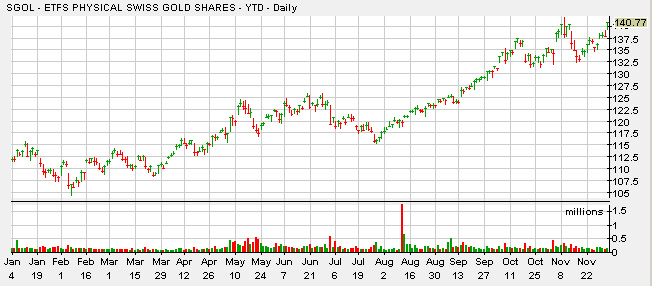
Gold is back on its climb. Last week it passed through $1,400 an ounce. It will keep rising.
I’m not big on banks. I suspect there’ll be more unpleasant surprises (like crappy commercial mortgages) than there will be pleasant surprises. I’m not prepared to short them, either. The New York Times did a love-hate cover story on Jamie Dimon, CEO of JPMorgan Chase.
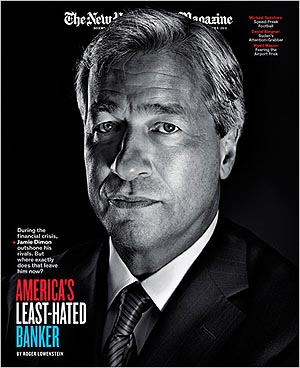
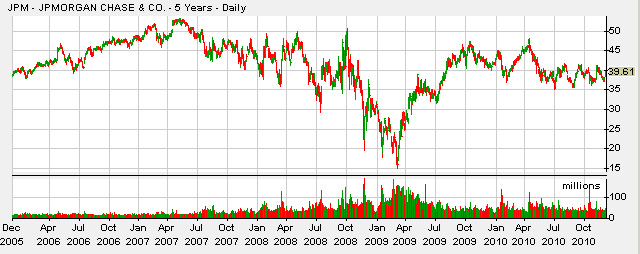
The man has a lot of admirers, but few (I’m guessing) among his shareholders, for whom he’s done nothing these past five years.
Some excerpts:
+ Prudent as they were, his precautions were not enough. Over the last two years, JPMorgan Chase suffered an astonishing $51 billion in faulty mortgages, unpaid credit cards and other bad loans. And Dimon has landed dead center in the controversies that have caused many Americans to lose faith in banking. Chase issued too many faulty mortgages, it was embarrassed by high overdraft fees on debit cards and recently it has admitted to cutting corners in processing home foreclosures. Americans are angry at bankers for helping to bring the financial system to its knees; they are especially angry at those like Dimon whose banks accepted taxpayer investment.
+ JPMorgan Chase is a true colossus, the kind that progressives like Louis Brandeis inveighed against early in the previous century. It is America’s biggest credit-card company, the third-ranking mortgage issuer and the biggest in auto loans. In investment banking, it is neck and neck with Goldman Sachs. But neither Goldman nor any other firm can match J. P. Morgan’s breadth or overall strength.
+ During the Dodd-Frank debates, he argued with a U.S. senator, and later, during a family dinner at the Four Seasons restaurant, he spoiled the family’s night out by ripping into a politician who innocently wandered by his table. He seems to not quite connect the backlash against bankers to the deep recession that Wall Street did in fact trigger.
Bankers, of course, live in a world they concoct for themselves. My favorite piece from Roger Lowenstein’s article is:
+ Since the financial crisis, Dimon has asserted that it’s the interconnectedness of markets — the tendency of investors to flee from one vulnerable asset class and then another — rather than the size of banks that presents the greatest systemic threat. Banking in the United States, he notes, remains far less concentrated than in just about every other developed nation. As he wrote in one of his sermonlike shareholder letters: “This is not your grandfather’s economy. The role of banks in the capital markets has changed considerably.” He means that banks, once the principal source of loans for America, today supply less than a third of the total credit. The rest comes from bond investors, money-market funds, mutual funds. These new or expanded capital markets, Dimon says, have converted formerly long-term assets (think mortgages) into liquid securities that can be sold in an eye blink. And it was those securities that were the main source of panic in 2008.
This last quote is total bullshit. It’s thoroughly depressing to me that the banking industry is lead by someone who blames investors (you and me) for the mess we’re in.
It turns out I have a Chase credit card. As I went to pay it on the weekend, I glanced at the penalties. Read them. This is not banking. This is usury. Remember Chase is the biggest credit card issuer in the country.

The Economist’s Books of the Year. The list included books in two categories of interest to me. Ignore the English prices. They’re all available from Amazon.
Economics and business
The Big Short: Inside the Doomsday Machine. By Michael Lewis. Norton; 266 pages; $27.95. Allen Lane; £25
The author of a 1989 bestseller, “Liar’s Poker”, exposes the greed and double-dealing that helped ignite the financial meltdown. One of the best books on the recent crisis.
More Money Than God: Hedge Funds and the Making of the New Elite. By Sebastian Mallaby. Penguin Press; 482 pages; $29.95. Bloomsbury; £25
A superbly researched history of hedge-fund heroes stretching back to the 1950s and a fascinating tale of the contrarian and cerebral misfits who created successful, flexible businesses in an otherwise conventional financial world, by a Washington-based British journalist who is married to our economics editor.
High Financier: The Lives and Time of Siegmund Warburg. By Niall Ferguson. Penguin Press; 548 pages; $35. Allen Lane; £30
The story of the scrappy refugee from Hitler’s Germany who changed the City and did more than most to boost London’s standing, although his own firm lost its way and fell to a foreign rival after his death. The author is a British economic historian who teaches at Harvard and the London School of Economics.
Science and technology
A Vast Machine: Computer Models, Climate Data, and the Politics of Global Warming. By Paul Edwards. MIT Press; 528 pages; $32.95 and £24.95
Not enough intelligent, scholarly and critically minded history of contemporary science gets published, but this work, by a professor at the University of Michigan, is a nice exception on an important area.
Biology is Technology: The Promise, Peril, and New Business of Engineering Life. By Rob Carlson. Harvard University Press; 288 pages; $39.95 and £29.95
A thoughtful attempt to put what we think we know about biotechnology into a larger context, by a physicist-turned-bio-entrepreneur.
The Rational Optimist: How Prosperity Evolves. By Matt Ridley. Harper; 448 pages; $26.99. Fourth Estate; £20
A well-known British science writer (and former Economist journalist) challenges the nabobs of negativity who argue that the world cannot possibly feed 9 billion mouths, that Africa is destined to fail and that the planet is surely heading for a climate disaster.
Where Good Ideas Come From: The Natural History of Innovation. By Steven Johnson. Riverhead; 326 pages; $26.95. Allen Lane; £20
In a crowded field, Steven Johnson, an American popular-science writer, finds new and original things to say about the nature of innovation, and the different forms it can take.
What Technology Wants. By Kevin Kelly. Viking; 416 pages; $27.95
A book that provides a new understanding of innovation, proving it to be more gradual, serendipitous, inevitable and evolutionary than we have hitherto given it credit for.
The Emperor of All Maladies: A Biography of Cancer. By Siddhartha Mukherjee. Scribner; 541 pages; $30. Fourth Estate; £25
A young American oncologist analyses cancer’s endless mutability, its ruthless adaptability and the resources being thrown into overpowering it.
The Economist’s full list of favorite books is here.
More happy surprises from the IRS for Harry.

Harry’s problem: Should he send the money back? Or bank the whopping check and hope they don’t hit him with penalties and interest? Maybe the Feds are in cahoots with JPMorgan Chase?
Our children’s careers.8 years in, she hated her job. Her industry was collapsing. Her projects were doing spectacularly. Her firm said “thank you,” but gave her no extra money. Her boss was a disaster. What now? A new firm came calling. But how to size it up? Its management? Its future? Could it become like her present employer?
We don’t teach our kids — especially our girls — the business skills they need to deal with today’s ultra-complex employment market.
My standard answer is to strike out on your own. Become your own boss. Be master of your own destiny. But that wasn’t in her cards. She wanted a wholesale endorsement of her new employer, which I couldn’t give. I wasn’t impressed with what I read on their web site.
Kids need serious business education. They’re not getting it. Please talk to your kids about business.
Your web site. Put your web site on all the things you sell. This way your happy customers can buy another one.
I’m staggered how many products I own that have no name, no model number, no web site. Totally impossible to buy a second one!
The Choice.
A Baptist Preacher was seated next to a cowboy on a flight to Texas. After the plane took off, the cowboy asked for a whiskey and soda, which was brought and placed before him.
The flight attendant then asked the preacher if he would like a drink.
Appalled, the preacher replied, “I’d rather be tied up and taken advantage of by women of ill-repute, than let liquor touch my lips.”
The cowboy then handed his drink back to the attendant and said, “Me too, I didn’t know we had a choice.”
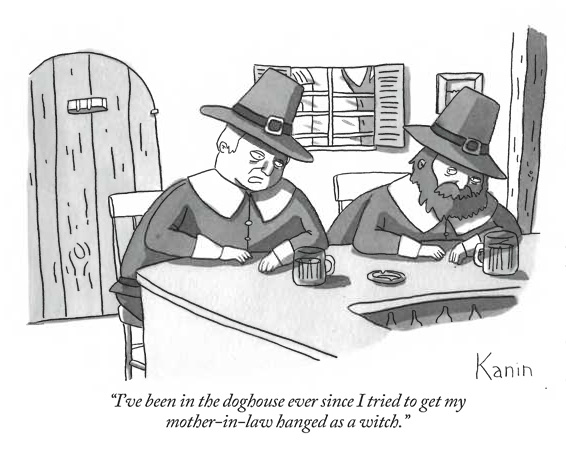
Favorite recent New Yorker cartoon.

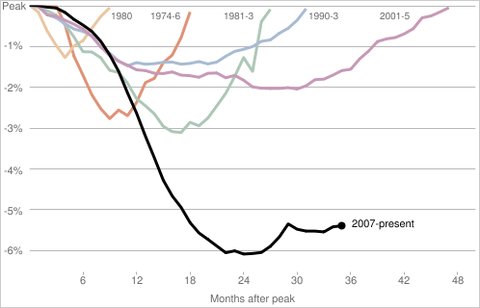
Harry Newton who watched the Bernanke interview on 60 Minutes last night. Bernanke said it will take the U.S. at least 4-5 years to recover from its present heavy unemployment. I agree.
Comaring this recovery with the last five recessions.. Chart courtesy the New York Times:
On CNBC this morning: I love David Einhorn. He made me big money with his recommendation on shorting Lehmann Brothers. David just bought a big position in Spring Nextel (S). He likes Vodafone (VOD). He loves Pfizer (PFE). He still loves Apple. So do I. Gold is his largest exposure. Me too.

Great……. I like this blog because I found very knowledgeable information in it. The graph named Gold is back on its climb, is very interesting. Thanks for giving a lot of information.
Thanks a lot
Great……. I like this blog because I found very knowledgeable information in it. The graph named Gold is back on its climb, is very interesting. Thanks for giving a lot of information
Re Late Payment Warning…AutoPay directly from my bank account for at least the minimum payment solves problems such as forgetting to mail it in, late mail delivery etc. When I want to over-pay I do it online. I never write a check if I can avoid it and have never had a problem in many many years.
I overpaid last time. So they actually owe me money. I haven't been caught with these fees. I instanced them to show the level of greed still in our banking system.