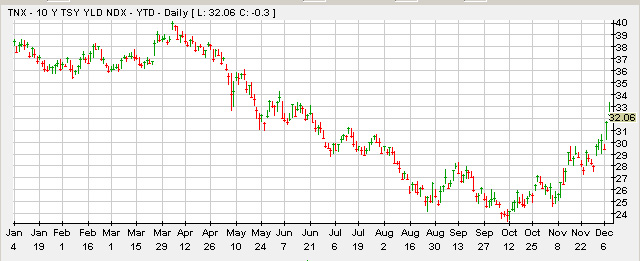
Yields are rising. I guess that means someone believes the economy is coming back. Or the government is simply selling lots of bonds, driving their prices down and their yields up. The exact opposite of what the Fed is seeking. Weird. This won’t last long. Looking at muni bonds — if you need them for income — might make sense.
My favorite money manager, Scott Udine, writes:
“As we approach year-end and everyone starts making their New Years Resolutions, now is the time to make sure your portfolio is working as hard and efficient as it should be. Here is an interesting statistic. At the close of trading in December 1998 the SP500 closed at 1225. As we close out the year 2010, the SP500 is trading at approximately 1225. That is 12 years of absolutely no growth. 12 YEARS!! Goes back to what I always say, you better make sure you are buying the right stocks at the right times and having downside protection in place so you don’t participate in the big down periods. If you are buying index funds or your generic type mutual funds, you are on a roller coaster to nowhere. There are better, less risky and more efficient ways to grow your capital in the equity markets.”
Check out LuluLemon today. their stuff is hot. But when I looked at the stock, I thought it overpriced. I was wrong. Momentum still works. The top momentum stocks include Netflix, Amazon, Open Table, BIDU, MON, CAT, SGOL, PCX, ICO, WLT, and AAPL (especially when we see the new iPad with the camera for facetime and possibly a 3D screen.
The tax deal. It’s good for you and me today, but horrible for Washington’ escalating National debt. But who cares? Our children will deal with that minor problem, while simultaneously paying our nursing home bills.
Terms of the deal, so far:
Extended for two years, through December 31, 2012:
• All 2010 individual income tax rates;
• 2010 capital gains and dividend rates (15%/5%);
• Expanded Earned Income Credit is extended for two years
• Expanded child credit is extended for two years
• “American Opportunity” (education) tax credit
• Alternative Minimum Taxes as in the McConnell bill, such that no additional taxpayers face AMT
+ Estate and gift taxes return, with a $5 million per person exemption and a 35% rate. After 2012 they would revert to pre-Bush levels ($1 M / 45%)
+ Full expensing of business investment for all non-property investment for all businesses made between September 8, 2010 and December 31, 2011. 50% expensing for investment made in 2012.
+ Extended unemployment insurance benefits are available through December 31, 2011.
+ Two percent payroll tax credit for 2011 (employee side, replaces the refundable Making Work Pay credit)
+ The smorgasbord of “extender” provisions will run for two years, which is retroactive for 2010 and prospectively for 2011. Details on this are still TBD and will occupy every tax lobbyist in Washington.
The easiest cloning and/or backup kit. A reader asked about my backup/cloning tools. The easiest way is simply to buy Kingston SSD kit, which consists of a sold state drive and an ultra-easy-to-use CD, which is a bootup drive containing Acronis cloning software, which works flawlessly.

I find the 128 gig $289 drive more than adequate for my daily work. I keep movies on a cheap external drive. My son prefers the more expensive 256 gig $655 drive, but he’s got an indulgent father. Buy the kit at Newegg.
Another great Internet idea I didn’t think of.

So far, 1179 online companies (including Apple, Eddie Bauer, Brookstone, Lands End and Apple) have agreed to drop their shipping charges if you buy on December 17. They will have your goodies to you by Christmas. Neat idea. Click here.
Emails with blank images? Hit “Reply.” Your images will appear. I don’t know how this magic works. But it does work.
Sharks on the Payroll of the Mossad? Recently there have been shark attacks along Egypt’s coastline.

A regional Egyptian governor says Israel is responsible. He says Israel is trying to hurt his tourism and disrupt the Egyptian economy:
Israel says the claim is “too ludicrous” to comment. Conspiracy theorists say that means since Israel doesn’t deny it, it means they did it.
How you train sharks to attack Egyptians and not Israelis is a Mossad secret. If I told you, I’d have to feed you to the sharks.
Harry’s Simple Guide to Buying a Camera — Part 2. This ugly thing is the Fuji W3.

It takes stunning 3D pictures. Notice the two lenses. They are exactly the distance apart that your eyes are on your head. You can view them on its big lenticular 3D screen on the back.

Best Buy will match prices.Walk into Best Buy with an ad or screenshot from someone else and they’ll match the price. Even retroactively.

Harry Newton who likes the new, free CNBC app for his iPad. His other favorite app is Kindle (from Amazon) for iPad, for the PC and the iPhone. Amazon does a really good job of syncing all the books you bought across all the e-reading devices you own. In my case they include the iPad, the iPhone 4 and an Lenovo ThinkPad X201. Each of these “reading” platforms have pluses and minuses. The iPhone 4, for example, works best on the subway and when Susan is sleeping and doesn’t want the disturbance.

Our economic ship of state is foundering as its bulkheads are flooded, one by one, by oceans of debt. (I pause to admire my efficacious imagery.) The first enormous waves began under the parlous economic stewardship of Ronald Reagan. Reagan cut the marginal tax rate on the wealthiest of Americans from 70% to 38%. He promised that it would spur investment and rocket the economy to new levels of production and prosperity. Instead, his “supply side economics” did the exact opposite, producing a deep recession. Output fell 2.2% in 1982 while budget deficits soared. When Reagan took office in 1981, the national debt stood at $995 billion. Twelve years later, by the end of George H.W. Bush s presidency, it had exploded to $4 trillion.
Bill Clinton reversed Reagan's course, raising taxes on the wealthy, and lowering them for the working and middle classes. This produced the longest sustained economic expansion in American history. Importantly, it also produced budgetary surpluses allowing the government to begin paying down the crippling debt begun under Reagan. In 2000, Clinton s last year, the surplus amounted to $236 billion. The forecast ten year surplus stood at $5.6 trillion. It was the last black ink America would see for decades, perhaps forever.
George W. Bush immediately reversed Clinton's policy in order to revive Reagan's, once again showering an embarrassment of riches on the already most embarrassingly rich – his “base” as he called them. He ladled out some $630 billion in tax cuts to the top 1% of income earners. But the cost to the public was a return to the exploding deficits of the Reagan years. Bush blew through Clinton's surplus in his first year, and by the thankful end of his disastrous presidency, the national debt had increased by a mind-numbing $3.4 trillion. (It is important to note that, during most of this period, Republicans controlled not only the White House, but Congress as well.) To paraphrase Stalin, a debt of a million may be a tragedy; debt in the trillions is a statistic. Of course, the “real” numbers are actually worse, since the Iraq and Afghanistan ventures were funded off-budget, by “emergency supplemental appropriations.” Heaven forbid we should pay for wars by raising levies; instead, Dubya advised us all to “go shopping.”
During all of this time, the wealthiest among us have made out, big-time. Over the past decade, they were the only ones who have benefitted financially, as (e.g.) two-thirds of the nation’s total income gains from 2002 to 2007 flowed to the top 1 percent of U.S. households, and that top 1 percent held a larger share of income in 2007 than at any time since 1928. During those years, the inflation-adjusted income of the top 1 percent of households grew more than ten times faster than the income of the bottom 90 percent of households.
The inexorable process of the upward flow of the nation's wealth to a miniscule percent of Americans, at the expense of everyone else, is ongoing.
Notwithstanding the abysmal failure of Reaganomics and its bastard child – the catastrophic economic “policy” of the Dubya years – many still adhere to such nonsensical maxims as “tax cuts will reduce the deficit” and “tax cuts to the wealthy create jobs.” And these same folks have, magically and all-of-a-sudden, discovered fiscal responsibility. No outlays to the struggling 98% of Americans whose annual income is below $250,000 – unless such assistance can be retrieved from some yet-to-be-identified segment of our tattered social safety net. No charts or stats will convince them not to favor tax cuts at any cost, to the wealthiest among us. No calls to reason will convince them that extending payments to the unemployed – the very people who are running on economic fumes and will directly spur the economy by spending on groceries, rent or mortgages – is as sound economically as it is morally. Instead, they will forever favor subsidizing those who will keep it, at the expense of. those who would spend it.
We stand at a brink, while those who have driven us there contemplate the final push.
Our economic ship of state is foundering as its bulkheads are flooded, one by one, by oceans of debt. (I pause to admire my efficacious imagery.) The first enormous waves began under the parlous economic stewardship of Ronald Reagan. Reagan cut the marginal tax rate on the wealthiest of Americans from 70% to 38%. He promised that it would spur investment and rocket the economy to new levels of production and prosperity. Instead, his “supply side economics” did the exact opposite, producing a deep recession. Output fell 2.2% in 1982 while budget deficits soared. When Reagan took office in 1981, the national debt stood at $995 billion. Twelve years later, by the end of George H.W. Bush s presidency, it had exploded to $4 trillion.
Bill Clinton reversed Reagan's course, raising taxes on the wealthy, and lowering them for the working and middle classes. This produced the longest sustained economic expansion in American history. Importantly, it also produced budgetary surpluses allowing the government to begin paying down the crippling debt begun under Reagan. In 2000, Clinton s last year, the surplus amounted to $236 billion. The forecast ten year surplus stood at $5.6 trillion. It was the last black ink America would see for decades, perhaps forever.
George W. Bush immediately reversed Clinton's policy in order to revive Reagan's, once again showering an embarrassment of riches on the already most embarrassingly rich – his “base” as he called them. He ladled out some $630 billion in tax cuts to the top 1% of income earners. But the cost to the public was a return to the exploding deficits of the Reagan years. Bush blew through Clinton's surplus in his first year, and by the thankful end of his disastrous presidency, the national debt had increased by a mind-numbing $3.4 trillion. (It is important to note that, during most of this period, Republicans controlled not only the White House, but Congress as well.) To paraphrase Stalin, a debt of a million may be a tragedy; debt in the trillions is a statistic. Of course, the “real” numbers are actually worse, since the Iraq and Afghanistan ventures were funded off-budget, by “emergency supplemental appropriations.” Heaven forbid we should pay for wars by raising levies; instead, Dubya advised us all to “go shopping.”
During all of this time, the wealthiest among us have made out, big-time. Over the past decade, they were the only ones who have benefitted financially, as (e.g.) two-thirds of the nation’s total income gains from 2002 to 2007 flowed to the top 1 percent of U.S. households, and that top 1 percent held a larger share of income in 2007 than at any time since 1928. During those years, the inflation-adjusted income of the top 1 percent of households grew more than ten times faster than the income of the bottom 90 percent of households.
The inexorable process of the upward flow of the nation's wealth to a miniscule percent of Americans, at the expense of everyone else, is ongoing..
Notwithstanding the abysmal failure of Reaganomics and its bastard child – the catastrophic economic “policy” of the Dubya years – many still adhere to such nonsensical maxims as “tax cuts will reduce the deficit” and “tax cuts to the wealthy create jobs.” And these same folks have, magically and all-of-a-sudden, discovered fiscal responsibility. No outlays to the struggling 98% of Americans whose annual income is below $250,000 – unless such assistance can be retrieved from some yet-to-be-identified segment of our tattered social safety net. No charts or stats will convince them not to favor tax cuts at any cost, to the wealthiest among us. No calls to reason will convince them that extending payments to the unemployed – the very people who are running on economic fumes and will directly spur the economy by spending on groceries, rent or mortgages – is economically and morally sound. Instead, they will forever favor subsidizing those who will keep it, at the expense of. those who would spend it.
We stand at a brink, while those who have driven us there contemplate the final push.
Harry – I MUST, even just for the sake of form, advance the position that it isn't lack of tax revenue that puts us into a fiscal bind. The idiots sailing under any flag in Washington will spend ALL they get and more. It is SPENDING, not lack of taxation, that unbalances the ship of state. Giving them more tax revenue will NOT cause them to act more responsibly.
In extension: I wonder at the commentators who say that the tax deal will cause government to “LOSE” tax revenue. It isn't the government's to lose! The attitude that somehow it is the “government's money” is poisonous.
Flag,
I agree with you all the way.
To relieve my frustrations I have become an active volunteer to get the FairTax bill (HR 25) passed as written. This change in tax code will take power from our politicians, give us back much financial freedom and greatly stimulate our economy with no government spending and new debt. Please learn more at http://www.fairtax.org
great! what spending would you like to cut.