Stocks go up. Stocks go down. Lately, thankfully up. Predicting is not possible. You buy the best you can. But you can’t abandon yourself to Mr. Market’s whims.
Scott Udine, money manager, writes,
“I was speaking yesterday with a client/friend. He asked a good question about stop loss orders. “If I own a stock at $62 and had a stop in at $60, how would I know that if I got stopped out, the stock wouldn’t bounce right back and close higher and then take off to the upside without me?”
The truth is, writes Scott, you don’t know. Says Scott, using stops and hedges is not an exact science but rather an art that hopefully over time is fine-tuned and effective. It all comes back to risk management. If you navigate the markets year in and year out and maintain your disciplines, than from time to time, you will be stopped out of things and they will turn right around and charge higher. It is part of the business and something that comes with the territory. The other scenario would be to never use stops and “hope” that the position comes back, but as you know “hoping and praying” is not a viable investment strategy. I can list hundreds of names that are widely held by the retail investing community that are still “hoping and praying” for things to come back, and have been for 10-20 years now. (Harry comments: They include Microsoft, Cisco, Dell, HP, etc.)
Scott continues, I cannot tell you how many times I will establish a small position in a name with a tight stop loss order just to probe the market or the stock to sort of take the temperature of things. Many times we get stopped out for small losses and that is ok. Remember, if the stock is going to go higher, we can always buy it back.. Which we do quite often and more importantly, as a portfolio manager, my goal is to make gains of $20-$100+ in the names we invest in, so if it takes getting stopped out a few times, and losing a couple bucks each time, to get our timing right and in position for those MAJOR moves, then that is the price we pay for putting the probabilities more in our favor.
Personally I’ve always believed in stop losses. When I ran Technology Investor magazine, we did a big study and found that 15% stop losses overwhelmingly paid off — i.e. you were a lot better off, selling and being in cash than hanging around praying.
Over the years I’ve heard people swear by 3%, 5% 8% and 15% stop losses. Clearly, the smaller the %, the bigger chance you have of the stock roaring back on you.
A lot depends on the market we’re in — boom or bust. Who can tell? Right now, I’d say moderate boom. Stick with 8% if you’re obsessed with safety. Go with 15% if you’re convinced that the stocks you bought are excellent companies doing well.
Heh, nice employment numbers today!
The boom in feeding the world’s billions. Everything farm-related — produce, fertilizer and land — is booming. Two pieces to read:
In Price of Farmland, Echoes of Another Boom
By WILLIAM NEUMAN of the New York Times
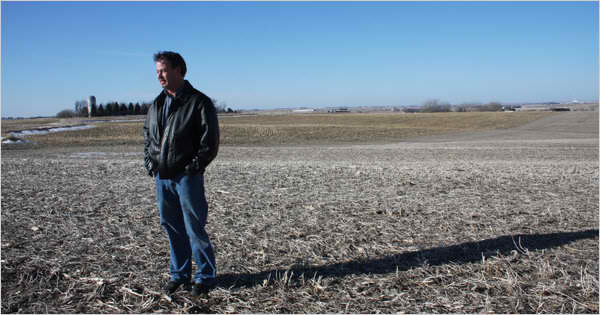
Jeff P. Freking, a farmer, in one of the fields near Le Mars, Iowa, that he purchased for $10,000 a acre at a land auction.
The 80 acres of rich farmland that Jeff Freking and his brother Randy bought near Le Mars, Iowa, on Monday for $10,000 an acre would seem to have nothing in common with a condo in Miami or a house in Las Vegas.
But as prices for agricultural land surge across America’s grain belt, regulators are warning that a new real estate bubble may be forming — echoing the frothy boom in home prices that saw values in Miami and Las Vegas skyrocket and then plummet.
“It just seems to be going up in leaps and bounds here,” said Jeff Freking, who bought a similar farm, also in northwestern Iowa, for $6,000 an acre just two years ago. “Everybody thinks it’s crazy.”
The surge in prices has been dizzying throughout the Midwest, with double-digit percentage increases last year in Illinois, Indiana, Iowa, Kansas, Minnesota and Nebraska. In parts of Iowa, prices for good farmland rose as much as 23 percent last year, according to the Federal Reserve Bank of Chicago.
Just a few years ago, farmers marveled as land prices began to rise in response to demand for corn to make ethanol. More recently, soaring prices for wheat, corn, soybeans and other crops have driven the increase. Corn futures on the Chicago Board of Trade closed at $7.27 a bushel on Tuesday, up from $3.70 a year earlier. Soybean futures were $13.67, up from $9.52 cents on March 1 last year. Average grain prices, adjusted for inflation, are nearing the giddy levels they reached in the late 1970s, the peak of the last disastrous boom-and-bust cycle for agricultural land.
That has regulators worried.
“History has taught us that it is nearly impossible to determine how much of the farmland boom may be an unsustainable bubble driven by financial markets,” said Thomas M. Hoenig, president of the Federal Reserve Bank of Kansas City, in testimony before the Senate Agriculture Committee last month.
Officials at Mr. Hoenig’s bank warn that farmers face a “huge” risk that rising interest rates, perhaps combined with falling crop prices, could undercut land values. Farmland values could drop by a third to a half in such a situation, Mr. Hoeing testified.
Prices have risen so far so fast that “it’s getting scary,” said Mike Green, a real estate auctioneer. He brought the hammer down last Friday on a 118-acre farm in Yetter, Iowa, that sold for $11,000 an acre, which he said was a record for farmland in Calhoun County, in western Iowa. In December, Mr. Green said, he got oohs and ahs when a parcel went for $9,300 an acre. Last fall, similar farms were selling for less than $8,000 an acre.
“It’s very hard to guess what a property will sell for these days because it seems like it’s been changing on a weekly basis,” he said.
Nationwide data from the United States Department of Agriculture shows that inflation-adjusted farm prices passed their 1970s peak several years ago, but that includes land, especially on the coasts, whose price rose when it was sold for development. University and Federal Reserve Bank surveys, which give a more accurate picture of the value of land used for farming, show that current prices are approaching the top of the last boom when adjusted for inflation.
Farmland values have been pushed up by several factors. As crops like corn, wheat and soybeans bring higher prices, the land on which they are grown becomes more valuable. Low interest rates have also contributed; they draw investors seeking an alternative to low-yielding certificates of deposit and the volatile stock market as well as create an incentive for farmers to buy more land rather than invest their profits elsewhere.
“Farmland has been a favored asset class in a world where a lot of other asset classes have fallen out of favor,” said Richard A. Brown, chief economist of the Federal Deposit Insurance Corporation.
The rapid rise in agricultural land prices has raised alarms at the F.D.I.C., which insures bank deposits and monitors the industry’s financial health. The agency sent a letter to lenders in December, warning them to not let high farm land values lull them into lax lending practices. Next week, the F.D.I.C. will hold a forum in Washington to discuss its concerns.
“If it were to be a bubble,” Mr. Brown said, “it would be in its formative stages.”
Today’s farmland market has some crucial differences from the 1970s bubble and the housing boom of the last decade. In the 1970s, another period of low interest and high crop prices, farmers loaded up on debt, using their farms as collateral. In the housing bubble, many buyers were seduced by gimmicky loans, such as subprime mortgages with floating rates, that magnified risk.
Today, farmers have about one-third less debt over all than they did at the peak of the last boom, according to U.S.D.A. data.
But a big worry for regulators is that farmers will start taking out loans on property they already own, based on today’s elevated values, and use it to buy more property or make other purchases. That would be similar to what farmers did 30 years ago and what homeowners did in the housing boom.
Jason R. Henderson, a vice president at the Omaha branch of the Kansas City Fed, said he had heard reports from bankers that such a pattern might be emerging.
Mr. Freking said he and his brother had made their latest purchase using all borrowed money. Their banker lent them half of the purchase price, and the rest of the money came from refinancing and consolidating loans on other property they owned, which are worth more at current land values.
He said there was some sticker shock at the price but the deal made sense because the land adjoined two other properties that the family farmed. He also got an attractive fixed interest rate of about 5 percent, although the loan must be paid off after eight years.
“Everybody’s talking big on commodities, so hopefully this pays out,” Mr. Freking said.
The rising prices have also brought in speculators. A survey by Iowa State University found that investors made a quarter of farm purchases in the state last year, a slight increase from 2009. “It’s been very aggressive as far as bidding action,” said Todd Hattermann, an auctioneer who sold a farm in Paullina, Iowa, about 30 miles from Le Mars, for $9,600 an acre last week. Investors, he said, were “running the values up. A lot of them may not be the final bidder but they’re bidding all the way through.”
There is no agreement on whether a bubble is emerging.
Michael D. Duffy, an agricultural economist at Iowa State University who conducts the annual land value survey, said the market appeared fundamentally sound and that land prices were responding properly to high crop prices. “If you’ve got good ground, it’s worth a lot of money,” he said.
Bruce Brock, the broker who sold the farm to the Freking brothers, exudes an optimism that would sound familiar to anyone who bought a home in 2006. “If you look from the beginning of farming in the United States to now, the long-term trend has been up,” he said. “There will be market fluctuations where it will go down. But in 10 years, I won’t be surprised if our $10,000 land is $20,000.”
Michael Lewis does Ireland. He is America’s pre-eminent financial story teller. He begins his latest piece in Vanity Fair magazine:
When Irish Eyes Are Crying
First Iceland. Then Greece. Now Ireland, which headed for bankruptcy with its own mysterious logic. In 2000, suddenly among the richest people in Europe, the Irish decided to buy their country—from one another. After which their banks and government really screwed them. So where’s the rage?
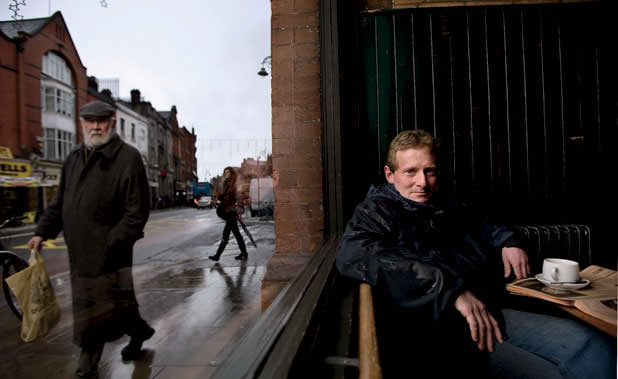
CRASH COURSE
University College Dublin professor Morgan Kelly, in Hogans pub, in Dublin. He predicted the Irish Crash in 2006.
When I flew to Dublin in early November, Michael Lewis writes, the Irish government was busy helping the Irish people come to terms with their loss. It had been two years since a handful of Irish politicians and bankers decided to guarantee all the debts of the country’s biggest banks, but the people were only now getting their minds around what that meant for them. The numbers were breathtaking. A single bank, Anglo Irish, which, two years before, the Irish government had claimed was merely suffering from a “liquidity problem,” faced losses of up to 34 billion euros. To get some sense of how “34 billion euros” sounds to Irish ears, an American thinking in dollars needs to multiply it by roughly one hundred: $3.4 trillion. And that was for a single bank. As the sum total of loans made by Anglo Irish, most of it to Irish property developers, was only 72 billion euros, the bank had lost nearly half of every dollar it invested.
The two other big Irish banks, Bank of Ireland and, especially, Allied Irish Banks (A.I.B.), remained Ireland’s dirty little secrets. Both older than Ireland itself (the Bank of Ireland was founded back in 1783; A.I.B. is made up of three banks founded in the 19th century), both were now also obviously bust. The Irish government owned big chunks of the two ancient banks but revealed less about them. As they had lent vast sums not only to Irish property developers but also to Irish homebuyers, their losses were also obviously vast—and similar in spirit to the losses at the upstart Anglo Irish.
Even in an era when capitalists went out of their way to destroy capitalism, the Irish bankers set some kind of record for destruction. Theo Phanos, a London hedge-fund manager with interests in Ireland, says that “Anglo Irish was probably the world’s worst bank. Even worse than the Icelandic banks.”
You can read the entire wonderful article here.
From the Michael Lewis archive:
• Euro DisasterLand Part I: Iceland (Michael Lewis, April 2009)
• Euro DisasterLand Part II: Greece (Michael Lewis, November 2010)
• An excerpt from The Big Short (Michael Lewis, April 2010)
That’ll teach him to mess. I have no idea if this story is true.
Orville Smith, a store manager for Best Buys in Augusta, Georgia, told police he observed a male customer, later identified as Tyrone Jackson of Augusta, on surveillance cameras putting a laptop computer under his jacket.. When confronted the man became irate, knocked down an employee, drew a knife and ran for the door.
Outside on the sidewalk were four Marines collecting toys for the “Toys for Tots” program. Smith said the Marines stopped the man, but he stabbed one of the Marines, Cpl. Phillip Duggan, in the back, the injury did not appear to be severe.
After Police and an ambulance arrived at the scene Cpl. Duggan was transported for treatment. The subject was also transported to the local hospital with two broken arms, a broken ankle, a broken leg, several missing teeth, possible broken ribs, multiple contusions, assorted lacerations, a broken nose and a broken jaw…injuries he sustained when he slipped and fell off of the curb after stabbing the Marine.

Harry Newton who traveled to California last night for his annual month in the desert — La Quinta, to be specific. Traveling is so exciting, but where did all obesity suddenly come from? Fat passengers, fat flight attendants. The new boom industry is manufacturing seat belt extensions.
Why has American Airlines “de-activated” (their word) their laptop outlets? Why was there no Internet on a New York to Los Angeles plane? It’s an old plane, they told me. What about their old passengers, like me?
It’s not easy writing this column at 3:30 AM. It’s awfully dark.
Have a great weekend. It’s remarkable how our stocks — see list on right — are flying.

LOVED THE COMMENT ABOUT THE MARINES!
Fun story about the Marines, Harry. Snopes says it's mostly true, except the last paragraph which is of course what makes it fun. There is apparently an Australian version too.
Read Snopes' article on it. Note the term “Loss Prevention Team” that is fielded by Best Buy. I like to imagine a cage full of former linebackers who are released to tackle shop lifters 😉
http://www.snopes.com/politics…