Bid your car rental on Priceline. A friend bid $20 a day for a car in Midland, Texas and got it. I paid much more by going directly to National’s Internet site. Other tricks on car rentals include AARP and AAA.
However, I’m very pleased with the KIA Sorento we got from National.
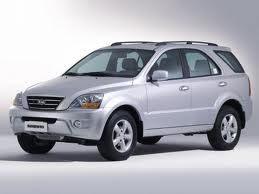
It has amazing acceleration and is surprisingly well-equipped. It came with Sirius Radio, which I had never experienced. Neat to hear BBC and NPR Radio.
Verizon versus AT&T? There’s no comparison. Verizon’s phone service is 1000% better than AT&T’s. It’s better in two respects. Verizon works in places AT&T simply doesn’t. AT&T’s calls fail mid-call. Verizon’s don’t. end of story.
Try AVG antivirus. Reader Charlie McChesney emails:
Harry,
I am writing to tell you to give AVG antivirus a try, I’ve used it for about 10-12 years and never had an infection. It has saved my bacon numerous times by identifying a virus or suspicious something, isolating it and locking it away in the “vault”. I know you recommended one of the commercial anti-virus programs, however, AVG is free for individual to use it and for the money, it can’t be beat… My feeling is “if it is free and works well, why pay?”
Facebook Mobile is a real gamechanger. If you’re on Facebook, please download Facebook for your smartphone — iPhone, Android, etc. The big –in fact HUGE — difference between running Facebook on your laptop and running it on your phone is that Facebook knows where you are on your phone. That means it can alert your nearby friends who might be staying in the same hotel. It will also be able to alert you to local bargains via very targeted ads.
All smartphones these days come with GPS and a compass. The ability of phones to know where you are at any moment will also lead to thousands of new apps. It’s a huge entrepreneurial opportunity.
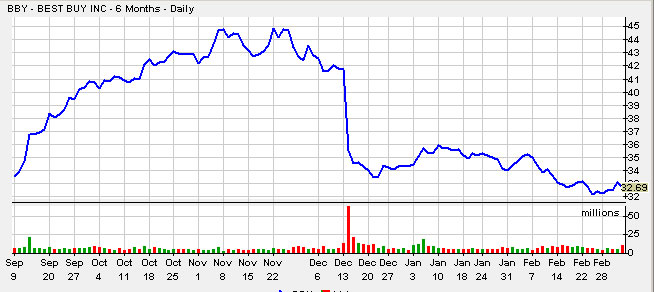
Best Buy’s days are numbered. If you own this stock, sell it. Do not buy it.
Yesterday I shopped at the Best Buy in Palm Desert, California. It was a miserable experience. The salesmen were young, stupid and ill-informed. They knew not what they sold. The prices were high. But worse, was the size of the place. As I wandered around searching for my stuff, I thought “My God, I could run a very successful online international electronics retailer out of a space this large — a store like Abes of Maine, Abt Electronics or Amazon (when it was much smaller).
These days best Buy has become the world’s showroom for online retailers. A place you go to look, but not to buy. The Wall Street Journal did a piece on Best Buy recently in Heard on the Street:
Forecast for Best Buy: Worst Is Yet to Come
Just two years after its arch rival was knocked out of the ring, Best Buy is itself on the ropes.
The company revealed a problem last December that has left investors scrambling for answers. Even with bankrupt Circuit City out of the picture, the retailer was losing market share, especially in the key television and computing categories. Best Buy shares have since tumbled 21% and now trade at a mere nine times this fiscal year’s consensus earnings.
Investors shouldn’t assume Best Buy simply needs time to recover. Rather, the threats it faces are likely only to worsen. Take Amazon.com, whose relentless growth has undercut the raison d’être of specialty retailers. That is true both in books—where Borders Group recently filed for bankruptcy protection—and in electronics.
Indeed, Amazon’s electronics and nonmedia revenue rose 66% to $18 billion last year, helping it lift market share in different segments. Its share of LCD TV sets, for instance, nearly tripled, to 3.7% at the end of 2010 from 1.3% in 2007, estimates research firm Traqline. Its share of portable audio devices rose to 11% from 4.6% in the same period.
A key to that success is that Amazon beats bricks-and-mortar retailers across the board on average electronics prices, a Wells Fargo study showed. Best Buy, on the other hand, traditionally hasn’t tried to compete on price alone but has preferred to highlight its tech-savvy staff and wider selection.
Its selection, at least, probably meant more a few years ago, when manufacturers like Sony sold products to Best Buy but not to nonspecialty retailers. But that has changed. Sony now sells to Costco Wholesale, for instance.
And it has become much easier for consumers to compare prices—ironically, using applications on the smartphones they can purchase in Best Buy. Shoppers can visit Best Buy stores to examine items before buying them elsewhere. Or, as Greg Melich of research firm ISI Group says, they are using Best Buy as Amazon’s “showroom.”
Best Buy’s market share is still so big—it accounts for nearly a third of U.S. consumer-electronics sales—it is reasonable to assume many Best Buy shoppers make decisions primarily based on price.
That helps explain why Best Buy is exploring a switch to consistently competitive prices rather than strategically timed sales.
But history suggests changes in pricing strategies can be problematic. David Schick of Stifel Nicolaus points out that BJ’s Wholesale Club decided to lower prices on some items in 2002 to defend market share. The result: Sales at stores open more than a year quickly improved. But gross margins fell for eight straight quarters. BJ’s shares also fell more than 70% from April 2002 to April 2003, when rival Costco’s fell just 20%. While BJ’s stock has recovered somewhat since then, it hasn’t caught up with Costco’s.
And reducing prices might mean Best Buy has to cut costs, such as for its sales staff. That leaves the question of what a specialty retailer still has to offer.
Best Buy’s edge has been apparent when shoppers wanted new technologies like LED TVs, which it sold with more success than rivals. But high hopes for 3-D television have faded, and there is nothing promising on the immediate horizon. Moreover, the major source of must-have electronics is Apple, whose own retail-store chain is increasingly a rival even as Best Buy stocks Apple products. Sales at Apple’s U.S. stores rose 83% to $2.8 billion in the fourth quarter of 2010, estimates Mr. Melich, making it the third-biggest electronics retailer in the U.S.
Unless a new technology takes hold, the worst of times are likely to come for Best Buy investors.
How Bahrain’s ruling elite steals from its people. And how Google Earth is fomenting a revolution.
The Kingdom of Bahrain is a small island country with 1,23 million inhabitants (2010), located near the western shores of the Persian Gulf and ruled by the Al Khalifa royal family. Bahrain is an archipelago of thirty-three islands. These Are The Controversial Satellite Photos That Set Off Protests In Bahrain A few years ago, Bahrain’s oppressed and overcrowded Shiite majority began using Google Earth to view palaces and other estates that make up 95% of the country. As these images churned up discontent, the government blocked Google Earth. However, an anonymous PDF guide was distributed by email. Here are 46 slides with many images. Here’s one:
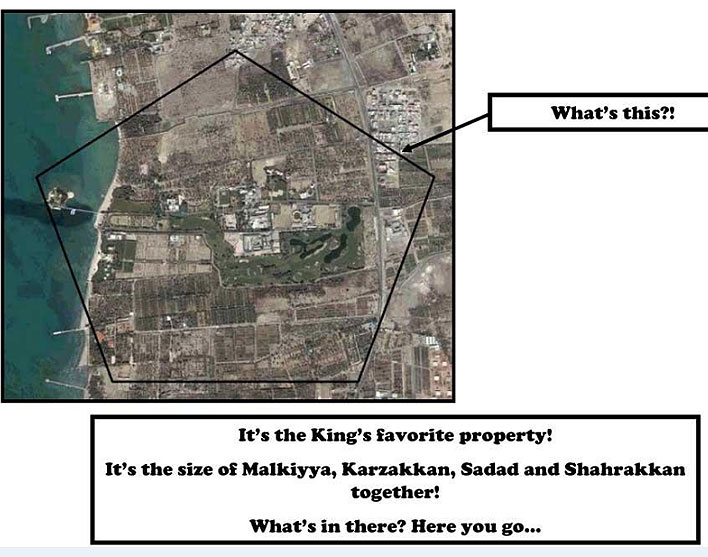
A golf course, a race track, an incredibly large yacht and opulence that beats Versailles. For these incredible images, click here.
A little bit about Bahrain, from Wikipedia:
+ Oil was discovered in 1932 and brought rapid modernization to Bahrain. This discovery made relations with the United Kingdom closer, as evidenced by the British establishing more bases there. British influence would continue to grow as the country developed, culminating with the appointment of Charles Belgrave as an advisor; Belgrave established modern education systems in Bahrain.[41] After World War II, increasing anti-British sentiment spread throughout the Arab World and led to riots in Bahrain. The riots focused on the Jewish community, which counted among its members distinguished writers and singers, accountants, engineers and middle managers working for the Oil Company, textile merchants with business all over the peninsula, and free professionals.
+ In 1948, following rising hostilities and looting, most members of Bahrain’s Jewish community abandoned their properties and evacuated to Bombay, later settling in Israel (Pardes Hanna-Karkur) and the United Kingdom. As of 2008, 37 Jews remained in the country. The issue of compensation was never settled.
+ Bahrain is a constitutional monarchy headed by the King, Shaikh Hamad bin Isa Al Khalifa; the head of government is the Prime Minister, Shaikh Khalīfa bin Salman al Khalifa, who presides over a cabinet of twenty-five members, where 80% of its members are from the royal family.
+ The kingdom has a small but well equipped military called the Bahrain Defence Force (BDF). The BDF is primarily equipped with United States equipment, such as the F16 Fighting Falcon, F5 Freedom Fighter, UH60 Blackhawk, M60A3 tanks, and the ex-USS Jack Williams, an Oliver Hazard Perry class frigate renamed the RBNS Sabha. The Government of Bahrain has a cooperative agreement with the United States Military and has provided the United States a base in Juffair since the early 1990s. This is the home of the headquarters for Commander, United States Naval Forces Central Command (COMUSNAVCENT) / United States Fifth Fleet (COMFIFTHFLT), and about 1500 United States and coalition military personnel.
The Jewish bra.
A young Jewish gentleman walks into the Lingerie Department of Macy’s in New York. “I would like a Jewish bra for my wife size 34B.”
With a quizzical look the saleslady asks, “What kind of bra?”
He repeated, “A Jewish bra. She said to tell you that she wanted a Jewish bra, and that you would know what she wanted.”
“Ah, now I remember,” said the saleslady. “We don’t get as many requests for them as we used to. Most of our customers lately want the Catholic bra, or the Salvation Army bra, or the Presbyterian bra.”
Confused, and a little flustered, the man asked “So, what are the differences?”
The saleslady responded. “It is all really quite simple. The Catholic bra supports the masses. The Salvation Army lifts up the fallen, and the Presbyterian bra keeps them staunch and upright.”
He mused on that information for a minute and said: “Hmm. I know I’ll regret asking, but what does the Jewish bra do?”
“Ah, the Jewish bra,” she replied “It makes mountains out of molehills”.

Harry Newton who wonders what madness drives him to get up at 4:00 AM in order to write this column from California. Playing tennis outside is a particular joy. however.

My family has 4 personal computers running. I have tried several Anti-Virus programs. My favorite (which is free) is Avast Anti-Virus. http://www.avast.com/index
… you don't even need anti-virus stuff.
1. We should do our web surfing on a completely different computer than a computer used for any trading/banking/etc.
2. If you can't, you should use your computer in limited user (XP lingo) or standard user (Vista/Win7) lingo mode. There are things you can't do in limited user, like burn discs, software upgrades, … but it's much safer than running in admin privileges. The admin mode, or “super user” is the reason why unix/macs are inherently safer than Windoze machines.
3. If you can't use a limited user machine since some legacy software requires it, then you should check out something called “dropmyrights” which is some software from MS that lets you run specific applications with fewer privileges even if your account is administrative. Software that you should run in limited user is anything that connects to the net. Browsers, media players, email (outlook), pdf readers… just off the top of my head.
4. The above is important if you run SSDs. I've worn through 3 of them already, and I'm back on hard disks.
5. The above should keep you safe, but there's always the possibility of getting a virus on a thumb drive or some other removable media. For that, yeah, scanning the source with a program is useful for me, so I have anti-virus programs on my machines, but I don't have them running in real time. I like malwarebytes.
Good luck.
To Reader Charlie McChesney: AVG Antivirus at http://www.avg.com says it is “free” for a 30 day trial then you have to pay an annual subscription like the other companies; am I missing something here?
http://free.avg.com/us-en/down…
Last column on right.
Thanks