This is brilliant:
Let me tell you why.
My father, escaping the Nazis and the Russians, came to Australia in 1939.
By the mid-fifties, he sliced enough onions in his hamburger shop to start an investment bank. He funded businesses that didn’t exist in Australia, like lolly (hard candy) factories to gelato bars to nylon factories to tire distribution (think Mavis).
He financed Jewish Europeans who, like him, had run to Australia in 1939. His business was so successful he was able to pay his depositors 24% annual interest.
It was a wonderful business — talented men with European experience — and no hope with the xenophobic Australian banks who wouldn’t lend to people who spoke only faltering English with a strange accent. Think Henry Kissinger.
Shift to America, 2023.
We are overbuilt with office buildings, apartments in the sunbelt and retailing space that can sell you more clothes and shoes than you can ever give away.
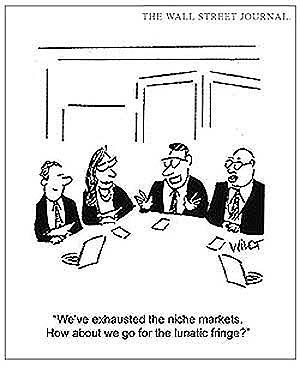
In 2023, there’s oodles of money looking desperately for a place to make 24% a year.
Hence “lunatic” markets (see cartoon above).
The classic lunatic market company is Intel. I figure they have spent billions getting into everything from video conferencing, to computer telephony, from self-driving car gadgetry to cellphone chips. Lunatic markets (for them). Maybe one or two make a shekel, but he vast bulk lost them billions.
I have some idle shekels. I look away from lunatic markets. I search for new opportunities which are:
+ Scaleable — like those that use the cloud.
+ Have major technological breakthrough advantages, like AI.
+ Have immensely talented, honest, hard-working entrepreneurs. Like Jensen Huang who founded NVIDIA in 1993 and has served since as president and CEO.
I’m desperately searching for companies who are using AI in ways that will make their companies hugely more profitable.
Take Amazon: They use AI in the robots that pick all the stuff that you and I buy. They also use AI to make their website increasingly better. Which is why you and i like shopping there and don’t go to our local, poorly-stocked mall. Amazon also has AWS — Amazon Web Services — which sells AI cloud-enhanced, scalable services. AWS is their most profitable business.
Take Google. AI is improving Chrome daily. Check it out. It’s sort of like ChatGPT.
Take Apple. You can easily see what AI (and brilliant) programming to doing to how increasingly useful our iPhones are.
Take Microsoft. AI is improving all their products. Microsoft wants every corporation in the world to be 100% reliant on them for all their computing and collaboration needs.
I own shares in all these. But the impact AI will have on them is not the extraordinary impact AI has had (and is having on NVIDIA).
I want a pure-play AI with visionary, talented, entrepreneurial management.
That’s my dream.
Anyone got any ideas?
The War

A CNN journalist heard about a very old Jewish man who had been going to the Wailing Wall to pray, twice a day, every day, for a long, long time.
So she went to check him out. She went to the Wailing Wall and there he was walking slowly up to the holy site.
She watched him pray. After 45 minutes, when he turned to leave, she approached him for an interview.
“Pardon me Sir, I’m Rebecca Smith from CNN, What’s your name?
“Maury Fishbein” he replied.
“Sir, how long have you been coming to the Wailing Wall and praying?”
“For about 60 years.”
“60 years! That’s amazing! What do you pray for?”
“I pray for peace between the Christians, Jews and the Muslims. I pray for all the wars and hatred to stop, I pray for all our children to grow up safely as responsible adults, and to love their fellow man.”
“How do you feel after coming here and praying for 60 years?”
“Like I’m talking to a wall.”
In Lisbon, Portugal
Lisbon airport ranks among the ten worst. We waited two hours while the understaffed immigration officers slowly processed the thronging incoming travelers.
Fifty feet away were dozens of unused machines for travelers with electronic passports. They speed you through in seconds, not hours.
So where do I get an electronic passport?
Turns out I already had one and didn’t know it.
Idiot me.
Google says “The simplest way to tell if your passport is biometric is by looking at the cover. If there’s a small, gold camera logo at the bottom, then it’s biometric. Otherwise, the technology held within a biometric passport has become so advanced and the components so small that you can’t feel any lumps or ridges at all” on the back cover where your chip is.
So, check your passport for this gold symbol on the front cover.
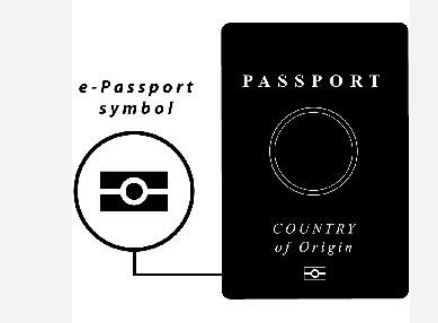
I bet you have an electronic passport. The U.S. government has been issuing e-passports for eons. But not telling anyone.
And you and I didn’t know it.
Now, for the first time ever, you may have learned something from my blog.
Something that may save you hours.
Tomorrow, we’re going on a walking tour of Lisbon. The weather is sunny and cool.
We lucked out.
Anyone got any good stories on how they or their company is using AI?
Send me an email, please, or post in comments below. Thanks. — Harry Newton
