Predicting crashes can be big business.
You can write a book and get on TV.
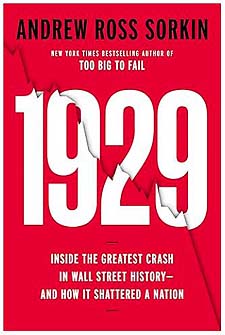
Andrew Ross Sorkin hit the big time. He made Sixty Minutes on Sunday with his 1929 book.
You can keep predicting doom and gloom like Jamie Dimon of JPMorgan Chase. People will be attracted to your bank, because it seems like you’re doing a really good job preparing for the worst. And you’re the safest place to be — which may actually be true.
There are lots of reasons crashes happen. In 1929 everyone and his uncle and their barber bought stocks on margin. When the stock fell more than your margin, the bank sold your shares and you lost all your money. This has happened in recent years to office buildings bought on margin, when the building suddenly got empty – working at home post-pandemic has become preferred for many erstwhile office occupiers. The biggest office building in Portland has lost 80% of its value.
Fraud will do it too. In the 2000s, people who were broke were encouraged to borrow to buy nice houses. Those loans got bundled into bundles of houses “owned” by deadbeats. Those bundles were sold to stupid banks who forgot to check what they were buying. Someone can always be found to value something at a ridiculous price. Pay your appraiser enough and your disgusting trailer magically becomes a MacMansion.
Sometimes the asset everyone is buying (and thus bidding the price up) just simply gets so pricey even Blind Freddie (the proverbial village idiot) can see that a tulip bulb is not worth $1 million which is what it reached (in today’s dollar equivalent) in the Tulip Mania of the 1600s. More than the price of a luxurious Amsterdam house.
The New Yorker has jumped on the bandwagon with today’s piece, “The A.I. Boom and the Spectre of 1929.“
The article quotes my favorite dead economist John Kenneth Galbraith, who wrote in his book on the 1929 Crash, “If there must be madness something may be said for having it on a heroic scale.”
The New Yorker writes, “In any case, though, it’s true that speculative booms tend to take on a life of their own, creating incentives and opportunities that warp people’s judgment at all levels of the economy, from small investors and professional intermediaries to major corporate and financial institutions.”
The New Yorker ends its article thus:
The sudden demise of a single highly leveraged company that operated in a sector far from the A.I. frontier may be a one-off event, with no broader implications. Or it could conceivably be a harbinger of what lies ahead. We won’t know for a while—perhaps a good while. But in the words of the nineteenth-century English journalist Walter Bagehot, whom Galbraith quoted, “every great crisis reveals the excessive speculations of many houses which no one before suspected.” This time is unlikely to be different.
Bah, humbug.
What should we all do? Harry’s Rules:
+ Don’t borrow money to buy today’s speculative assets, like stocks of AI companies, i.e. The Magnficent Seven.
+ Make sure you have cash. Greenbacks, money market funds and treasuries. You won’t be popular with the family if your bank chucks you on the street because you couldn’t pay the mortgage. God knows what Donald’s private army will then do to you.
+ If you’re worried – some of us are worried more than others – sell a little of your much appreciated stocks – perhaps what you paid for them. At this point you’re “playing with the bank’s money.”
+ Pick a point when your psyche can’t take it any longer and sell. A 15% to 20% drop is a good psyche/major angst position.
But recognize:
…there are good and bad companies. Good companies have a future, and often a low stock price. Apple sold for less than a $1 in 1980. Amazon sold for less than a dollar in 1998. But there were plenty of bad companies that got financed in the dot com boom – Pets.com, Webvan, eToys, Global Crossing, etc. And they all went broke.
I have a huge portfolio – 94 stocks, up 3.22% today. Much better than a slap in the belly with a cold fish — bad Australian expression.
I don’t profess any longer to know all 94 intimately – so I tend to dump ones that are doing stupid stuff. But I also recognize there are amazing days when some shoot though the roof – for reasons I can’t predict. I hope the shooters outweigh the stupiders. And so far that has worked,
I favor some that I get to know and watch – like Nvidia, Broadcom, Amazon, Apple. I’m not a big fan of AMD but I owned enough to benefit by the surprise deal with OpenAI. There have been others.
Am I a genius?
I sold the business in 1997. If I had taken all the money and put it in an S&P index fund, I’d be several times richer than I am today. If I had put all the money into Berkshire Hathaway I’d be even richer.
But who knew?
I’m not complaining.
I have my health. My family has its health. And the grandkids are on a path to be much, much smarter than me.
Browsing my bookshelves this evening, I became totally fascinated with my collection of Crash books. I bet all the authors got rich on their not-shabby royalties.
Prediction is so easy. Bob Metcalfe was actually one of the Internet’s founders…Metcalfe is famous for inventing Ethernet a networking technology that allows computers to communicate with each other and is the foundation of today’s Internet. Everything today communicates via Ethernet. The Internet hasn’t collapsed. Sorry Bob. Nice book.
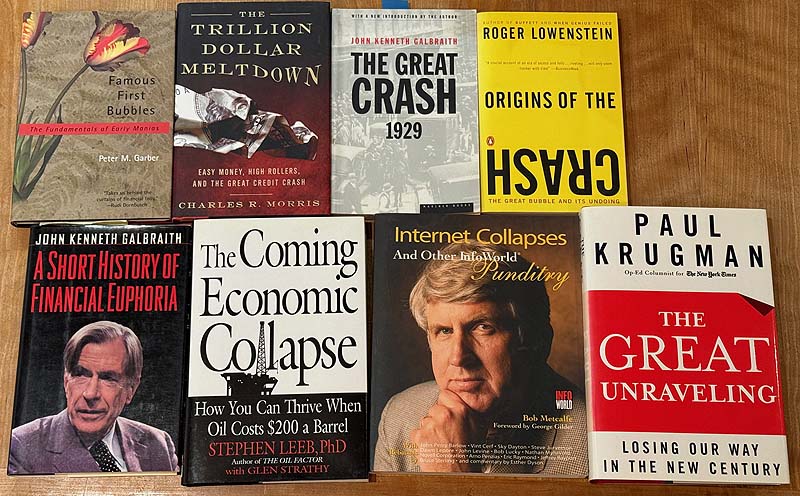
Favorite inspirations
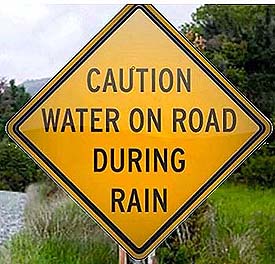

In the late 1990s, Steve Sparrow, a reader of my blog, was in a restaurant in Saudi Arabia.
One of our party, reported Steve, stopped the waiter and asked “What’s the turkey like?”
The young Indian man paused, thought a moment, held his hands a couple of feet apart and said in heavily accented Indian-English “like a beeeg chicken,”
My God, two blogs in one day…
See you soon. — Harry Newton
