Liquidity is key. Can you sell when you want to? Leverage is second. Excessive leverage kills. Excessive leverage chokes you. It forces you into panic selling, when a little patience would work a lot better. Earlier this month, The Economist did a 16-page special report on property, called Bricks and Slaughter. Here’s the beginning of it:
Property is widely seen as a safe asset. It is arguably the most dangerous of all, says Andrew Palmer
THERE are plenty of candidates, from the ghost estates of Ireland to the foreclosure signs on American homes. But as a symbol of the property cycle that still distorts the world economy, the Burj Khalifa in Dubai (pictured above) takes some beating. The world’s tallest building is literally built on sand. Its height, at half a mile (838 metres), violates a basic rule of commercial property: when land is plentiful, build outward to use up as much of it as possible. The building opened in January 2010, just weeks after the emirate announced a standstill on debts largely incurred on glitzy property projects. Its name was hastily changed from Burj Dubai to Burj Khalifa to honour the ruler of Abu Dhabi for sending bail-out funds to its fellow emirate. A year on, tourists cluster at its base to take photos or to visit the observation deck; inside, many of the flats lie empty.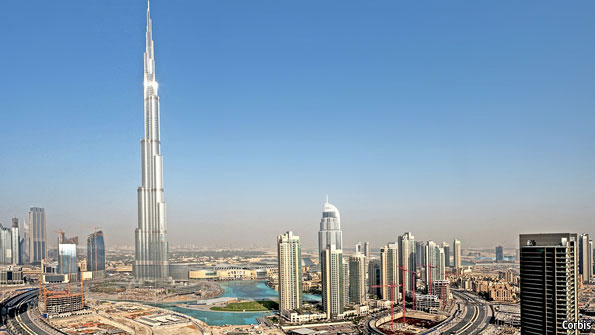
Dubai’s record-breaker is also a powerful emblem of forgetfulness. According to Andrew Lawrence of Barclays Capital, the construction of exceptionally tall buildings is a reliable indicator of economic crises in the making. From the time the first skyscraper went up—the Equitable Life Building in New York, in 1870—to the completion of the Empire State Building (1931) and the World Trade Centre (1972) in the same city and the Petronas Towers in Kuala Lumpur (1998), great height has usually coincided with big trouble.
Mr Lawrence’s theory is not perfect, but it feels right. Property moves in cycles, and the more ambitious the scale of construction on the way up, the steeper the drop on the way down. A sharp turn in the property cycle is a serious matter. The five big banking blow-ups in the rich world before the latest crisis (Spain in the 1970s, Norway in the 1980s and Sweden, Finland and Japan in the 1990s) had property at their heart. Banking crises in the developing world have also tended to happen at the peak of housing booms or just after a bust in prices.
Not all booms are alike. There were many reasons for the housing bubble that has now burst, from huge amounts of global liquidity seeking high returns to the rise of private-label securitisation. But it is striking how often property causes financial trouble. “We do not want to fight the last war,” says one European banking regulator, referring to property busts, “but the fact is that we keep fighting the same war over and over.”
Markets remain horribly fragile. Dud commercial-property assets clog banks’ balance-sheets. House prices in America and several European markets are still falling. This special report will argue that the effects of property booms and busts can be made less damaging, but that the asset itself is inherently unsafe. Another rich-world bubble may be unlikely in the near term, but things feel very different in emerging markets. In China in particular, the worry is about another bubble that could shake the world economy. And even in developed markets, property, which many people regard as stable, will always be prone to volatility.
Why is property so dangerous? One obvious answer is the sheer size of the asset class. The aggregate value of property held by American households in the peak year of 2006 was $22.7 trillion, their biggest single asset by a wide margin (pension-fund reserves were next, at $12.8 trillion). Working out the figures in other countries involves much more guesswork. Back in 2002 this newspaper reckoned that residential property in the rich world as a whole was worth about $48 trillion and the commercial sort $15 trillion: if you allow for property-price changes in the intervening period, the current values, even after the bust, would be $52 trillion and $28 trillion (see chart 1), or 126% and 67% respectively of the rich countries’ combined GDP in 2010. Whatever the precise number, property is so big that when credit conditions loosen it is likely to absorb a lot of the extra liquidity; and when something goes wrong the effects will be serious.
An even bigger reason to beware of property is the amount of debt it involves. Most people do not borrow to buy shares and bonds, and if they do, the degree of leverage usually hovers around half the value of the investment. Moreover, when stock prices fall, borrowers can usually get their loan-to-value ratios back into balance by selling some of the shares. By contrast, in many pre-crisis housing markets buyers routinely took on loans worth 90% or more of the value of the property. Most had no way of bringing down their debt short of selling the whole house. Gearing in commercial property was lower but in the boom years it still regularly touched 80-85% (it is now back to 60-65% for new borrowing in the rich world).
With only a small sliver of their own capital to protect them, many owners were quickly pushed into negative equity when property prices fell. As borrowers defaulted, the banks’ losses started to erode their own thin layers of capital. “Banks are leveraged and property is leveraged, so there is double leverage,” says Brian Robertson, who runs HSBC’s British and European operations and used to be the bank’s chief risk officer. “That is why a property crash is a problem for the banks.”
Property bubbles almost always start because fundamentals such as population growth, interest rates and economic expansion are benign. A shrinking population weighs on Germany’s housing market, for example, and a rising one underpins long-term confidence in America’s. These fundamentals explain why many market participants are able to persuade themselves that huge price rises are justified and sustainable. Chastened regulators now talk about a presumption of guilt, not innocence, when prices look frothy. That is because property markets are inefficient in several ways which make it more likely that they will overshoot.
Cycle paths
For the lenders, property is attractive in part because it attracts lower capital charges than most other assets. That makes sense—the loan is secured by a tangible asset that will retain some value if the borrower defaults—but it can also lead to overlending. Indeed, one of the bigger ironies of the property bubble was that lenders and investors probably thought they were being relatively prudent. Capital charges are higher for commercial property than for homes but banks can still be seduced by the apparent stability of a real asset producing predictable cash flows. “Commercial real estate is often a borrower of last resort,” says Bart Gysens, an analyst at Morgan Stanley. “It tends to be willing to absorb a bit more debt if and when banks and debt markets want to provide it.”
Collateralised lending offers a degree of protection to the individual lender, but it has some unfortunate systemic effects. One is the feedback loop between asset prices and the availability of credit. In a boom, rising property prices increase the value of the collateral held by banks, which makes them more willing to extend credit. Easier credit means that property can sell for more, driving up house prices further. The loop operates in reverse, too. As prices fall, lenders tighten their standards, forcing struggling borrowers to sell and speeding up the decline in prices. Since property accounts for so much of the financial system’s aggregate balance-sheet, losses from real-estate busts are likely to be synchronised across banks.
Borrowers, too, contribute to the inefficiency of property markets, particularly on the residential side. Some people think that renting will enjoy a renaissance as a result of the crisis (see article), but few expect a wholesale, permanent shift in attitudes. Unlike other assets, housing is seen both as an investment and something to consume. In its latest survey of consumer attitudes in July 2010, Fannie Mae, one of America’s two housing-finance giants, found that Americans wanted to buy houses for a range of reasons, from providing a safe environment for their children and having more control over their living space to making a financial return. In China there is another item to put on the list: for many young men owning a property is a prerequisite for attracting a wife.
This mixture of motives can be toxic for financial stability. If housing were like any other consumer good, rising prices should eventually dampen demand. But since it is also seen as a financial asset, higher values are a signal to buy.
And if housing were simply a financial investment, buyers might be clearer-eyed in their decision-making. People generally do not fall in love with government bonds, and Treasuries have no other use to compensate for a fall in value. Housing is different. Greg Davies, a behavioural-finance expert at Barclays Wealth, says the experience of buying a home is a largely emotional one, similar to that of buying art. That makes it likelier that people will pay over the odds. Commercial property is a more rational affair, although hubris can play a part: there is nothing like a picture of a trophy property to adorn a fund manager’s annual report.
Once house prices start to rise, the momentum can build up quickly. No single individual (except, perhaps, Warren Buffett) can push up a company’s share price by buying its stock at an inflated price, but the price of residential property is set locally by the latest transactions. The value of any particular home, and the amount that can be borrowed against it, is largely determined by whatever a similar house nearby sells for. One absurd bid can push up prices for lots of people.
As prices rise, property is arguably more likely than many other asset classes to encourage speculation. One reason is that property is so much part of everyday life. People do not gossip about the value of copper and tin, but they like to talk about how much the neighbour’s house went for. They watch endless TV shows about houses and fancy themselves as interior designers, able to raise the price of their home with a new sofa and artful lighting. Eventually the temptation to take a punt on property becomes overwhelming. “Speculation is a bit like sex,” says Robert Shiller of Yale University, a long-standing observer of speculative bubbles. “People who have lots of sex are not approved of but they are thought to live life with gusto. People eventually decided to try for themselves.”
Even the risk-averse may well respond to rising prices by entering the market. Everyone needs somewhere to live, and many want to own their own homes. The amount of space that people need increases predictably over time as they find partners and have children. James Banks, Richard Blundell and Zoë Oldfield of Britain’s Institute for Fiscal Studies and James Smith of RAND, an American think-tank, find that this gives people an incentive to buy early in order to protect themselves against the risk of future price increases that would make houses unaffordable.
Another reason for momentum in property markets is the fact that there are no short-sellers. If you think property is overpriced, it is difficult to profit from that view. As Adam Levitin of Georgetown University Law Centre and Susan Wachter of the University of Pennsylvania pointed out in a recent paper on the causes of the housing bubble in America, it is impossible to borrow the Empire State Building in order to sell New York real estate short. HSBC probably came closest by selling its Canary Wharf tower in London for £1.1 billion ($2.18 billion) in 2007 and buying it back from its debt-laden Spanish owners for £250m less in late 2008—the greatest short sale in the history of property, says one observer. Some investors infamously did make money from betting against American subprime mortgages, but their real achievement was to find a way of doing so, by buying up credit-default swaps that paid out when mortgage-backed securities soured.
There have been attempts to create instruments that allow property to be hedged or shorted. Mr Shiller himself has been involved in launching derivatives linked to home-price indices for both large and small investors, but with limited success to date. Commercial-property derivatives, however, are gaining ground.
Such products are conceptually appealing but face several obstacles. Some are common to all financial innovations: new products lack enough liquidity to lure buyers in, for example. Others are more specific to property. Individual properties and neighbourhoods differ, which makes it hard to construct accurate hedges. Government interventions to shore up the housing market add an extra element of unpredictability. And since house-price cycles tend to last for a long time, says Mike Poulos of Oliver Wyman, a consultancy, it can be expensive to sustain a short position.
Up, up and away with the fairies
The effects of buying a home when prices are rising are insidious. A 2008 paper by Hugo Benitez-Silva, Selcuk Eren, Frank Heiland and Sergi Jiménez-Martín used the Health and Retirement Study, a biennial survey of Americans over the age of 50, to compare people’s estimates of the value of their homes with actual values when a sale took place. The authors found that homeowners overestimate the value of their homes by an average of 5-10%. Those who had bought during good times tended to be more optimistic in their valuations, whereas those who had bought during a downturn were more realistic. Expectations of higher prices explain why bubble-era buyers were more willing to buy risky mortgage products and take on ever greater quantities of debt. The amount of mortgage debt in America almost doubled between 2001 and 2007, to $10.5 trillion.
The rich-world buyers of today ought to be more realistic about the future value of their homes, but attitudes are deeply entrenched. When asked to rate the safety of various investments, two-thirds of the respondents in the Fannie Mae survey classed homeownership as a safe investment, compared with just 15% for buying shares. Only savings accounts and money-market funds, both of which enjoyed an explicit government guarantee during the financial crisis, scored higher than homes. Homeowners who were “under water” on their mortgages (ie, they owed more than their properties were worth) were just as sure as everyone else that housing was a safe investment.
If the Burj Khalifa shows that memories of property cycles are short, the Fannie Mae survey suggests that some of the lessons are never taken on board at all. Given the state of residential property around the rich world, perhaps the victims are suffering from post-traumatic amnesia.
Please the entire report by the Economist.
Verizon will clearly benefit by AT&T nuttiness. Verizon has the fastest 4G network — by far. Verizon has the fastest Internet broadband service by far — it’s called FiOS. Verizon has the most reliable cell phone service — by far . Now it has the iPhone and the new ultra-speedy Thunderbolt running on 4G. Its stock is yielding a handsome 5.24%. And the stock is rising nicely.
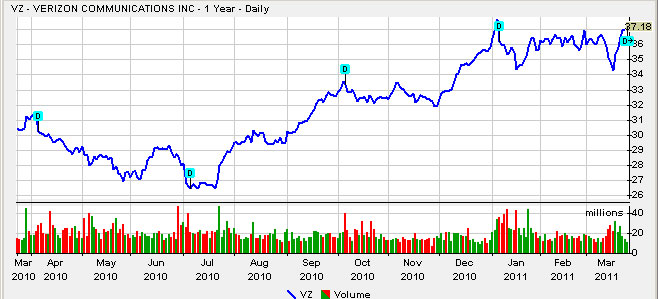
The little blue dots show when it paid its dividend. The first two were 47.5 cents. The last three are 48.75 cents. What is there not to like about Verizon?
Articles on Libya worth reading:
+ Tribes With Flags by Thomas Friedman
David Kirkpatrick, the Cairo bureau chief for The Times, wrote an article from Libya on Monday that posed the key question, not only about Libya but about all the new revolutions brewing in the Arab world: “The question has hovered over the Libyan uprising from the moment the first tank commander defected to join his cousins protesting in the streets of Benghazi: Is the battle for Libya the clash of a brutal dictator against a democratic opposition, or is it fundamentally a tribal civil war?”
This is the question because there are two kinds of states in the Middle East: “real countries” with long histories in their territory and strong national identities (Egypt, Tunisia, Morocco, Iran); and those that might be called “tribes with flags,” or more artificial states with boundaries drawn in sharp straight lines by pens of colonial powers that have trapped inside their borders myriad tribes and sects who not only never volunteered to live together but have never fully melded into a unified family of citizens. They are Libya, Iraq, Jordan, Saudi Arabia, Syria, Bahrain, Yemen, Kuwait, Qatar and the United Arab Emirates. The tribes and sects that make up these more artificial states have long been held together by the iron fist of colonial powers, kings or military dictators. They have no real “citizens” in the modern sense. Democratic rotations in power are impossible because each tribe lives by the motto “rule or die” — either my tribe or sect is in power or we’re dead. …
Read the entire piece in the New York Times.
+ Shady Dealings Helped Qaddafi Build Fortune and Regime by Eric Lichtblau, David Rohde, and James Risen.
Colonel Qaddafi’s family and his government have accumulated billions of dollars with the help of international corporations.
WASHINGTON — In 2009, top aides to Col. Muammar el-Qaddafi called together 15 executives from global energy companies operating in Libya’s oil fields and issued an extraordinary demand: Shell out the money for his country’s $1.5 billion bill for its role in the downing of Pan Am Flight 103 and other terrorist attacks.
If the companies did not comply, the Libyan officials warned, there would be “serious consequences” for their oil leases, according to a State Department summary of the meeting.
Many of those businesses balked, saying that covering Libya’s legal settlement with victims’ families for acts of terrorism was unthinkable. But some companies, including several based in the United States, appeared willing to give in to Libya’s coercion and make what amounted to payoffs to keep doing business, according to industry executives, American officials and State Department documents.
The episode and others like it, the officials said, reflect a Libyan culture rife with corruption, kickbacks, strong-arm tactics and political patronage since the United States reopened trade with Colonel Qaddafi’s government in 2004. As American and international oil companies, telecommunications firms and contractors moved into the Libyan market, they discovered that Colonel Qaddafi or his loyalists often sought to extract millions of dollars in “signing bonuses” and “consultancy contracts” — or insisted that the strongman’s sons get a piece of the action through shotgun partnerships.
Read the entire piece in the New York Times.
Send faxes and receive faxes to and from your PC. Fax1.com and eFax.com
How to irritate your wife.
“Please go to the store for me and buy a carton of milk. If they have eggs, get six.”
The husband returns with six cartons of milk.
The wife asks, “Why the heck did you buy six cartons of milk?”
“They had eggs.”

Harry Newton who despairs at the idiocy rampant in government. Try this story for the height of stupidity. From today’s Wall Street Journal:
The Federal Aviation Administration chief suspended the air-traffic controller who nodded off while two jetliners landed at Washington’s Reagan National Airport, even as lawmakers and labor union officials demanded an end to single-person staffing at any airport tower.
FAA chief Randy Babbitt suspended the controller supervisor, a 20-year veteran who was the only person on duty around midnight Wednesday when the airport’s tower went silent for roughly half an hour. The agency employee, whose identity hasn’t been disclosed, admitted he dozed off while working his fourth consecutive overnight shift, according to investigators from the National Transportation Safety Board.
Both planes, with a total of more than 160 people aboard, touched down safely without communicating with the tower. But the event has prompted renewed public and congressional scrutiny over controller fatigue, along with skeleton staffing levels at many U.S. airports during overnight shifts, when air traffic can be minimal.
Airports Sometimes Staffed by a Single Controller
San Diego International Airport
Ontario International Airport
Bob Hope Airport (Burbank, Calif.)
Sacramento International Airport
Reno-Tahoe International Airport
Tucson International Airport
San Juan Luis Munoz Marin International Airport (Puerto Rico)
Denver/Centennial Airport
Huntsville International Airport
Fort Lauderdale Executive Airport
Orlando Sanford International Airport

Looking at the list of “Airports Sometimes Staffed by a Single Controller” I see that “Denver/Centennial Airport” is included on that list as well as a couple of other airports I have flown into. It appears a bit misleading to compare Centennial Airport – which is a small airport primarily used for private business travel and not for commercial passenger traffic – to the other commercial airports such as Reagan-National in D.C. where the ATC dozed off. In most cities, most commercial flights go to the major airports while those who have access to private planes utilize small municipal airports like Centennial. Accordingly, the risk of having to land a Cessna or a Leer at a small airport like Centennial at night without an ATC is a far cry from doing it with a Boeing or an Airbus plane filled with dozens of passengers at Denver International Airport or Reagan-National.
Having only one ATC by himself is irresponsible. What if he had a medical emergency such as a heart attack or stroke? There should be at least two people in the control room at all times.
For fax online, http://www.faxaway.com is materially cheaper than your suggestions, and it works OK.
So an air-traffic controller gets suspended for falling asleep for 30 minutes during his fourth consecutive overnight shift. I had a summer job working for a steel company in Bridgeport Ct. I worked the 3rd shift, 12:00 AM to 8:00 AM, 5 days a week and never fell asleep once. This guy is responsible for peoples lives and falls asleep for 30 minutes! Lucky for him that he's a UNION GUY because he should have been FIRED. These air-traffic controllers get outstanding pay and benefits to say nothing of the amount of money that is spent training these guys. To even suggest that this guy is overworked or to feel sympathetic towards him for working his “fourth consecutive overnight shift” is ridiculous.