Michael and Anne are here for a long weekend, escaping Portland’s rain and cold. Kids are wonderful. They’re so delightfully optimistic. And so they should. What a wonderful world of boundless opportunity they face.
My friends in Australia are praying: From the Business Spectator down under comes this story:
The Reserve Bank of Australia (RBA) is expecting a massive rise in the level of foreign investment in Australia as the mining boom continues, with inflows increasing by as much as $120 billion, according to The Australian newspaper.
According to the report, a June 2010 paper by RBA economist Kristina Clifton says incoming capital could lift by up to 10 per cent of Australia’s gross domestic product (GDP), as exports rise and local resources projects become a more attractive destination for overseas investors.
The level of investment would lead to a further increase in the Australian dollar, already trading above parity with its US counterpart, the paper said.
The Australian reports that the mining boom could lead to foreign investors sinking their funds into the Australian dollar, placing further upward pressure on the local unit. …
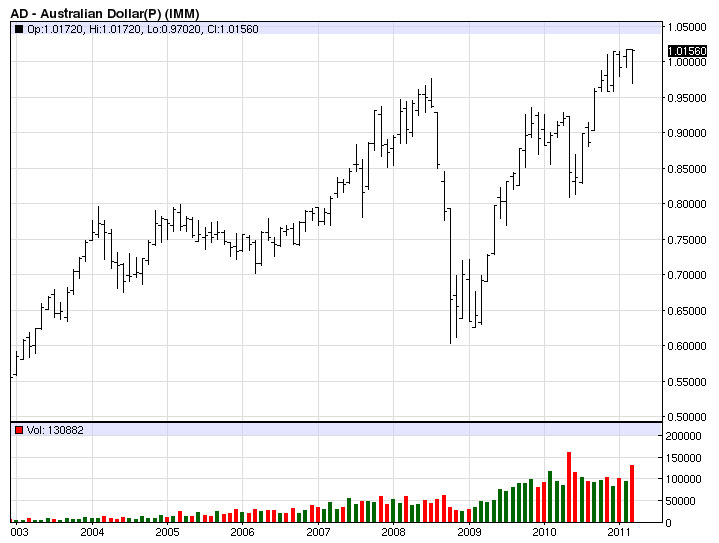
The Australian dollar closed last night at $1.0257. Here’s its chart since 2003.
There are four simple ways to invest in Australia:
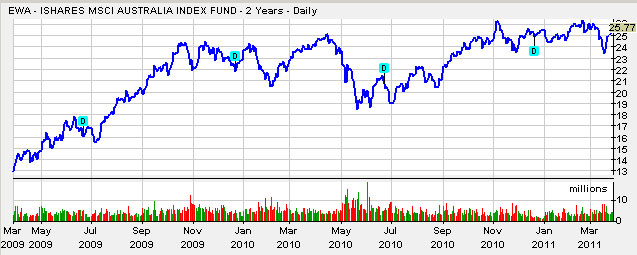
The EFT of Australia’s top stocks:
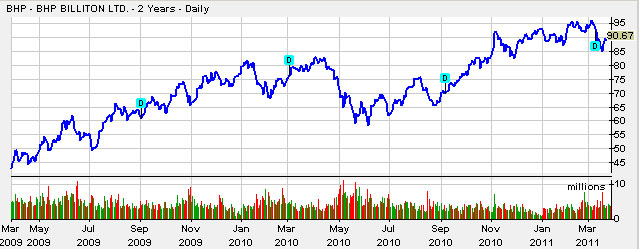
Australia’s top mining stock:
Australia’s second top mining stocl:
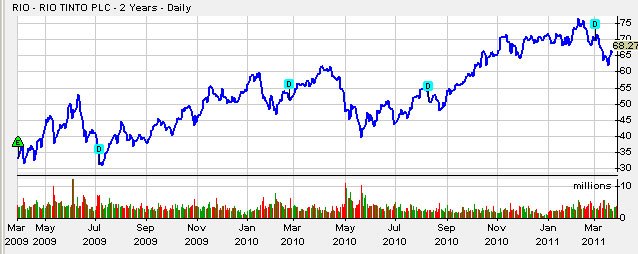
The little blue bubbles show when it paid a dividend. Rio Tinto yields 1.56%, BHP yields 1.99% and EWA yields 3.24%. I own BHP and EWA.
You can also buy a CD with Westpac, Australia’s largest bank. I have one. Last time I checked I was earning 6.3%.
How to sell your business. Friends asked me “What did I learn from selling my business 14 years ago? Key lessons:
+ Selling a good business for only money makes no sense. Buffett is right.
+ Selling a good business for outrageous money makes sense — especially if you’re in a boom.
+ Managing the money you get from the sale is a new business — one that’s ten times as hard as running the original business.
+ Thinking about what you’ll do after the sale is a critical part of the sale.
+ It’s hellishly difficult to find a second act, i.e. a business you love as much as the first one.
+ Going from someone to no one can be harrowing.
A neat story with a happy ending. My friend (and reader) Lucky Marr gets his Internet service from Cox Cable. He emailed me:
I was having problems with connection speeds on my old Linksys WiFi/Modem Gateway…I decided that, like old men, old modems (these were about 7-8 years old) get weak and wear out. I was down to around 10 mbps (million bits per second) on WiFi and under 20 mbps on wired Ethernet.
I bought a new $49.95 Netgear N300 Wireless Router and a new $79.99 Motorola Surfboard Cable Modem for Cox Cable (model SB5101U) and WOW — 21.35 mbps on WiFi and 34.41 mbps on wired Ethernet.
I am now a happier old man. No more lost SKYPE connections!
Lucky tells me there was no change to his Internet service — “In fact, I have the least expensive service.” He also says he bought the Netgear on the recommendations of three of his friends (not including me) and the local Best Buy salesman.
Snippets:
+ Syria: The Baath party instituted a state of emergency after taking power in 1963. It has been in place ever since.
The emergency laws, which have been a feature of many Arab countries, allow people to be arrested without warrants and imprisoned without trial. Human rights groups say violations of other basic liberties are rife in Syria, with torture and abuse common in police stations, detention centers and prisons, and dissenters regularly imprisoned for years without due process.
+ The world. From The Economist: Faced with the uncertainties of life, John Maynard Keynes argued that businessmen rely on the convention that the “existing state of affairs will continue indefinitely”. The events of recent weeks have shaken that cosy assumption. The piece is titled, “From tsunamis to Typhoons. The damage to the world economy from Japan’s disaster, Europe’s debt crisis and war in Libya is uncertain. That in itself is damaging.” For the Economist article.
Upgrade to Firefox 4.0. I like the new look. It’s stable. It sports more external add-in than all the others. I like Showcase and MeasureIt. Download 4.0 for free from Mozilla.
No one likes the AT&T buy of T-Mobile — except the stockmarket. The Economist headlined: Mobile telecoms in America. An audacious merger with a poor reception. Seeking Alpha wrote AT&T: How to Lose 90% of a Customer Base. click here. Web site Gigacom wrote:
Here is a list of who loses, in my opinion, in this deal:
Consumers. The biggest losers of this deal are going to be the consumers. While AT&T and T-Mobile are going to try to spin it as a good deal to combine wireless spectrum assets, the fact is, T-Mobile USA is now out of the market.
T-Mobile USA has been fairly aggressive in offering cheaper voice and data plans as it has tried to compete with its larger brethren. The competition has kept the prices in the market low enough. This has worked well for U.S. consumers. With the merger of AT&T and T-Mobile, the market is now reduced to three national players: AT&T, Verizon and Sprint. Net-net, U.S. consumers are going to lose.
Phone Handset Makers. Before the merger was announced, the handset makers such as HTC and Motorola had two major carriers who could buy their GSM-based phones. They just lost any ability to control price and profits on handsets because now there is a single buyer that can dictate what GSM phones come to market. Even with LTE becoming the standard for the 4G world, it would essentially be a market dominated by three buyers (should Sprint go with LTE), which would place handset makers at the mercy of the giants.
Sprint. The nation’s third-largest carrier was in talks to buy T-Mobile according to Bloomberg, but AT&T’s offer has now pushed Sprint to the bottom of the pile in terms of size and potentially spectrum assets if it goes through. If it doesn’t go through, then Sprint now has a price it has to match in order to get its hands on T-Mobile. Plus, Sprint and T-Mobile often stood against AT&T and Verizon on a variety of regulatory issues, so if AT&T succeeds, Sprint will stand alone on special access and other issues.
Network Equipment Suppliers. The carrier consolidation has proved to be a living hell for companies that make infrastructure network equipment. Alcatel-Lucent, along with Ericsson and Nokia Siemens, are suppliers of gears to both AT&T and T-Mobile USA. With a single customer, they will lost ability to control their own fate and are going to see their profits suffer as a result.
Google. I think the biggest loser in this could be Google. In T-Mobile, it has a great partner for its Android OS-based devices. Now the company will be beholden to two massive phone companies — Verizon and AT&T — who are going to try to hijack Android to serve their own ends.
Don’t be surprised if you see AT&T impose its own will on what apps and service are put on its Android smartphones. I wouldn’t be surprised to see the worst phone company in the U.S. (according to Consumer Reports) tries to create its own app store and force everyone to buy apps through it.
It doesn’t matter how you look at it; this is just bad for wireless innovation, which means bad news for consumers. T-Mobile has been pretty experimental and innovative: It has experimented with newer technologies such as UMA, built its own handsets and has generally been a more consumer-centric company. AT&T, on the other hand, has the innovation of a lead pencil and has the mentality more suited to a monopoly: a position it wants to regain.
I’m tempted to sell AT&T (T) short on the basis the deal won’t be approved. But, (and it’s a big BUT), AT&T is spending $150 million at least on Washington lobbying…
Favorite recent cartoons.
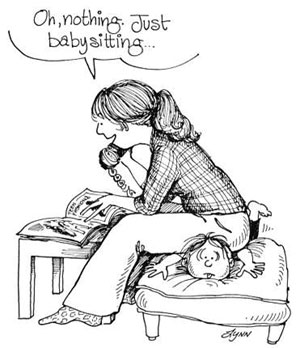
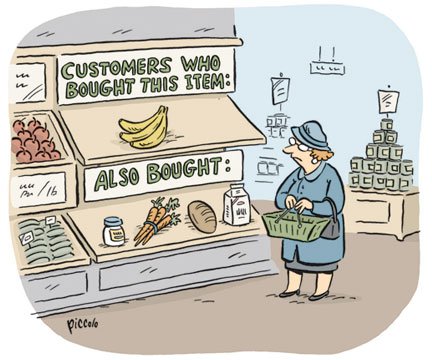

Harry Newton whose daughter Claire emails him serious advice this morning, “In Boston today it’s 18 degrees. It’s seriously miserable here. No point in coming back. Stay in California.”
I understand why people love this place. I photographed these yesterday.

Flowers are everywhere.


Harry, under the term no one likes AT&T buy you left out those of us with DTEGY — we like this deal a lot!
Peter