The movie is called Inside Job:
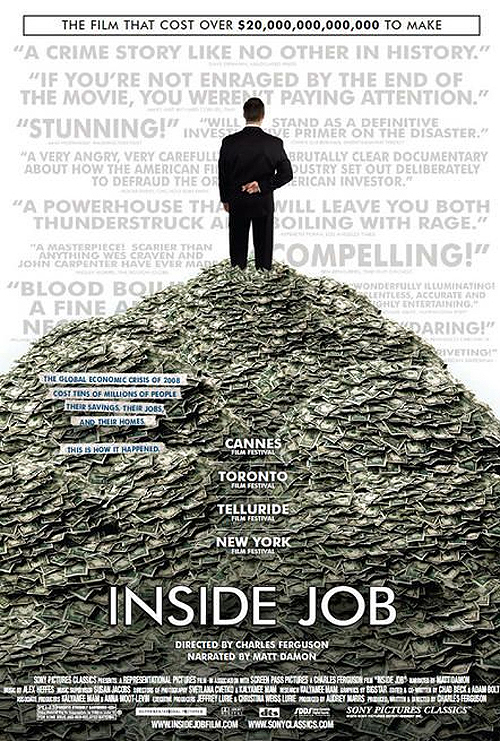
The official writeup.
Inside Job is the first film to expose the shocking truth behind the economic crisis of 2008. The global financial meltdown, at a cost of over $20 trillion, resulted in millions of people losing their homes and jobs. Through extensive research and interviews with major financial insiders, politicians and journalists, Inside Job traces the rise of a rogue industry and unveils the corrosive relationships which have corrupted politics, regulation and academia. Narrated by Matt Damon.
Harry’s comments after seeing the movie/documentary last night:
I lived through the economic crisis of 2008. I lost money in it. Lots of money.
I was stupid. I shelved good judgment and substituted hope. Booms do that to you.
As I watch this movie portraying the Wall Street “villains” taking their millions, with not one in jail, I wonder if they are the “villains” the movie portrays or just a bunch of ordinary people (like me), who also substituted hope.
Heck, it worked. They bought, they bundled, they sold. There was, for several years, always a bigger fool (like me or a pension fund) willing to pony up a few bucks for the triple-A rated stuff they were selling.
Wall Street had everyone snookered. Heck, Goldman Sachs, Citigroup (and others) snookered me into buying stuff they were selling. Like fellow investors, I saw the dancing dollars that Wall Street dangled. I ignored the risks going forward for the returns going backwards — past performance was huge. Private equity funds, leveraged buyout funds, hedged derivatives. Funds I through V had done spectacularly. It was a privilege to be allowed into Fund VI. I had to beg to get in. And with me firmly in, it now nosedived. Who knew.
I can’t speak to the ethics of the billions in bonuses Wall Street execs took home. They’re all detailed in the movie. I can’t speak to the incredible success that Wall Street has had in taking over Washington. Think of Washington as Wall Street’s ultimate derivative play. In the end, it wasn’t AIG that backed all those successful gambles Goldman Sachs, Morgan Stanley and others took against sub-prime securitzed mortgages. It was the Federal Government. It was Wall Street’s best investment ever — the 3,000 lobbyists and countless millions that it spent to convince Washington that it do Wall Street’s biding — to de-regulate, to protect it, and ultimately, to bail it out.
Washington only acts when someone thrusts a crisis in its face — e.g. Hitler invades Poland or the Japanese bomb Pearl Harbor — or the imminent meltdown of the world’s financial system. The ultimate brilliance is to be able to orchesstrate a crisis. Wall Street did that brilliantly with the economic crisis 2008.
We can fantasize what would have happened if we had left the capitalist system do what it’s meant to do — let Goldman Sachs, Morgan Stanley, Bear Stearns, Citigroup and Bank of America fail and declare bankruptcy. Personally, I think the bits and pieces of these firms would have been re-organized into smaller, more nimble entities. And today’s world of finance would have been a different, healthier place. But that’s not the way it happened. With ex-Goldman Sachs employees running Treasury and the Federal Reserve and screaming fire, we got the fire engines in and printed dollar bills to put out the flames.
Still, you should watch this movie. As a investor, you’ll learn what I’ve been preaching in this column for several years: Don’t trust Wall Street. Above all, you should not buy any of the products it sells. As I’ve explained, Wall Street firms are product machines like every other company in the U.S. It designs new black jeans. If they sell at full retail, great. If not, they’ll sell somewhere at a discount. The only difference betwen clothing makers and Wall Street is that, with Wall Street, you can also lose your shirt. And they won’t care less. After all, you’re “sophisticated.” It’s your money. If you’re foolish enough to believe them (and the rating agencies they pay), then you deserve to lose your money.
Play the movie every time they call and ask in their deep earnest voices, “How are you Mister Newton?” And then, when you’ve heard their pitch, politely say “No, thank you.”
The real culpability for the economic crisis of 2008 lies with the regulators — everyone from Greenspan on down. They knew of liar loans, of ninja loans (no income, no job), of no-doc loans. They could see that millions of Americans would never be able to pay their housing loans back. They knew that instititions like pension funds that bought the loans in bundles called securitization were going to suffer and worker pensions would be hurt. The regulators knew the system of paying the rating agencies by Wall Street was a shame, designed to mislead the pension funds and other buyers of the garbage securitized sub-prime loans. Heck, articles and books were written. The regulators — including all the ones at the key players at the Federal Reserve — were visited by dozens of analysts and hedge fund managers and told what was happening out there in the real world. But, in the end, they choose not to listen. You and I can pontificate on the reasons, some of which might include:
1. A belief that everyone in America deserves to own a house, irrespective of their income.
2. A belief in zero government regulation and people being intelligent enough to police their own actions.
3. A belief in economists and the mumbo-jumbo garbage they espouse. Politicians actually believed that economists knew of what they spoke. Trust me, they didn’t and they don’t. I have a degree in that dismal science. I studied it. The world works in strange and mysterious ways. But it’s not the way economists (or Wall Street analysts, for that matter) would lead you to believe.
Which brings me to my second takeaway — the first one being don’t buy the crap Wall Street creates and sells. The second is you can’t trust regulators. Given half a chance, Wall Street will sell you garbage. The regulators won’t protect you. Item: Investors are still stuck with $100 billion of auction rate preferred securities which they can’t sell. All the owners of $100 billion of ARPs got told was that ARPs were as liquid as money market funds. But they weren’t. Neither were the AAA-rated packages of sub-prime bonds worth an AAA-rating. (More likely, an F, for failure.)
As an economic person — investor, buyer, borrower, candlestick maker — you’re on your own.
When in doubt, stay out.
No is a wonderful word. Practice saying it every day.
Buying tips:
1. Don’t buy packing tape unless it’s Scotch and made by 3M. All the others are garbage — cheap, nasty and don’t stick.
2. The best pima cotton short-sleeve shirts are now available from Lands End. The cotton is soft as a baby’s bottom, or some other silly analog. Click Lands End.
3. The best travel dress shirts are made by Paul Fredericks. They’re called non-iron, 100% cotton. I prefer their Trim Fit shirts. For Paul Frederics non-iron.
4. Renting a car?Give Priceline a low bid. And watch the car renters come crawling for your cheap business. Alternatively, many organizations — like AAA, AARP, etc. — will give you a six digit code which, if entered into the web site of car renters, will save you money. The AAA’s number is 152622. It’s called a PC code, whatever that means.
Soap in the bed works. Jim Costello returned from a trip. For three nights he had leg cramps. Then he put a bar of soap in his bed. Bingo, the next night, no cramps.
Jim says happily, “The soap worked. Thank you.”
Finally, someone learned something useful from this column.
Moral question: If I’m not interested in investing, may I still meet with the principals for comic relief?
Time to go traveling. In Africa, they warned us of the baboons.
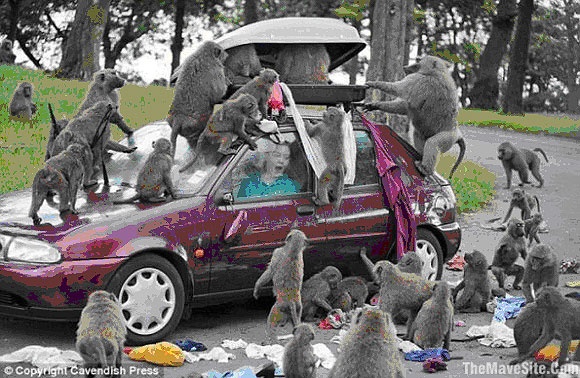
And elephants who are powerful and irritable.
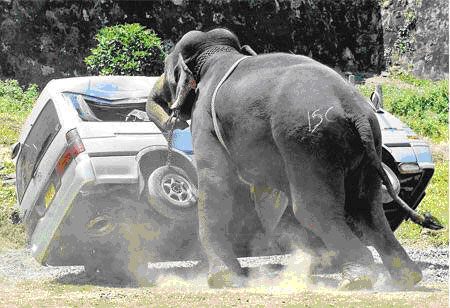
Anyone for an African safari? Or perhaps a nice golf game?
A nice golf game.
A golfer has been slicing off the tee on every hole.
He asks his Irish caddy if he has noticed any obvious reasons for his poor tee shots, to which the caddy replies:
“Aye, there’s a piece of shyt on the end of your driver. “
The golfer picks up his driver and cleans the club face, at which point the caddy says:
“No, the other end.”

Harry Newton who wonders about how tennis is affecting his feet. Suddenly, all my shoes are too small. Tennis is flattening my arches, lengthening my feet. Once I was an 11, then an 11.5, then a 12, now a 12.5, especially in Nike which run small.
Richard Russell worries about the market. From his last night’s newsletter — nice words:
Where are we now? My studies tell me that we are still in a primary bull market. True, there is a good deal of deterioration going on, but I see nothing to suggest that the bull market is actually over.

Harry,
Your summary and comments about Wall Street, Washington, the 2008 Crisis, etc., today (April 7, 2011) are the best, most intelligent and thorough write-up you have ever done. Superb, and right-on.
Don't know the appropriate Aussie saying, but it probably involves a fish!
But again, your write-up is truly “top flight”, balanced with consideration of human nature, and Wall Street's obscene corrupting take-over of Washington.
The “better” grade of Staples packing tape is excellent — certainly as good as the more expensive 3M. My company has been using it for years, with no trouble, ever.
Jos. A. Bank has excellent dress shirts. Alleged regular price is $79.50, but they're almost always on sale for $30 – $40. They look great and hold up very well. Today I 'm wearing one that has been laundered probably 20 times or more. I had a blood test this morning, and the nurse said she was going to be extra careful because she didn't want to mess up my “new shirt.”
Harry, I started investing in the 70's. After going thru several brokers, I decided they really didnt know anything.. By the early eighties, I decided mutual funds were scams (I never invested in one). Early 80's, I decided the brokerage houses were no different than grocery stores; but products wholesale, mark up, and sell retail.. Also advertize what great bargains they were.. And occassionally introduce new unusual products deemed to better, improved versions of the old products..
I simply view WALL STREET anymore just like any other retail store.. Always selling the newest, hottest product until the next one comes along.. Just focus on the stocks.. The top 5-10 best.. Ignore the noise..
So what are your best 5-10 stocks right now?
Marc
Harry- I also saw the movie. What disturbed me most is that the director/producer/writer of this “documentary” practically ignored the governements role in the financial crisis. While the big Wall St banks took all the heat in this movie (and desrved it) there was almost no mnetion and certainly no focus on the regulators, and especially on Fannie and Freddie. Without these GSE's the packaging , securitization, and marketing of sub prime mortgages could have never taken place. With governement support (especially Congress) FNM and FRE were encouraged to lend and lend and lend. Once these garbage loans were made they were then traded. So had Congress (Barney Frank especially) heeded the warnings of 2 seperate Fed Chairman under 2 different presidents much of the carnage would have been prevented. This movie entirely ignored that FACT!
The lesson to be learned and never forgotten is: The regulators will never be able to keep up with the regulated.
If you are a low paid government employee you are not sufficiently knowledgeable to keep up with those that you are regulating. The ones that are quickly learn that there is significantly more money to be made on the regulated side of the employment scene that the regulating
Russell also turned bullish before the top in 2007. Hmmmm…..
“Given half a chance, Wall Street will sell you garbage. The regulators won’t protect you.” You got that right, as an investor you have to look out for yourself. If it looks like a duck and quacks like a duck, don't believe your broker when he tells you it is a valuable poodle…..
You apparently have discovered the fact that as we age our feet actually grow (or lengthen) I thought mine was due to many miles of walking…my arches are still high. Unfortunately, the same does not appear to hold true for other male extremities. Have you measured your height lately? You may be in for a surprise.
I've got an appointment for body stretching this evening. They guarantee at least two inches after 345 visits.
Ha.