My friend Dan Good made comments on yesterday’s column Investing Lessons from the Movies:
+ You give legislators and regulators too much credit. They don’t have as much knowledge or experience as the people they are trying to control.
+ It is true you probably didn’t understand or ignored the risks as you read of enormous profits and wanted in. Returns of 10X were not uncommon for some deals. However, leverage can work both ways and ultimately can bite you in the ass. You have your own aggressive behavior and greed to blame for blinding you.
+ You write When in doubt, stay out. Then what?
+ You write No is a wonderful word. Practice saying it every day. When do you say Yes?
And that question kept me awake most of last night. I don’t have a good answer today. It needs more though, mulling on the weekend. But it seems to me that my “style” of investing today (i.e. based on all the mistakes I made yesterday — the past few years) consists of:
+ A heavy emphasis on liquid investments, i.e. ones I can sell when I panic or when my stop losses kick in. Panic works for me. Patience works for others. I have a low tolerance for pain.
+ An opportunistic, iterative style that consists of buying opportunities as I find them, as against investing the bundle in a predetermined selection — like mutual funds do.
+ An emphasis on long track records, decent dividends and real value on the balance sheet. My days of startups, Wall Street funds, and other fantasies are over. The idea may be great. But today I wait to see if the management can make it happen. In the old days I’d fantasize that they’d do it because I knew I could do it. But they’re not me. And these days I’m not me. The world is different to when I started and grew successful businesses. Moreover, they (entrepreneurs and CEOs) don’t listen. That’s irksome.
+ I do like stocks that I like the products of, e.g. Apple. Google and even BHP. I like Costco’s style. Its business model works.
+ A heavy emphasis on being able to sleep at night and count the roses. That’s two-fold: Cash and muni bonds. If chosen wisely, muni bonds pay effective pre-tax returns that have far exceeded equities in the past ten years. The income they provide puts food on our table and pays our escalating energy bills.
So, when do I say YES. he simple answer: Not often. I have t to feel mighty comfortable to say Yes. I only feel that way with lots of research, lots of due diligence and lots of mulling.
Please add your own thoughts below in Comments.
The economy is doing better. So is gold and silver:
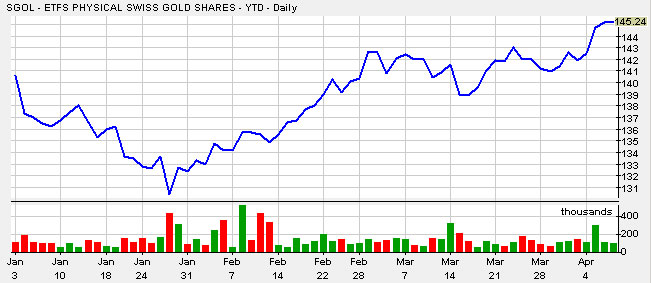
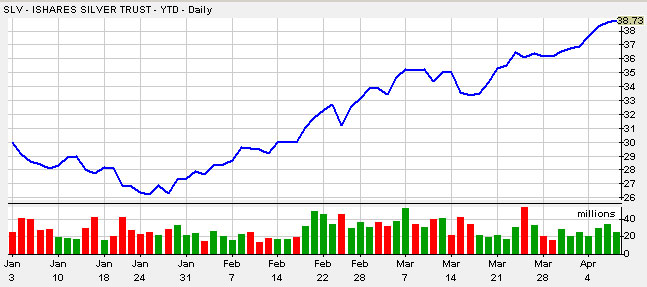
But so also doing well are DHR, BHP, CVX, DD, EWA, KO, AGNC, GOOG and COST, and recently, QQQ and SWZ.
I do occasionally edit the list of recommended stocks — the list in the right hand column. Today I removed JNJ (this year, it’s become a cockroach stock) and added COST.
Renting versus buying? Most friends still believe it makes more sense to own a house or an apartment, instead of renting one.
If you’re thinking of buying, you should think your assumptions through.
Real estate is not assured of the capital gains going forward as it had in the past — at least pre-2008.
Reading on religion for the weekend:
+ When the King Saved God by Christopher Hitchens in the latest Vanity Fair:
An unbeliever argues that our language and culture are incomplete without a 400-year-old book—the King James translation of the Bible. Spurned by the Establishment, it really represents a triumph for rebellion and dissent. Accept no substitutes! …
Those who opposed the translation of the Bible into the vernacular—rather like those Catholics who wish the Mass were still recited in Latin, or those Muslims who regard it as profane to render the Koran out of Arabic—were afraid that the mystic potency of incantation and ritual would be lost, and that daylight would be let in upon magic. They also feared that if God’s word became too everyday and commonplace it would become less impressive, or less able to inspire awe. But the reverse turns out to have been the case, at least in this instance. The Tyndale/King James translation, even if all its copies were to be burned, would still live on in our language through its transmission by way of Shakespeare and Milton and Bunyan and Coleridge, and also by way of beloved popular idioms such as “fatted calf” and “pearls before swine.” It turned out to be rather more than the sum of its ancient predecessors, as well as a repository and edifice of language which towers above its successors. Its abandonment by the Church of England establishment, which hoped to refill its churches and ended up denuding them, is yet another demonstration that religion is man-made, with inky human fingerprints all over its supposedly inspired and unalterable texts. Ma Ferguson was right in her way. She just didn’t know how many Englishmen and how many Englishes, and how many Jesus stories and Jesuses, there were to choose from.
+ How Gandhi Became Gandhi by Geoffrey Ward from last weekend’s New York Times Book Review
…while he may have “struggled with doubt and self until his last days,” Gandhi “made the predicament of the millions his own, whatever the tensions among them, as no other leader of modern times has.” And, for all his inconsistencies, his dream for India remained constant throughout his life. “Today,” Gandhi wrote less than three weeks before he was murdered by a member of his own faith, “we must forget that we are Hindus or Sikhs or Muslims or Parsis. . . . It is of no consequence by what name we call God in our homes.”
That was a revolutionary notion when he first urged Indians to unite against their oppressors in South Africa before the turn of the 20th century. It was revolutionary when he came home to India at the time of World War I, and still revolutionary in 1947 when India was simultaneously liberated and ripped apart by the religious hatred he had repeatedly risked his life to quell, and sadly, it remains revolutionary today — for India and, by extension, for the wider world as well.
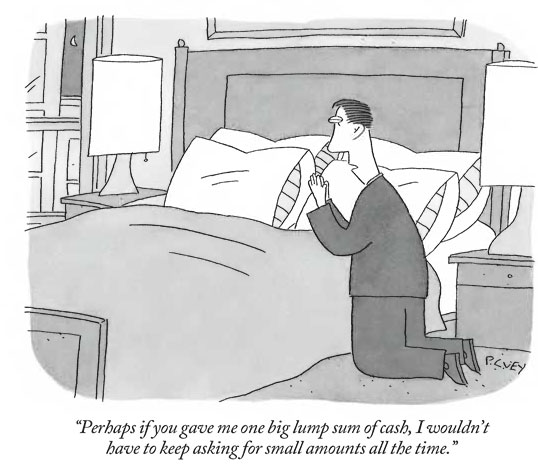
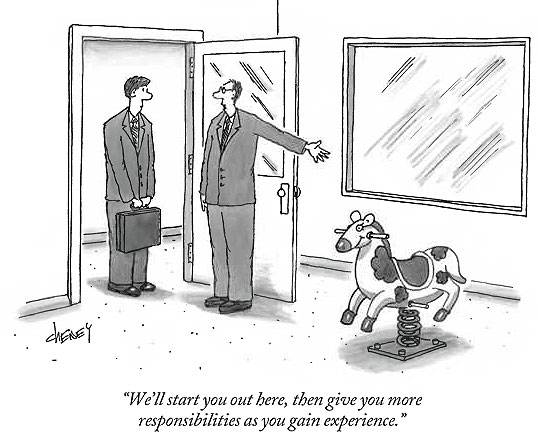
Favorite recent New Yorker cartoons:


Harry Newton who marvels at Washington. If you were the best fiction writer in the world, you couldn’t imagine what those idiots are doing today. Kennedy (or someone once said) “Washington is eight square miles surrounded by reality.” Boy, were they right!
Heh, they got a new, pretty, young face on BubbleVision. Things are looking up. I haven’t heard her speak yet. I keep CNBC on mute.

Dear Harry:
My Mum is from Perth……so I can say this:
There is NOTHING BETTER than YOU and
Vegemite on Toast in the Morning!!
Bravo of Late……and for the last TEN YEARS!!
Do you ever sleep?
So Many Thanks!!
Blessings,
Mark H
Harry,
Your summary and comments about Wall Street, Washington, the 2008 Crisis, etc. yesterday (April 7, 2011) are the best, most intelligent and thorough write-up you have ever done. Superb, and right-on.
Don't know the appropriate Aussie saying, but it probably involves a fish!
But again, your write-up is truly “top flight”. Insightful, balanced with consideration of human nature, and Wall Street's obscene corrupting take-over of Washington.
Peter
Harry,
What is more important – profit or risk-management?
What are your long-term goals?
Bill, I agreed with what you wrote, so what are your favorite 5-10 stocks right now?
In response to:
I simply view WALL STREET anymore just like any other retail store.. Always selling the newest, hottest product until the next one comes along.. Just focus on the stocks.. The top 5-10 best.. Ignore the noise..
“add your own thoughts below in Comments”
Harry, IMO, stay in safe cash type investments Cd's, Muni's , etc. How much money does one need, and why try to push returns to the very max.
Do you want peace of mind or more money. Do you want more time (freedom) or more money?
It seems you have more than enough wealth to suffce, be happy and to leave to your children. After while it becomes futility, or is it one big Monopoly game that does not add an iota to ones quality of life.