Gold and silver are skyrocketing — a direct result of investors despairing of Washington’s fiscal incompetence. That incompetence includes Democrats and Republicans.
Hence our SLV and SGOL continue to do well.
David Stockman is a former Republican representative from Michigan and the director of the Office of Management and Budget from 1981 to 1985. Two days ago, he wrote a piece in New York Times, which began:
The Bipartisan March to Fiscal Madness
IT is obvious that the nation’s desperate fiscal condition requires higher taxes on the middle class, not just the richest 2 percent. Likewise, entitlement reform requires means-testing the giant Social Security and Medicare programs, not merely squeezing the far smaller safety net in areas like Medicaid and food stamps.
Unfortunately, in proposing tax increases only for the very rich, President Obama has denied the first of these fiscal truths, while Representative Paul D. Ryan, the chairman of the House Budget Committee, has contradicted the second by putting the entire burden of entitlement reform on the poor. The resulting squabble is not only deepening the fiscal stalemate, but also bringing us dangerously close to class war.
This lamentable prospect is deeply grounded in the policy-driven transformation of the economy during recent decades that has shifted income and wealth to the top of the economic ladder. While not the stated objective of policy, this reverse Robin Hood outcome cannot be gainsaid: the share of wealth held by the top 1 percent of households has risen to 35 percent from 21 percent since 1979, while their share of income has more than doubled to around 20 percent.
The culprit here was the combination of ultralow rates of interest at the Federal Reserve and ultralow rates of taxation on capital gains. The former destroyed the nation’s capital markets, fueling huge growth in household and business debt, serial asset bubbles and endless leveraged speculation in equities, commodities, currencies and other assets.
At the same time, the nearly untaxed windfall gains accrued to pure financial speculators, not the backyard inventors envisioned by the Republican-inspired capital-gains tax revolution of 1978. And they happened in an environment of essentially zero inflation, the opposite of the double-digit inflation that justified a lower tax rate on capital gains back then — but which is now simply an obsolete tax subsidy to the rich.
You can read his entire article here.
The junk Wall Street sells. I’ve written this before — many times. Wall Street is a product marketing machine. They invent product. They sell it to unsuspecting customers. They call many of their new products “structured investments.” Such investments are structured to make Wall Street rich, not their customers. The following two articles — both by eminent financial writers at the New York Times — highlight the pitfalls for you and I investors.
Before you read these things, know my latest “discovery.” I have an on-line brokerage at Fidelity, which works well. Cash in the account is invested in a fund called the Fidelity New York Municipal Money Market Fund, which, you’d think, would be invested in short-term muni bonds. As of January 31, 2011, I just discovered by reading the prospectus, a whopping 68.9% is invested in something called “variable rate demand notes,” which were created by Wall Street after the auction rate preferreds disaster in February 2008. (There’s still over $100 billion locked in auction rate preferreds. That’s money which investors can’t get to.)
I am constantly amazed at the shenanigans Wall Street is constantly pulling. Harry’s two rules remain:
1. Check. Check. Check.
2. When in doubt (like what the hell is a variable rate demand note?), stay out.
Here are two articles that will blow you away. Read them carefully.
April 22, 2011
Sewers, Swaps and Bachus
By JOE NOCERA
Let me tell you a story about Jefferson County, Alabama, whose county seat is Birmingham, and whose congressman is Spencer Bachus, the Republican who chairs the House Financial Services Committee.
Once upon a time — back when too many people viewed derivatives as glittering innovations with magical powers to hedge against risk — Jefferson County was ordered by the Environmental Protection Agency to upgrade its sewer system. To finance the new sewers, it issued bonds totaling nearly $3.2 billion.
After the sewer system was completed, the county moved all that debt from fixed rates to variable rates. It did so because some investment bankers at JPMorgan persuaded the county to purchase derivative contracts, in the form of interest rate swaps, that would supposedly allow it to avoid paying higher interest if rates went up. Magic indeed.
At first, this arrangement worked well enough. Though the cost of the sewers was bloated beyond belief — they were originally supposed to cost $1 billion — the county made its bond payments. The bank reaped handsome fees from its swaps contracts.
But the financial crisis caused those clever hedges to go blooey. Indeed, the swaps not only failed to protect the county from losses — they actually exacerbated the losses. In addition, two of its bond insurers had their credit rating lowered because they had also insured lots of toxic subprime derivatives. The downgrade triggered huge hikes in interest and principal for Jefferson County.*
Today, the county is broke; according to The Birmingham News, it may run out of cash by July. It is toying with a bankruptcy filing — which, if it happened, would be the largest municipal bankruptcy in history.
Though the county no longer has to pay fees to JPMorgan — the bank agreed to void the swaps as part of a settlement with the Securities and Exchange Commission — its bond debt for the sewers now totals almost $4 billion. The Birmingham News described Jefferson County as a “poster child” for all that can go wrong when municipalities start playing with unregulated derivatives peddled by Wall Street sharpies.
Has Spencer Bachus, as the local congressman, decried this debacle? Of course — what local congressman wouldn’t? In a letter last year to Mary Schapiro, the chairwoman of the S.E.C., he said that the county’s financing schemes “magnified the inherent risks of the municipal finance market.” (He also blamed, among other things, “serious corruption,” of which there was plenty, including secret payments by JPMorgan to people who could influence the county commissioners.)
Bachus is not just your garden variety local congressman, though. As chairman of the Financial Services Committee, he is uniquely positioned to help make sure that similar disasters never happen again — not just in Jefferson County but anywhere. After all, the new Dodd-Frank financial reform law will, at long last, regulate derivatives. And the implementation of that law is being overseen by Bachus and his committee.
Among its many provisions related to derivatives — all designed to lessen their systemic risk — is a series of rules that would make it close to impossible for the likes of JPMorgan to pawn risky derivatives off on municipalities. Dodd-Frank requires sellers of derivatives to take a near-fiduciary interest in the well-being of a municipality.
You would think Bachus would want these regulations in place as quickly as possible, given the pain his constituents are suffering. Yet, last week, along with a handful of other House Republican bigwigs, he introduced legislation that would do just the opposite: It would delay derivative regulation until January 2013.
It is hard not to see this move as an act of hostility toward any derivative regulation. After all, by 2013 a presidential election will have taken place, and if the Republicans take the White House and the Senate, one can expect that the next step would be to roll back derivative regulation entirely. Even if it is just about delay, rather than outright obstruction, that means the Republicans are asking for two more years during which the industry will add trillions of dollars worth of “financial weapons of mass destruction” (to use Warren Buffett’s famous description) to the $466.8 trillion of unregulated derivatives already in existence. How can this possibly be good?
I tried to ask this question of Bachus, but I was told he was unavailable. I asked his staff if he believed, after the experience of Jefferson County, that derivatives should be regulated at all. I couldn’t get an answer.
I’ll keep trying. It’s not just an answer his constituents deserve to hear. Given the risks derivatives still pose, it’s something the nation needs to know about Chairman Bachus. If he decides to tell me, I promise to pass it on.
April 23, 2011
A Crack in Wall Street’s Defenses
By GRETCHEN MORGENSON
TWO individual investors just scored a remarkable win against Citigroup.
A few weeks ago, the pair was awarded a total of $54.1 million in a securities arbitration case against the Smith Barney unit of the company — the largest amount ever awarded to individuals in such a case, according to the Financial Industry Regulatory Authority.
This legal dust-up involved supposedly conservative municipal bond investments that Smith Barney had peddled to its wealthiest clients. The investments, which were big money-makers for Smith Barney, turned out to be anything but safe for the firm’s clients: various portfolios lost between half and three-quarters of their value during the financial crisis.
Arbitrators rarely, if ever, discuss such cases, and the materials turned over by both sides are kept under wraps. But the outsize award, which included $17 million in punitive damages, is not the only thing that is noteworthy. The arbitrators appeared to reject — resoundingly — three defenses that Wall Street often employs when clients sue:
No. 1: We didn’t blow up your portfolio. The financial crisis did.
No. 2: If you’re wealthy and sophisticated, you should have understood the risks.
And, No. 3, the most common defense of all: The prospectus warned that you could lose your shirt, so don’t come crying to us if you do.
The investors who prevailed here are Gerald D. Hosier, 69, a wildly successful intellectual-property lawyer, and Jerry Murdock Jr., 52, a prosperous venture capitalist. Mr. Hosier and a trust he set up for his adult children received $48 million. Mr. Murdock got about $6 million.
The men, neighbors in Aspen, Colo., suffered $27 million in out-of-pocket losses on their investments. The big clunker was a municipal bond arbitrage strategy that their Smith Barney broker had characterized as safe, according to the men’s complaint. The deal was supposedly designed to eke out more income than a simple portfolio of bonds would generate.
Not only did the men recover all their losses in the award, they also received damages. Mr. Hosier was awarded $15 million in punitive damages and $6.3 million in market-adjusted damages. The arbitrators also awarded $3 million for the men’s legal fees.
Alexander Samuelson, a Citigroup spokesman, said: “We are disappointed with the decision, which we believe is not supported by the facts or law.” He noted that the bank had won a number of arbitrations involving such leveraged municipal bond strategies and said that the bank was considering its legal options in this case.
Mr. Hosier invested in the bank’s municipal arbitrage strategy from 2002 through 2007. Requiring a minimum investment of $500,000, the deals employed the wonders of leverage, borrowing 8 to 10 times the value of the municipal bonds in an underlying portfolio to generate higher income. Calling the strategy conservative and ideal for investors’ safe money, Smith Barney sold the trusts to wealthy investors.
But Smith Barney and its brokers were the prime beneficiaries of the strategy, which generated fees not only on the money that had been borrowed to juice the returns but also through the life of the investment. Clients paid 0.35 percent annually on the portfolios, plus a fee of 20 percent of all income earned by the investors above a 5.5 percent threshold each year.
Smith Barney’s sales representatives kept 40 percent of the total fees paid by their investors, far exceeding what they would have earned selling ordinary municipal bonds. This arrangement encouraged Smith Barney to lever up the portfolios, Mr. Hosier’s lawyers argued, putting the interests of their clients and those of Smith Barney at odds.
Investors who bought these deals agreed to lock up their money for two years and had to pay a substantial fee if they redeemed their holdings during the next three years.
Mr. Hosier was the single biggest buyer of Smith Barney’s municipal arbitrage deals, with $26 million invested over time. But four different portfolios in which he invested raised almost $2 billion from all investors. All of the portfolios performed badly.
“Citigroup mismarketed this product to high-net-worth investors as an alternative to municipal bonds with a slightly higher return,” said Philip M. Aidikoff, a lawyer at Aidikoff, Uhl & Bakhtiari in Beverly Hills, Calif., who represented Mr. Hosier and Mr. Murdock. “Our clients never knowingly agreed to risk a significant loss of principal for a few extra points of interest.”
AS for Citigroup’s three defenses, Mr. Aidikoff, along with the co-counsel Steven B. Caruso, at Maddox, Hargett & Caruso in New York, demonstrated that municipal bonds did not suffer catastrophic losses during the period. This squelched the bank’s argument that the financial crisis did in the strategy.
Regarding their clients’ sophistication and wealth, the lawyers agreed that both men were comfortable taking risks in certain circumstances, but not with the money they had given to the bank. “Citigroup misled their wealthiest clients and then tried to blame them for relying on what they were told,” Mr. Caruso said.
Arguing that the risks were laid out in the prospectus also seems to have run into a stone wall. Mr. Hosier’s lawyers produced seven different notices on the topic published by Finra and its predecessor regulator since 1994, including a notice from 2009 that states: “Providing risk disclosure in a prospectus or product description does not cure otherwise deficient disclosure in sales material, even if such sales material is accompanied or preceded by the prospectus.”
Mr. Hosier’s victory is particularly noteworthy, given the nominal amounts typically extracted by regulators in cases against major banks. The punitive damages awarded to Mr. Hosier, for example, are more than triple the $4.45 million penalty levied against Wachovia Securities by the Securities and Exchange Commission this month in a suit that the S.E.C. settled with the bank. The S.E.C. accused the bank of selling about $10 million of mortgage-related securities to investors at above-market prices and at excessive markups. Wachovia, now part of Wells Fargo, neither admitted nor denied wrongdoing in the settlement.
The arbitrators in Mr. Hosier’s case seemed keen to hold Wall Street accountable. And his win against Citigroup does not appear to be an anomaly. Since April 2010, his lawyer, Mr. Aidikoff, has argued 16 other arbitrations involving the same type of investment. Mr. Aidikoff and the lawyers who assist him have won every one.
In an interview, Mr. Hosier said the experience had opened his eyes to the disturbing ways of Wall Street.
“Instead of the financial world being the lubricant for business, they are out there manufacturing products with no utility whatsoever except for generating fees,” he said. “Somebody’s got to do something about Wall Street. It is destroying the country.”
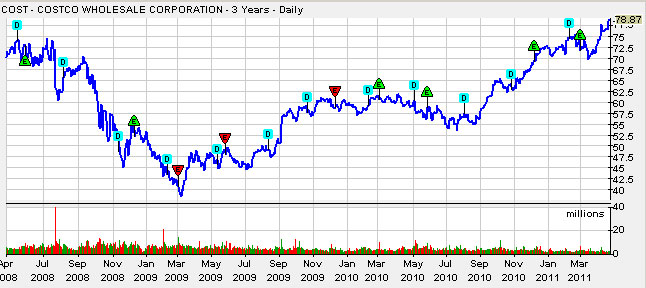
Nice results from Costco
Costco Wholesale Corp. said Thursday that sales at stores open at least a year climbed 13% last month, handily beating Wall Street’s view.
Watch Battery Central replaces watch batteries. It’s not easy to replace batteries. I recently broke the glass on one watch by closing it too tightly.
A better idea: Send your watch to these guys watchbatterycentral.com.
New joint Republican/Democrat deficit closing proposal:
Starting May 1, 2011, your pecker will be taxed using the Pecker-Checker Tax scale.
|
PECKER-CHECKER TAX SCALE
|
||
| 10-12 inches | Luxury Tax |
$500
|
| 8-10 inches | Pole Tax |
$250
|
| 6-8 inches | Privilege Tax |
$150
|
| 4-6 inches | Nuisance Tax |
$50
|
Any pecker under four inches is eligible for the Pecker Subsidy Program. Any peckers over twelve inches will be liable for capital gains.
Why the Stock Exchanges close on Good Friday. In 1930, the non-Christian brokers complained there were no holidays for Passover, but one for Good Friday. So the Exchange opened on Good Friday.
Over the next year, stocks plummeted. God wreaked his wrath at the sacrilege of trading shares on Good Friday. and the following year — and ever since — markets have closed on Good Friday.
Of course, all this is urban legend. And since no broker from 1930 is still alive to argue with me, I’ll go with my story.

Harry Newton who wonders at his new skill. He hid his own Easter eggs. … And, managed to find them.

I always get a chuckle whenever I see the phrase “to help make sure that similar disasters never happen again” or some sort…
Harry,
Might I suggest that you do a little research before posting ridiculous columns trying to hurt Republicans. Joe Nocera is a huge liberal writing for everything NY Times. The title of the article should have been Sewers, Swamps and Bullshit. Rep Spencer Bachus is doing the correct thing by trying to reduce the damage of Dodd-Frank. Do a little research to find out what actually happened in Alabama and you might find out that thieving liberals on Wall St were in bed with high level government types in Alabama, who just happen to be DEMOCRATS when this ridicules EPA mandate was handed down. Do some research to see who the Att. Gen was during this time. Find out who worked for Raymond James, take a look at who went to jail. Finally here's a link to help you unveil exactly who Joe Nocera is. He is a liar and here's the proof. http://gawker.com/#!5662811/jo…
Harry you said: I have an on-line brokerage at Fidelity, which works well. Cash in the account is invested in a fund called the Fidelity New York Municipal Money Market Fund, which, you’d think, would be invested in short-term muni bonds. As of January 31, 2011, I just discovered by reading the prospectus, a whopping 68.9% is invested in something called “variable rate demand notes,”
so the $64K ? after you found out the information on the fund did you liquidate that Fidelity NYMMA fund or are you holding on to it!!…..sounds like a new version of ARS…and we all know how that worked out
I liquidated it and went to cash.
good! fool me once shame on you…..fool me twice shame on me!
as you say..wallstreet selling machines!!
Hey Harry, I really enjoy reading your website (almost every day) but I prefer reading the things you have to say, much more than the links you post to what others have to say. Anyway, thanks and I really miss Technology Investor magazine.
A.J.
Sometimes other people say them much better than I do. It's important for these timeless messages to be repeated. I always draw my own messages out them, though. How many times also can I say buy gold and silver?